
“The medical practitioners remind me of a flock of sheep. When the leader starts to run in a certain direction, the whole flock follow without question, and the faster the leader runs, the more excited the rest become.”[1]
— Dr. B. H. Cubbage, 1908
“The outside pressure upon the physician is very great, tending to force him to active treatment, whether in his judgment necessary or not. Some error of diet, some improper habit of the patient, may only need correction, and the administration of drugs be unnecessary or hurtful.”[2]
— H. Brown, MD, Huntsville, Kentucky, 1892
“Advertising may be described as the science of arresting the human intelligence long enough to get money from it.”
— Stephen Leacock, Garden of Folly, 1924
Executive Summary
Modern life is making us sick, and the system that profits from our sickness has little incentive to change. The dramatic rise in chronic disease since the 1960s is not a failure of medicine but a predictable consequence of how we live: we sit too much, eat processed food, suffer unrelenting stress, sleep poorly, and isolate ourselves from genuine human connection. Meanwhile, the “Sickness Industrial Complex”—an interlocking web of big agriculture, big food, big pharma, and their financial, political, and advertising allies—profits handsomely from treating the symptoms of these lifestyle diseases while ignoring their root causes.
The numbers tell a stark story: obesity has tripled since the 1960s, from 13.4% to over 40% of U.S. adults. Generations born after 1970 face worsening mortality from heart disease and cancer—a reversal of decades of health progress. We spend nearly 18% of our GDP on health care, yet we are sicker than our parents were. This is not because medicine has failed; it is because we have outsourced health to a system designed to manage disease, not prevent it.
Drawing on Sam’s personal testimony, historical data on infectious disease decline, and the work of physicians like Seth Capehart, MD, this essay traces how we arrived at this moment and offers a way out. The solution is neither a new drug nor a complex protocol. It is, quite simply, to live like a human: move daily, eat real food, manage stress, sleep well, and connect with others. These are not extreme measures. They are the baseline we have strayed from.
I. The Commercial: A Promise in a Minute
While grinding through my workout at the gym, I happened to glance up at the sprawling wall of screens. I routinely tune out that familiar noise, regarding the screens as little more than propaganda engines, each broadcasting its own curated brand of manipulation. But today, one caught my eye. There it was: the unmistakable, formulaic blueprint of a pharmaceutical advertisement. This one: another semaglutide fad pill, Wegovy.
An upbeat tune filled the air as a cheerful chorus crooned the medication’s name, drilling it into every captive viewer’s subconscious. The commercial unfolded scene after scene of manufactured bliss. Overweight individuals, beaming with unearned confidence, jogged effortlessly before cannonballing into a crystalline lake. Elderly obese bodies, softened by age and gravity, pedaled bicycles with the unbridled joy of children, their laughter echoing against a backdrop of golden sunlight. Another frame featured a heavyset man, drenched in sweat and glee, triumphantly putting at a whimsical mini-golf course bathed in the sugary glow of Disneyland magic.
Not a single shadow fell across this curated paradise. No ailments, no negative effects, no hospital beds. It was just a curated trailer of happiness, carefully engineered to sell not a pill, but a promise. The subtext hums louder than the tune: Buy this, and you too can live this life.
II. The Floodgates Open: How We Got Here
This is the world the FDA ushered in with its fateful 1997 decision—a regulatory shift that cracked open the floodgates and unleashed a relentless tide of televised pharmaceutical seduction.[3] The numbers tell the story of a deluge: direct-to-consumer prescription drug advertising ballooned from $1.3 billion (79,000 ads) in 1997 to a staggering $6 billion (4.6 million ads, including 663,000 television commercials) by 2016.[4]
So, we are left drowning in a ceaseless torrent of mesmerizing promises. Each commercial a happy song assuring us that salvation lies in a little bottle, a little shot. Every flaw, every ache, every problem, every whisper of mortality can be erased, if only we ask our doctor. The focus is relentlessly, ruthlessly positive. The risks? Buried in a monotone voiceover that rushes through a litany of horrors —kidney problems, pancreas inflammation, severe stomach problems—reduced to background noise, a technical formality. No commercial dares show the faces of those who trusted the promise and paid with their health. No images of hospital gurneys, no grieving families, no shattered lives. Just happy, happy, happy—an unbroken parade of smiles designed to anesthetize our skepticism.
If we slow that rush to the speed of understanding, we see that the happy, happy, happy message grinds to a halt.
“Don’t take if you or your family have a history of MTC (medullary thyroid cancer) or MEN2 (multiple endocrine neoplasia syndrome type 2), or if you are allergic to it. Tell your provider if you plan to have surgery or a procedure, are breastfeeding, pregnant, or plan to be. Stop taking it and get medical help right away if you get a lump or swelling in your neck, severe stomach pain, or serious allergic reaction.
Serious side effects include pancreas inflammation and gallbladder or severe stomach problems. Wegovy may cause low blood sugar in people with diabetes, especially if you take medicines for it. Call your prescriber if you experience vision changes or heart racing at rest. Side effects like nausea, vomiting, and diarrhea can lead to dehydration, which may cause kidney problems.”
We, the public, along with a medical system too often complicit, have been conditioned to look away. We’ve been trained to believe these tragedies are statistical anomalies, rare misfortunes that happen to someone else. But the statistics are not abstractions; they are mothers, fathers, neighbors. The system has programmed us to ignore the fine print, to trust the melody, to believe—against all evidence—that the nightmare will never knock on our door.
III. Sam’s Story: When the Promise Turns Sour
And yet, for all the gloss and glee of that televised paradise, the truth has a way of surfacing, not in the sterile glow of a commercial break, but in the raw, unvarnished testimony of those who trusted the pitch and paid the price. Plucking just one lived experience from the vast silence the advertisers depend upon should give anyone, everyone, a reason to pause and reconsider. The sickly, syrupy promise that happiness can be uncorked from a little bottle curdles into something far more bitter when confronted with the reality on the other side of the prescription pad. Consider Sam, whose Ozempic (another semaglutide medication) story unfolds not as a triumph, but as a quiet cautionary tale:
“My experience is not very documented, but I can tell what I think was happening. I feel like I lost muscle tone. I did lose weight, but it quickly returned along with added weight. I was so sick I had to go to bed for a couple of days each month after my injection, and even after that. Actually, my entire life was just nausea and sickness during the time I was trying it. It definitely was NOT living. At this point, I wish I had never tried it, but I was desperate to lose weight and felt like I should try.
The absolute best results I’ve had are with a more whole-foods diet, fiber and probiotics every time I eat, watching carbs but not too closely, moderate protein, and a ton of intermittent fasting that is changed up every day, meaning fasting times, eating times, etc., are different every day. And a prolonged fast thrown in every so often. That is the absolute best luck I’ve had, and my resting blood glucose is lower than it’s been in a long time. Even at that, my weight comes off slowly, but it keeps coming off. So, I feel like this is a healthy way to do it.”
Here, in Sam’s unadorned words, the glossy happiness trailer crashes against the jagged rocks of lived experience. This was not a statistical outlier to be dismissed, but a woman who was desperate, hopeful, and ultimately betrayed by a promise that glittered from afar but crumbled on contact. She did not find her salvation in a shot; she found it instead in the slow, unglamorous labor of whole foods, fasting, and patience. It’s a path that offered no anthem, no golden sunlight, no cannonball into a crystalline lake, and most importantly, no profits for a system that needs to be continually fed. Just steady, unspectacular progress, earned one day at a time. Her story challenges the pharmaceutical euphoria. A reminder that the cure, for so many, becomes its own quiet catastrophe, and that the happiness we are sold so relentlessly is too often a mirage. Something beautiful from a distance, but dissolving into bitter dust the moment we reach out to grasp it.
To be clear, these medications do help some people lose weight, but at what potential cost? Semaglutide also carries a Boxed Warning for the risk of thyroid C-cell tumors, the FDA’s most prominent warning.[5] Among people taking Ozempic, about 1 in 100 developed gallstones. And about 1 in 1,000 people developed gallbladder infections.[6] Information leaflets for drugs such as Wegovy, Ozempic, and Mounjaro state that pancreatitis is an “uncommon” side effect, affecting about 1 in 100 patients.[7] And what about the long-term effects we just don’t know about?
For further reading, explore the following:
The Ozempic Gold Rush
·
Aug 5
While GLP-1s act on the brain and gut to regulate appetite, fullness, hunger cues, and blood sugar pharmaceutically, psyllium is a natural source of soluble fiber that helps regulate digestion, improves satiety, and can subtly curb appetite by helping you feel fuller longer.
IV. The Bigger Picture: Spending More, Getting Sicker
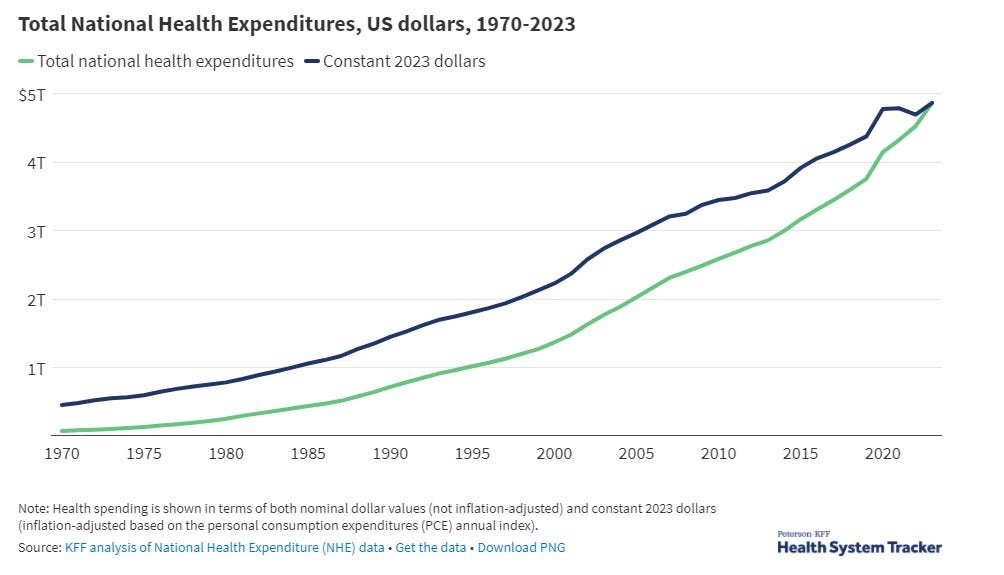
But the problem is much bigger than a single advertisement, or just a single drug or class of drugs. Modern medicine. Pharmaceuticals. Tests. Procedures. Our society has been shaped for decades by the notion that industrial medicine solves health problems, accelerating over the last 50 years or so. In 1930, Americans spent $2.8 billion on health care—$23 per person and 3.5% of the GDP (Gross Domestic Product).[8] Health spending was 17.6% of the U.S. economy, reaching $4.87 trillion in 2023, and is expected to reach 19.7% by 2032.[9] But with this phenomenal increase in spending, have we gotten better health?
Since the 1960s, the trajectory of American health has taken a startling turn for the worse. Obesity rates, for example, have skyrocketed. The age-adjusted prevalence of obesity among U.S. adults was a mere 13.4% in 1960–1962. By August 2021–August 2023, that figure had surged to 40.3% — obesity since 1960 has tripled.[10] The prevalence of severe obesity similarly skyrocketed, from just 0.9% in the 1960s to 9.7% today.
Generations born after 1970 are experiencing deteriorating mortality from cardiovascular disease, cancer, and other major causes, a reversal of decades of health progress. We are, by any honest measure, fatter, sicker, and more medicated than our parents were despite, or perhaps because of, a fifty-year avalanche of diet fads, processed food innovations, and ever-expanding pharmaceutical solutions that promised deliverance but delivered only dependency.[11]
“The United States faces a prolonged life expectancy stall. Using demographic visualization across major cause-of-death groups, we reveal that recent mortality trends stem from an interplay of cohort and period dynamics. The 1950s birth cohort represents a transition from general improvements in earlier cohorts to deterioration across later cohorts. This pattern interacts with a broad period-based mortality deterioration beginning around 2010 affecting all adult cohorts. Recent cohorts born since 1970 exhibit increasing mortality in cardiovascular disease, cancer, and external causes compared to their predecessors, implying continuation of poor mortality trends as they age. Our comprehensive findings suggest that the lack of US mortality improvement is due to multilayered social, biological, and generational forces.”
V. The True Cause of Sickness: Modern Life
Walk into any doctor’s office, and you’ll see the same story playing out. People in their thirties and forties walking around with bodies that look and act like they’re sixty. High blood pressure. Blood sugar creeping into diabetic territory. Joints that ache for no good reason. Brains that feel foggy, anxious, depressed. And when you ask them how they live—really live—the answer is always the same. They spend ten hours parked in a chair. They eat whatever comes in a package or through a drive-thru. They get five hours of sleep and call it a night. They repeat this day after day after day. Their bodies aren’t betraying them. Modern life is betraying their bodies.
Most of the health problems we face today aren’t written in our genes. They aren’t random bad luck. They aren’t mysterious acts of fate. They are the predictable, almost inevitable result of how we’ve chosen to organize our lives. We’ve built a world that fights against our biology at every turn. Then we act confused when people fall apart by middle age. We sit for twelve hours. We eat food that our great-grandparents wouldn’t recognize as food. We stare into glowing rectangles until our eyes burn and our brains buzz. We live in a state of low-grade panic that never turns off. We rarely see the sun. We’ve never been more “connected” and never been more alone. We’re overstimulated, under-rested, and running on empty. Then we reach for pills to fix what our lifestyle broke. This isn’t aging. This isn’t normal. This is what happens when you take a creature built to walk, hunt, sleep with the sun, and belong to a tribe—and you drop it into a cubicle, feed it chemicals, and plug it into a screen.
A. We Stopped Moving

Let’s start with the most obvious one: we don’t move anymore. For the vast stretch of human existence, we walked ten to fifteen miles a day. Not as exercise. Just as life. We hunted. We gathered. We built. We carried. We moved constantly—slow and steady most of the time, with sudden bursts of speed when needed. Now? The average person shuffles fewer than 3,000 steps a day, spends ten to twelve hours in a chair, and thinks a thirty-minute gym session counts as “active.”
Here’s what happens to a body that sits all day. Muscles stop working. When muscles don’t contract, they don’t pull sugar out of your blood. Insulin stops doing its job. Blood sugar creeps up. Hello, pre-diabetes. Your hips tighten, your glutes go to sleep, and your entire back chain collapses. Neck pain. Shoulder pain. Lower back pain. Sound familiar? Your metabolism slows because your body figures: “We’re not doing anything important—let’s save energy.” So, you gain fat, lose muscle, and feel tired all the time.
And here’s the really strange part. Sitting all day sends a signal to your body that you’re sick or injured. Because in nature, healthy animals don’t lounge around for twelve hours. Only dying animals do that. So, your body shifts into survival mode. Inflammation rises. Recovery slows. Stress hormones stay elevated. You’re not built for this. Your body knows it, even if your brain has forgotten.
B. We Eat Food That Isn’t Food
Second problem: we eat garbage. For 99% of human history, we ate what we could find. Meat. Fish. Vegetables. Fruits. Nuts. Seeds. Tubers. Real food. (And to be clear, this advice applies equally to the many plant-based proteins that vegetarians and others across the planet have thrived on for centuries—legumes, lentils, tofu, tempeh, and other whole-food protein sources. The principle is real food, not factory-made imitations.) Today, the average person gets about 60% of their calories from things that didn’t exist a century ago. Seed oils. Refined sugars. Artificial flavors. Preservatives. Emulsifiers. Lab creations designed in factories, not grown in fields. Engineered to be cheap, shelf-stable, and addictive. Your body has no idea what to do with any of it.
Watch what happens when you eat ultra-processed food. Your blood sugar spikes. Insulin floods your system. Your body stores fat. Then blood sugar crashes. You’re hungry again in an hour. Cravings hit. You eat more processed food. The cycle never ends. Meanwhile, your immune system sees these artificial ingredients as invaders and attacks. Chronic inflammation sets in. Joints ache. Your brain gets foggy. Fatigue settles in. Autoimmune issues flare up. Your gut microbiome—the trillions of bacteria that help digest food, regulate mood, and support immunity—can’t survive on this stuff. The good bacteria die. The bad bacteria that thrive on sugar take over. Leaky gut. IBS. Anxiety. Depression. All connected to what’s on your plate.
And here’s the cruelest trick: these foods are designed to override your “I’m full” signals. You can eat 2,000 calories of processed garbage and still feel hungry. Try eating 2,000 calories of steak and vegetables and see how far you get. You’ll be full for the rest of the day. We’re eating food that makes us fat, sick, inflamed, and addicted—and we’ve convinced ourselves it’s normal.
C. We’re Stressed and Can’t Turn It Off
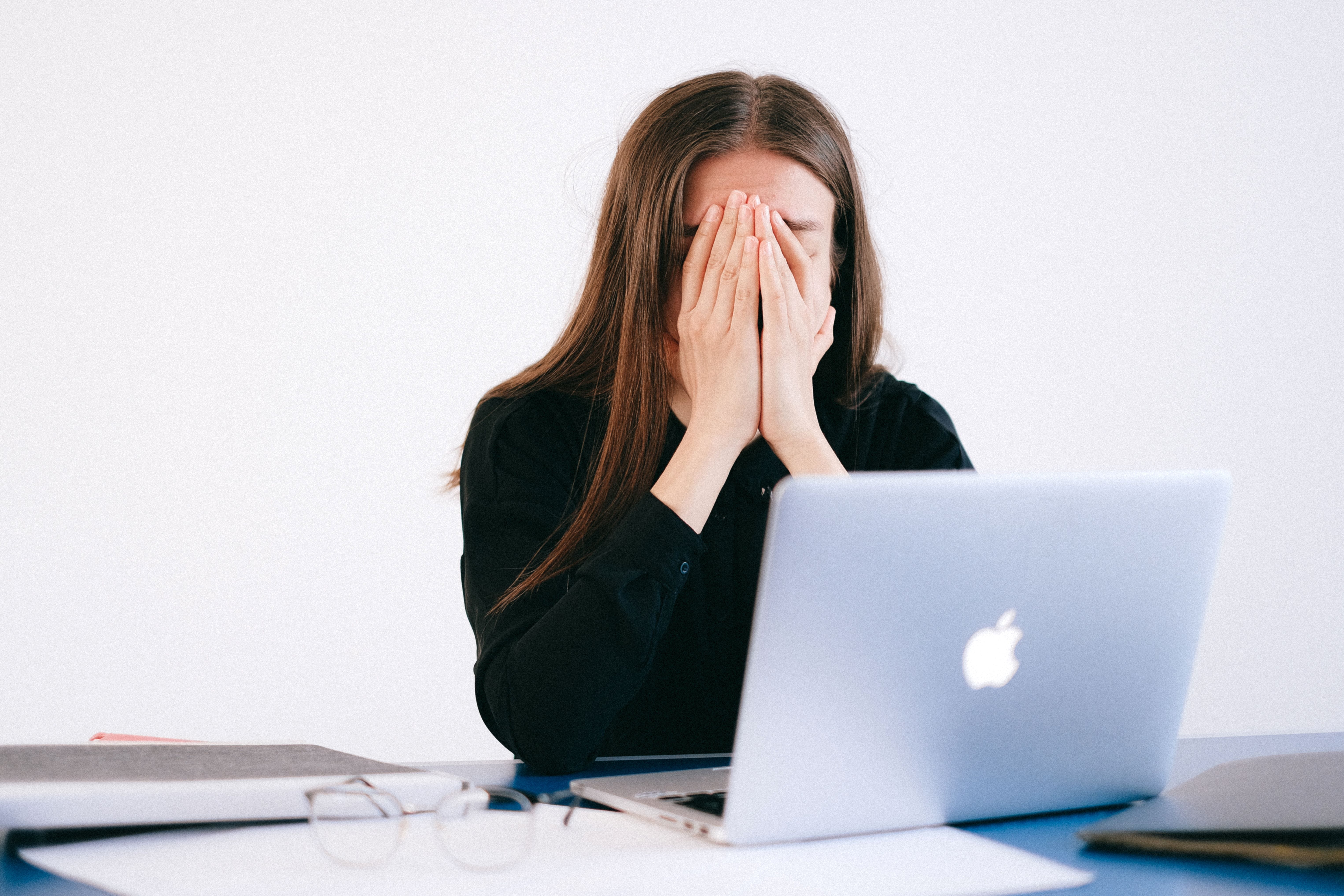
Third problem: chronic stress with no release. Our bodies evolved to handle short, sharp bursts of stress. A predator appears. Heart rate spikes. Adrenaline flows. Cortisol rises. You fight or run. The danger passes. Your nervous system calms down. You recover. Done.
But modern life doesn’t work that way. You wake up to email. You sit in traffic. You face deadlines. You worry about money. You scroll through bad news. You argue with strangers online. Your kids need things. Your boss needs things. Everyone needs things. Your nervous system stays in fight-or-flight mode for twelve, sixteen, twenty hours straight. But there’s no physical release. You’re not running. You’re not fighting. You’re just sitting there, marinating in stress hormones.
What does chronic stress do? Cortisol stays high. Your body prioritizes survival. It stores fat around your middle. It breaks down muscle for energy. It suppresses your immune system—you get sick more often. It tanks your hormones—testosterone drops, thyroid slows. Your stress-regulating system breaks down. Small things start to feel overwhelming. You’re irritable. Anxious. Can’t focus. Sleep gets destroyed because your body can’t calm down. You feel wired and exhausted at the same time. Inflammation goes through the roof. Chronic stress drives most of our modern diseases. We live in a state of constant, low-grade panic, and our bodies are paying the price.
D. We Don’t Sleep
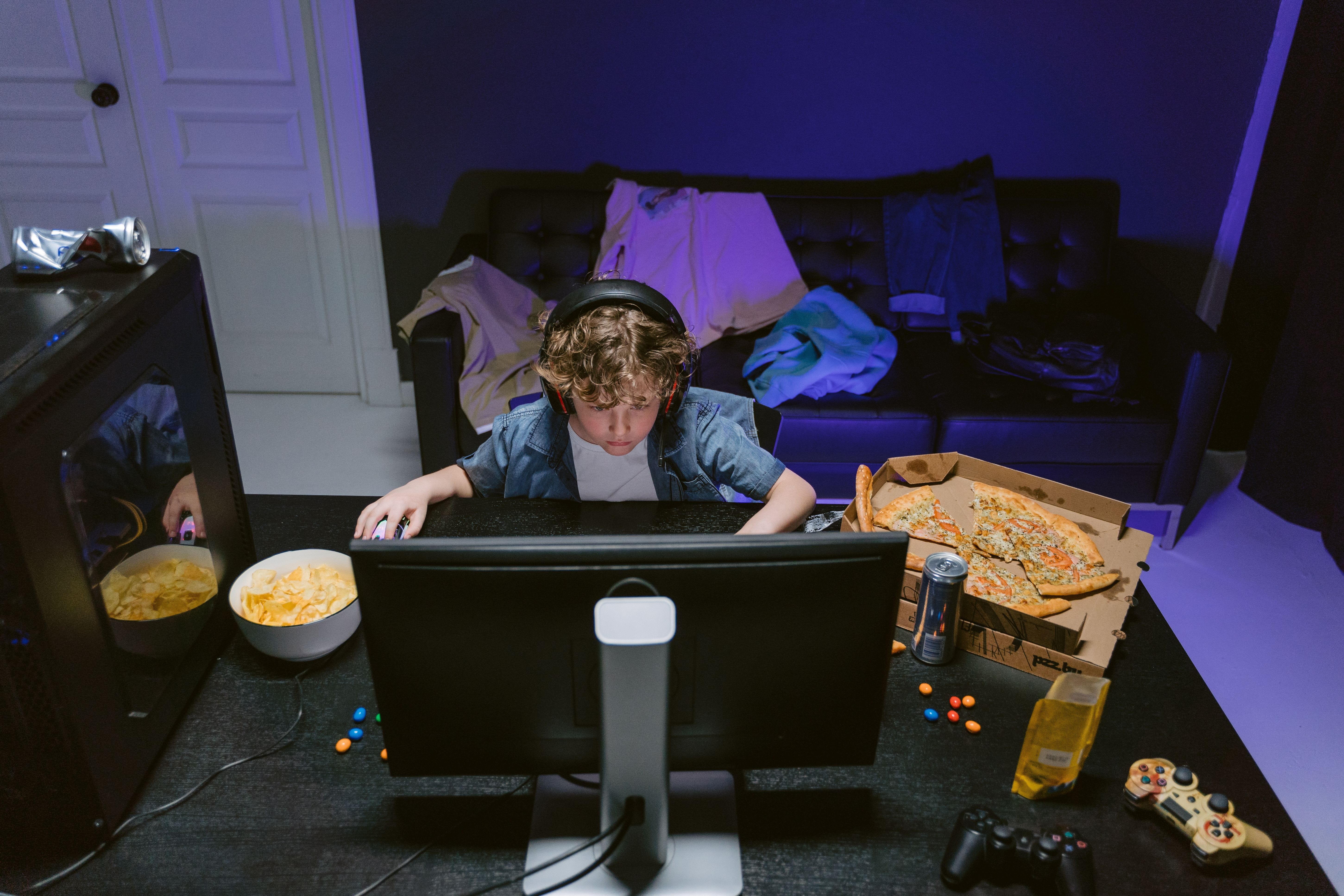
Fourth problem: sleep. Or rather, the lack of it. For all of human history, we slept when it got dark and woke when it got light. Our bodies were locked to the rhythm of the sun. Now we stare at blue light until midnight. We drink caffeine in the afternoon. We sleep in rooms that aren’t dark. We wake to alarms before sunrise. Then we wonder why we feel broken.
Here’s what happens when you don’t sleep. Your body can’t repair itself. Deep sleep is when your brain clears out metabolic waste, rebuilds damaged tissues, and locks in memories. No deep sleep means no recovery. Your hormones tank. Growth hormone and testosterone—the things that keep you strong, lean, and vital—are produced during sleep. Cut your sleep short, and they drop. Your appetite goes haywire. Ghrelin (the hunger hormone) rises. Leptin (the “I’m full” hormone) falls. You’re hungrier, less satisfied, and crave junk. Your insulin sensitivity crashes. One bad night of sleep can make you temporarily pre-diabetic. Chronic sleep deprivation means you’re walking around with the metabolism of someone twenty years older. Your stress tolerance vanishes. Everything feels harder because your prefrontal cortex—the decision-making, emotion-regulating part of your brain—goes offline.
And we’ve normalized this. We brag about running on four or five hours. “I’ll sleep when I’m dead.” You’re not being productive. You’re slowly killing yourself and calling it discipline.
E. We’re Lonely
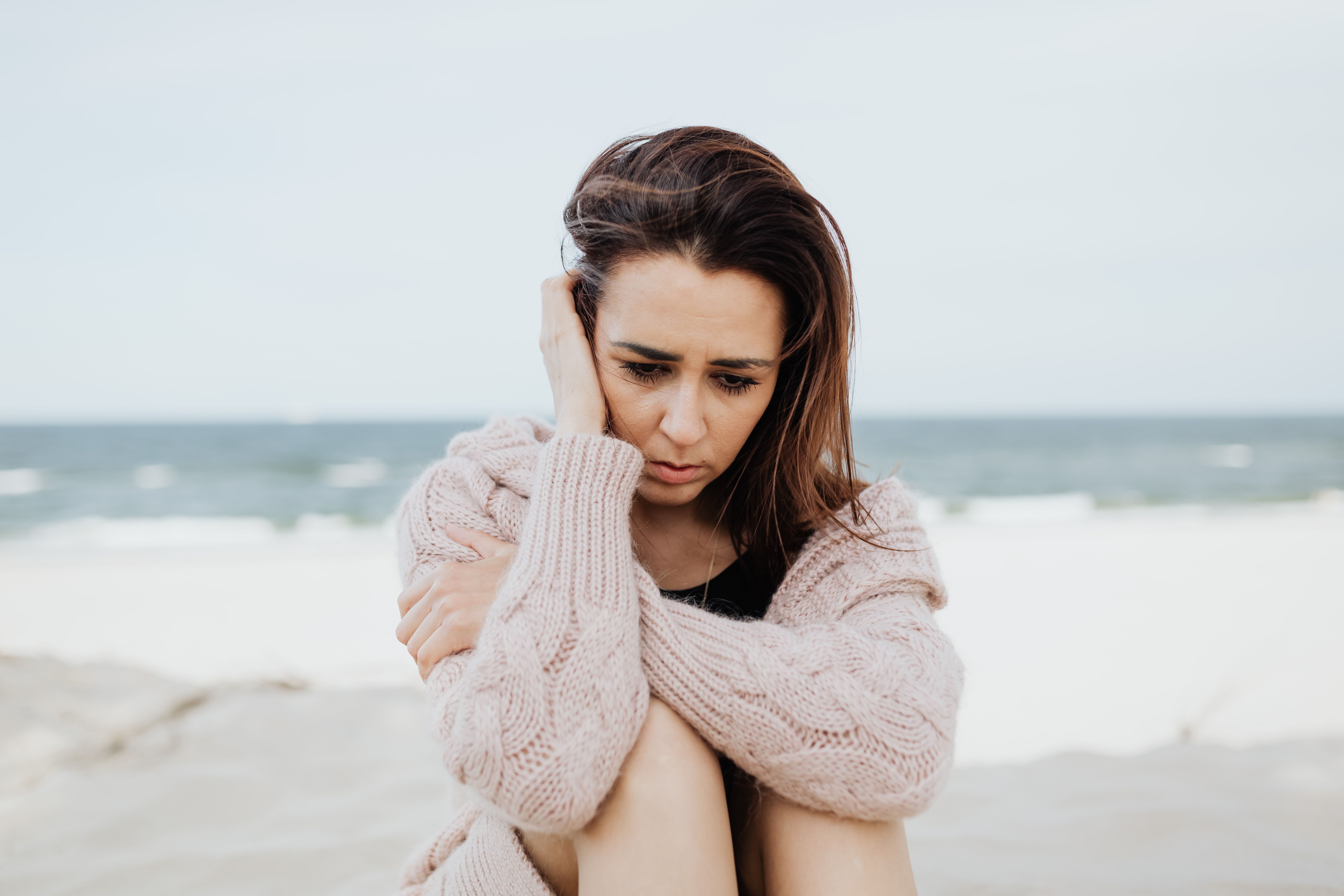
Fifth problem: we’re more connected than ever, and more isolated than ever. Humans are tribal animals. We evolved in small groups with real relationships. Face-to-face. Skin-to-skin. Shared meals. Shared purpose. Now we have a thousand “friends” on social media and no one to call when we’re falling apart. We’re drowning in notifications and starved for real connection.
Loneliness isn’t just sad—it’s physically destructive. It increases inflammation. It raises cortisol. It weakens your immune system—lonely people get sick more often and recover more slowly. It destroys mental health. Depression, anxiety, suicide—all spike with isolation. Chronic loneliness has the same impact on your health as smoking fifteen cigarettes a day. We scroll through other people’s lives while our own bodies and minds disintegrate, and we can’t figure out why we feel so empty.
VI. How We Got Here: A System Designed for Profit, Not Health
Now that you see the problems, let’s talk about how we got here. Because this didn’t just happen. This was designed.
It started with the Industrial Revolution. For most of history, life required physical work. You moved to survive. You ate what you could grow or kill. You slept when the sun went down. Then came factories. Assembly lines. Mechanization. For the first time, you could earn a living sitting still for twelve hours a day. Productivity soared. Wealth grew. Health began to slide—but nobody cared. Efficiency and profit were the goals. Health was an afterthought.
Then came Big Food. In the 1900s, food companies discovered something remarkable. Combine sugar, fat, and salt in just the right way, and you can override the human brain’s stop signals. You can make people eat more than they need and crave more. Food scientists called it the “bliss point”—the perfect formula for addiction. Processed food became cheap, convenient, and enormously profitable. Real food got replaced with cheap substitutes. Seed oils. High-fructose corn syrup instead of sugar. Artificial everything. Not because it was better for you. Because it was cheaper and lasted longer on shelves. Then they spent billions convincing you it was healthy. Breakfast cereal is good for you. Low-fat is smart. Seed oils are heart-healthy. Lies. Profitable lies.
Then came Big Pharma. By the 1950s and ’60s, chronic disease rates were soaring. Heart disease. Diabetes. Obesity. Cancer. All linked to the way we’d changed our food and our lives. But instead of asking why people were getting sick, the medical industry decided to treat the symptoms. High cholesterol? Take a statin. High blood pressure? Take a beta blocker. Can’t sleep? Take a sleeping pill. Depressed? Take an SSRI. We stopped asking why. Because there’s no money in telling people to eat better and move more. You can’t patent a vegetable. You can’t sell a walk. But you can patent a pill and sell it for the rest of someone’s life. The pharmaceutical industry makes over $500 billion a year in the U.S. alone. They’re not incentivized to fix problems. They’re incentivized to manage them. This isn’t to say we don’t need medicine—we sometimes do. But when profit drives everything, people suffer.
And here’s where it all connects. The system isn’t designed for your health. It’s designed to keep you just functional enough to keep working and consuming. You sit all day because your job demands it. You’re stressed and tired, so you buy processed food because it’s fast and easy. You drink coffee to wake up, take pills to sleep, numb out with alcohol or Netflix or social media. You’re not thriving—you’re surviving. And that’s enough to keep the machine running. You go to the doctor. They run tests. Your numbers are bad. They ask about your lifestyle for thirty seconds, then write a prescription. You go home. Nothing changes. This isn’t the doctor’s fault. It’s the system’s fault. The system isn’t built to fix you. It’s built to keep you functional enough to keep participating.
This isn’t a conspiracy. It’s economics. Food companies profit when you eat garbage. Pharma profits when you need medication. The healthcare system profits when you’re sick. Nobody profits when you’re healthy.
So here we are. We sit. We eat garbage. We stress. We don’t sleep. We’re isolated. And when we break down, we’re told it’s our fault. We’re lazy. We lack discipline. We need to try harder. But that’s not true. The system is broken, and it was designed and evolved that way.
But here’s the good news. Once you see it, you can step off the treadmill.
VII. Opting Out: How to Live Like a Human
You can’t fix the system. Not alone. You can’t change Big Food, Big Pharma, or the way society is structured. But you can change your own life. You can opt out—for yourself and your family. You can choose to live in a way that aligns with human biology instead of corporate profit. It’s not complicated. It’s not easy—but it is simple.
I recognize that not everyone has equal access to whole foods or safe walking spaces. Food deserts, economic constraints, time constraints (especially for single parents or multiple-job workers), disability, and chronic conditions that limit mobility are all problems some people face. But within whatever constraints you face, small steps still matter.
A. Move Like a Human

Stop thinking about “exercise” as something you do for thirty minutes in spandex. That’s not how humans move. We move all day, low and slow, with occasional bursts of intensity. This is what that looks like:
Walk. Every day. Eight to ten thousand steps. Not because a watch told you to—because that’s what humans did for thousands of years. Walking stabilizes blood sugar. Lowers inflammation. Reduces stress. Clears your head. Costs nothing.
Lift heavy things. Two or three times a week. Squats. Deadlifts. Presses. Rows. Big movements that use your whole body. Signal to your body that you’re still useful, still strong, still worth maintaining.
Sprint now and then. Once a week, go hard for twenty or thirty seconds. Rest. Repeat a few times. That’s what intensity looks like in nature—short bursts when you need to chase or flee.
Stop sitting for twelve hours. Stand up every hour. Walk around. Stretch. Don’t let your body think you’re dying.
That’s it. No fancy program. No expensive equipment. Just move like a human.
B. Eat Real Food

Here’s the rule: if your great-grandmother wouldn’t recognize it as food, don’t eat it. Animal proteins—meat, fish, eggs—are good choices, and this principle applies equally to the many plant-based proteins that vegetarians and others across the planet have thrived on for centuries: legumes, lentils, tofu, tempeh, and other whole-food protein sources. Vegetables. Tubers. Fruits. Nuts. Seeds. That’s the list. No seed oils. No processed junk. No artificial anything. Very little sugar. If it comes in a package with ingredients you can’t pronounce, leave it on the shelf.
I know what you’re thinking: “That’s restrictive.” No. You’ve just been conditioned to think factory-made garbage is food. Real food tastes good. Your taste buds just need to reset. Eat protein from real sources—whether animal or plant-based. Eat vegetables for fiber and nutrients. Eat tubers for carbs if you’re active. Stop counting macros and calories. Just eat real food until you’re full. Your body knows what to do with it. When you eat this way, inflammation drops. Energy stabilizes. Cravings disappear. Fat melts off. Your gut heals. Your brain works better. Not because you’re on a diet. Because you’re finally eating what humans are supposed to eat.
C. Manage Stress and Recover

You can’t avoid stress. But you can stop living in it. Here’s how:
Build in quiet time every day. Breathwork. Walking without headphones. Stretching. Sitting in silence. Five minutes in the morning, five minutes at night. Tell your nervous system: “We’re safe. We can relax now.”
Get outside. Sunlight in the morning. Sunlight in the evening. Bare feet on the ground if you can. Your circadian rhythm needs natural light. Your stress hormones need the outdoors.
Stop consuming stress. Turn off the news. Limit social media. Stop doom-scrolling. You don’t need to know about every crisis on the planet. It’s not helping you—it’s keeping your cortisol high. If something is happening and you’re not doing anything about it, let it go—your stress doesn’t fix a thing.
Take real rest days. Not “active recovery” where you still do stuff. Real rest. Do nothing. Feel no guilt. Your body needs repair time.
D. Sleep Like Your Life Depends On It
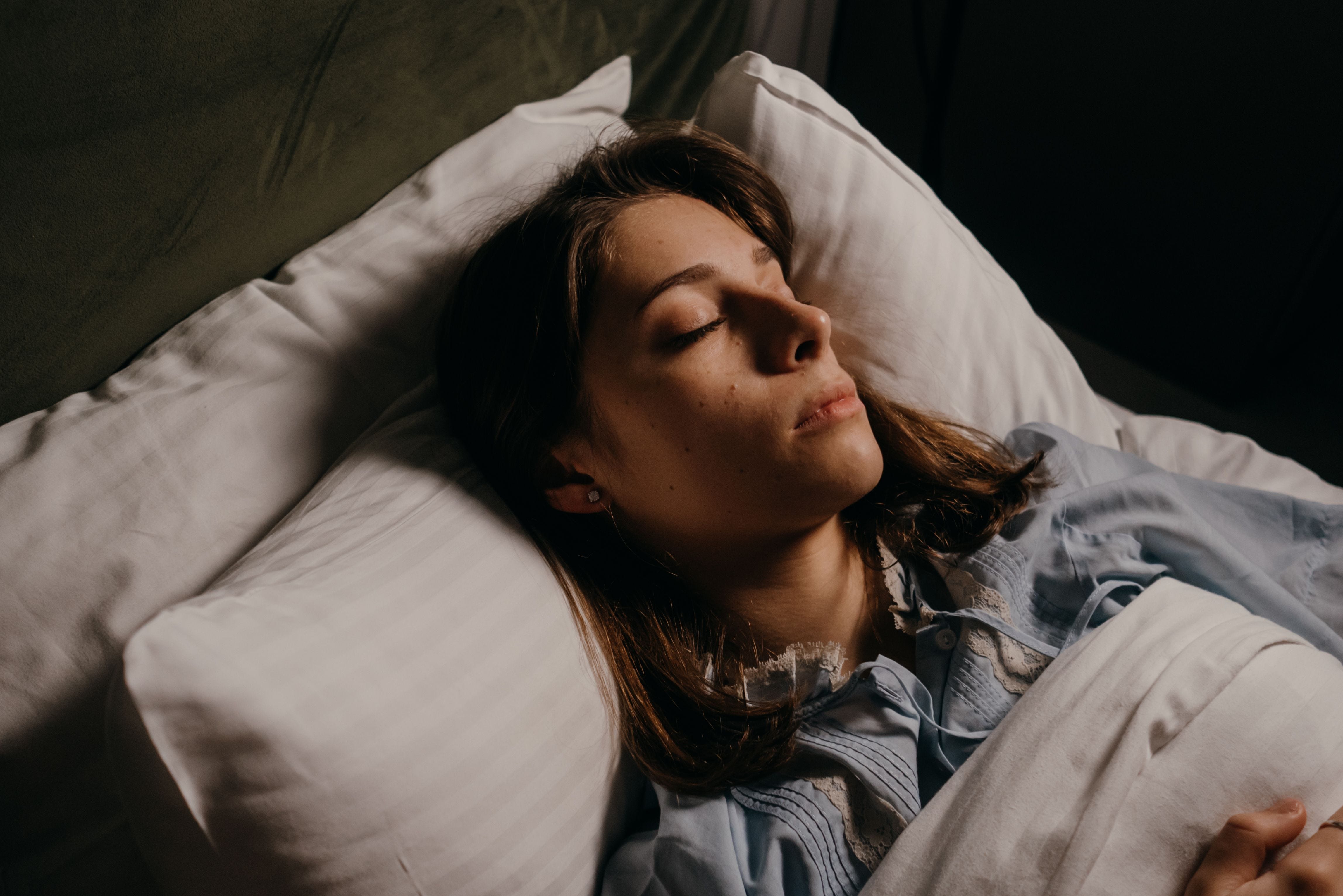
Because it does.
Same bedtime. Same wake time. Every day. Lock in your rhythm.
Dark room. Cool room. Quiet room.
No screens an hour before bed.
No caffeine after 2 PM.
No alcohol close to bedtime—it destroys sleep quality.
Stop bragging about how little sleep you need. You’re not tough. You’re slowly breaking down.
Seven to nine hours. Non-negotiable. If you fix nothing else, fix your sleep. Everything gets easier when you’re well-rested.
E. Build Real Connections

Put the phone down. Talk to people face to face. Join something—a gym, a sports league, a church, a volunteer group. Show up in person. Eat dinner with your family without screens. Go for a walk with a friend. Be present.
Loneliness is killing us, and Instagram and Facebook aren’t going to fix it. You need real people. Real touch. Real conversation. Prioritize it.
VIII. Conclusion: The Baseline We Forgot
Here’s the bottom line. Modern life is designed to make you sick. But you don’t have to play along. Move like a human. Eat real food. Manage stress. Sleep well. Connect with people. That’s it. That’s the whole plan. It’s not sexy. It’s not complicated. Nobody’s selling it in a $2,000 course. But it works because it’s how humans are built to live.
Once you start living this way, you’ll see how broken the system really is. You’ll feel better than you have in years. More energy. Sharper focus. Greater capacity. And you’ll wonder why anyone lives any other way.
I know this sounds extreme. I know it feels overwhelming. But look at what we’ve normalized. Sitting twelve hours a day—that’s extreme. Eating lab-created food-like substances—that’s extreme. Sleeping five hours and calling it productivity—that’s extreme. Chronic stress and isolation—that’s extreme. Living like a human—moving, sleeping, eating real food, recovering, connecting—that’s not extreme. That’s baseline.
You don’t have to move to the woods and hunt your own dinner. You just have to make small changes that bring you back into alignment with your biology. And when you do, everything gets easier. I’ve seen it happen. People who start moving daily, eating real food, prioritizing sleep—six months later, they’re off medications. Thirty pounds lighter without trying. Energy back. Focus back. Life back. Not because they found some magic bullet. Because they stopped fighting their own biology.
IX. Giving Credit Where Credit Wasn’t Due
History isn’t the glitz and glamour many of us picture. For much of human history, most people were horribly poor—not the modern version of “I can’t afford a vacation,” but poor in the older, uglier sense of the word: struggling just to stay alive. If you were born at random in the Roman Empire, you probably wouldn’t be discussing investments near the Forum or reclining in a senator’s villa. You’d be working the land, like the vast majority. If you were born in medieval Europe, roughly 85 to 90 out of every 100 people were peasants, tenants, or serfs—not merchants, guild masters, or nobles. Even by 1820, historical reconstructions suggest that three-quarters to four-fifths of humanity still lived in extreme poverty, unable to reliably afford the basic necessities of food, clothing, shelter, and heat. The rich families left portraits, stone houses, and account books; the poor left almost nothing, which is why our image of the past often looks richer than the people who actually lived in it.
That romantic filter colors our view of the 1800s especially. You might picture gentleman callers in finely furnished parlors, elegant ladies descending from horse-drawn carriages, or leisure cruises on paddlewheel riverboats. But remove those nostalgic filters, and a very different picture emerges. The 1800s were a century when people labored 12 to 16 hours a day in tedious, dangerous work—often in workplaces with no health, safety, or minimum-wage laws. Children roamed the streets in bands because their parents were away working, and many children themselves were subjected to dangerous and demoralizing labor. Cities like New York were surrounded not by suburbs but by rings of smoldering garbage dumps and shantytowns; hogs, horses, and refuse were commonplace in the streets. Infectious diseases ran rampant. This was not the Third World—this was much of what the United States and other Western countries looked like only a century or so ago.
Then, remarkably, the mid-20th century brought something unprecedented. Between 1914 and 1945, world wars, depression, inflation, and revolution shattered the old economic order—catastrophes that weakened old fortunes and rearranged power. Governments needed soldiers, factories needed workers, labor movements organized, and voting rights expanded. The postwar period that followed—especially the 1950s, ‘60s, and ‘70s—gave rise to Western societies that would have been beyond imagining just a few decades earlier. Productivity surged, unions were powerful, governments invested in roads, education, housing, and social insurance, and ordinary workers captured a substantially larger share of rising prosperity. In America, homeownership climbed from roughly 41% in 1940 to around 61% by 1960. A worker without a university degree could plausibly support a household, build equity in a home, receive a pension, save money, and expect his children to become richer than he was. For a brief, extraordinary window, the middle class—a broad base of people with durable personal wealth and economic security—became a reality for millions.
That was the historical anomaly. For most of history, wealth creation alone never guaranteed a middle class; it produced a tiny elite atop a vast base of insecurity. The postwar era was the exception, not the rule, made possible by a unique combination of factors—strong labor, limited global competition, high taxes on the wealthy, massive public investment, and geopolitical fear that capitalism had to deliver for ordinary people or lose them to communism.
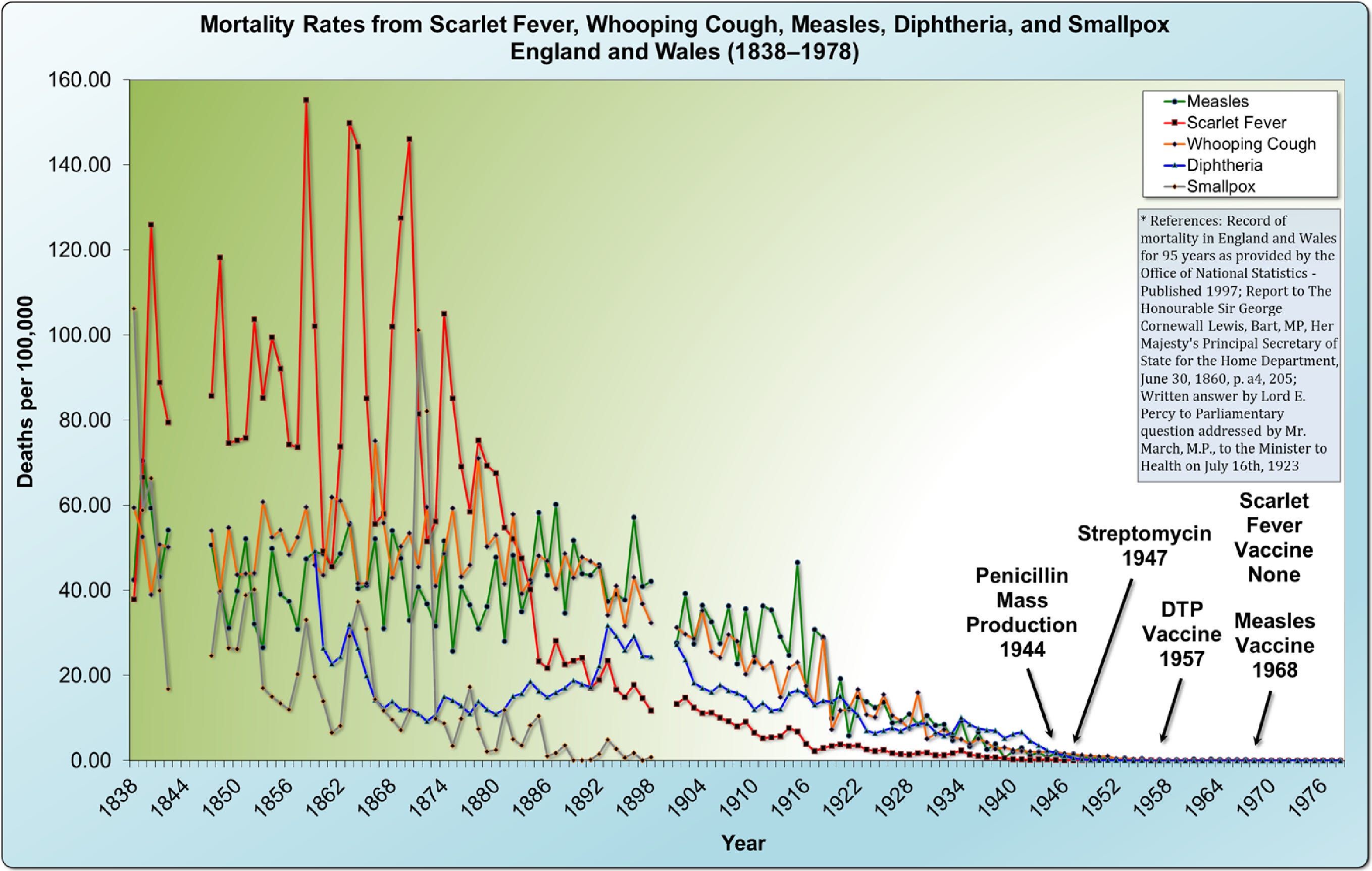
With such sweeping changes and improving lives for the masses, the impact on infectious disease was nothing short of revolutionary. Mortality rates from typhoid, scarlet fever, typhus, whooping cough, and measles plummeted to near zero. For example, in England, measles and whooping cough deaths declined by nearly 100% from the mid-1800s to the mid-1900s before vaccines or antibiotics were widely available, and the death rate from the even bigger killer, scarlet fever, also declined by nearly 100% without any vaccine. Mass production of penicillin also began in 1944, after most of the decline in mortality from these diseases had already occurred.
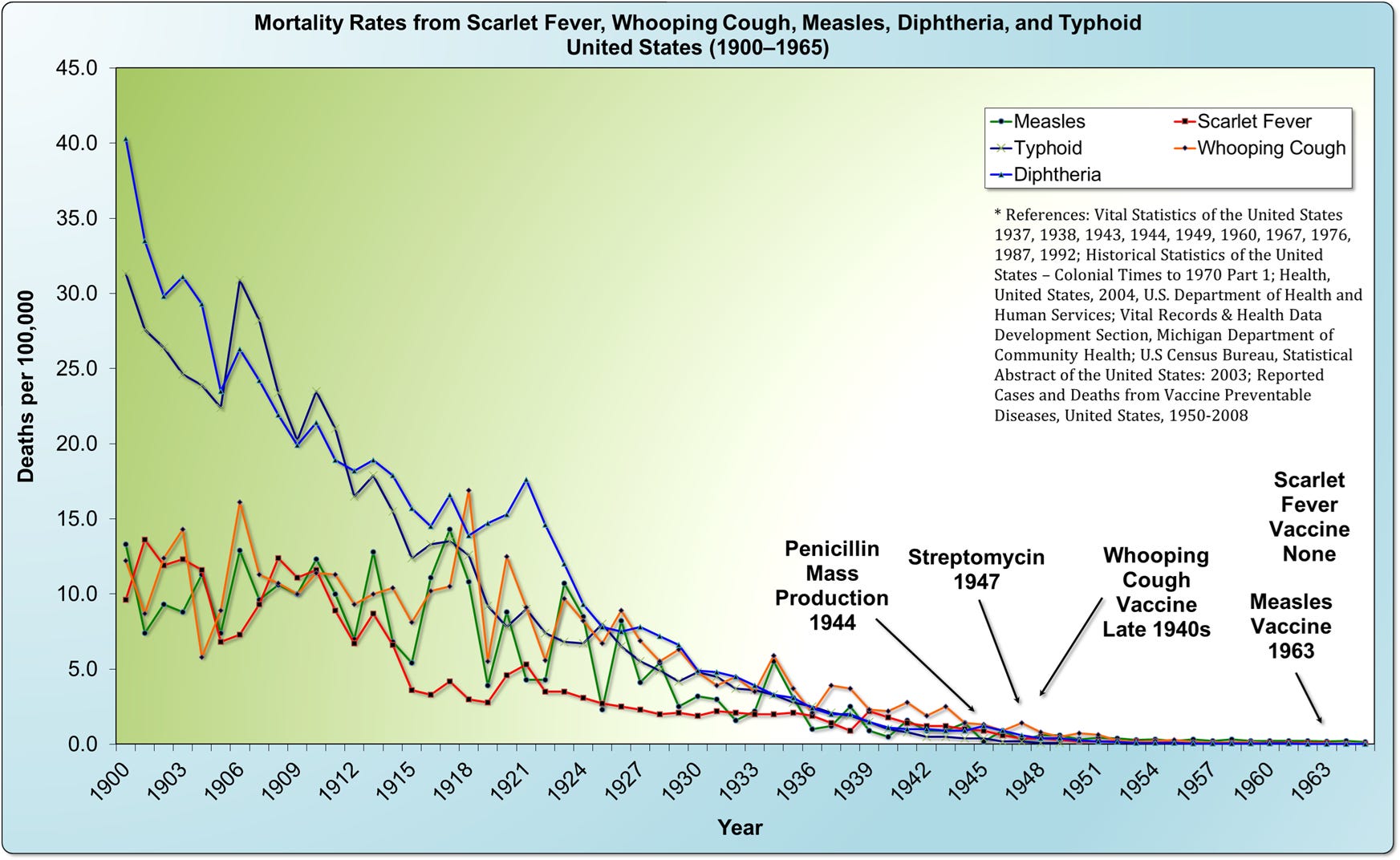
Similar patterns unfolded in the United States. Measles death rate had already fallen by a staggering 98% before the introduction of the first vaccine in 1963. The mortality rate from whooping cough had already declined by an astonishing 95% by the time its vaccine was introduced in 1948.
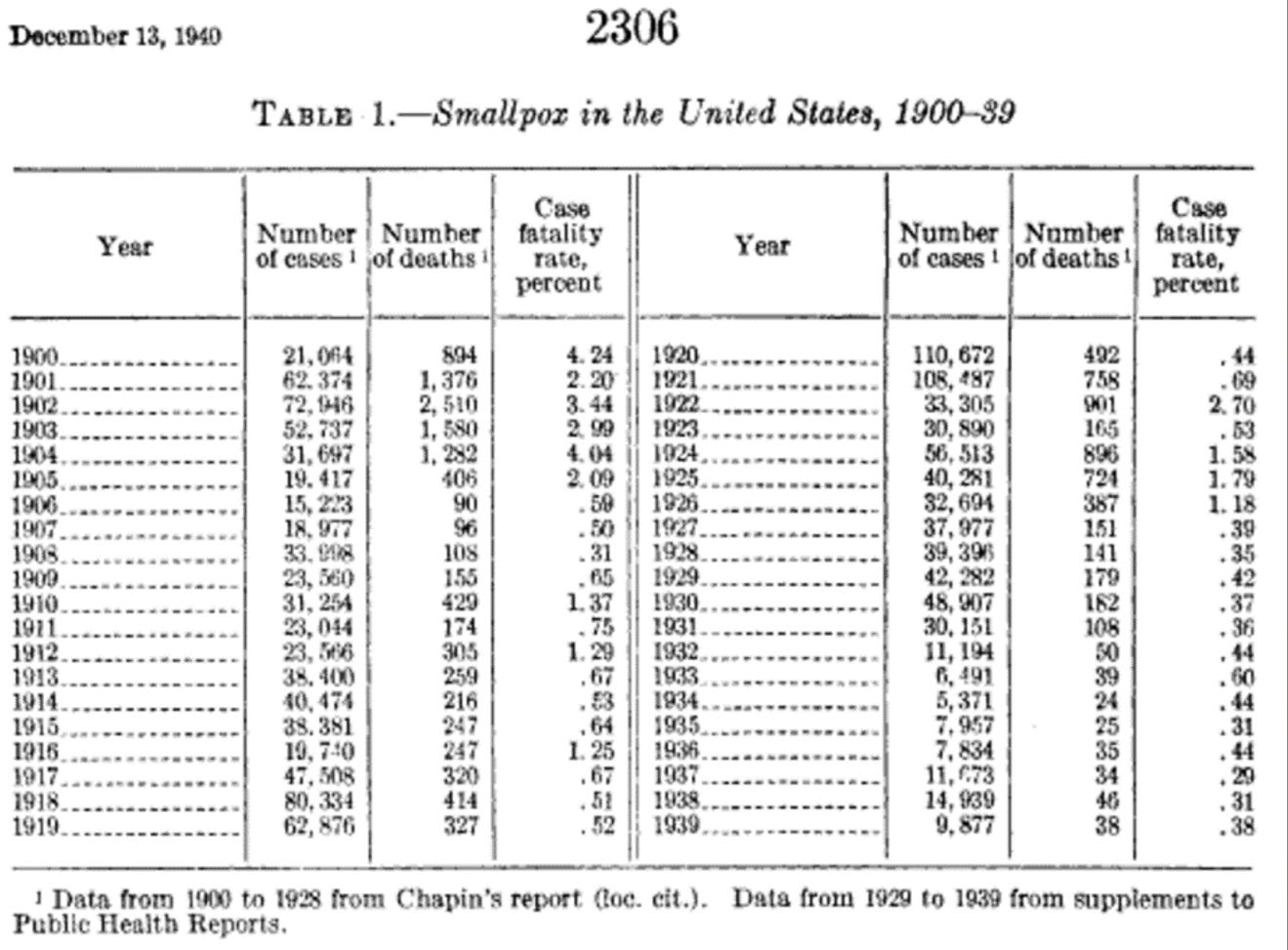
Even the dread smallpox—a disease that had haunted humanity for centuries, scarring and killing millions—saw its mortality rate plummet dramatically. By 1939, mortality had fallen by over 98%, as noted in a 1940 article in Public Health Reports, becoming a negligible threat long before the World Health Organization’s eradication campaign began.[12]
This wasn’t a gradual improvement; it was a dramatic, unprecedented collapse of diseases that had once been routine killers, especially among children. In the span of just a few decades, the Western world transitioned from a place where families expected to lose multiple children to illness, to one where childhood survival became the norm.
The mistake we have made—viewing this transformation through rose-colored glasses—is giving nearly all the credit to modern medicine. We tend to imagine that vaccines and antibiotics swept in like saviors and single-handedly conquered these plagues. But the historical reality tells a very different story. The dramatic decline in infectious disease mortality began long before penicillin or widespread vaccine use.
Massive public health initiatives drove it instead: sanitary infrastructure, clean water systems, proper sewage disposal, better hygiene, improved nutrition, labor laws, and scientific advances that changed how people lived, worked, and ate. This transformation came from specific, measurable interventions: building modern sewer systems in cities like London and New York, chlorinating water supplies, passing housing and labor reforms, establishing food safety regulations, and widely adopting handwashing and basic hygiene practices. These improvements—often unglamorous, the work of engineers, plumbers, and public health officials—were the real engines of this health revolution. Medicine came much later and played a far smaller role than we commonly believe.
It wasn’t medicine; it was infrastructure.
But we gave medicine all the credit anyway. And that misattribution wasn’t harmless. By crediting doctors and pharmaceuticals with a transformation that was fundamentally about sanitation, nutrition, and living conditions, we elevated medicine to a status it hadn’t earned. We began to see health as something delivered by experts and prescriptions, rather than something built by clean water, good food, and safe environments. This gave rise not to a culture of engineers, inventors, and plumbers—the very people who had actually saved us—but to the ascendancy of medicine itself. We traded a focus on prevention and infrastructure for a focus on treatment and pills. And in doing so, we forgot the lesson that history teaches: that health is created far more by how we live than by what we take.
Why did we give medicine the credit? Partly because the narrative was compelling—heroic doctors conquering ancient plagues—and partly because it served the interests of an ascendant medical establishment. But partly, too, because we simply forgot. When children stopped dying, we stopped asking why, and when we did ask, we looked to the most visible agents of change: doctors and drugs, not sewers and soap.
For further reading, explore the following:
The Greatest Health Revolution
·
September 8, 2025

“The history of vaccination from its beginning to its present position is a refreshing illustration of the truth that medical science is human first and scientific afterwards... The refusal of the professional leaders to go back upon their mistake, when it was abundantly proved to be a mistake, has become an inherited obligation of hard swearing to succ…
X. The Sickness Industrial Complex (SIC)
Our worldview is largely mistaken. People have equated medical degrees, shiny buildings, and well-dressed medical personnel with real health. Once a problem arises, they look for a miracle cure for problems they often created, and that should have resolved themselves.
What the drug “does” is promoted, while all those other side effects are largely ignored. Point of fact, they are all what the drug does, and there really is no such thing as a “side” effect. The ones that companies like, they promote; the others, they largely ignore, to the benefit of their profits and control, not necessarily your well-being. Much of this is not science, but empiricism performed on the public. If it were science, they could tell you whether your digestive system would stop, whether you would get kidney stones, or whether you would experience a rare but fatal reaction. But they do not know. They simply point to experiments that showed problems, which they list as side effects, and which they promptly largely ignore before happily giving you the pill or injection to try, to experiment.
Ozempic and similar pharmaceuticals are the Nth stage of the Sickness Industrial Complex (SIC). By SIC, I mean the interwoven system of food, pharmaceutical, and healthcare industries that profit from treating disease rather than preventing it. This is a complex that only exists at nearly 18 percent of GDP because we’ve brainwashed ourselves as a society into believing that we should eat food that is like chemically manufactured substances made with industrially grown, GMO, nutrient-deficient crops; that we should sit on iPads avoiding sunlight and anything physical; and then run like sheep to the slaughter into the maw of medical interventions masked as health care.
The main players keeping us sick in modern life are big agriculture, big food, and big pharma. Banks, politicians, and advertisers round out the cast, creating a health disaster that can only be reversed once we understand history and the problem we face.
That is not to say that modern medicine doesn’t do amazing things. Emergency surgery, diagnostic advances (from X-rays to MRIs), and fixing major physical deformities such as cleft palates are simply miraculous. Many drugs can be life-saving and needed in various circumstances. However, the overarching problem is that we are almost completely ignoring our modern lifestyle as the primary cause of disease.
XI. A Final Word: The Choice Is Yours
Here’s what I want you to sit with. You’ve read the numbers. You’ve seen the ads. You’ve heard Sam’s story. You’ve walked through the five ways modern life breaks us down, and you’ve seen how we got here—not by accident, but by design. You know the system is rigged. You know the deck is stacked against you.
So, what now?
You have a choice. You always have a choice. You can keep doing what you’re doing. Keep sitting. Keep eating processed food. Keep scrolling. Keep running on empty. Keep hoping that the next pill, the next diet, the next quick fix will be the one that finally works. You can keep trusting a system that profits from your sickness to make you well.
Or you can opt out.
Not all at once. Not perfectly. Not with some grand, dramatic gesture. Just one small step at a time. Trade one processed meal for real food. Walk for ten minutes instead of scrolling. Go to bed thirty minutes earlier. Call a friend instead of texting. Just one thing. Today.
Because here’s the thing nobody tells you: you don’t have to be perfect. You just have to start. The system wants you to believe that if you can’t do everything perfectly, there’s no point in doing anything at all. That’s a lie. It’s a lie designed to keep you paralyzed, to keep you consuming, to keep you sick. One real meal is better than none. One walk is better than sitting. One good night of sleep is better than another restless one. Progress, not perfection. That’s the only rule.
And when you start—really start—something shifts. You feel it in your body first. A little more energy. A little less brain fog. A little more patience. Then you feel it in your mind. A little more clarity. A little less anxiety. A little more hope. Then you feel it in your life. You start making better choices because you actually want to, not because you’re forcing yourself. The momentum builds. The cravings fade. The old habits lose their grip. And one day you wake up and realize: you don’t miss it. You don’t miss the junk food. You don’t miss the exhaustion. You don’t miss the numbing. Because you’ve tasted something better. You’ve tasted what it feels like to be alive, really alive, in a body that works, in a mind that’s clear, in a life that has meaning.
And that, right there, is the most radical thing you can do. Not just for yourself. For everyone around you. When you choose health, you become a living example. A quiet refutation of the lie the system tells. Your kids see it. Your friends see it. Your family sees it. They see that there’s another way. That they don’t have to be slaves to the machine. That they can step off, too.

You can’t fix the whole system. But you can fix you. And in a world designed to make you sick, choosing health is an act of rebellion. A quiet, daily, stubborn refusal to play along. A declaration that your body matters. Your mind matters. Your life matters. More than the profits of food companies. More than the bottom lines of pharmaceutical giants. More than the convenience of a system that would rather medicate you than heal you.
So don’t wait. Don’t wait for the perfect moment. Don’t wait until you have more time, more money, more willpower. There is no perfect moment. There is only now. And now is the only moment you can do anything about.
Start small. Start simple. Start today.
Move like a human. Eat real food. Sleep. Recover. Connect.
And watch what happens.
Acknowledgments
Many thanks to Seth Capehart, MD, and his video, Modern Life Is A Disease
for the information contained in this article. His work on how modern living drives chronic disease was invaluable in shaping these parts of the essay. And thank you as well to The Financial Historian for the video, Why the Middle Class Was a Historical Accident
which provided the historical framing for how we arrived at this unusual moment in history—and why we should never take it for granted.
[1] Dr. B. H. Cubbage, “Anti-Diptheritic Serum,” The Columbus Medical Journal, vol. XXXII, no. 7, July 1908, pp. 371–372.
[2] H. Brown, MD, “The use and abuse of medicines,” The American Practitioner and News, May 21, 1892, vol. XIII, no. 11, pp. 322–323.
[3] Public Citizen. “Pharma Advertising: Driving Up Health Care Costs at the Expense of Taxpayers Since 1981.” August 10, 2017. https://www.citizen.org/news/dtc-advertising-driving-health-care-costs-expense-taxpayers-since-1981.
[4] Pharmacy Times. “Medical Marketing Spending Increases, While Regulation Stalls.” August 23, 2019. https://www.pharmacytimes.com/view/medical-marketing-spending-increases-while-regulation-stalls.
[5] WEGOVY (semaglutide) injection, for subcutaneous use – Prescribing Information,” U.S. Food and Drug Administration (FDA), DailyMed, https://dailymed.nlm.nih.gov/dailymed/fda/fdaDrugXsl.cfm?setid=ee06186f-2aa3-4990-a760-757579d8f77b
[6] Farthing, H. and Golden, K.E., “Ozempic and Your Gallbladder: Can Ozempic Cause Gallbladder Issues?” 2025, GoodRx, https://www.goodrx.com/ozempic/ozempic-and-gallbladder-issues
[7] Sakay, Y.N., “Expert Q&A: Do weight-loss drugs cause pancreatitis?” 2026, Medical News Today, https://resources.healthgrades.com/pro/expert-qa-weight-loss-drugs-cause-pancreatitis-side-effects-risk
[8] Roberts, W. C. (2019). Facts and ideas from anywhere. Proceedings (Baylor University. Medical Center), *32*(2), 317–320. https://www.tandfonline.com/doi/full/10.1080/08998280.2019.1545968
[9] “Currently, health care represents about 18% of the U.S. economy (measured as a share of gross domestic product, or GDP). In other words, almost 1 out of every 5 dollars spent in the U.S. goes toward health care.” https://www.kff.org/health-costs/health-policy-101-health-care-costs-and-affordability/?entry=table-of-contents-how-has-u-s-health-care-spending-changed-over-time
[10] Fryar, Cheryl D., Joseph Afful, and Nadia T. Saif. “Prevalence of Overweight, Obesity, and Severe Obesity Among Adults Age 20 and Older: United States, 1960–1962 Through August 2021–August 2023.” NCHS Health E-Stat no. 111 (February 2026). https://www.cdc.gov/nchs/data/hestat/hestat111.htm
[11] Abrams, L. R., O. Bramajo, A. A. van Raalte, M. Myrskylä, and N. K. Mehta. “Insights into US Life Expectancy Stagnation from Birth Cohort Mortality Dynamics.” Proceedings of the National Academy of Sciences 123, no. 11 (2026): e2519356123. https://doi.org/10.1073/pnas.2519356123. Also available via the Max Planck Institute for Demographic Research: https://www.demogr.mpg.de/en/publications_databases_6118/publications_1904/journal_articles/insights_into_us_life_expectancy_stagnation_from_birth_cohort_mortality_dynamics_8854/.
[12] “Smallpox in the United States: Its decline and geographic distribution,” Public Health Reports, vol. 55, no. 50, December 13, 1940, pp. 2303-2312.
Comments
Nothing yet. Say the first thing.
Sign in to join the conversation.