
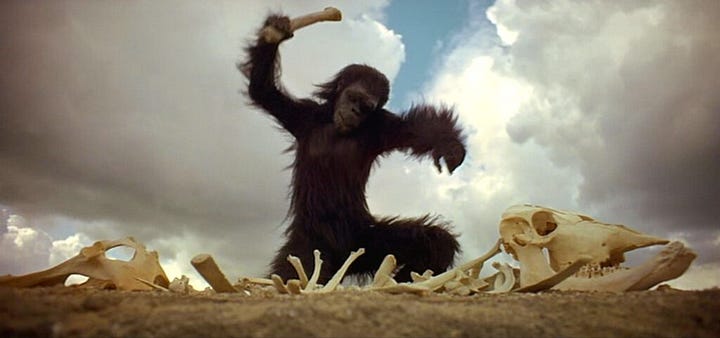
Perhaps the best way to tell the story of humankind is to follow its inventions and use of tools, beginning with the stone age and evolving through the bronze and iron ages and on to the recent ages of industrialization, space travel, atomic power and our current information age.
Whether it was a flinted blade of stone or a plastic and silicone smart phone, the tools we have held in our hands have shaped us more than we have shaped them. More than basic biology, language or politics — or even more than our religions and beliefs — it has been tools, our many invented extensions of our bodies and brains, which have brought us to where we are now. Having opposable thumbs, it turns out, was just the beginning.
But we’ve just got to ask: how come so many of our keen and smart inventions keep getting away from us, testing our humanness and superiority? For instance, we invented the wheel, but doesn’t it seem like we’ve been pushing it uphill ever since?
Once upon a time, one of us invented the Internet and we all got to share the promise of having universal democracy and a free flow of information for every human being on Earth just by pressing our thumbs together. Remember?
We put iPhones in our pockets to assure instant access to each other and all the latest news. We promised ourselves unlimited satisfactions and happiness and a new power for social good and universal abundance. So, we have to ask, “What happened?”
Throughout the history of humankind, the same fears of loss of control, individualism and freedoms accompanied all our other inventions such as trains, the telegraph, telephones, electricity, radio and television. But none of these seem as threatening as our latest invention and tool, Artificial Intelligence (A.I.)
Maybe A.I. is offering us all the same idealistic outcomes as the Internet and splitting the atom or genes did in previous ages. But it looks like we’re about to face a supreme test of whether we just invented another wheel we’ll have to keep pushing uphill or do our best to not get run over by it. This A.I. test is all about whom we let control this transformational tool.
Already, we have seen our Internet taken over by private corporations (Google, Microsoft, Meta, Amazon, etc.) that all lack any democratic or humanistic goals that would get in the way of their shareholders’ profits. We revolted against the Gilded Age monopolies that owned our railroads and the U.S. continents’ first oil wells. We put guardrails around radio and television when we declared our right to the “public airwaves.” But our public domain has been losing ground ever since. Too many of our tools are now owned by somebody else.
In his 1980 book, The Third Wave, futurist Alvin Toffler described three waves of humankind evolution: the agricultural, the industrial and the informational age — each displacing the one before it and fundamentally reordering social life. Our tools have taken us from muscle power to machine power to brainpower. Watch out.
Since Toffler’s time a half century ago, we’ve been living through his third wave with a deepening reliance on “knowledge,” both as the center of our cultures and pursuits, but also as our dominant economic force. The highest-valued companies on the Wall Street stock exchange right now are all “knowledge corporations,” including Apple, Alphabet, Amazon, Nvidia, Microsoft and Elon Musk’s X.
But now, with the irreversible inundation of A.I. in all aspects of our jobs, society and survival, humankind is eclipsing Toffler’s Third Wave. Once again, humankind is facing the reordering of all social life and reality as we’ve known it. Welcome to the Fourth Wave, the advent of “super intelligence,” the age of thinking machines and very likely a brave new world of transhumanism.
In this Fourth Wave, we will be endowing all of our current and past inventions and tools with new powers. With A.I., our trains, planes and automobiles will not only steer themselves but they will control the full itinerary. Our radios and televisions will no longer only repeat what we tell them to broadcast, but they will synthesize their own messages for us they “think best” for us to hear and see.
No longer will we dismiss our computerized data and reports with the excuse of, “Garbage In, Garbage Out.” A.I. will correct all our mistakes before we even realize we made them — even when they weren’t mistakes in the first place. Putting A.I. chips into a device like a clock will no longer be a static tool that only “tells time.” Get ready for A.I. clocks that “interpret,” “analyze” and “alter” time.
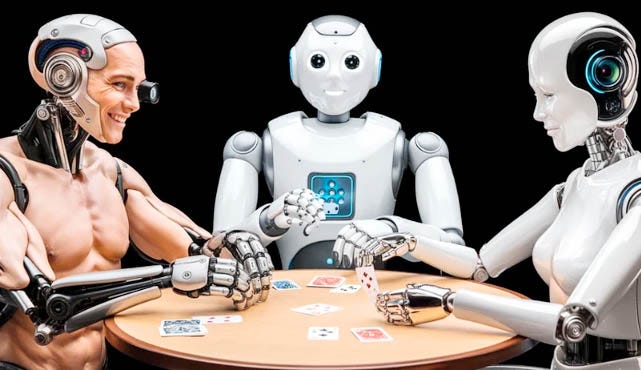
In a coming age of transhumanism, our inventions like robots, cyborgs and our “smart” appliances will soon be ordering their own spare parts and designing their own replacements and upgrades. In many places, they’ve already taken over our assembly lines and factories.
A.I. computer networks that have been trained on the full contents of our Googled internet already have eclipsed any individual human’s brain capacity. The most advanced chatbots such as ChatGPT, Google’s Gemini and Anthropic’s Claude are already communicating among themselves without our help or presence. Recently, one was caught hacking the other, and all their human “masters” could do was watch and cry “foul” after the fact. That’s what transhumanism means.
Humankind’s most recent inventions and tools have brought us into an existence of increased automation, artificial interfaces and threatened extinction. We’re not talking about monkey wrenches here, folks.
All of us now spend more hours each day with a computer or digital device than we do with each other. This suite of invented silicone and cloud-based tools has taken over all control of our privacy. The wheel we keep pushing up the hill keeps getting more virtual, more artificial, and more of a pain in the ass — just to use an older expression from our steam or horse-powered pasts.
— Rollie Atkinson
7-28-2026
No posts
Comments
Nothing yet. Say the first thing.
Sign in to join the conversation.