
Tripartite: The Architecture of Three and The Wholly Trinity
The Rule of Three is a communication and writing principle stating that a trio of words, events, or ideas is more memorable, satisfying, and persuasive than any other number. It leverages the brain’s natural pattern-recognition, providing the minimum amount of information needed to establish rhythm without diluting impact. Trinity.
Why this rather subjective observation is considered the brain’s natural pattern recognition would seem a fascinating debate, were I qualified to engage in it.
I am not.
I shall not.Nonetheless, research indicates that the human mind appears inherently drawn to patterns, but one specific digit seems to exert a unique hold over consciousness: the number three. From the structural integrity of geometry to the rules of our most popular pastimes, the concept of the triad serves as an organizing principle for reality. The number three manifests across geometry, rhetoric, religion, politics, social structures, and sports, demonstrating that it is not a mere human invention, but an essential framework for sociopolitical manipulation, programming, and control.
And there, I daresay, is a damned sight difference between a brain and a “mind” though I readily acquiesce that one likely complements, or detracts, from the other.
Pizza For Three
The ubiquity of three can be practically problematic. For instance, there is an infamous case of a Black Man in the United States named Jerry Dewayne Williams, a 27-year-old from Compton who became known globally as the “pizza thief” after being sentenced to 25 years to life in prison in March 1995. On July 30, 1994, Williams approached a group of children, ages 7 to 14, who were eating a pepperoni pizza at an eatery on the Redondo Beach Pier in Los Angeles County. He grabbed a single slice of pizza from them. Because it was charged as a felony, it triggered California’s “Three Strikes” law and I will leave that for the rumination of the reader.
Modern democracies, allegedly, prevent tyranny through a tripartite system, splitting power between three distinct branches: the executive, legislative, and judicial. By creating three points of contact, governance achieves a geometric stability akin to a triangle; no single branch can easily collapse the structure. That, however, does not appear to be functioning very well; speaking in moderation.
But, I digress.
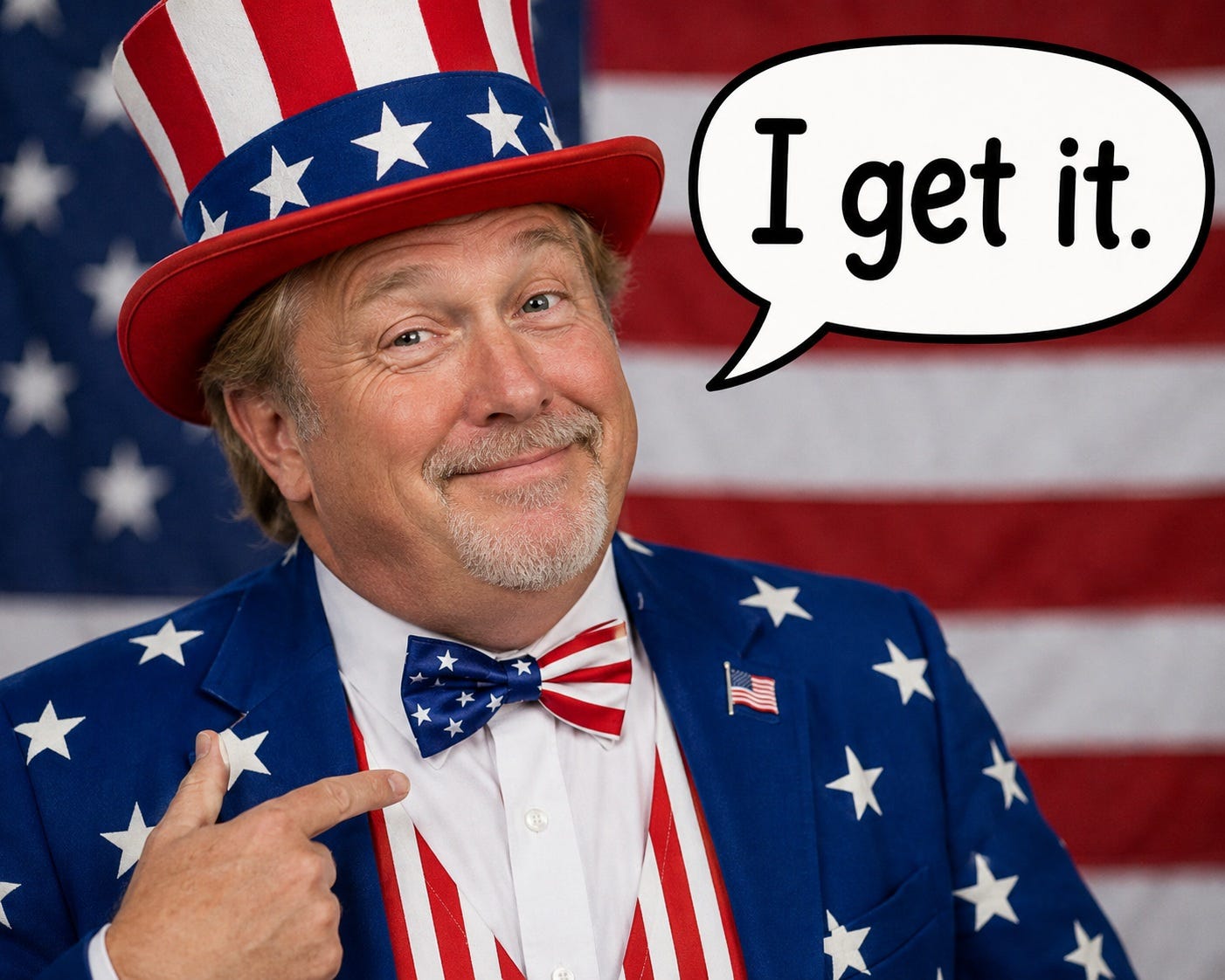
“We The People”: I Get It
From “I Like Ike” to “Hope And Change” and “That’s Not US” we are bombarded with this wholly unholy trinity of verbiage and sloganeering that is nothing more than linguistic insult directed at the collective ignorance of the US population. Schools are underfunded, teachers are underpaid, and students are “underserved.” Trinitarian hogwash that guarantees a fresh supply of idiots unable to think or listen critically.
We the people.
I get it.
A most interesting and fascinating aspect of the aforementioned verbal trinity is a thing that many do not consider. The Preamble to the United States Constitution, begins with the words “We the People.” However, depending on which word in the phrase one chooses to emphasize it takes on different meanings. When one says “I love you” and emphasizes “I” the phrase takes on a different, uh, “color.” By the by, that lofty phrase of “We the People” excluded people that looked like me, the only group in fact. It, and its systems, were designed to do so.
That’s a fact.
You Got It?
I am one fascinated, if not entranced and enchanted, by language. I am also horrified, terrified and respectful of it as I know its power; as do others. And its power exceeds that of any nuclear weapon cubed millions of times. As the cursed, unfortunate and pitiful linguistic critter that is I, I pay keen attention to what I call “linguistic tics and one of which that has come into vogue of late is “I get it.”
But do you?
Aside from how this trinitarian verbiage, three little words, can become entirely different depending on the word emphasized, it can also become completely different by who is uttering it. I am noticing that when certain people say “I get it” it is actually a blowoff, trivialization and minimization of what has been presented to them. Most of the time when I hear “I get it” the statement is followed with “but.”
“I get it” does not say “I understand you,” or “you are correct,” or “point well taken.” It is a linguistic placebo that feigns acknowledgement and comprehension. That’s the truth.
Figure it out.
I Get It, You Got It?
Amerikan law is founded on Roman law. The bedrock of Roman law is: “All the law that we use relates either to persons, to things, or to actions.” Ah, the holiest of trinities and the ultimate legal triad. For over 2,000 years, this phrase has been the structural foundation of the legal world. The Romans argued that you can boil every single law down to three buckets:
Personae (Persons)
Res (Things)
Actiones (Actions)
I, and those like me, have the dubious, unique and historical privilege of being “Res.” As such we find ourselves, like pizza-man, subject to the most wondrous of circumstances. And though I understand that pizza is a pie, the bullshit is baked in the cake. So, the next time you, or someone else, dismissively says I get it, make sure you do.
Because I do.
You got that?
Comments
Nothing yet. Say the first thing.
Sign in to join the conversation.