
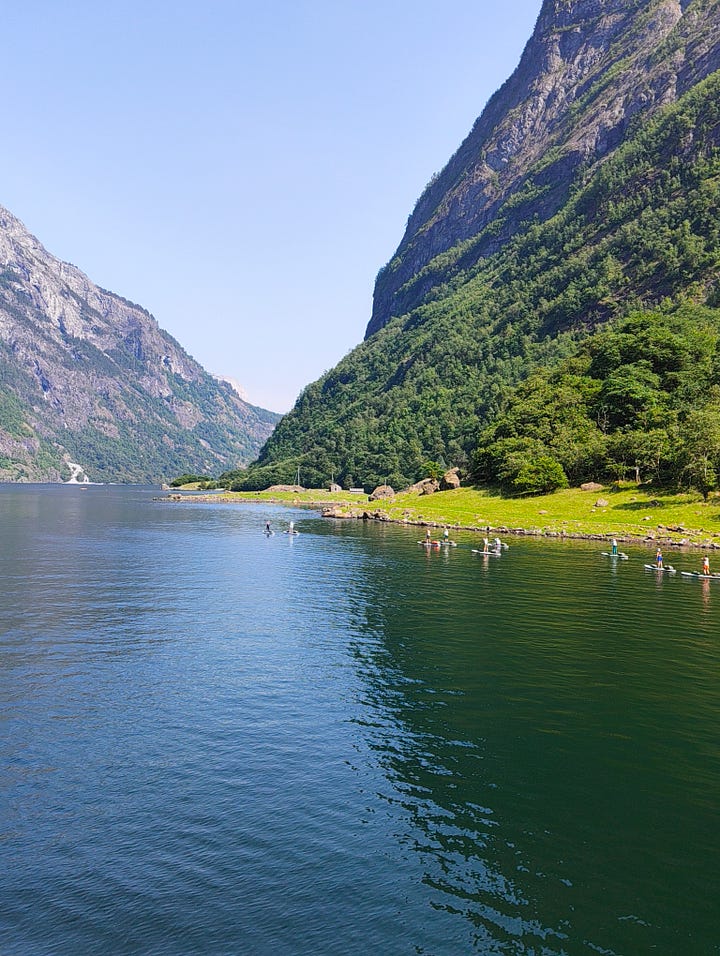
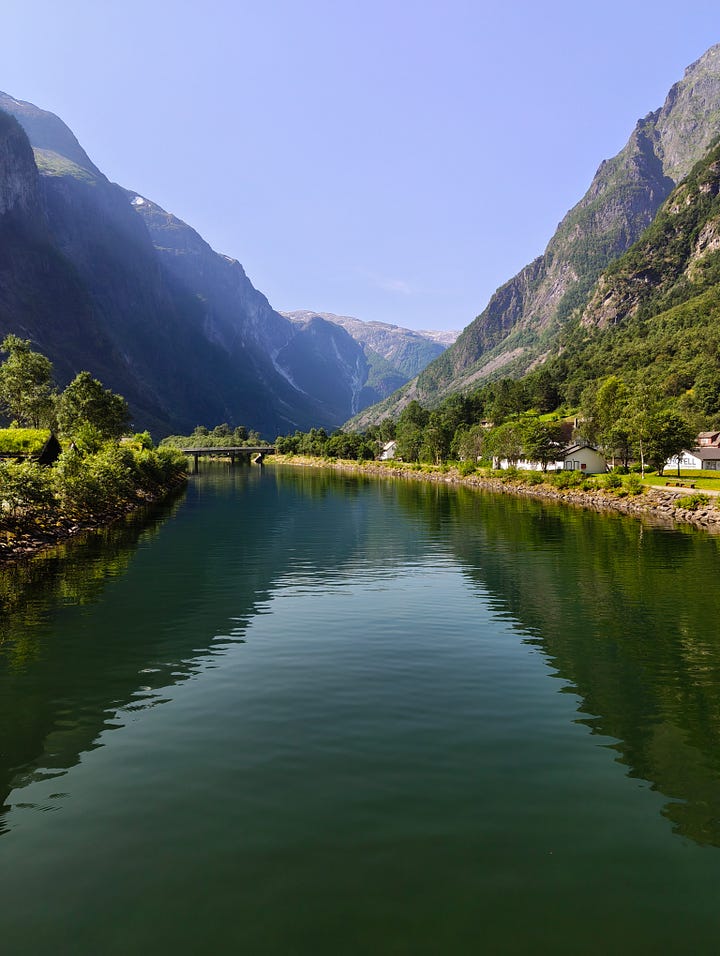
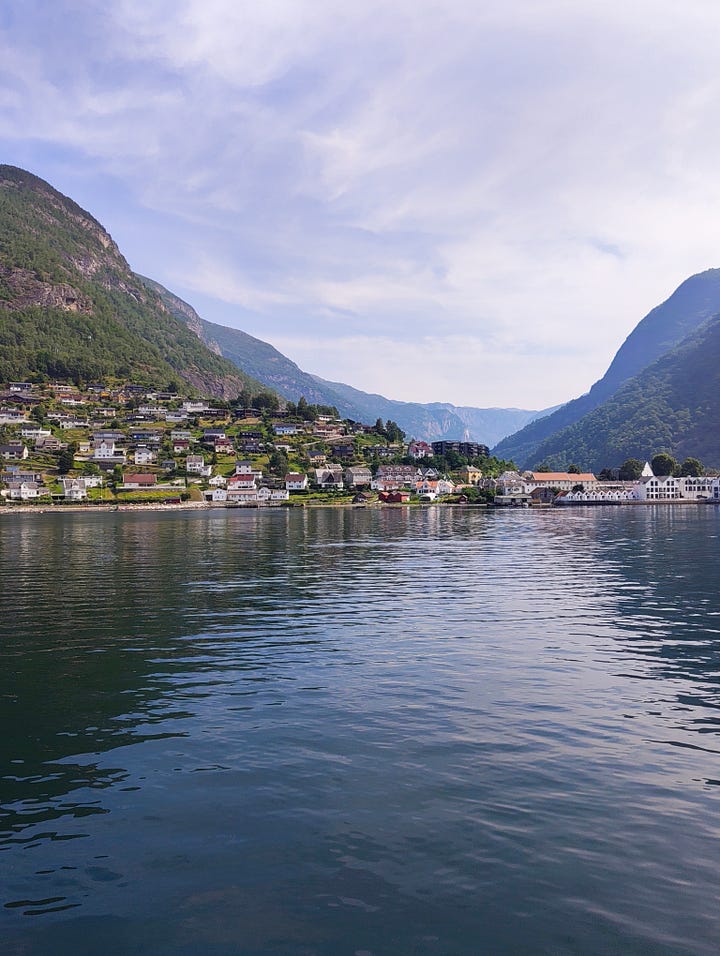
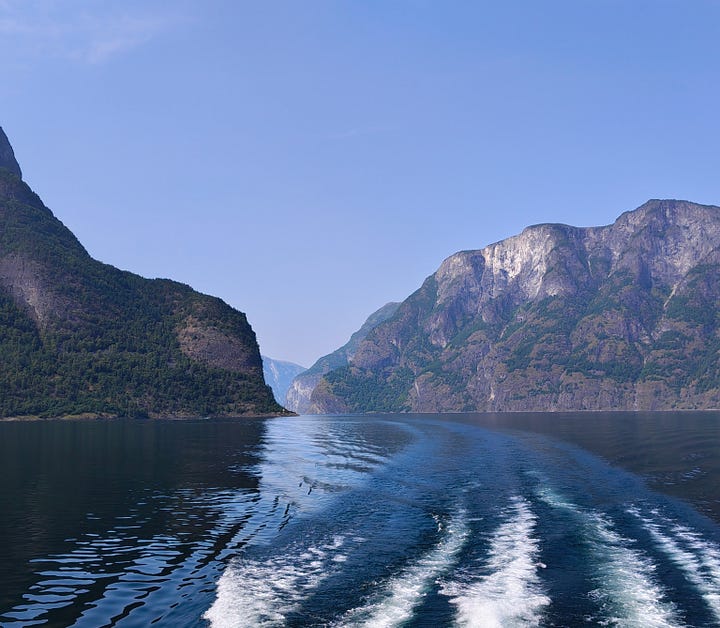
As our boat glides towards the pier at Flåm, a tiny village deep in the Norwegian fjords, I swivel on the deck to take it all in. On both sides of us, wooded slopes rise from the water’s edge to block out great chunks of the sky. For long parts of the year these hills are dusted with snow, the sugar-coated pines resembling a Christmas postcard. Now, in peak summer, the cliffs wear a mantle of many greens — the grass, the leaves, the scrub, all flaunting a different shade. The water reflects this greenness, turning it a touch darker. Behind us, there is a trail of white froth and ice-blue ripples marking the path our boat has travelled. It is a bright day — too bright, to be honest, the midday Scandinavian sun is brutal — and the cirrus clouds are wispy brushstrokes high above us.
I am craning my neck, in ways I will later regret, to memorise this panorama when I hear a woman tut. She looks South Asian and my hunch is confirmed when she speaks to her companion in Hindi.
‘Yahaan kya special hai?’ she says with a grimace. ‘Kyun aaye hum yahaan? Aise hi faltu ka hype banaya rakha hai.’1
The man she is addressing, perhaps her husband who is guilty of booking this trip, avoids her eyes and bears her complaints with stoic silence. Since I am not bound by the vows of matrimony that stay his tongue, I can express my outrage. I turn to Simran, who is trying to hide a smile.
‘Is she blind?’ I exclaim, in a voice that I hope will carry. ‘Does she genuinely believe all this’ — I wave my agitated arms — ‘this incredible setting is “faltu ka hype”? What was she expecting to see during a cruise in the UNESCO World Heritage fjords? Shopping malls!?’
The woman doesn’t seem to hear me and I am, of course, too much of a coward to confront her. Instead, I mutter curses as we step onto the gangplank and glare at the back of her head until a crowd of tourists swallows her and carries her out of sight.
Later, when my rage subsides, I wonder why the woman was left so cold by a place so scenic. She is unlikely to have encountered more picturesque landscape, atleast not without the aid of mind-expanding substances, so it couldn’t have been a case of her being underwhelmed by the fjords. I suspect her disappointment resulted from a more fundamental failure: an omission to examine her desire to travel.
Travel can offer varying types of experiences, and what impresses one person may cause another to only shrug. I am a reasonable man, and so I understand that the spectacular vistas I find breathtaking may hold no appeal for dimwits who listen to Yo Yo Honey Singh. It is all a matter of individual taste and preference. This is why it is important to think about one’s own expectations from a trip, and to ascertain what one wants from a vacation. If you aren’t clear-eyed about the things that motivate you to travel, you cannot design an itinerary that is best suited to you.
Realising this has made me more intentional when planning trips. I have also become more wary of ‘must-see attractions’ all tourists are urged to visit since my ambiguous experiences in Japan. (You can read about it here and here.) Eavesdropping on that lady may not have been great for my blood pressure, but it did surface a query I spend a lot of time turning over in my head: Why do I like to travel?
At the same time that we are anxious to explore and learn all things, we require that all things be mysterious and unexplorable.
— Henry David Thoreau
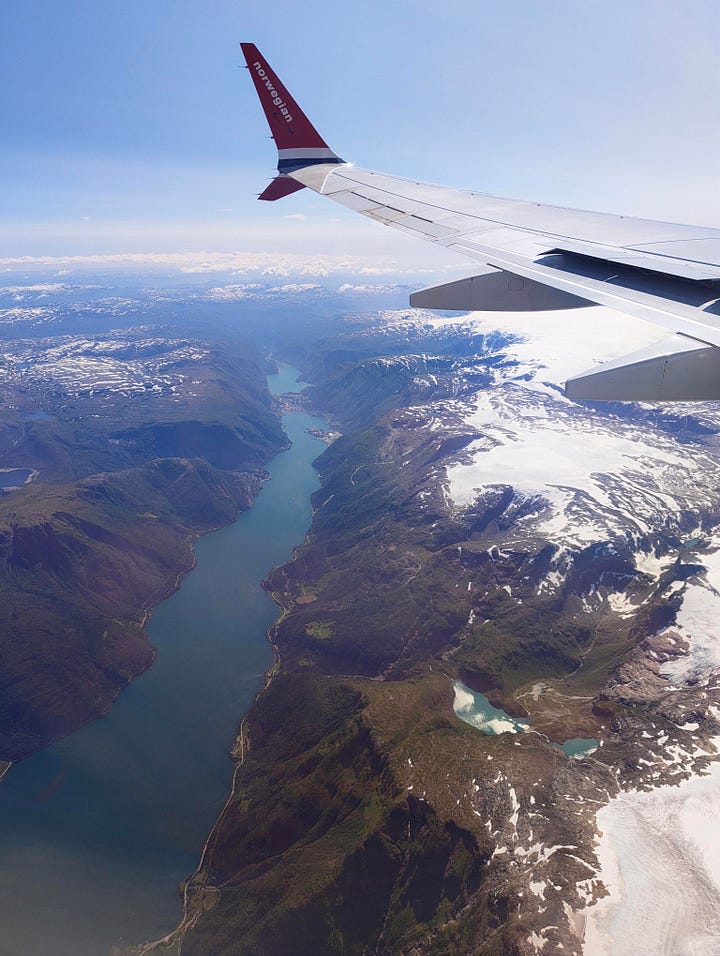
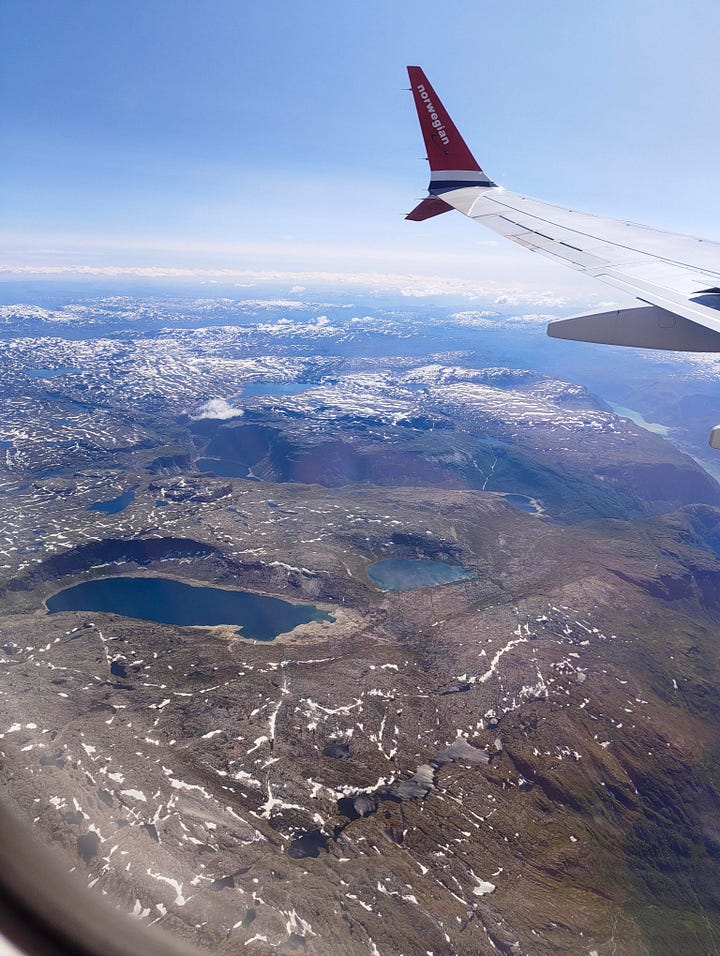
My love for travel is grounded in a longing to see more of the world, especially the natural wonders of our planet. A trip to Norway in July ruled out the possibility of seeing the aurora borealis, the mesmeric northern lights that appear in the Arctic sky during winter. But I was keen to sample the other geographical quirk that dominated fridge magnets in this country: the fjords. I had read about fjords being ‘long, narrow inlets [of water] with steep sides… formed through glaciers deepening existing valleys’. This description, however, had not prepared me for my first sighting of them, from the window of an airplane.
The flight from Oslo to Bergen takes less than an hour, which is probably why the aircraft skims close to the ground. Other than some scattered clouds, the land below remains in view as you coast over it; and my god what a view it is. The fjords become visible soon after you leave the runway in Oslo. Initially, they appear as pockmarks on the earth, little pools glittering in the sun like coins that have spilled out of an overfull purse. As the plane heads west, they widen into thick fingers cleaving the terrain, almost riverine. Low hills begin to appear. In places, the rockfaces are streaked with snow, long slashes of white on a canvas of green and grey in the manner of a Jackson Pollock painting. By the time you descend towards Bergen, the sea and land have swapped places. Small islands now lie as smudgy dots in a wide expanse of blue.
(Just to be clear, the plane does not keep descending to plunge into the ocean, and I am not writing to you from beyond the grave. It does land on solid ground in Bergen.)
Views of snowcapped mountains feature high on my list of ideal travel experiences, but I am not wedded to the wilderness. I enjoy exploring cities too, particularly when they look as if they’ve been 3D-printed out of a picture book. In Oslo and Bergen, there were entire neighbourhoods that seemed too pristine to contain people. For one thing, there was no sound. There never is any sound in European cities. Over twelve days in Norway and Denmark, I noted two instances of honking. Two short, seemingly apologetic, notes of protest. Earlier today, I nearly ran into a van that jumped a red light at Khar, and then the two of us composed a passionate duet of screamed obscenities and long-pressed horns, until the honking of the vehicles behind us drowned out our music. And this was within fifteen minutes of leaving my home.
The silence was not the only bit that was striking. The streets were clean. The public parks were immaculate. There were quaint cobbled paths everywhere (which are, admittedly, a bloody pain when you’re dragging your suitcase to a hotel). And most houses looked like confectionery items you could stick a fork in to gouge out a frosting-filled bite. I have rarely felt the urge to sink my teeth into a building as much as in the past week.
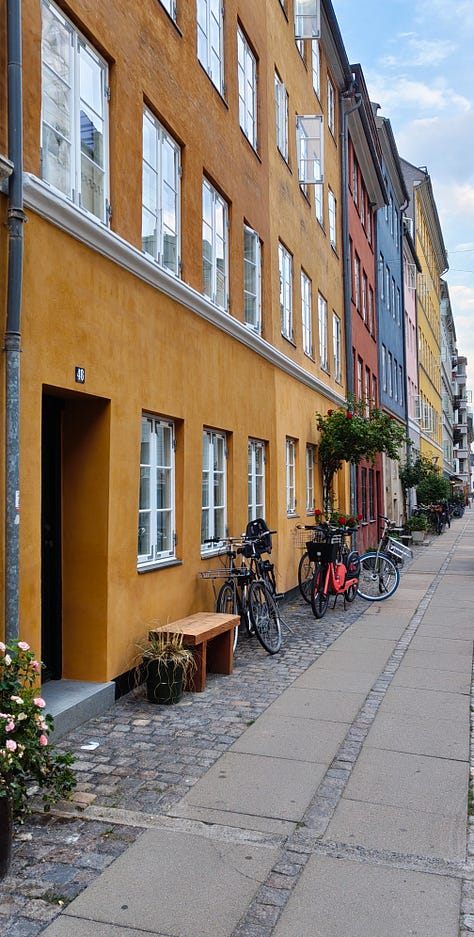
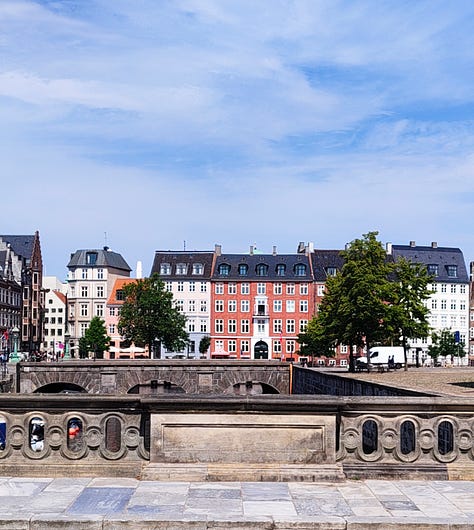
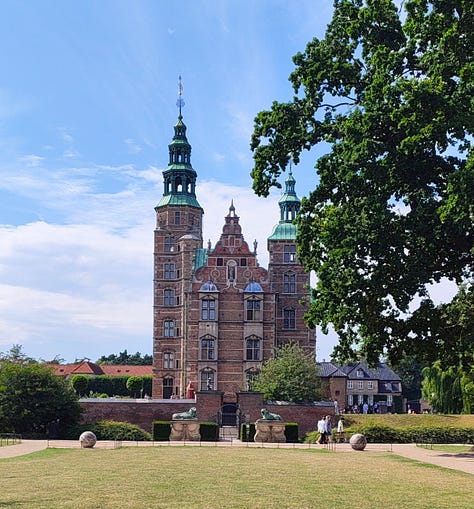
The architectural aesthetic of a city can also reveal aspects of its history and character. The old quarters of Oslo bear testament to the centuries Norway spent under Danish rule. The famous steeple-roofed facade of the wharf in Bergen (Bryggen) was built by German traders and stands as a symbol of the city’s multiculturalism. And the cycling paths of Copenhagen exist to remind us of the Dark Ages, when life was precarious and you could be ambushed any moment by speeding bikes.
Cyclists infest every corner of Copenhagen, hurtling about its thoroughfares like angels of Death. I suppose they were humans once, but chronic pedalling has hollowed them, leaving empty husks wearing those ridiculous helmets. They wait for no one and are forever in a rush. As in most first-world cities, in Copenhagen, too, pedestrians have right of way.2 This means you can step onto the road (at designated spots) and oncoming cars will stop to let you cross. But if you try this in the cycling lane, you will be lying on the ground with tread marks on your face.
My theory is that modern-day Scandinavians tend to be courteous and peaceable, until they mount a bike. Once they start pedalling, the old Viking instincts emerge.
I am a bit of a history buff, so I had set aside an afternoon to visit the National Museum in Oslo (Nasjonalmuseet). I had expected Viking artefacts and Edvard Munch paintings — but what I got, instead, was exhibit after exhibit of chairs. No, no, that was not a typo. You read it right the first time. Chairs. Sometimes with four legs, often three, occassionally two. Dozens and dozens of chairs with varied morphology. I walked from one room to the next, marvelling at the ingenuity, and doggedness, of the Norwegians. Here was a race that had dedicated itself to crafting the perfect piece of furniture, and proudly demonstrating it to the world. So immersed were they in this pursuit that at some point they stopped caring whether the über-chair they were designing even looked like a chair any more. I mean, what else could explain them coming up with the Ekstrem Chair:

With so many chairs to display, the Nasjonalmuseet had little space left for Viking history. I thought I’d have better luck at Copenhagen, but I was wrong. Apart from one, somewhat creepy, exhibition about a Viking-age sorceress, the National Museum at Copenhagen was also quite light on Viking memorabilia. It was on the last day of our trip, when we visited Roskilde, that we unearthed the reason for this mysterious paucity.
Roskilde is a quiet, suburban district, a thirty-minute train ride from Copenhagen. A museum on its seafront houses the remains of five Viking ships that are a thousand years old. Archeologists worked for decades to excavate the wrecks from the seabed and reconstruct them for public display. It is a remarkable initiative, and standing at an arm’s length from millennia-old vessels offers a rare perspective of history. It was at this museum that we learnt how few Viking artefacts have survived, and how the term ‘Viking’ itself is debated by historians. Even the totems of viking-hood you find in popular media — like the horned helmets — have no basis in archeological fact. I think that’s a shame. Adding horns to the helmets of modern-day cyclists would certainly suit those devils.3
Jizō, he explained, was the patron saint of children and travellers (very apt, I thought, since every child is a born adventurer and every traveller a born-again child).
— Peter Matthiessen
Countrysides and cities exert a pull on me, no doubt, but I also value travel as an opportunity to encounter new cultures and people. You can, of course, meet interesting folk in the place where you live. But travelling expands the set of characters you meet, it widens the surface area of serendipity.
If I had not travelled to Norway, for instance, I would never have seen Oslo turn red as football fans flooded its streets and city plazas became party hubs. I would not have learnt the Haaland, Haaland song. (To be fair, Simran would also not have discovered the ‘Alt for Norge!’ playlist on Spotify, which, in retrospect, would have been a blessing.) I would not have stood in the rain with thousands of Norwegians to enter a fan park, would’ve never lent my voice to the roar when their team scored or feel the anguish when a goal was disallowed. And I would certainly not have heard boisterous Argentinian chants in a train on the outskirts of Bergen.
It was the day of the World Cup semifinal. Argentina were due to play England at 9PM local time, and our train was running late. A few minutes before kickoff, the family of nine — most of them clad in white-and-blue jerseys — started singing and waving plastic flags, much to the bemusement of the other passengers. I saw them whip out an iPad and search for a livestream.
Regular readers will know I am incapable of talking to strangers.4 On a normal evening, I would have noted the antics of this exuberant group from a distance and never dreamed of approaching them. But this was a momentous occasion. If they had access to the telecast, I had to step out of my comfort zone. I walked up to them and asked if I could watch the match with them. The matriarch, who was the only one with a bit of English, asked me which team I was rooting for. In that company, there was only one answer to this. ‘Messi!’ I responded, adding with a touch of panic, ‘I love Messi!’ This satisfied her, though the rest of them paid me no heed. They were too busy trying to find the right streaming channel.
The match began, but we could barely follow the action. The train kept diving into tunnels, and the consequent loss of network would trigger a flurry of Spanish expletives. During the brief moments when the screen lit up, all of us would lean in. It took very little to charge this gang. A simple horizontal pass was cheered, and a tackle induced a war cry. Once, the camera panned to the stands and the young girl next to me shrieked: ‘Fuck you, Louis Tomlinson! FUCK YOU!’ It was the only time I heard her speaking in English.
By the time our train rolled into the station, the stream had shut down. Not that this diminished their enthusiasm. They had started chanting again, at an even louder volume. I mumbled my thanks and wished them luck before returning to my seat. Part of the lure of travelling is visiting places that you know will leave you awestruck. But the other attraction of travel, perhaps one that is even sweeter, is stumbling into experiences you could never have anticipated and which you will never forget.
‘What is so special here? Why did we come all this way? This place is overhyped.’
Let me amend my statement. Pedestrians have right of way in India, too. As do cows, and dogs. In fact, all manner of creatures and vehicles have right of way on Indian roads because we do whatever the fuck we want.
The Scandinavians excel at preserving famous ships. If you are ever in Oslo, I urge you to visit the Fram Museum. The museum is built around the Fram, a 19th-century ship that sailed to both poles and was an engineering marvel. You can walk on the deck and visit the crew quarters that were once occupied by members of Roald Amundsen’s South Pole expedition. (Be warned, it gets claustrophobic.)
Comments
Nothing yet. Say the first thing.
Sign in to join the conversation.