
Every few weeks, as we heat our dinner in the microwave, Simran and I are confronted with a problem that plagues all modern-day marriages.
‘What do you want to watch?’ she asks.
‘Oh man, not this again. We finished that last show already? Dammit.’
‘Yeah.’
‘Should we do a rerun of The Office?’ I suggest, trying to find a pristine patch on my plate to stow the rotis.
I hate it when different food items begin to mingle on a dish. Curries and dal go in separate bowls, obviously. But you’d expect a dry aloo gobi to maintain decorum and keep to its corner when sharing plate space with chicken kebabs. Far too often, however, a watery discharge seeps out of the sabzi, extending to the left and right like outstretched arms eager to embrace all comers. The roti becomes soggy and the kebabs turn damp. It’s disgusting.
‘Just take a side plate for the rotis,’ Simran says, rolling her eyes. ‘And no, not The Office. How about a movie?’
‘Now?! At eight-thirty? We will have to stay up way past our bedtime. Not a chance in hell.’
‘That’s true. But let’s watch a movie tomorrow. We can start early.’
‘Do you have one in mind?’
‘Yes. Annabelle.’
I purse my lips. Simran has a sly smile on her face but I am not so easily baited. I know I must pick my next words with care.
‘Is that the one with the haunted doll?’ I ask, nonchalance personified.
‘Correct.’
‘I thought you didn’t care for movies of that sort.’
‘Oh, I like horror films a lot,’ she says, with a wide grin. ‘You are the one who is scare…’
‘Listen, woman!’ I did not mean to squeak but a man can only take so much. ‘I have told you this a million times. I am NOT scared of horror films. I just don’t enjoy them. There is a massive difference.’
My baleful look is lost on her because Simran has her back to me, with elbows out and hands on her waist. She flaps her arms and embellishes the act with pitch-perfect vocals.
‘Cluck! Cluck! Chicken! Chicken!’
As the more mature person in the relationship, I choose not to dignify this performance with a response. But what annoys me all the more is knowing Simran would be petrified if she had to watch Annabelle alone. She would never do it. She does not actually like horror movies, not in the way my father does.
One of my earliest memories is of sitting on a small cot with my father, a green knitted quilt drawn all the way up to my eyes, as Evil Dead played on the TV. I must’ve been four, perhaps five, at the time. This was before the era of cable television, so my father would procure video cassettes and plan movie nights for one. I suppose others were welcome to join, but my mother couldn’t be bothered and I was deemed too young. I do not recall why an exception was made for Evil Dead. Maybe my parents had tired of locking me in the bathroom and were experimenting with newer forms of punishment.1
I have long forgotten the plot of the movie and have only a dim memory of some scenes. But I do remember the tightness in my chest as I sat through the full thing, every jump scare making me wonder: ‘This is what grown-ups watch for fun?’
Satellite channels brought a richer bouquet of creepy content to Indian homes a few years later, and my father devoured them all. The Zee Horror Show was a national treasure, as far as he was concerned, until it lost its place to Aahat. The latter show ran an episode, once, about a full-length mirror that was a portal to another dimension. If you made the mistake of looking into it, you were trapped in the mirror-prison while your reflection stepped out and took your place in the real world. After that episode aired, I went days without so much as glancing at any mirror in my vicinity, not even to check on the pimples that would forever be mushrooming on my face.
When it came to chilling title tracks, though, the Zee Horror Show was unmatched. Every time it came on, I would scurry back to my room. ‘Can you please turn that down?’ I’d shout as I opened a comic book. ‘I’m trying to study!’
My father would take this as his cue to increase the volume. Sometimes he would add his own baritone to the eerie choral, managing to sound both spooky and overjoyed. ‘Come, the show is starting,’ he would beckon from the living room, oblivious to my desire to be in a corner of the house that was furthest from the TV.
The diseased minds behind the Zee Horror Show, the Ramsay Brothers, also made a slew of horror movies that ended up on TV channels. The Ramsays were great believers in optimization and making the most of a single script. Why write five screenplays if one could do the job?
And so, every film would feature a tantrik, an abandoned haveli in the wilderness, a group of young people with terrible haircuts, and a watchman who was always one body part short of being fully abled — missing any eye in one instance, or a limb in another. There would be frequent power failures (which, to be fair, was true to life) and thunderstorms. An amawas ki raat would occur at some point in the story. And like clockwork, the monster would appear at the precise moment a woman entered the shower. For heroines in a Ramsay movie, bathing was akin to inviting death.
These films were a bit too campy for my taste but my father lapped them up. His love for the genre was so pure as to make quality irrelevant. It didn’t matter to him whether a movie had been critically acclaimed and won honours, or been cobbled together after a weekend’s shooting in Lonavala. If it claimed to be macabre and terrifying, he would watch it without question. (It is this same logic that now keeps him glued to Aaj Tak, but let us not digress.)
I suspect his love for the supernatural was seeded at an early age when his mother rocked him to sleep with a bedtime yarn, because few people narrated a ghost story with as much relish as my thamma.
My paternal grandfather worked in government, and spent his career travelling to remote corners of Madhya Pradesh. His family would tag along for his long-term postings, but during his shorter field visits he would often be alone. In the twenty-odd years that I knew him, my grandfather couldn’t have spoken more than two dozen words to me. He was a reserved man and, I realise now, I made little effort to know him. But I suppose he was more communicative with his wife because thamma was never short of stories of his adventures.
Thamma was garrulous till the end, capable of long monologues about Western literature, Hindu mythology, and the spiritual traditions. When she hit her groove you couldn’t get a word in and had to inch towards the door before claiming you’d heard someone calling for you. But when she recounted stories of my grandfather’s travels, I was riveted.
She always began these accounts with the declaration that everything she was about to relate was true, that the events had actually occurred; the conviction of this statement always made my spine tingle.
‘This happened in the 1960s,’ she’d begin, ‘when your grandfather went on a tour of the villages in his district. These tours would last for weeks and back then there was no way for us to stay in touch. Many of the places he visited didn’t have electricity or even proper roads. I only learnt about this incident when he returned and told me.
‘One evening, he got delayed at a programme and realised he would not be able to get to the village where he was supposed to spend the night. Your grandfather avoided travelling after sunset, even when he had a driver with him. There was the risk of dacoits on some roads, and his government-issued Ambassador was trusty but old. A puncture in the middle of nowhere could be catastrophic. He’d travelled in the area before and knew there was a dak bungalow a few kilometres away. He decided to make an unscheduled stop there, and leave the next morning.
‘When they drove into the compound, it looked like the bungalow was empty. They called out for a watchman or a caretaker but nobody responded. There were no other houses nearby, not a soul around for miles. It was dark already and they had to choose between forcing the doors of the bungalow open or spending the night in the car. You know your grandfather would never dream of damaging government property, so a sleepless night in the Ambassador seemed inevitable. He was about to suggest this to his driver, when he saw a man hobbling towards them. The man had a stick in his right hand, and held out a kerosene lamp with his left. The brown shawl wrapped around him made him blend into the inky blackness. Only his arm was visible in the feeble glow of the lamp, the flame swinging gently as he came closer. “Hello, sir,” he said, in a soft voice. “I was not told to expect anyone tonight.”
‘The man was standing at a respectful distance and his face was covered by his shawl. He sounded old, though, and the skin on his arm was like the bark of an ancient tree. Your grandfather explained the situation and asked if the man was the caretaker. “I am,” he confirmed in that soft voice, “I have held that post for many years.” Over the next couple of hours, rooms were readied and food was prepared. There was no power. Candles and oil lamps formed little pools of light while the rest of the house was cast in shadow. After dinner, the driver retired to his quarters and the caretaker led your grandfather to the guestroom. “You’ve come here before, haven’t you?” the old man whispered, when they were alone. “I remember you.”
‘“Yes, that’s true….but… I’m sorry, I don’t recognise you.”
‘The old man nodded, as if he expected this answer. “I hope you’ll be comfortable here,” he said, “please call me if you need anything.”
‘“That’s fine, I won’t trouble you any more. Thank you…. And don’t you live in the outhouse? I doubt my voice would reach you all the way there, so I won’t bother.”
‘“Don’t worry. I’ll hear you. Just shout ‘Caretaker’ and I’ll come. Sleep well, sir.”
‘After a fitful night — your grandfather never managed to sleep well in unfamiliar places — he was woken by a knock on the door. It was early but bright already. The sunlight streaming in from the windows made the dust motes dance in the air. When he unlatched the door, the driver rushed in, pale and panting: “Sir! Please come outside. You have to meet someone.” He wouldn’t even let your grandfather change and so, dressed in his nightsuit, he followed the driver out of the bungalow. In the compound, a man stood with his head bowed. “Tell him,” the driver ordered. “Tell sahib everything you told me.”
‘The man, wringing his hands and keeping his eyes on the ground, said, “Sir, I am the caretaker of this dak bungalow. My name is…”
‘“You? But last night, there was someone else here. An old man..”
‘“Yes sir, please let me finish. I am the new caretaker. I was appointed a couple of years ago because the previous caretaker died. He had spent most of his life looking after this bungalow and the guests who would visit. But he got smallpox and did not recover. When I first started, I knew there was something wrong with this place. On many nights, I would hear someone walking around the compound or see a lamp in the distance. When I’d go to investigate, there would be no one there. I was convinced he never left, that old caretaker. His aatma returned here every night. I cannot quit this job but I decided I would not spend any more nights in this haunted place. Hardly anyone comes to this bungalow anyway, and I am usually informed when guests are expected. So, I return to my village every evening and come back in the daytime. I am sorry, sir. But from what your driver said it seems both of you met the old caretaker so you know I am not lying. His aatma will never leave this dak bungalow.”’
The first time masimuni heard this story, she refused to believe it. ‘You’re making this up,’ she said to thamma when the story was over, her eyes very wide. ‘There couldn’t have really been a ghost, no way!’
When I was a child, I had trouble imagining masimuni as my mother’s younger sibling. She was more of an elder sister to me than an aunt — not so much an adult as a playmate. It helped, also, that she shared my distaste for the paranormal.
‘Of course it’s true.’ Thamma was indignant; she never lost a debate in her life. ‘There are things in this world that are beyond our understanding. Let me tell you about this other time…’
Masimuni soon learnt not to question the veracity of these tales, but midway through a story she would turn to me with a morose expression and say, ‘Ajke raat e ar ghum hobe na.’2
Psychologists point to a number of reasons to explain the appeal of horror stories. Part of it is thrill-seeking behaviour and the sense of accomplishment that comes from overcoming a fear. Curiosity about a world beyond our own plays a role, too. And some academics even believe that scary movies can help reduce anxiety. This theory claims that when you watch an unsettling film, your attention is focussed on the dangers playing out on screen. As a result, when the film ends your pent-up stress is released, and you feel like you’ve just stepped out of the spa.
Complete garbage, of course.
There is an obvious and gaping hole in this logic which must be evident to anybody who has watched a horror film: What about the rocketing of stress when you switch off the lights at bedtime?
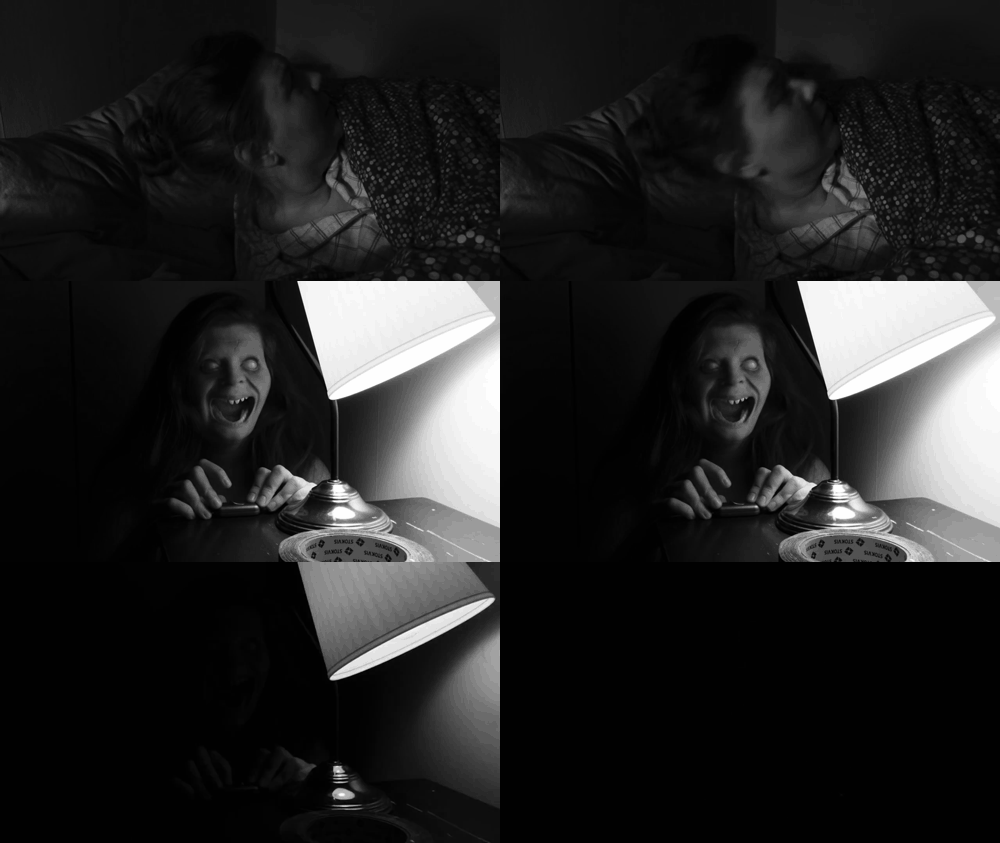
In the mid-1990s, soon after we moved to Kolkata, masimuni lived with us for a time. I did not mind sharing my room with her; in fact, I was glad for the company. As an eight-year-old, I had a reasonable fear of the black hole under my bed and I figured having another person in the room would reduce the chances of demonic incursions. But masimuni alerted me to other risks I had failed to consider.
The room had a large steel trunk, set against the wall across from the bed. It was a battered old thing. Every square inch of the trunk sported a dent and a corner of the lid had caved in. I don’t think it housed anything useful because we rarely opened it. It was covered with a blanket and had become one of those vestigial pieces of furniture we neither use nor throw away. It just lay there, squatting, blocking the entrance to the toilet.
Masimuni was convinced that every night, while we slept, a skeleton came and sat on that steel trunk.
We discussed this problem at great length. Was she sure it was a skeleton, and not a wraith or ghoul of some other sort? She was insistent. ‘I know it in my bones,’ she said. (I didn’t dare ask why she was so certain, and whether she’d caught a glimpse of the creature.) Would keeping the doors and windows locked serve to bar him — or her, far be it from me to misgender anyone — from our room? Unlikely, we concluded. Locked doors meant nothing to apparitions. What if we told my parents and asked them to come up with a solution?
‘They won’t believe us,’ said masimuni with a sad shake of her head, and she was right. My mother laughed away the idea, but also refused to swap rooms with us. Since we were left to deal with this situation, we came up with a protocol: Always sleep facing away from the trunk. Never leave the bed at night. Never open eyes till dawn. This strategy worked and I never saw the skeleton; but it wasn’t easy. There were times when I’d wake up, my bladder fit to burst, and realise it was still dark. I’d snap my eyes shut and lie there, holding it in until the first rays of the sun allowed passage to the loo. Shaolin monks are also known to possess such mastery over their bodies, though perhaps their training impulse is different.
Masimuni moved out a couple of years later and the trunk soon followed. I stopped thinking about the skeleton then because why would it return to my room if it had no place to sit?
The trouble with being a teenager is you don’t realise how bravado leads to self-sabotage. Say, for instance, you’re at a sleepover with your friends and one of them suggests putting on The Exorcist. Perhaps the fellow meant it as a joke, but once the idea is floated you are all locked in a game theory hellscape. Each of you is perturbed by the prospect of watching that ghastly movie in the middle of the night. But nobody wants to veto this proposal and be forever labelled a coward. ‘Sure, I have no problem,’ you say, in turns. ‘Do you have a problem?’
That, more or less, is how we ended up, all six of us huddled on a bed, watching The Exorcist at 2AM.
I had strategically procured a pillow before the movie started, and was thus able to duck behind it when necessary while also using it to muffle my screams. There were a few gasps and cries along the way, but when the film ended we all agreed it is was not all that scary.
‘They say it’s the best horror movie of all time.’
‘Yeah. Apparently, the theatres had ambulances on standby. Because so many people had heart attacks during the shows.’
‘Pfft. I mean, sure, some bits were good. But I think it’s overrated.’
‘Yeah, I don’t know why people are frightened by it.’
‘Listen, will you go the kitchen and get some water?’
‘Me? Why me? Why don’t you go?’
‘Haha.. you’re scared to leave the room or what?’
‘No, I just don’t feel like it. You go if you want water.’
‘Where is the light switch for the corridor and kitchen?’
‘I don’t know. You’ll have to go and find out.’
‘Fine, forget it. I am not that thirsty anyway.’
Two decades on from that screening of The Exorcist, I no longer let my ego lead me astray. I have grown more self-aware, more in touch with who I am. This knowledge allows me to be secure in my skin and not be swayed by how others may perceive me.
It is very freeing, I must tell you. Because now, when people ask if I want to watch a horror movie I do not hesitate to say no. ‘It’s not that I am scared of horror films,’ I clarify. ‘It’s just that I have never enjoyed them.’
Just to be clear, I deserved to be disciplined. As a child, I took great pleasure in spitting at anyone within a two-foot radius.
‘We will not get any sleep tonight.’
Comments
Nothing yet. Say the first thing.
Sign in to join the conversation.