
When I visited Goa for the first time, as part of a family holiday in 2005, an icecream vendor told my mother that while he admired the wanderlust of Bengali tourists, they were too loud for his liking. ‘Why do you people shout so much?’ he asked her. During peak holiday season, he went on to complain, when the tide of vacationers was at its highest, Bangla would ring around the beach like the siren of an ambulance. Were all Bengalis hard of hearing?
My mother and I responded with sheepish smiles for we could hardly refute this allegation. We knew our compatriots had a habit of ratcheting up the volume, and, to be honest, it was something we were often guilty of ourselves. The size of our group had a direct bearing on our decibels. If the travelling party exceeded eight members, earplugs became a necessity for anyone in our vicinity. Conversations were conducted at a level that has now been normalised by TV news anchors, and the laughter triggered by a joke — at the expense of the non-Bengalis in the adjoining seats — would reverberate inside the AC Three Tier coach. But we expressed our true range at mealtimes. We communicated with our companions as if instead of being at the other end of the table they were, in fact, still in Kolkata.
‘CHICKEN KHABI? NA MUTTON?…. DUTOI? BESH…. Ay, waiter, suno, chicken aur mutton mein tum kya khabar banata hai?…. Kya? Sudhu veg?…. SORBONASH KORECHE! ARRE SHON, EKHANE TOH SUDHU VEG PAWA JAY. CHOL, BERO JOLDI. PASER RESTAURANT TA DEKH. KI JALATON!’1
If I met the icecream vendor now, however, I would indulge in a spot of whataboutery. I would point out that the failure to be considerate in public spaces was not a flaw exclusive to my brethren. Last year, when I was in Nara, the screeching of a Gujarati tour guide who was herding a group of daytrippers was as annoying as the gluttonous deer that swarmed the town. (There was no shortage of grass in the parks, so I failed to see why scores of deer kept walking up to me expecting to be fed crackers. Greedy fucks.) The tour guide in question was wielding a megaphone, which meant the grounds of an 8th-century Buddhist temple echoed with high-pitched invocations insisting that members of her group should keep an eye on her flag, and refrain from offering thepla to the deer.2
Before the icecream guy could accuse me of parochialism, I would clarify that the Nara episode was merely an illustration. Some tourists, no matter what their linguistic or regional identity, are prone to being boisterous. While others, belying their national reputation of fastidiousness, can turn out to be slobs — I have it on good authority, for example, that a bunch of Japanese spectators at a FIFA World Cup game in Qatar did not clean up after themselves. They left their empty popcorn buckets and cola cups littered in the aisles, just like we do in movie theatres.
The more I’ve travelled, the more I’ve realised that while it is easy to reach for stereotypes, they rarely hold true for an entire community. Generalisations do us all a disservice, my friend, I would’ve told the chap while he handed me a Cornetto. We should not let hackneyed perceptions colour our interactions with our fellow humans. Sadly, I have been deprived of the opportunity to lecture the man because I’ve never bumped into him again, even though I’ve travelled to Goa close to a dozen times since that first visit in 2005.
Goa is, in some ways, the Puri of the West. Much like a Goa trip is the default option Mumbaikars resort to when a long weekend looms in the calendar, Puri was, during my childhood, a staple of summer holidays.
To those unfamiliar, Puri is a coastal town in Odisha, famous for its beaches and the Jagannath Temple. When I was in school, it was an overnight train ride away from Kolkata, and this proximity no doubt helped establish the law that every respectable Bengali family must plan at least one pilgrimage there every year. There were competing seaside getaways in Bengal — Digha, for example — but the cognoscenti preferred Puri. It held an enduring appeal for middle-class Bengalis, who never seemed to tire of it. A friend of mine must’ve notched up twenty-three family trips before he turned eighteen. Sometimes, their suitcases would have remained unpacked since the last visit, and their slippers would still be trailing sand around the house, when they planned a return.
This obsession was a little perplexing because Puri did not boast of a wealth of distractions. It had a gorgeous beach, yes, that stretched on as far as the eye could see, like an interminable golden avenue. There was the temple, crowded with priests whose faith demanded they lighten the purses of the pious. And there were the Dada Boudi Restaurants, no-frills canteens that served homely food. But that was it. The itinerary, on all our travels, split our time among these three attractions. ‘Surprise me’ was not an expectation we harboured when we travelled to Puri.
In this respect, at least, my experiences in Goa have been different.
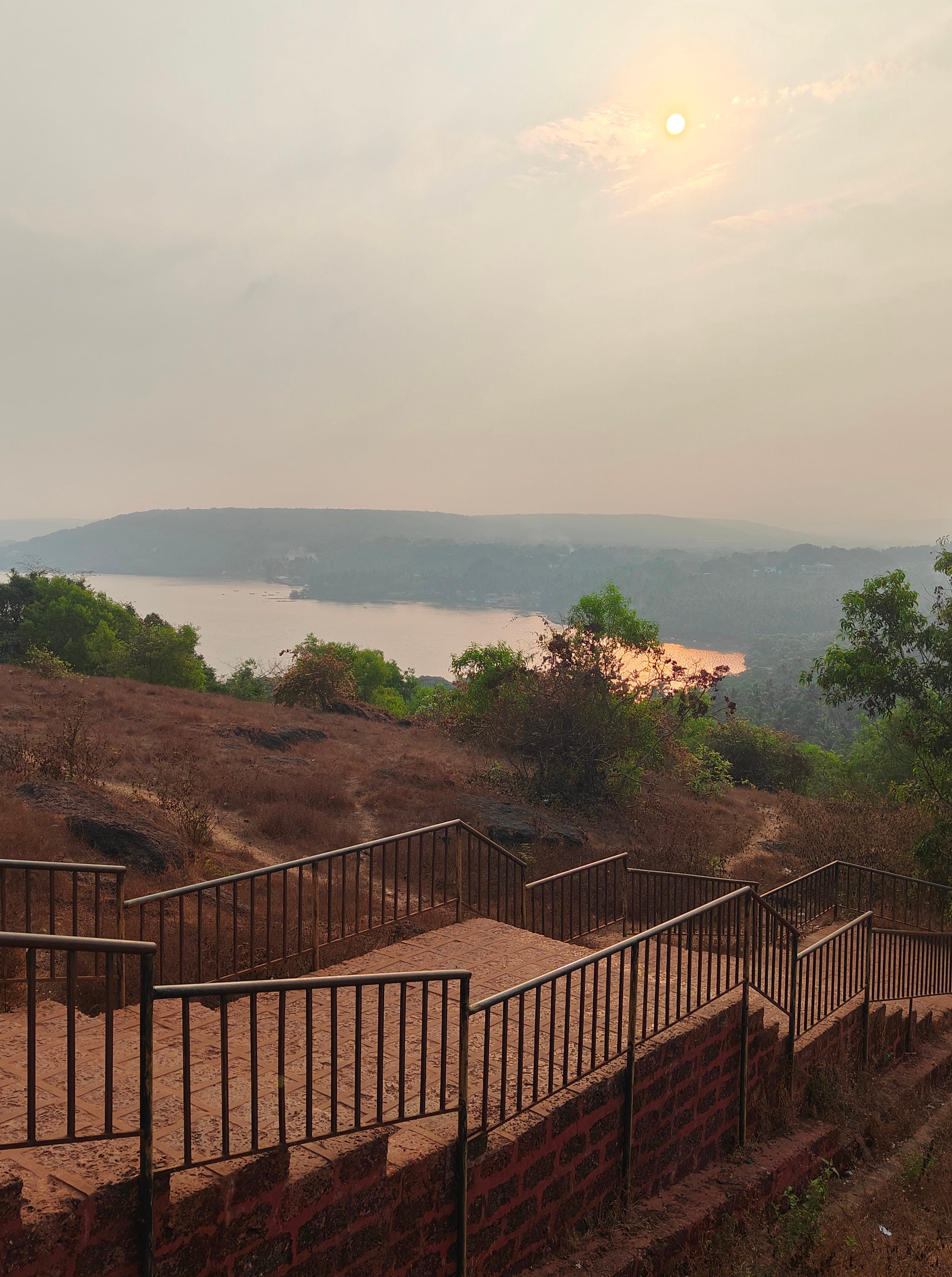
During that first family trip, sightseeing was the priority. We drove from the Basilica of Bom Jesus to the ruins of Fort Agoda. We posed for pictures on the white steps of Our Lady of the Immaculate Conception Church. We took a cruise on the river and bought packets of cashew at Panjim. We even visited the Archaeological Museum, perhaps believing the Goa government would award us a certificate for completing the tourist handbook. (They did not.)
But later, in my 20s, the holidays acquired a different hue. Excursions to Goa became a means of escaping the city. My friends and I would seek refuge in the semi-permanent shacks that lined Goan beaches, desperate to forget the work deadlines and domestic chores that awaited us in Mumbai. There was no plan, no to-do list. We would meander from Baga to Anjuna, from Calungate to Candolim — our only objective being to while away the hours. Lounging on deck chairs, we would watch the sun inch closer to the crimson sea, like a piece of golden-friend prawn being dipped into a vast bowl of red chilli sauce. We did not mind when the servers took forty minutes to hand us our beers. It was not like we had anywhere else to go, except, perhaps, the beach in the next village. Susegad rocks, we would say with a smile, toying with the idea of socialising this philosophy with our bosses upon our return. (We never did, of course. What reasonable person would risk being unemployed?)
This bohemian spirit found expression in our attire, too. Trousers were rarely packed for these weekenders, and I wore sleeveless vests in public far too many times than I’d care to admit. There was also one memorable instance when we tried entering a casino in flip-flops and found our way barred. Shoes only, read a sign at the entrance. We were, obviously, outraged. This was Goa! If there was one place in this country where our toes had the right to be free, to wriggle without restriction, it was here! We couldn’t let some despots rob us of our liberty! Fuelled by righteous rage, we were registering our protest when a couple of bouncers stepped forward and we decided that maybe nipping across the street to buy some shoes was not such a bother after all. As it turned out, the shoes were the best investment we made that night, and they cost us a great deal less than a few rounds at the Blackjack table.
In recent years, the tone of my Goa excursions has altered once more — inevitably so, I suppose, since Goa itself has undergone so much change. Parts of it are barely recognizable from a decade ago. Brand new airports sprawl over acres and six-lane highways cleave through the hills. In many places, the pristine roads are flanked by rockfaces that bear the tell-tale striations of an excavator’s claw, fingernail marks left by development’s hand. Marketplaces are bathed in a neon glow that makes you squint at night-time. And in the space between two breaths, as you drive along a road in Assagao, you cross a restaurant, a boutique resort, and an artisanal store. It is hard to imagine a more bourgeoisie enclave; and I say this as a resident of Bandra — a locality that, quite literally, has a café called ‘Boojee’.
Perhaps my own actions have contributed to this transformation. During my past few visits, I’ve rarely made my way to the seafront. (When I was in Goa last week, I did plan a run to Chapora beach, but a growling pack of stray dogs sent me scurrying in a different direction. This happens every time I go running in Goa. I keep a sharp eye out for canines as I jog through quaint hamlets, but the buggers still manage to ambush me. They storm out of a thicket or a courtyard, and the ferocity of their barking is matched by the pitch of my yelping. Nowhere else have I been chased by dogs exhibiting such deep indignation. Goan mutts really hate runners. I guess they take the susegad culture very seriously.)
Instead of shack visits and beach jaunts, a trip to Goa now features an endless array of fine-dining restaurants. Sampling Goan, and global, cuisine is top of the agenda, punctuated by coffee breaks at chic cafés that serve manual brews. Over breakfast, we scan the list of restaurants recommended by Condé Nast Traveller to make a reservation for lunch. In the afternoon, we look up the best sundowner spots within driving distance. And when we feel weary, we spend the evening in our Airbnb villa and summon the familiar food delivery and q-commerce apps to bring what we need to our doorstep.
In the book Sun After Dark, one of my favourite writers, Pico Iyer, noted:
This is, I think, part of the impulse that moves many a traveler - the chance to confront the questions and challenges that he would never see at home…
…We travel, some of us, to slip through the curtain of the ordinary, and into the presence of whatever lies just outside our apprehension.
But when I travel to Goa now, I see what I have grown accustomed to at home. I remain, quite firmly, on the same side of the curtain of the ordinary, visiting the same spaces, with the same aesthetic, that I frequent when I’m in Mumbai. Even the people in these cafés and restaurants look like folks I’d encounter in any urban milieu: wearing clothes that hang in my wardrobe and speaking in an idiom I recognize as my own. In Goa, they drive rented cars and get lost when Google Maps glitches — like I do — and refuse to remove their sunglasses even when indoors — a crime that I, too, commit.
When I imagined that conversation with the icecream vendor, I was not being disingenuous. I do believe that travel can make you unlearn stereotypes and reshape the image you hold in your head of all that is foreign. It can also, as Pico Iyer suggests, help you discover new facets of yourself, to understand who you are once you’ve slipped through the curtain of the ordinary. But not always. As my recent trips to Goa have revealed, travel can, on occasions, just leave you feeling like a cliché.
‘WILL YOU EAT CHICKEN? OR MUTTON?…. BOTH? EXCELLENT…. Ay, waiter, what dishes do you have in chicken and mutton?…. What? Only veg?…. DAMNATIONS! LISTEN, THEY ONLY SERVE VEG FOOD HERE. LET’S LEAVE QUICKLY. CHECK THE RESTAURANT NEXT DOOR. WHAT A BOTHER!’
It is possible I misunderstood the last bit. My Gujarati isn’t all that great.
Comments
Nothing yet. Say the first thing.
Sign in to join the conversation.