
It’s not often politicians will use jargon that the average person will have trouble immediately grasping. That didn’t seem to bother Canadian Prime Minister Mark Carney during his speech at the 2026 WEF in Davos, Switzerland. Carney opted for a posture of defiance, forgoing the usual decorum world leaders show in public, by naming what most of us already know: the fall of the American empire is nigh.
He didn’t say those precise words, instead Carney used the term, “American hegemony”, calling it a fable, useful for a time, and a bargain that no longer serves world order.
he·gem·o·ny
/həˈjemənē,ˈhejəˌmōnē/
noun: hegemony; plural noun: hegemonies
leadership or dominance, especially by one country or social group over others.
World leaders avoid antagonizing super-powers like America because of the potential economic ramifications (or being invaded). Yet when economic ties are severed (or severing), naming the “gaps between rhetoric and reality”, as Carney did in his speech, is noteworthy. In front of media, diplomats, pundits, and other heads of state—and underneath the gloom of US antagonism over Greenland—the PM met the watershed moment head-on. His speech had immediate impact.
In Canada, intense national pride swelled; a country under economic attack since the Trump Tariffs began. Some political commentators, like Chantal Hébert, suggested it was one of the most important international moments delivered by a Canadian PM ever, and the most important since WWII.
Notably, Canadian news outlets, alongside media across the globe, latched on to the shift in rhetoric. A head of state was pushing past “rules-based international order”, citing growing American antagonism globally, while simultaneously offering a new alternative.
In the realm of international relations it’s astounding how quickly nations are pivoting away from American hegemony. A costly but necessary shift given unhinged behaviours spewing from the White House. The utterly disastrous Trump administration—alongside tacit Republican approval and utter Democratic Party incompetence—has catalyzed the world to decenter America before it destroys itself. From senseless policies, legitimate sovereignty threats, destabilization tactics, random illegal tariffs, orchestrated wars, all demonstrate the current American posture. Policies indicative of an incompetent government desperately trying to secure the last vestiges of power as their status at the forefront of global politics erodes.
Carney likely predicted the shift and met the moment with a re-frame of global economic order that divests from American hegemony towards something new.
“…if great powers abandon even the pretence of rules and values for the unhindered pursuit of their power and interests, the gains from “transactionalism” become harder to replicate. Hegemons cannot continually monetize their relationships.
Allies will diversify to hedge against uncertainty. Buy insurance. Increase options. This rebuilds sovereignty – sovereignty that was once grounded in rules, but will be increasingly anchored in the ability to withstand pressure.
…such classic risk management comes at a price, but that cost of strategic autonomy, of sovereignty, can also be shared. Collective investments in resilience are cheaper than everyone building their own fortress….
The question for middle powers, like Canada, is not whether to adapt to this new reality. We must. The question is whether we adapt by simply building higher walls – or whether we can do something more ambitious.
…we aim to be principled and pragmatic.”
Unsurprisingly, most of the opining about the ‘old’ order has to do with economies—in other words money. It’s always about money. Money, money, money. Money with a side of militarism if you’re the US, particularly poignant if you live in Iran, Canada, Greenland, Venezuela, Gaza, Ecuador, the list goes on….
Carney names the economic failures but falls short of any form of lament or introspection regarding hegemony. Rather, his focus lands squarely on securing new economic mechanisms so Canada, alongside other “middle powers”, may build on top of the American rubble. (I suppose it was the World Economic Forum….) He used phrases like “Variable geometry,” a fancy way of saying, trade with any nation based on need. A stark contrast from the old norm: filtering trade deals with American approval.
If Carney sounds pragmatic it’s because he’s delivering to the role of Prime Minister to ensure safety and economic prosperity for the nation. This is the primary reason, alongside standing up to the US, why many Canadians swooned. But there’s a significant disconnect: how can we laud Carney’s re-frame of global finances while ignoring the manner said economies operate within inherently exploitative capitalist systems?
This was the first question that gave me pause while analyzing the speech (and subsequent policies). How do I hold the tension between cheering on Carney’s bold positioning for Canadian sovereignty, a nation under threat from Trump’s fascist regime, with the reality his proposal is rooted in systemic inequalities (capitalism)?
That leads to another question, Can we embrace participating in one hegemonic structure whilst ignoring another?
This is a real tension because threats emanating from America are materializing into serious consequences for ordinary citizens. How do we hold these intersections amidst tangible threats?
The US military kidnapped Venezuelan president Nicolás Maduro in January 2026. (This does not include the extrajudicial killings on fishermen ‘drugdealers’ in Venezuelan waters months before.) The purpose was purely about…have a guess…money. In this case oil money. Unsurprisingly, within a week of the kidnapping, the US seized an oil tanker, and somehow that oil was sold for hundreds of millions of dollars, profits now parked in a private (Trump) bank account in Qatar. A type of corruption only dictators manage to pull off.
Trump on Greenland. Feigning national security reasons, Trump upped the rhetoric to promised action to seize control of the Danish controlled territory. (But really, like Venezuela it’s all about money.) NATO and the EU, caught by surprise by the rapid escalation of Trump’s willingness to put more US troops on Greenland, was going down in real-time during WEF, Davos. The EU has committed to economic divestment from American goods in response.
US led bombings in Africa (Somalia, Iran, Yemen) and the continued support of the genocidal campaign in Gaza by Israel. And let’s not forget the millions who are at risk or dead because Trump’s Republicans (and Elon Musk) cut funding to USAID. Let’s loop in America’s complete abdication from international aid here too.
The ‘annexation’ rhetoric for Canada to become the 51st State. Facing American tariffs almost since Day 1 (tariffs are paid by Americans), Canadians have responded by overwhelmingly boycotting American products, obliterating US tourism and export demand. (Don’t get me started on Republican interference funneling money to hapless separatist losers in Alberta.)
[Addition since writing the bulk of this essay.] Most recently, the disastrous war with Iran. America replicated their Venezuelan action by killing rather than kidnapping the Ayatollah at the behest of Israel and Trump’s specific need to distract…. Trump is even consider reinstating the draft to accomplish his ‘boots on the ground’ mission which would end in total and complete disaster for America.
Combining incompetence alongside malformed hegemonic forces exacerbated by Republican blood-lust is a recipe for disaster. And disaster is coming, albeit slowly because not enough American legislators are willing to topple the fascist regime. It’s an incredulous reality perpetuated by a white supremacist and wealthy class seeking to pilfer the public purse for their own material gain. It’s for this reason why even the damning proofs in the redacted Epstein files have yet to land Trump and Co. in prison.
Trump’s motivations are always self-serving. He seeks to personally enrich himself by any means and has been extremely successful because Republicans are fully committed to the grift so long as their cult of ideas gain traction too.
But then there’s the Epstein files.
We already know Trump is a felon. We know he’s a rapist. Americans had access to earlier court docs outlining Trump’s pedophilia prior the 2016 election. Then in early 2026, the Department of Justice (USA) finally released a slew of carelessly redacted versions of the Epstein files, and despite attempts to obfuscate, wound up implicating Trump and the ‘Epstein class’ of billionaires.
We also know the files are connected to a larger complex network of intelligence gathering (arguably connecting Trump to Russia and Epstein to Israel), operating as a ‘honeypot’ capturing rich white billionaires looking fulfill depraved sexual fantasies with children. Is Trump in trouble at home? Nope. His supporters are unbothered.
So-called ‘Christian’ conservatives, overwhelming proponents of the Trump-cult, have churned the excuse machine to condone the pedophilia. Turns out a religious culture that embraces authoritarian leadership and grooming children cares little about pedophilia so long as their man is in office. Sex trafficking minors is simply not enough to alter unmitigated support and the prospect of power Republican lawmakers promise to share with conservative Christians.
Power is also the apt word here. Power is what hegemons seek to accumulate and preserve. It explains why conservative voters are uninterested in demanding immediate resignations, jail, ending wars, or impeaching the president and his grossly under-qualified Cabinet. Their sights are set on preserving hegemony. In other words, these voters are not changing their minds because the prospects of money and power outweigh the consequences (especially when someone else takes the fall).
Dominance, money, illegals, abuse, war, rape, white power, are the keywords that activate Trump supporters to align themselves with incredulous policies and war. In turn, rape, misogyny, pedophilia, embezzlement, etc., become features in the Republican propaganda machine. It’s how hegemons work; amassing malformed power for material and carnal benefit.
So it took guts for Carney to confront American hegemony on the world stage. A risky move given the level of damage the president can inflict in a single late night social media tirade.
The USA, probably Russia (cause of the nukes and not the economy), and China fall into the global ‘super power’ status, although the USA probably thinks they’re in that category on their own (maybe they are). A global super-power that has adopted postures of predatory behaviours mimicking their Commander in Chief.
The next ‘tier’ of powers include: UK, France, Germany, and perhaps Japan. Along with the G20, these are the “middle powers” Carney refers to in his speech.
But here’s the thing: Who has power depends on location.
Naming the ‘Big Bad American Wolf’ lumbering aimlessly through the woods as a hegemon applies in relation to nation states. Oftentimes, policy decisions at a national level are not immediately discernible on our day-to-day lives. This quickly shifts when governments stray from—well—governance and instead destabilize democracies to amass power. A 50% increase in oil prices, and subsequently gas prices, is one simple example of stupid policy impacting everyone. That’s merely a recent example, the accumulating impacts are far worse.
American hegemony is reliant on the insatiable appetite for war. A brand of militarism that never ceases and is even applied domestically. After all, if you don’t have wars to fight, who do you use all of the equipment on? Create a new military wing in the government and deploy them to the cities. Trump is happily using militaristic intervention to attack US citizens in Democratic controlled states (see ICE vs. Minnesota, et al.).
So there is a straight line between American hegemony and its nefarious impact on ordinary citizens in the US. A similar connection can obviously be made internationally too.
From Iran, Ukraine, Venezuela, Canada to a certain extent, all are experiencing violent outbursts from American hegemony seeking to destroy dissent and assert dominance for the sake of material gain.
I worry about this reality because it is so real. I have friends living in neighbourhoods where ICE is roaming and kidnapping. I live in Alberta where Republican elites are funding and stoking the so-called ‘Alberta Separatist’ movement. [And I’m not even broaching the lingering possibility that American troops will spill over the world’s longest undefended border to take Alberta’s rich energy reserves. (Should I be buying bullets?)] I have friends with family in Iran, friends from Ukraine, all experiencing visceral and material encounters with hegemonic power beyond scrolling screens.
And it’s within this context of destabilization I had a moment, along with so many other Canadians, of intense national pride when Prime Minister Carney commanded the world stage affirming Canadian sovereignty, positioning us as world leaders, and simultaneously putting America in its place. It’s a good pride to have in light of events at home and abroad.
I have on occasion used the term hegemony in reference to malformed power structures be it the institutional church, unbridled capitalism, white supremacy, etc. These are the hegemonies I’m familiar with and ones that impact my day-to-day. So when Carney used the term to decry American hegemony, we must also name how incongruent that is coming from the Prime Minister of a colonial nation.
Be it nations, big business, established institutions, banks, all operate with seeming impunity preserving power and wealth because that’s what they’re designed to do. They cannot be any other way. It doesn’t matter which country they are from. [Although, it must be noted countries with functioning legislative branches do better at protecting the rights of citizens/consumers.] Herein lies a reveal.
In regions where conservative (which increasingly means fascist) governments rule, the theme is: steal from the public purse for private gain and erode basic democratic rights. The latter occurs through election fraud; gerrymandering; ending freedoms, rule of law, and open inquiry; cancelling elections entirely; and gold ol fashion propaganda. Carney rejects these extremes (now norms) and is lauded. But the bar doesn’t have to be so low.
The PM on one hand can be celebrated over his statesmanship and business acumen. But he’s also trampling over Indigenous rights, expanding energy projects at speed, has no climate plan, has ‘tough on crime’ legislation waiting in the wings…. A true Red Tory…I mean Liberal.
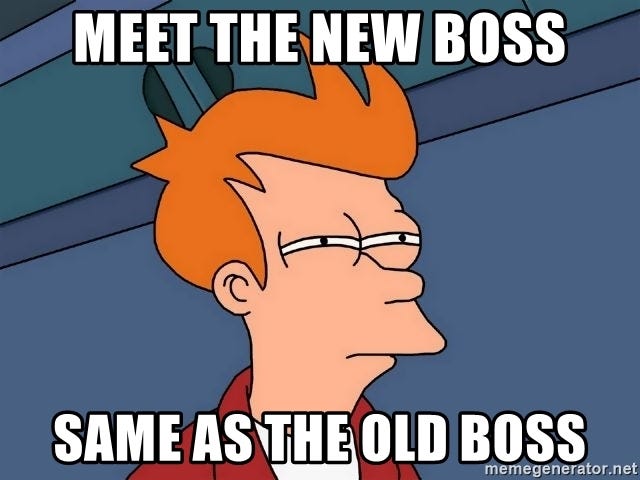
In reality, hegemonies are intersectional. One can resist American hegemony on one hand, and be under the rule of Canadian hegemony, or capitalist hegemony, and so forth, simultaneously.
Now if this sounds too ‘woke’ for you remember I wasn’t the one who went to Davos and tossed out the word ‘hegemony’ to begin with. And frankly, our society could use a little more political acumen. In fact, the lack of competency surrounding, say, identifying disinformation is increasing, and at stake is our democracy.
Our democratic rights are eroding in a combination of stupidity coupled with social media algos. Conservatives in particular are easy pickings, a demographic prone to absorbing propaganda that most often winds up being—ironically—against their own best interests (universal healthcare in America anyone?) This reality is weaponized by hegemons, mobilizing voting groups not with good ideas but by stoking outrage through sideshow distractions. This ties into what it means to be “conservative” nowadays. It’s more about identity politics than policy including the fundamentals of differentiating between ‘in-groups’ vs. ‘out-groups’. This pragmatically looks like leveling outrage and eventual harm against minority communities: LGBTQ, trans folks, Black bodies, Indigenous bodies, Bad Bunny, ICE, DEI, etc.)
Duping conservative masses (or less educated electorates) is an effective strategy, yet still requires an exchange. Hegemonies lure their supporters with promises (or threats) to preserve (or recapture) power and privilege. The loss of freedoms, healthcare, and wealth (the erosion of the middle class anybody?) are obfuscated with the promises of preserving a particular (white) way of life. This explains how fringe theories, from the Great (White) Replacement (the loss of white race majority), the hilariously stupid QAnon, to the not so hilarious rise of Nazism, are now considered worthy of our attention rather than our disdain.
And what can the rest of us do about it? How do we confront the intersections of hegemony?
In America, legislative and judicial checks and balances have failed after decades (maybe centuries) of Klandestine Republican designs to amass power at expense of rights and freedoms. Localized resistance movements have rightly countered these orchestrated strategies. But critical mass is missing. Not enough people—white people in particular—care enough to get engaged.
Many white folks are learning how to protest for the first time, and many are reticent to admit how ill-prepared they are for the moment. Although weekend rallies are well attended, there lacks a critical mass tipping into meaningful action for eventual change. The reality: Too many remain undisturbed.
Too many still believe that their success is tied to ‘following the rules’ of hegemony by maintaining the status quo. But the tools to win exist even if disruptive action is hard.
Folks are beginning to finally commit to learning effective methods of protest by learning from Black and Indigenous folks who have gone before. The elders who look outside today and see ‘just another Tuesday’, but only this time white people are getting beat up too.
Resistance movements opposing empires are historically led by minority folks with minority resources. Today, white people (progressives in particular) are increasingly in the mix. Like the Carney speech notes, timing is everything, and alongside the right time (which is NOW) is the need for the right number of people to tip resistance momentum into movements that produces substantive social change.
One of the strategies that accompanies resistance is non-violent action. An art form that has the potential to lead us all towards liberation.
The adoption of non-violent tools is a direct counter measure to malformed power—hegemonies—specifically by rejecting violence as a viable strategy for success. To adopt the tools of hegemonic powers amounts to war where nobody wins. Non-violent resistance adopts an opposing posture to constant death and destruction of empire.
Alongside non-violent action is the need for widespread adoption. This requires coordination to help social movements reach a critical mass of participation. The critical mass number is not very big. We can learn from previous social movements from the Arab Spring, to 1990s Serbia, that around 3.5% of the population mobilized with specific action is enough to topple regimes (see Otpor). The trick is to get folks to care and join.
Curiously, the aforementioned movements were generally youth driven. Although Gen Z has yet to have their social action reckoning (although 2020s BLM would count as the first taste), there is another facet we rarely see mobilized across North America: labour.
Social change could find help from labour unions. Labour has the power to bring the economy to its knees, albeit muted from decades of curtailing labor rights particularly in the USA. This almost happened in Alberta when the 2025 teachers strike catalyzed provincial unions to discuss a general strike. It would have dealt a serious blow to the fascist UCP government. But the Teachers Association folded like spaghetti in a pot of tepid water. The moment was lost. They didn’t meet the moment.
There’s also a lot to learn from people (and cultures) from, say, France or South Korea.
South Korea’s version of Donald Trump attempted a coup in 2024, and within a single night was ousted, impeached 10 days later, arrested within a month, and was recently sentenced. Americans, and Canadians specifically, are enormously disengaged with any level of politics and are apathetic to public participation (in politics and protest). Societies built with central values of rugged individualism tend to defer problems as “out there” for someone else to solve.
Hegemonies count on the majority doing nothing, content with their monetary incentives (jobs and riches) alongside burgeoning privileges (‘go woke go broke’).
Yet if indiscriminate bombing of children in Gaza, Iran, Lebanon, Ukraine, Yemen, Sudan, Venezuela, etc., can’t get you out of your seat; and the curtailment of our democracy, Charter of Rights, constitutions, don’t have you moving, what will motivate you?
Power hegemonies do not emerge overnight. They establish themselves over generations. They are designed to grasp power and keep it by all means. Confronting these systems is often a deep disruption to the very fabric of many nations. It’s also hard and long work.
Sometimes that work seeks to reform the current systems (hegemonies). Yet embracing respectability politics—or adopting the master’s tools for scraps at the table—is just that: scraps of change. Plus, adopting respectability while your marginalized neighbour, or children in a foreign land, are dying on the streets, once again fails to meet the moment.
Change needs to happen now and opining for reform within the current system is a recipe for retaining status quo. It’s certainly possible, notably when combined with a working legislative apparatus. Yet the stark reality is placating hegemony doesn’t produce material change. Therefore movements critiquing hegemonies are ultimately movements seeking its destruction. Hegemonies are fundamentally rooted on a bedrock of exploitation, wealth extraction, and privileges. It’s almost impossible to change the DNA. We need a renewed imagination to build a new way forward.
I know in my bones that merely reforming a broken system won’t amount to the liberation I seek. Therefore the question we must linger with is “what” to replace it with instead. This requires a different type of imagination—a different way to show up in the world.
Although money, death, and taxes are the extent many care to dream, there are other fundamental longings we all hold whether we acknowledge them or not. They wrap around the notions of freedom and liberation. Not the Americanized version of ‘freedumb’, but freedom to simple be in peace. Liberation to have all your needs met and to show up in the world as your whole self.
Liberation of all counters the fallacy of the self-made man who operates with the mentality of “I’ll get mine and screw everyone else”. A mantra so entrenched that even questioning its validity produces snap opposition. It seems unnatural to value liberation for all over the falsehood of self-made. The former requires community to succeed, the later pretends community doesn’t exist.
It often seems unnatural when defying the logic of empires and hegemons. But it’s what we need in this age of widespread destabilization. It’s also why I can’t get excited about the PMs speech on hegemony.
When PM Carney opined over the ‘old order’ no longer working, we must ask who is it no longer working for? Swapping hegemonies ain’t it. Switching the gaze of exceptionalism won’t meet our needs. Sure, it might help some of us, but none of us are better off until we’re all better off. I, alongside my neighbour, must be good and well. The land must be full and well. And for any of this to happen we must reject the hypocrisy of power hegemonies old and new because they do not hold the answers for what we all need to be well and good.
No posts
Comments
Nothing yet. Say the first thing.
Sign in to join the conversation.