
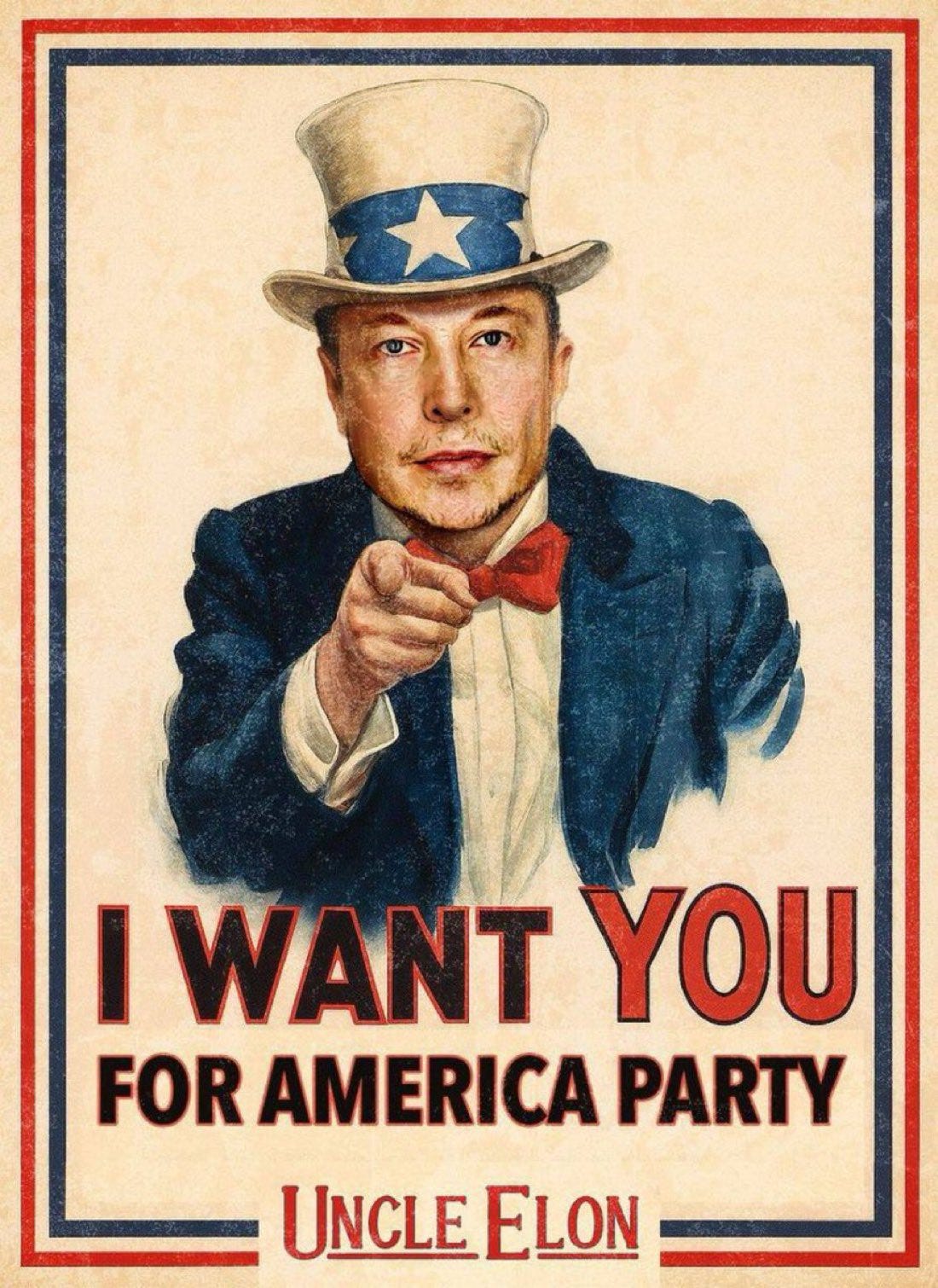
Elon Musk is an idiot, but his plan to establish a new American party (beyond existing on paper) should not be taken lightly. If he actually goes through with it, and manages to recruit candidates to run, he could be a danger—to Democrats.
As tempting as it may be for some Democrats to believe the American party could fracture the right wing block, that expectation would violate everything that we have learned (and Democrats have always attested) about the Maga movement and President Trump's hold over the Republican party. If Maga is a cult, they won't abandon their leader simply because an outcast begs them. If Republicans in Congress fear President Trump, they will not be motivated by a man who bought the Wisconsin Supreme Court race and still lost. If Elon Musk proved radioactive to voters with amazingly low approval numbers (even among Republicans and Maga voters) during his brief time in the Magasphere, his America party will have an extremely weak attraction against Maga's cult driven gravitation.
Elon Musk has no chance of fracturing the right. But Democrats are foolish to think that's even his goal. It's neither what he wants to do, nor what he needs to do. Musk's objective is to simply insert himself strategically in the mix and play a similar role as Joe Manchin and Kyrsten Sinema did, not long ago. Musk doesn't need to fracture either party, he only needs to collect a few scraps that are being left on the floor by both.
In the long run, this poses far more danger to Democrats than it does to the Republicans and Maga.
The Democrats are floundering amid a vacuum of meaningful leadership. Even as a majority of the public oppose the Maga agenda, Democrats are failing to capture that energy and convert into anything. Their strategy of waiting to be the alternative by default is proving to be a showcase of both weakness and deliberate indifference that fuels increased disapproval by the public. Meanwhile a desperate need to moderate after their 2024 defeat, Democrats' nominating base is rushing to toward socialism, causing an identity crisis for the party that is continuing to alienate the broader voting public.
In an American political ecosystem that prefers binary choices, and where the public tends to vote against more than they vote for, the emergence of Musk's America party is of greatest danger to whichever of the two major parties is in the weakest position. That happens to be the Democrats. If Musk manages to put this new party on the political map, we could be looking at the biggest shakeup in party politics since the emergence of the Whig party in response to public demands to resist tyrannical Presidential power, restore the rule of law, and equal opportunity and meritocracy over privilege (all things the American public is especially seeking once again).
The current American party system is ready to collapse. In some ways, it's begging for it. Exhibit A: The share of American voters who don't affiliate with either of the two major parties has increased nearly 50% since the turn of the century, reaching all time highs.
With the two major parties becoming so thoroughly embedded into our very concept of political mechanics of over the past 200 years (Americans who think that a two party system is demanded by the constitution remains surprisingly common) they've both rotated positions and ideologies at times. But at any given time in history, they've always had a clear identity. That is, until now. Over the past decade and a half, the essential traits that have defined both the Democrats and Republicans have been twisted, inverted, and sometimes fully reversed, to the point that neither party has much of an identity anymore. At this point, the main thing that is holding the current party system together is inertia. When it comes down to it, the Republican party is already dead, and the Democratic party is dying.
The estate of the former Republican party is now being managed by the Maga party, which is here to stay. The MAGA party is masquerading as the old Republican party, wearing its carcass as a business suit. The only reason the “Republican” party lacks definition at this point is because it's branding is being kept alive for now, in order to maintain its old client list, causing some old guard Republicans to continue holding out hope to retake the reins. But Maga has built out its own client list effectively enough that before long, it won't matter anymore. By the next Presidential election, there will be nobody left clinging to the futile conceit that the modern group calling themselves Republicans are the party of Reagan.
If you ask 10 Democrats what it means to be a Democrat, you'll get 10 different answers. And while the party has tried to gloss over this slow decay of identity by claiming to be a big-tent party, this has been a key driving force in its own demise. The party has lacked effectively leadership for decades (and yes, this includes during the Obama years). And as a result its efforts to build out the aforementioned big tent have turned into a pile of seemingly arbitrary nonsense, justified on the strained principle intersectionality. Americans have been asked to believe far fetched ideas built on complex webs of hypotheses. For example, a recycling mandate becomes a woman's rights issue, because climate change allegedly forces women into prostitution. Anyone who doesn't accept that is either anti-science, or a misogynist, or owns stock in an oil company, etc. Instead of providing a welcome mat, this has created an inflexibility that is increasingly precludes non-orthodox thinking. The big tent, it turns out, is one of demands, not of ideas.
As filthy and dirty as it feels to even concede, the simple fact is that society is currently oriented toward enabling disruptors. The stupidity of this is a discussion for a different day. For now, it's enough to recognize that American political thought is no less immune to this as anything else, and we've already seen that on full display.
Maga is the disruption channel of the right. Socialists are now showing themselves to be the disruptor channel of the left. The future of the Democratic party is socialism, and the Democratic party will soon go through a similar process as we see with Maga's takeover of the old Republican party.
Elon Musk is obviously a disruptor figure. And while the socialist end of the Democratic party are the same ones who effectively worshiped Musk for years, reveling the hope of an all electric car world where anyone can be perpetually stoned off their ass and still get to work on time, he has fully burned that bridge at this point. With both the right wing channel and left wing disruption channels closed off to him, the only avenue that's open is to become a meta-disruptor somewhere through the middle.
The Musk version of the American party is not going to be an ideologically centrist party, though. At best, it will be just as much of a corruption of centrism as MAGA is of conservatism, and socialism of liberalism. But it will attempt to be a politically centrist party, where a small number of people can wield immense influence because nobody can manage to gain a majority without them. Musk's penchant for disruption therefore has a real chance to crowd out any effort by real Democrats to save liberalism through an appeal to the independent voters who have already become fed up with them.
In some cases, this will be the same idiots who voted for Donald Trump only to be outraged when grandma gets deported. But in many other cases it will be less politically active and attentive people who have been disillusioned and inattentive to politics for years, and didn't happen to get swept up in the superficial luster of Donald Trump. The desire for change candidates has not changed, but the availability of change candidates has been depleted.
American political thinking is heavily dependent on inertia, and highly inhibited by the perception of immutability. Large scale change is inherently difficult in our system, and the result is that terrible circumstances can persist even when widely loathed by the public. The current party system in isn't just dying, it needs to die because it isn't able to serve the people. While inertia has kept it on life support, the Democrat-Republican dichotomy is begging the American people for a coup de grace. American voters are well accustomed to complaining about the available options, because it's easier to give in to the status quo than to change it.
But without changes to existing structures, duopoly is difficult to avoid in the US. Even as Americans become increasingly dissatisfied with the two major parties, the [self-fulfilling prophesy] belief that an alternative can't be viable is a difficult hurdle to overcome. We can call this the problem of apparent viability. The greatest obstacle to a third party's success is the public's preexisting belief that a third party can't succeed.
This ultimately means that new entrants will be limited. Amid a dying party system, the first group that is able to break through the challenge of apparent viability will be able to set the new tone of American political thought, as it cannibalizes the major party that’s out of power.
For the purposes of this discussion let's consider establishing apparent viability to mean that a party is able to field a candidate whose success or failure is based on the public's feelings about the candidate, instead of the public's expectations about the underlying mechanics. The point is that the American people are unlikely to entertain a transition into three, four, or five persistent major parties. The public always trend back toward either-or voting behaviors. This will mean that an emerging party that initially establishes apparent viability will either replace the weakest of the existing major parties through a parasitic consumption (as the public's perception of the dying party's viability deteriorates), or will fail to remain on the scene for very long.
The ability to fund a fledgling political party's operations is what gives Musk a realistic chance to establish an initial sense of viability for the America party. This would normally be the main objective obstacle (apparent viability being subjective). Musk won't fund the party forever. And given Musk's paradoxical tendency for wealthy cheapness, the whole endeavor might fail due to not even funding the party enough. But if he avoids that initially, normal campaign financing solutions will eventually take hold if the party starts to thrive.
At that point, Musk will become increasingly irrelevant. Even if he tries to over-donate to the party, to maintain undue influence, the party still be forced to take a natural identity based on what voters are willing to support.
The America Party will likely target Congressional seats Democrats would hope to flip, and are willing to devote substantial resources. Instead of splitting the “Republican” vote they're more likely to split the anti-Maga vote, for the simple fact that Maga has an impenetrable cultish hold over the nominal Republican party.
Be that as it may, the danger to Democrats is not that the America party would be an election spoiler. It's that Elon Musk will concentrate all effort on winning just a small handful of seats that the Democrats would have wanted to flip, making the party a Congressional spoiler.
This isn't just hypothetical speculation, it's entirely possible. Imagine that the America party runs only three Senate candidates, and only one is successful by unseating Susan Collins in indy friendly Maine. Democrats otherwise managing a net gain of two seats would be a fairly successful outcome considering four of their incumbents are retiring. But it would leave a 49/49/1 Senate in something of a crisis, and likely require adopting new rules to decide how to proceed in a new world where old precedents no longer match reality.
Even more problematic, a 217/216/2 House of Representatives would be precluded from any business whatsoever, to include even considering rule changes, before a Speaker is chosen. With no party in the majority, the America party might be able to hold out to force one of their two new members to be chosen as Speaker. They might also be able to usurp the plurality away from Democrats and give control back to the Republicans. Perhaps the Muskiest case would be for the two America party candidates to initially and Democrats the Speakership, but spend the two years thereafter holding Democrats efforts hostage.
All of these would be a victory for Musk's initial objectives.
If the America party is able to break though the barrier of apparent viability, it would likely precipitate a chain reaction that leads to it replacing the Democrats in the new duopoly, as a center-right party that squares off against the Magapublicans. If the America party successfully establishes itself, it will swell with waves of anti-Maga voters who also reject the hard left turn of Democrats race towards socialism.
Even though Musk might provide the initial funding, that won't be the case indefinitely. He won't be able to control the party as if it's his company. As the Democrats become increasingly nonviable in the eyes of the public the Kyrsten Sinemas and Joe Manchins of the world, along with the Liz Cheneys, the Adam Kinzingers, and old style Democrats (i.e. those who embrace liberalism) will not have need for Musk anymore, and will eject him just as Maga did, leaving him just as used and washed up as the voters who cashed his $1 million checks to do what they were already going to do anyway.
As the Democratic party shrinks, the remnants will distill themselves into the avowed socialist wing of American politics. Alexandria Ocassio-Cortez, Zohran Mamdani, and their like-minded comrades will likely shed the yolk of “old” moderate Democrats, insisting that the reason they've bled support to the new center-right party is because the party has been too pedestrian and failing to “motivate” the base and that these young people are the future. The further socialist they go, the more previously Democratic-friendly independents (including many who are also relatively young) will avoid them.
Eventually a new crop of voter will emerge. The independent liberal will generally side with the de-Musked center-right party as an anti-Maga vote. They'll have complaints about the center-right party. But American voters are well accustomed to complaining about the available options, because it's easier to give in to the status quo than to change it.
This post is public so feel free to share it.
No posts
Comments
Nothing yet. Say the first thing.
Sign in to join the conversation.