
Parts One and Two of this series looked at the Declaration of Independence from the two perspectives most people expect. The founders, who despite coming from different colonies, different classes, and different political realities, arrived at the same conclusion: independence is necessary. And the loyalists, who answered that conclusion with everything from constitutional arguments to 132-page legal briefs. Hutchinson went line by line through Jefferson’s grievances and called them exaggerations. Chalmers answered Paine and predicted civil war. Lind and Bentham treated the whole document like a defective contract and methodically took it apart.
These are the voices history remembers. That makes sense. They are the ones making the decisions and the ones loudest in opposing them.
But they are not the only ones listening.
Hearing the Declaration read aloud in town squares women recognized the distance between “all men are created equal” and their own legal reality. Enslaved and free African Americans heard a document proclaiming liberty while the institution that denied them both remained untouched. Native nations heard a new government announcing its arrival on land that is not empty. As for the rest of the world? They asked a simpler question: will this republic survive long enough to matter?
None of them are in the room when it is written. None of them are consulted. And almost none of them appear in the versions of this story that get told most often.
That changes here.
On March 31, 1776, three months before Congress voted on independence, Abigail Adams is in Braintree, Massachusetts, managing the household, the farm, their children, and the ongoing anxiety of war. Her husband John is in Philadelphia attending the Continental Congress. She wrote to him regularly.
That March letter contained a warning he did not expect:
“I desire you would Remember the Ladies, and be more generous and favourable to them than your ancestors. Do not put such unlimited power into the hands of the Husbands. Remember all Men would be tyrants if they could. If perticuliar care and attention is not paid to the Laidies we are determined to foment a Rebelion, and will not hold ourselves bound by any Laws in which we have no voice, or Representation.” 1
The argument is precise. Americans are fighting British authority on the grounds that those governed must have a voice in the laws that govern them. Abigail applied the same standard to women. The logic is the same. The exception is not.
John Adams answered two weeks later:
“As to your extraordinary Code of Laws, I cannot but laugh. We have been told that our Struggle has loosened the bands of Government every where. That Children and Apprentices were disobedient — that schools and Colledges were grown turbulent — that Indians slighted their Guardians and Negroes grew insolent to their Masters. But your Letter was the first Intimation that another Tribe more numerous and powerfull than all the rest were grown discontented. Depend upon it, We know better than to repeal our Masculine systems.” 2
He is not alarmed. He is amused. The Founding Fathers are fighting to remove one unrepresented group from the authority of another. They had no intention of doing the same for women.
Abigail Adams is not alone in noticing this.
Mercy Otis Warren had been watching since before the war started. Born into a prominent Massachusetts family, she wrote anonymous political satire, poetry, and eventually a three-volume history of the Revolution. Her plays attacked loyalist figures by name at a time when women are not supposed to be writing political commentary at all. She did it anyway, and her work circulated widely.
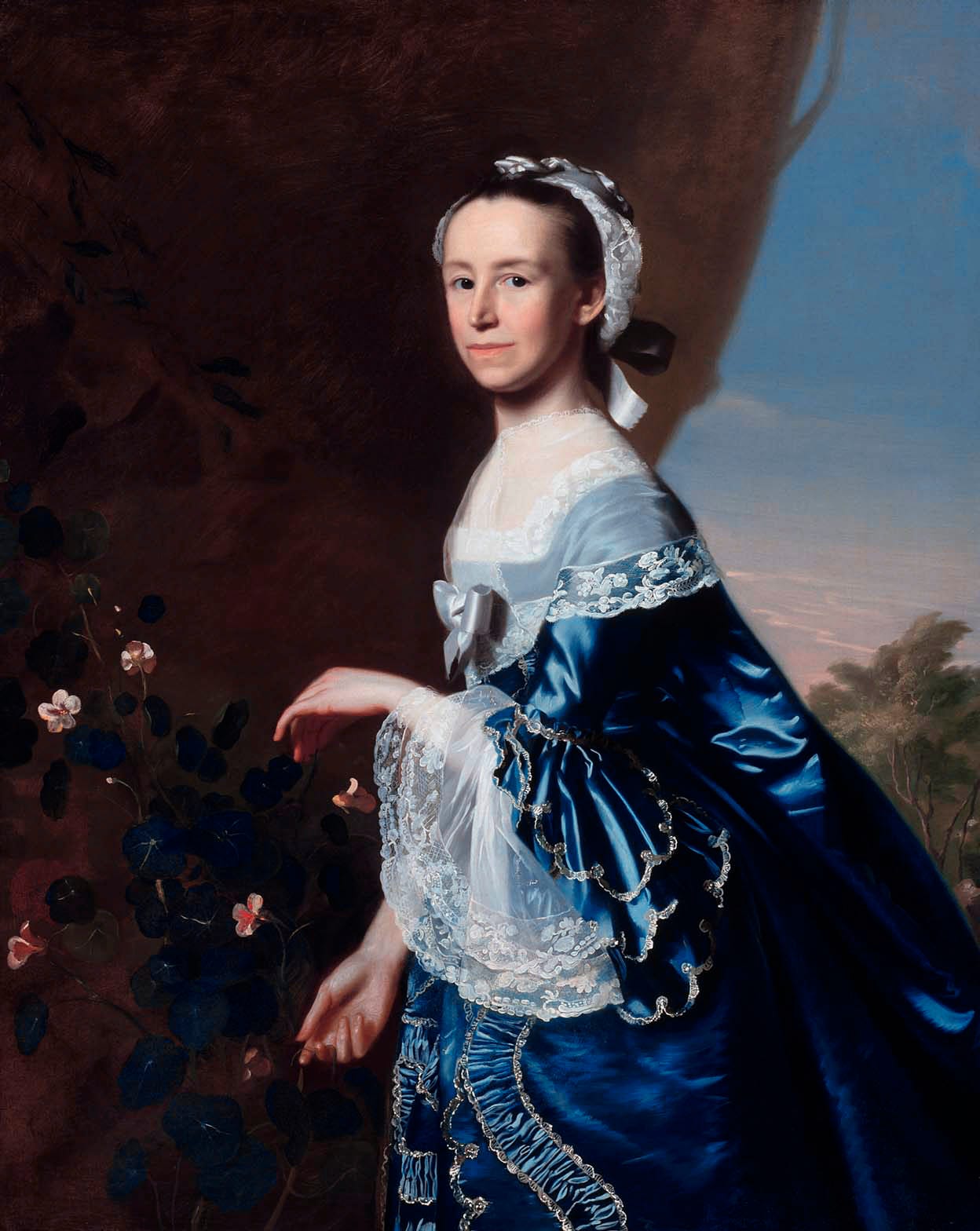
Warren’s correspondence with Abigail Adams shows two women tracking the gap between revolutionary rhetoric and revolutionary reality with clear eyes and no patience for pretense.
The practical contribution is largely invisible in the historical record. When colonial men organized nonimportation agreements to pressure Britain, women had to carry them out. They controlled household consumption. Boycotting British textiles meant spinning and weaving their own cloth, organizing their neighbors to do the same, and refusing goods that would make their lives easier.
This is political participation without a vote.
The formal record rarely acknowledges it.
The Declaration announces that consent is the foundation of legitimate government.
Women heard that too.
The document never mentions them. The new legal order being constructed around them excludes them. Under the common law doctrine of coverture, a married woman has no independent legal identity. She cannot own property, sign contracts, or sue in court. Her legal existence merges into her husband’s. The revolution changes who governs the colonies. It does not change who governs the household.
What the Declaration gives women is language. Not rights, not representation, not recognition. Language. And they use it. The argument that government derives its just powers from the consent of the governed is an argument women turn back on a government that never asks for theirs.
That argument takes generations to complete. But it starts in 1776, in letters between a woman in Braintree and her husband who does not listen.
The Declaration is adopted in July 1776. The conflict over what its words actually meant is already old.
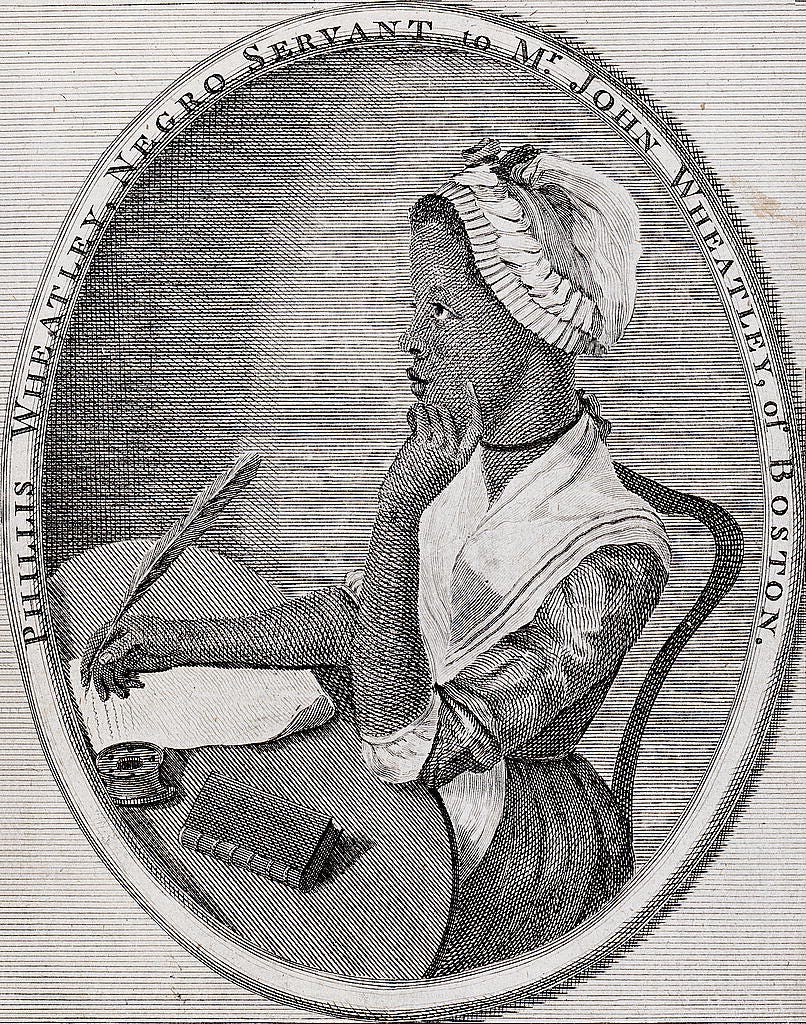
Phillis Wheatley has addressed the same question two years earlier. Born in West Africa and kidnapped as a child, she is enslaved in the household of Boston merchant John Wheatley. She became the first African American and first American woman to publish a book of poetry. Her Poems on Various Subjects, Religious and Moral appears in London in 1773, the same year she is emancipated.
On February 11, 1774, she writes to Reverend Samson Occom, a Mohegan minister and fellow activist:
“In every human Breast, God has implanted a Principle, which we call Love of Freedom; it is impatient of Oppression, and pants for Deliverance; and by the leave of our Modern Egyptians I will assert, that the same Principle lives in us.” 3
That letter is printed on the front page of the Connecticut Journal on April 1, 1774. Wheatley is making the same arguments Jefferson makes two years later about the self-evident nature of rights, and she is making it about enslaved people.
When the Declaration appears in 1776, it does not arrive in a political vacuum. Lord Dunmore, Virginia’s royal governor, issued his proclamation in November 1775 declaring that enslaved people belonging to rebels who joined British forces would be freed. The proclamation is a military calculation. For thousands of enslaved people, it is the most concrete offer of liberty anyone in authority has yet made.
Within weeks, 300 Black men had signed on with Dunmore’s Royal Ethiopian Regiment. The regiment’s uniforms bore the words “Liberty to Slaves.” Estimates suggest that between 800 and 2,000 reach Dunmore before smallpox and military defeat ends the effort. Throughout the war, the number of enslaved people who sought freedom behind British lines may have reached 100,000.4
The Continental Congress is aware of this. Jefferson’s original draft of the Declaration includes a grievance blaming the king for the slave trade, accusing him of violating “the most sacred rights of life and liberty in the persons of a distant people.” Congress cuts the passage entirely, because southern delegations do not accept it.5
What survives in the final document is different. The Declaration preserves the phrase “all men are created equal” but does nothing to reconcile it with the existence of slavery. Jefferson owns over 200 enslaved people when he writes these words. Half the signers of the Declaration also hold people in bondage.
Hutchinson notices this. In his Strictures upon the Declaration, he asks the delegates of Maryland, Virginia, and the Carolinas how they justify “depriving more than an hundred thousand Africans of their rights to liberty, and the pursuit of happiness, and in some degree to their lives, if these rights are so absolutely unalienable.” It is one of his sharpest points.6 He means it as a refutation of Jefferson’s logic. African Americans see it as a demand.
The January 1777 petition to the Massachusetts General Court, signed by a group of enslaved men on behalf of “a great number of Negroes, who are detained in a state of Slavery, in the Bowels of a free & Christian Country,” uses that same logic directly. They write that they had “in common with all other Men, a natural & unalienable right to that freedom, which the great Parent of the Universe hath bestowed equally on all Mankind.” The language of the Declaration, turned into a petition for freedom, submitted to the same legislature that helped push the Revolution forward.7
The petition is not granted.
This contradiction does not disappear. Black men serve in Patriot forces throughout the war, fighting under an ideology of liberty that excludes them from all benefits. They fight with British forces for the same reason: because Britain is offering freedom more concretely than the republic is. Some navigate between both sides looking for survival. Some make no choice at all and watch the war decide their fate regardless.
The Declaration of Independence does not end slavery. It gives enslaved people a document that says their enslavers’ own principles require it — written by the same men who hold them in chains.
They take these words seriously.
The founders do not.
The Declaration of Independence lists twenty-seven grievances against King George III. The last one reads:
“He has excited domestic insurrections amongst us, and has endeavoured to bring on the inhabitants of our frontiers, the merciless Indian Savages, whose known rule of warfare, is an undistinguished destruction of all ages, sexes and conditions.”8
That is the final charge. The culminating proof of British tyranny. The sentence that is meant to leave the strongest impression on readers.
Congress edits Jefferson’s draft for two days, cutting roughly a quarter of the text. The passage condemning the slave trade is removed as too controversial. The “merciless Indian Savages” line survives without apparent objection.9
The document does not treat Native nations as political actors. It treats them as a weapon the king points at the settlers. Native diplomacy, Native sovereignty, Native decisions about alliance and resistance — none of it exists in Jefferson’s framing. Native peoples are not parties to the conflict. They are instruments of someone else’s tyranny.
That framing is not accurate.
In July 1776, the British has not yet coordinated large-scale military operations with Native nations. Cherokee warriors attack frontier settlements that summer, but they do so on their own, without British direction and against the advice of British agents who urge them to wait. The Cherokees are responding to decades of colonial encroachment on their lands, not answering a call from London.10
That same summer, a Shawnee leader traveling with a delegation of Mohawks, Ottawas, and Delawares warns Cherokee leaders that the Virginians intended to extirpate the red people. He is describing what he saw as colonial ambition. Sadly, he is not wrong.11
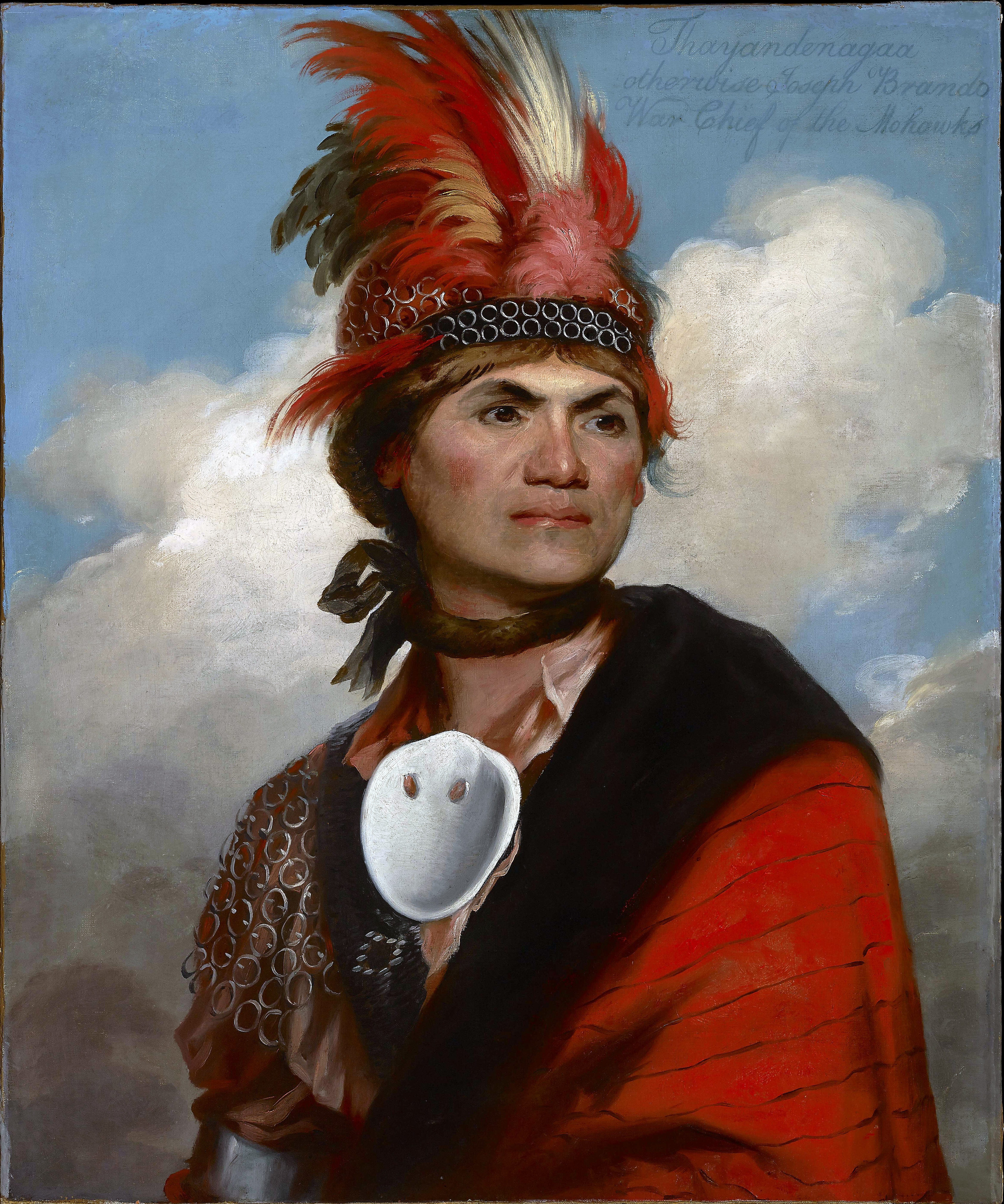
The Haudenosaunee Confederacy, the dominant Native political force in the northeast, is already fracturing under the pressure of the Revolution. The six nations, Mohawk, Oneida, Onondaga, Cayuga, Seneca, and Tuscarora, has maintained their confederacy for generations as a sophisticated diplomatic system. The Revolution shatters it. Mohawk leader Joseph Brant and his sister Molly Brant support the Crown, calculating that British imperial policy offers more protection for Haudenosaunee territory than an expanding colonial republic will. Numerous Oneida leaders move toward the American cause. The Revolution does not ask the Haudenosaunee to choose a side. It forces the choice on them.12
The Proclamation of 1763, whatever its enforcement failures, has at least attempted to establish boundaries on colonial settlement west of the Appalachians. The revolutionary leadership has no intention of honoring those boundaries. Veterans expect land grants. Speculators have already invested in western territory. The Declaration announces a new republic. Native leaders understand that a republic’s appetite for land will not stop at the colonial frontier.
From 1776 to 1783, American forces and colonial militias destroy more than 70 Cherokee towns, more than 50 Haudenosaunee towns, and at least 10 multiethnic towns in the Ohio Valley. Thousands of people are killed, displaced, or starved. The Declaration has not even dried when the war it announces began reshaping Native homelands with fire.13
None of this is acknowledged in the document that claims to speak for the American cause.
The Declaration states that governments derive their just powers from the consent of the governed. Native nations are governed, in practice, by colonial power they never consented to. The document condemns tyranny and announces liberty. It names them savages in the same breath.
They notice.
Jefferson’s opening paragraph declares that “a decent respect to the opinions of mankind” requires the colonies to explain themselves. The Declaration is addressed to the world. The world, naturally, has opinions.
Britain receives it as treason. King George III and his government does not engage the document on its merits. The constitutional position in London is straightforward: Parliament possesses sovereignty over the empire, the colonists are British subjects, and rebellion is rebellion regardless of how it is dressed in the language of natural rights. British newspapers cover the Declaration as an act of colonial defiance, not as a legitimate political founding.
What the British government actually needs is a rebuttal, and it finds one in Jonathan Lind, who produced his 132-page Answer to the Declaration of the American Congress within months. Even the government’s official response does not match Jefferson’s two dozen sentences of grievances with anything the general public desires to read.
France watches more carefully.
The rivalry between France and Britain has produced four wars in the previous century. France’s defeat in the Seven Years’ War cost it most of its North American empire. An American rebellion that weakens Britain is strategically useful. Foreign Minister Vergennes has already been providing covert assistance before the Declaration appears.
The Declaration helps make the American case in the language of Enlightenment principles that French intellectual culture has been developing for decades. Natural rights, social contract, the right of people to alter governments that violate their liberties: these are not foreign concepts in Paris. They are familiar arguments, and the Declaration deploys them with unusual clarity.
But France does not recognize the United States in 1776. It waits for evidence that the republic can survive. Evidence arrives in October 1777 at Saratoga, when American forces capture a British army. France signs a formal alliance in February 1778.14
The Declaration is a necessary argument. Saratoga is the proof.
Spain enters the war in 1779, fighting Britain for its own strategic reasons, not out of sympathy for American principles. The Spanish empire depends on colonial authority. A document announcing that colonists can legitimately overthrow imperial government is not something Madrid wants to celebrate. Spain supports the American cause with one eye on preventing the ideology from reaching its own colonies.
The Dutch Republic, deeply invested in Atlantic trade, moves toward the American cause on commercial grounds. Dutch merchants see opportunity in a new republic that needs credit and supplies. Dutch financial support proves consequential. John Adams negotiates a crucial loan from Amsterdam in 1782 that helps stabilize American finances during the war’s final phase.15
None of these governments act from the Declaration’s principles. They act from interest. The Declaration gives them a language for the alliance that interest already requires.
That is exactly what Jefferson intends. The document is never purely philosophy. It is diplomacy. It is a political instrument designed to move governments, and it does.
What the wider world hears in the Declaration is not what women in Braintree hear, or enslaved petitioners in Massachusetts hear, or Mohawk leaders surveying the fracture of their confederacy hear. The world hears a new republic announcing itself and asking to be taken seriously.
Some take it seriously enough to bet on it.
Some wait to see who will win.
Jefferson writes that all men are created equal.
The founders mean propertied white men. They do not say so. They do not need to. Women cannot vote or own property independently. Enslaved people are in fact property. Native nations see themselves defined as savages in the document itself. The franchise in the new republic is restricted, in most states, to men of property.
“All men” is a phrase that contains its own invisible asterisk.
Loyalists, for all their sharp analysis, never interrogate this. Hutchinson presses on the hypocrisy of enslaving people while announcing liberty. But his point is refutation, not reform. Chalmers calls independence and slavery synonymous terms, meaning economic slavery, not the institution. Lind and Bentham attack natural rights philosophy without examining who that philosophy has already excluded.
The most serious readings of the Declaration come from the people it ignores.
Abigail Adams reads “all men are created equal” and asks why that does not include women. African American petitioners read it and submit those words back to the legislature as an argument for their freedom.
Phillis Wheatley states it more plainly two years earlier than Jefferson does: the love of freedom lives in every human breast. She means every human. Jefferson does not.
Native nations do not need to read the Declaration carefully to understand what it means for them. They have been watching colonial expansion for a century. The document that announces American liberty also calls them merciless savages and uses them as the final charge against the king. What the Declaration reveals about the founders’ view of Native peoples is not subtle.
The Declaration of Independence remains one of the most powerful political documents in human history. This is not in dispute. What is worth examining is that its power is built on exclusions that the document’s own language is incapable of sustaining once people take it seriously.
They take it seriously. The founders, the loyalists, Abigail Adams, enslaved petitioners in Massachusetts, Phillis Wheatley, Joseph Brant, foreign ministers in Paris and Madrid. All of them read the same document.
Not one of them read the same thing.
That tension is what the next 250 years of American history still struggles, and often fails, to resolve.
It is not finished yet.
Thomas Jefferson, “Original Rough Draught” of the Declaration of Independence, Library of Congress, https://loc.gov/exhibits/declaration/ruffdrft.html. On Congress’s editorial process: Pauline Maier, American Scripture: Making the Declaration of Independence (New York: Alfred A. Knopf, 1997), 143–150.
Maier, American Scripture, 143–148.
Colin G. Calloway, The American Revolution in Indian Country: Crisis and Diversity in Native American Communities(Cambridge: Cambridge University Press, 1995).
On the Haudenosaunee split: Calloway, “The Indians’ War of Independence.” On Joseph Brant and Molly Brant: Barbara Graymont, The Iroquois in the American Revolution (Syracuse: Syracuse University Press, 1972).
Calloway, The American Revolution in Indian Country.
On French strategy and the Declaration: David Armitage, The Declaration of Independence: A Global History(Cambridge: Harvard University Press, 2007), 60–80. On Saratoga as the turning point for French recognition: John Ferling, Almost a Miracle: The American Victory in the War of Independence (New York: Oxford University Press, 2007).
Armitage, The Declaration of Independence: A Global History, 75–80.
Selected Bibliography
Adams, Abigail, and John Adams. Adams Family Correspondence. Vol. 1, ed. Lyman H. Butterfield. Cambridge: Harvard University Press, 1963. Full text at Founders Online, National Archives, https://founders.archives.gov
Aptheker, Herbert, ed. A Documentary History of the Negro People in the United States. Vol. 1. New York: Citadel Press, 1951.
Armitage, David. The Declaration of Independence: A Global History. Cambridge: Harvard University Press, 2007.
Calloway, Colin G. “The Indians’ War of Independence.” Gilder Lehrman Institute of American History. https://gilderlehrman.org/history-resources/essays/indians-war-independence.
Calloway, Colin G. The American Revolution in Indian Country: Crisis and Diversity in Native American Communities. Cambridge: Cambridge University Press, 1995.
Declaration of Independence, July 4, 1776. National Archives transcription. https://archives.gov/founding-docs/declaration-transcript.
Ferling, John. Almost a Miracle: The American Victory in the War of Independence. New York: Oxford University Press, 2007.
Graymont, Barbara. The Iroquois in the American Revolution. Syracuse: Syracuse University Press, 1972.
Hutchinson, Thomas. Strictures upon the Declaration of the Congress at Philadelphia. London, 1776. Internet Archive: https://archive.org/details/thomashutchinson00hutc.
Lanning, Michael Lee. African Americans in the Revolutionary War. New York: Citadel Press, 2005.
Lord Dunmore’s Proclamation, November 7, 1775. American Battlefield Trust: https://battlefields.org/learn/primary-sources/lord-dunmores-proclamation-1775.
Maier, Pauline. American Scripture: Making the Declaration of Independence. New York: Alfred A. Knopf, 1997.
Petition of a Great Number of Negroes to the Massachusetts General Court, January 13, 1777. In Herbert Aptheker, ed., A Documentary History of the Negro People in the United States. New York: Citadel Press, 1951. Also at Teaching American History: https://teachingamericanhistory.org/document/massachusetts-antislavery-petition/.
Taylor, Alan. American Colonies: The Settling of North America. New York: Viking, 2001.
Wheatley, Phillis. Letter to Reverend Samson Occom, February 11, 1774. Published Connecticut Journal, April 1, 1774. Transcription at Constitution Center: https://constitutioncenter.org/education/classroom-resource-library/classroom/12.3-primary-source-phillis-wheatley-letter-to-reverend-samuel-occum-1774.
Copyright © 2026 Richard Iorio. All rights reserved.
No posts
Comments
Nothing yet. Say the first thing.
Sign in to join the conversation.