

There’s an old joke. A traveler stops and asks a local old timer for directions. The local scratches his chin, thinks a while, and says: “Well, I wouldn’t start from here.”
That sums up my reaction to today’s Federal Register notice — from the White House Office of Science and Technology Policy (OSTP) and the interagency U.S. Global Change Research Program (USGCRP) — that opened a two-week comment window on a proposed amendment to the Fifth National Climate Assessment (NCA5). A national climate assessment is required under the 1990 law that established the USGCRP (and in fact was also the focus of my 1994 PhD dissertation).
The amendment makes three corrections to the NCA5:
RCP8.5, SSP5-8.5, and equivalent pathways no longer serve as “expected, likely, baseline, business-as-usual, central, or policy-relevant planning futures.”
Findings that rely on those pathways now require labels identifying them as “outcomes associated with implausible high-end scenario assumptions.”
And future assessments must evaluate scenarios for plausibility.
OSTP/USGCRP justify the amendment with Executive Order 14303, Restoring Gold Standard Science, and specifically its comments on the now-retired climate scenario, RCP8.5:
[A]gencies have used Representative Concentration Pathway (RCP) scenario 8.5 to assess the potential effects of climate change in a “higher” warming scenario. RCP 8.5 is a worst-case scenario based on highly unlikely assumptions like end-of-century coal use exceeding estimates of recoverable coal reserves. Scientists have warned that presenting RCP 8.5 as a likely outcome is misleading.
This is sorta correct — RCP8.5 was never a “worst case scenario” and its assumptions are not accurately characterized as “unlikely” but rather, the scenario is implausible and already falsified.
The Trump administration is directionally correct in recognizing that RCP8.5 is problematic, but at the same time: the administration’s proposed amendment to NCA5 cannot succeed, because NCA5’s problems are systemic and irreparable.
NCA5 is beyond fixing. The report should stand as it is and serve as an ignominious historical marker of what happens to scientific integrity when an assessment process becomes pathologically politicized — bad science, rampant conflicts of interest among contributors, and, in the end, an unreliable guide to understanding publicly-funded climate research.
Today’s post documents the top 10 problems with the NCA5 and proposes what Congress should do to improve the national climate assessment process, which is important enough to get right.
Let’s get to it.
From 10 to 1.
10. NCA5 recommends the use of implausible scenarios
The assessment’s Box A3.1 tells readers that (emphasis added):
“very high climate scenarios, such as RCP8.5 and SSP5-8.5, can be useful tools when considering a range of plausible greenhouse gas concentrations past 2100.”
The assessment ignored the literature on scenario plausibility, notably the work pioneered by Justin Ritchie.
The review editor — the person responsible for ensuring that the chapter accurately characterized the literature — for the NCA5 discussion of Scenarios and Datasets was Donald Wuebbles, of the University of Illinois, who has also been a long-time defender of RCP8.5.
He stated falsely in 2020:
“Last I knew, we are still on the RCP 8.5 pathway as of 2019, so let’s not get carried away too much with how unrealistic RCP 8.5 is.”
Assessments are supposed to accurately reflect the literature, and not serve as a gatekeeper to the idiosyncratic views of its authors.
9. “Common practice” substituted for expert judgment
NCA5 Chapter 12’s authors acknowledged that there was in fact debate over scenario plausibility and brushed it off:
“Although there continues to be debate on the likelihood of a high-end GHG emissions scenario, it is still common practice to quantify the full range of potential damages to infrastructure” (p. 12-34).
A scientific assessment exists to assess science, not to excuse it by claiming that certain research was being commonly used.
The common practice of using RCP8.5 in real-world planning was a huge problem then, and it remains a huge problem today.
8. The assessment endorses RCP8.5 as legitimate regulatory guidance
NCA5 Chapter 19 reports approvingly that
“the California Public Utilities Commission now asks energy utilities to use downscaled climate projections for a very high scenario (RCP8.5) for climate adaptation planning, investment, and operational purposes” (p. 19-16).
There was no acknowledgment of the debate over scenario plausibility or the fact that real-world use of implausible scenarios could lead to unnecessary real-world costs to real-world people.
This is the path from a flawed scientific assessment to your utility bill.
7. The sea level headline contradicts the literature on which it is based
The NCA5 Overview tells readers that projected continental US sea level rise of 3 to 7 feet (~0.9 to ~2.1 meters) by 2100 represents “distinct possibilities that cannot be ruled out” (p. xxviii).
Now turn to Table A3.1, which USGCRP’s authors built from the 2022 Interagency Sea Level Rise Technical Report. At a 3°C warming level, exceeding one meter by 2100 is estimated at a 5% likelihood and exceeding 2 meters is negligible.
The Overview’s 3-to-7-foot range comes from the low-confidence ice-sheet column that the interagency report conditioned explicitly on very high emissions (SSP5-8.5).
The NCA5 cherry picked an extreme, unlikely value, and misleadingly characterized it as a distinct possibility.
6. Reviewers asked for inclusion of the loss-normalization literature. The authors refused, and gave excuses for its exclusion that were false.
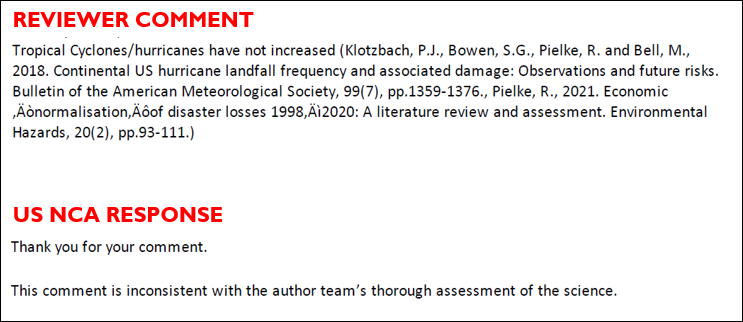
As I documented in November 2023, several reviewers asked NCA5 to engage our work on extreme weather and US losses. The NCA5 called the request “inconsistent with the author team’s thorough assessment of the science.”
Further, another reviewer asked the NCA5 to acknowledge our work on normalized hurricane losses.
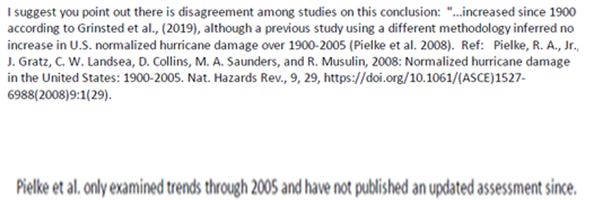
Bizarrely, the NCA5 argued that we had not updated our work since 2005, which was completely false (see image of our updated analysis below). It is hard to believe that the assessment authors could have been so inept. (More on Grinsted below.).
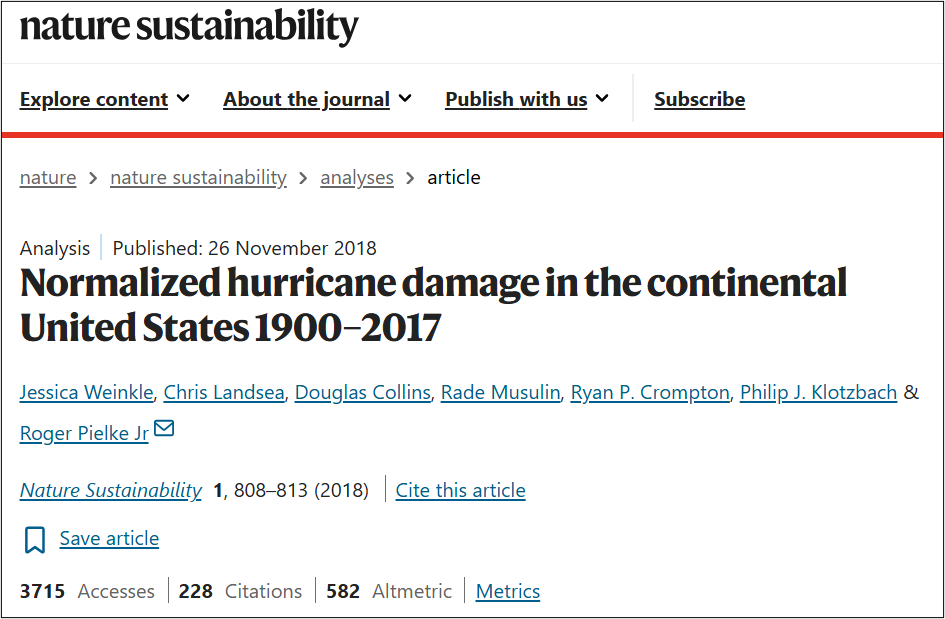
Review comments exist to catch errors and too improve assessments. Here the process was used to justify gatekeeping and exclusion of research that the NCA5 did not like.
5. A troubling number of NCA5 citations do not support the NCA5 claims
There are plenty of examples. Here are two:
Chapter 2, p. 2-20 (emphasis added):
“There is no long-term trend in the frequency of landfalling hurricanes in the United States since the late 19th century, but there has been an increase in basin-wide hurricane activity in the North Atlantic since the early 1970s. [152,153]”
Reference 153 goes to Vecchi, Landsea, Zhang, Villarini, and Knutson (2021), Nature Communications, “Changes in Atlantic major hurricane frequency since the late-19th century.” Here is that paper’s abstract on the point cited by NCA5 (emphasis added):
“We find that recorded century-scale increases in Atlantic hurricane and major hurricane frequency, and associated decrease in USA hurricanes strike fraction, are consistent with changes in observing practices and not likely a true climate trend. After homogenization, increases in basin-wide hurricane and major hurricane activity since the 1970s are not part of a century-scale increase, but a recovery from a deep minimum in the 1960s–1980s. We suggest internal (e.g., Atlantic multidecadal) climate variability and aerosol-induced mid-to-late-20th century major hurricane frequency reductions have probably masked century-scale greenhouse-gas warming contributions to North Atlantic tropical cyclone activity.”
NOAA scientists published a paper arguing against reading a meaningful trend into the post-1970s increase in hurricane activity, and NCA5 miscited the paper as evidence for a meaningful trend counter to the century-scale data.
A second case, from the same chapter. NCA5 reports “that tornado outbreaks have become more frequent,” citing Tippett, Lepore, and Cohen (2016). The paper supports that sentence. But its supplementary material qualifies it by explaining that
“[t]here are no significant trends or apparent discontinuities in the annual number of tornadoes rated F1 or EF1 and greater”
The accompanying Science editorial summary of the paper adds that
“the changes are not necessarily those that one would expect from climate change, which makes it difficult to predict whether this trend will continue.”
NCA5 kept the increase and dropped both qualifiers, giving an impression contrary to the cited literature.
4. The Overview drops every finding of no detected change
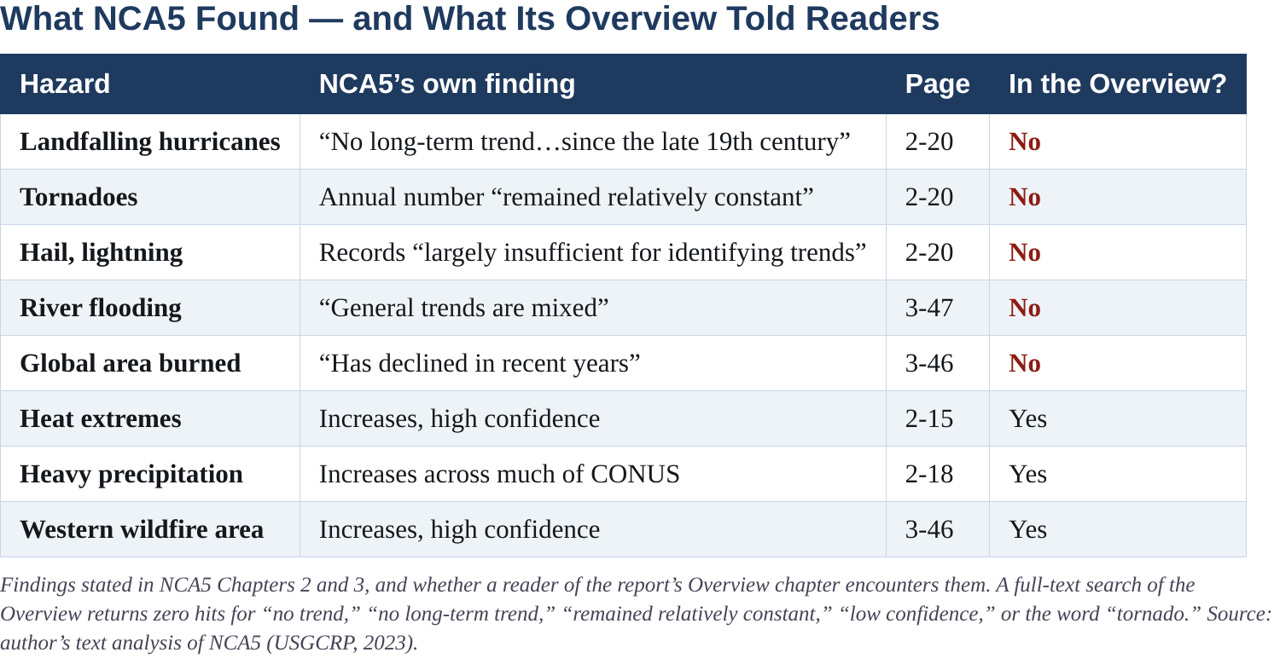
The NCA5 neglected to include in its Overview that there were no detected trends in hurricanes, tornadoes, hail, or flooding. Instead, it mentioned only three variables that had seen increases and completely misrepresented what the evidence shows for other phenomena (emphases added), writing:
“Many other extremes, including heavy precipitation, drought, flooding, wildfire, and hurricanes, are becoming more frequent and/or severe, with a cascade of effects in every part of the country.”
With respect to drought, flooding, and hurricanes this sentence is just wrong.
These trends haven’t changed since NCA5 and you can see the up-to-date data on the THB US Extreme Weather Dashboard.
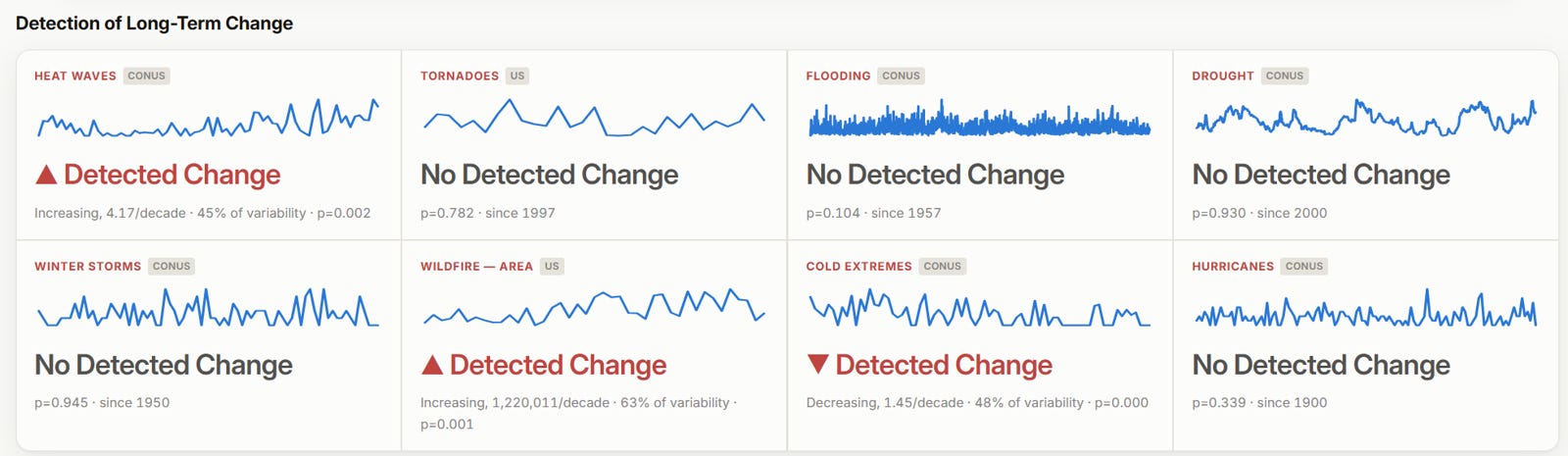
Climate data should not be buried deep inside a 1,800+ page report. Americans should not have to visit THB on Substack (as fantastic as it may be!) to see what the data they paid to have collected actually shows.
But for now, the only place you can reliably get this information is — right here at THB.
3. The Overview’s headline finding is that climate change causes more billion dollar disasters
The NCA5 Overview leads with NOAA’s billion-dollar disasters: one every four months in the 1980s, one every three weeks now. Climate change, obviously.
The report then states that rising costs stem from asset growth “and the increase in frequency or intensity of extreme events caused by climate change” (p. 1-17).
The NCA itemizes 89 events over 2018–2022: 76 of these events are floods, severe storms, and tropical cyclones. None of these phenomena in the U.S. have increasing trends, much less have trends attributed to increasing greenhouse gases. Normalized tornado losses have in fact fallen. Normalized hurricane losses show no trend, while normalized flood losses have dropped significantly. None of this is mentioned by the NCA5.
NOAA has since retired the billion dollar disaster dataset after I documented its many scientific integrity failures in npj Natural Hazards. The dataset was so flawed that NOAA did not even try to defend it — it wound up moving to a climate advocacy organization.
The leading argument of the NCA5 now rests on a discredited dataset.
2. On loss normalization, NCA5 cherry picks and ignores the literature
Here is the report’s only normalized-loss claim, Chapter 2, p. 2-20:
“Slower-moving storms can result in more heavy rainfall, wind damage, storm surge, and coastal flooding; notably, after accounting for changes in the value of property and other assets placed in harm’s way, hurricane damage in the United States has generally increased since 1900. [159]”
Reference 159 alone supports that sentence: Grinsted et al. (2019).
Three things about that curious choice.
First, and most importantly, their base damage series relies on the fatally flawed ICAT Damage Estimator, a compilation an insurance company assembled from our own earlier work and then altered without documentation and posted online. I laid out the biases in JAMC (2025) and have called for retraction of the studies built on it — including Grinsted et al. 2019. The trend identified by Grinsted et al. is entirely a result of using the Frankenstein dataset.
Second, the result contradicts the climatological record NCA5 itself reports two sentences earlier — no trend in US landfall frequency since the 19th century. An unbiased normalization should track the climatological record of landfalling hurricanes — with no trend sin landfalling hurricanes, overall or the most intense, there is no reason to expect trends in an unbiased normalization. When the two time series diverge, the method deserves scrutiny, not elevation above all other studies in the literature without such a divergence.
Third, and most damning, look at the number of studies NCA5 passed over:
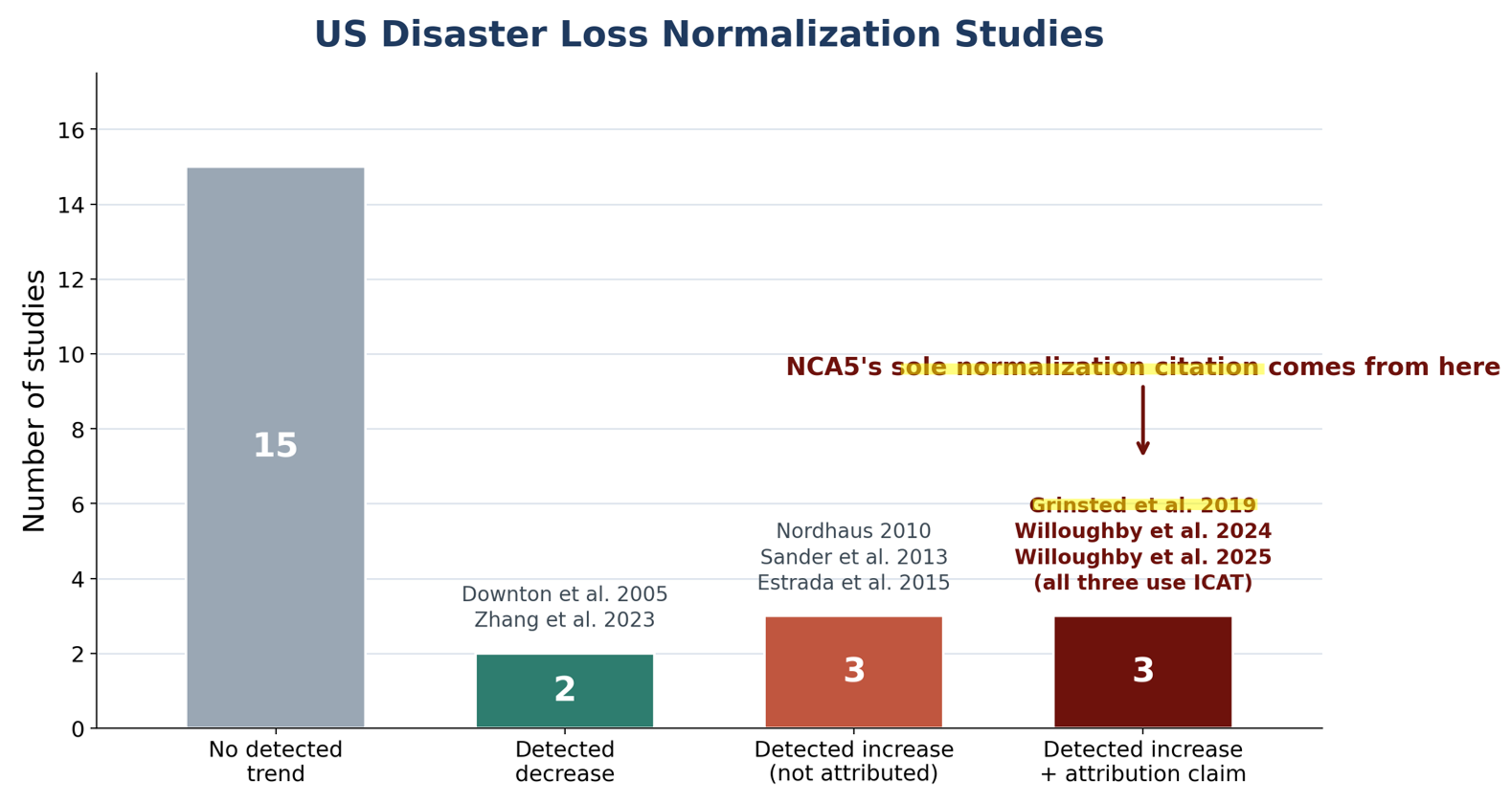
When the NCA5 was produced in 2023, there were about 20 published US normalization studies. Fourteen published prior to 2023 found no trend. Two found decreases. Three found increases without claiming attribution.
Only one study available in 2023 claimed a detected and attributed the increase to carbon dioxide emissions — Grinsted et al. 2019 — and as I’ve shown, its trend depends on the misuse of the flawed ICAT tabulation (as do the other two studies that rely on the flawed ICAT dataset, whoops).
Ignored by the NCA5?
US tropical-cyclone normalizations that found no trend: Pielke & Landsea 1998, Collins & Lowe 2001, Pielke et al. 2008, Schmidt et al. 2009, Bouwer & Botzen 2011, Klotzbach et al. 2018, Weinkle et al. 2018, Martinez 2020.
1. NCA5 treats RCP8.5 as the baseline, RCP4.5 as policy success, and the difference as the payoff from mitigation. All three are wrong.
This one sits at number 1.
The NCA5 gives readers key definitions for interpreting the report in Table 3 of the Guide to the Report (p. xxvi). The no mitigation scenario (i.e., a baseline):
“Among the scenarios described here, these reflect the highest range of carbon dioxide (CO₂) emissions and no mitigation.”
The mitigation scenarios (i.e., policy success):
“These scenarios reflect reductions in CO₂ emissions from current levels. Total annual CO₂ emissions in 2100 are 46% (RCP4.5) and 67% (SSP2-4.5) less than the year 2000. Mitigation efforts include low-carbon technology (SSP2-4.5) and expanded renewable energy compared to 2000 (RCP 4.5).”
That means that RCP8.5 shows what happens absent policy, RCP4.5 shows what climate policy does.
Other chapters draw conclusions implied by the framework.
For instance, Chapter 24, p. 24-17:
“By the end of the century, approximately 1,200 deaths related to extreme heat would be avoided under an intermediate scenario (RCP4.5) compared to a very high scenario (RCP8.5).”
Here is how the NCA5 emphasized different scenarios across the report:
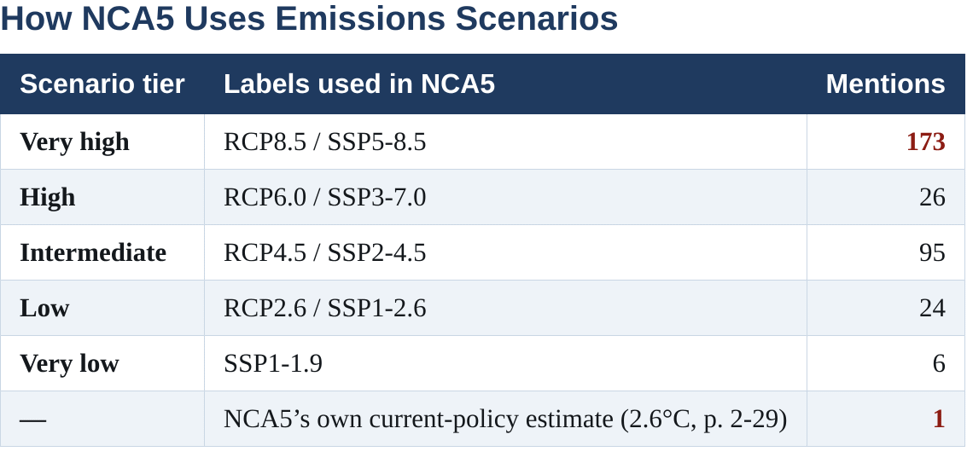
As THB readers well know, RCP8.5 was always implausible and misused from the start as a baseline. But what about RCP4.5 as policy success?
RCP4.5 is not a policy achievement. Current policies already put the world near or below its emissions trajectory.
NCA5 says so itself, once, deeply buried in the report on p. 2-29:
“Over the past few years, a number of analyses have narrowed the plausible range of current emissions outcomes based on policies in place today ... putting the world on track for a central warming estimate of around 2.6°C (ranging from 2°–3.7°C) by 2100.”
IPCC AR6 had SSP2-4.5 projecting 2.7C temperature increase by 2100.
That means that NCA5 acknowledged that current policies were similar to SSP2-4.5, and yet still used RCP8.5 as a baseline and RCP4.5 as policy success.
And the NCA5 authors knew that their framing was contested. Chapter 3’s Traceable Account, p. 3-39, states clearly (emphasis added):
“Scenarios of future emissions and land-use change are developed as plausible alternatives, but no relative likelihood is attached to them. Some recent studies, however, have argued that the highest scenario, SSP5-8.5, is no longer plausible without a reversal of current trends in the adoption of renewables and energy efficiency. The scenario development community is always testing the structural uncertainties of integrated assessment models and, therefore, the assumptions that produce the alternative emissions pathways. Timely updates of the baseline from which future projections are made, on the basis of current trends and observations of emissions, are necessary to maintain the plausibility of alternative pathways.”
Note what that paragraph does not contain: a citation to the literature, which by 2023 was quite robust on problems with RCP8.5 — including many of our papers. The NCA5 seems to have been allergic to our work.
These ten problems with the NCA5 are not fixable.
The report is a hot steaming mess.
The National Climate Assessment matters. Congress created it for good reasons, and the U.S. citizens who have invested tens of billions of dollars into climate research deserve an assessment of that research with the highest standards of scientific integrity.
Fixing it requires amended legislation, not executive orders.
Here are a five proposed amendments to the Global Change Research Act of 1990 (P.L. 101-606):
1. Most importantly, move the assessment out from under the White House. Vest assessment authority in a body insulated from direct executive control — a standing National Academies committee, or a structure under Congress resembling CBO or GAO, with an empaneling committee, staggered terms, and appointments from a bipartisan group of legislators (like the members of the House Science committee). Nearly every failure on my list traces back to an author team that produced a report that sounded more like a marketing or communications strategy than a dispassionate review of climate research. This fix will make sense no matter who holds the White House.
2. Require a published plausibility assessment for every scenario used. Any scenario supporting a projected impact must arrive with a documented evaluation against observed emissions, energy-system trends, and demographic projections — and any scenario difference presented as a policy benefit must state its reference case explicitly. Notably, at the international level ScenarioMIP still has not done this. A US assessment could show the world how its done.
3. Make review comments and responses public and binding. Publish every substantive comment, every response, and every rejection with its stated and supported reason and a named responsible author.
4. Mandate an independent citation audit before release. Here AI tools may prove useful. Citations are more than window dressing or plausible deniability for claims — they are the basis for the claims. In my areas of expertise the NCA5 failed to accurately represent the literature it was supposedly assessing, in favor of cherry picking and misrepresentations. The review process for NCA5 failed comprehensively.
5. Require conflict-of-interest disclosure. The image below shows just some of the climate advocacy organizations and businesses with interests in climate policy whose employees played major roles in writing the NCA5.
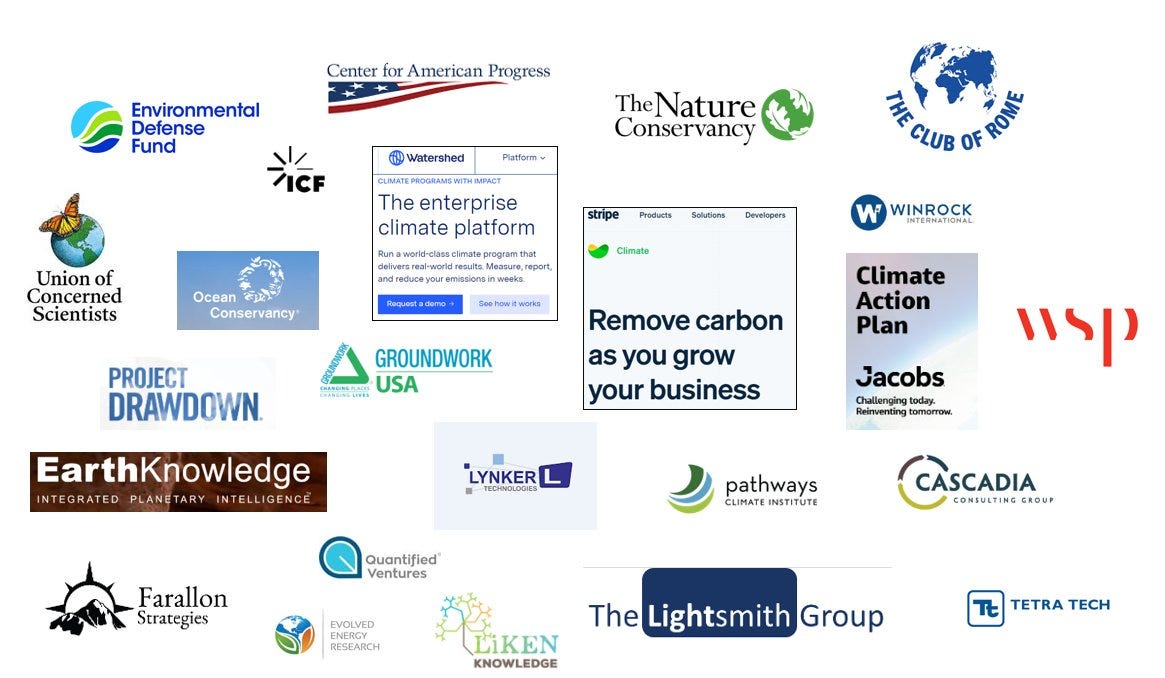
Imagine if these organizations were those opposed to climate policy and from fossil fuel companies. The problem would be the same. There needs to be one COI standard for the NCA and applied consistently.
Bottom line:
If the Trump administration wants to improve the national climate assessment process, forget about corrections and executive orders. Work with Congress to improve the process and create a NCA6 with scientific integrity that can be trusted by the American public.
That’s where I’d start.
Comments on the proposed amendment go to federalregister@ostp.eop.gov, subject line “RFI Response: Proposed Amendment to NCA5,” by 11:59 p.m. ET September 9, 2026.
Comments welcomed!
THB represents a new approach to rigorous research and public engagement. The effort depends on financial support from its paid subscribers.
Please consider an upgrade.
Comments
Nothing yet. Say the first thing.
Sign in to join the conversation.