
You’ve heard the advice, “trust your gut” or “follow your intuition.” Sounds great. But what about when your gut is wrong? What about when you lack the expertise and experience required, and your gut is taking shots in the dark?
Nil Demircubuk has a very specific and grounded answer to that question. As an intuition facilitator, certified coach, and author of Down to Earth: Demystify Intuition to Upgrade Your Life, Nil says that her superpower of intuition can be a superpower for everyone, once we learn how to use it.
Nil’s discover of her superpower, however, came from a devastating event: a multi-vehicle car accident, a severe head injury, and the strange clarity that followed.
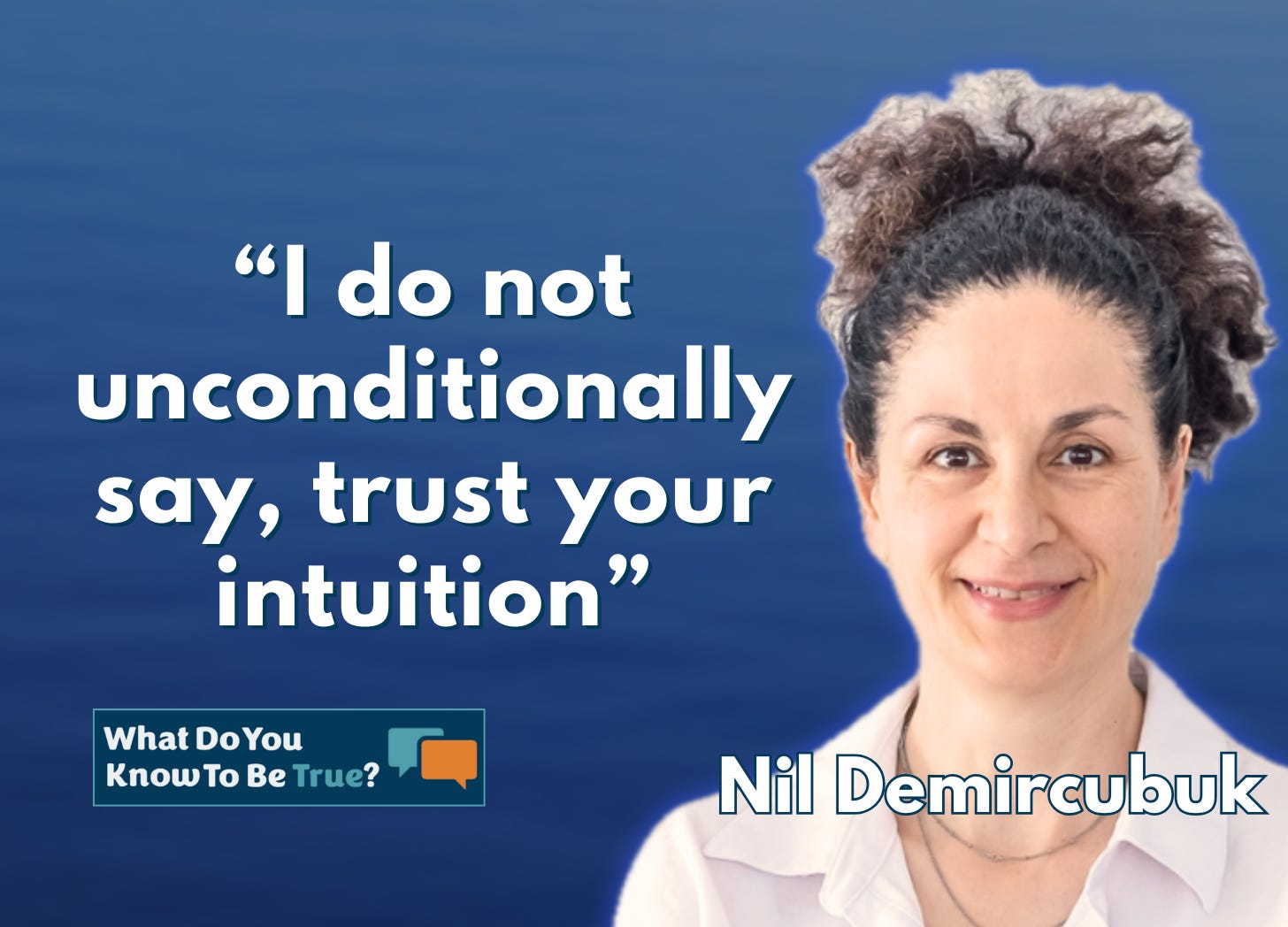
The latest conversation in the What Do You Know To Be True? podcast, “Overthinking? When To Trust Intuition vs. Logic for Better Decision Making” with Nil Demircubuk is available on YouTube, Apple, and Spotify.
Here are my three takeaways from the conversation with Nil:
Nil defines intuition in the most grounded way I’ve heard:
“Imagine you had a companion with you that kept track of everything you learned, everything you experienced throughout your life. Would you ignore that friend? Or would you turn and ask, what do you think about this? Intuition is that friend.”
Intuition isn’t a vague feeling or a mystical signal from the universe. It’s your unconscious source of every experience, pattern, and lesson you’ve ever accumulated. It’s a wisdom ready to be tapped.
And when we’re unable to tap into it, we need to change the conditions so we can hear it.
Nil calls those conditions priming: intentionally quieting the mind chatter and emotional noise so that intuition has room to surface. Different things prime different people. The method is personal. The principle is the same: calm the conscious thinking mind, then drop the question in, and wait for the response.
After the accident, Nil experienced this involuntarily. The shaking episodes that preceded total stillness, followed by sudden clarity and insight. Her education and then early work in engineering and finance placed a large value in logic. Her accident re-introduced her to her intuition.
Early in the conversation, Nil makes it clear, intuition is not the method of choice for every decision.
“I do not unconditionally say, trust your intuition.”
Nil advocates for assessing what is needed to make a decision based on one’s experience and familiarity with he subject matter.
When reflecting on this important point, that context matters, I was reminded of what Malcolm Gladwell wrote in Blink about using one’s intuition. Gladwell talks about the power of rapid cognition: the idea that in the right conditions, your gut knows things your conscious mind hasn’t caught up to yet. And he’s right. But his caution is mostly about domain: are you experienced enough in this area for your instincts to be well-calibrated?
Nil takes it a step further.
Even when you have relevant experience, she argues, you still need to ask a harder question: is what I’m hearing actually my intuition? Because fear sounds a lot like intuition. So do the stories you’ve been telling yourself since you were six. So does bias. And without reflection and awareness, most of us can’t tell the difference without practice.
That’s where her priming method becomes essential. Not just as a way to access intuition, but as a way to verify it. Prime yourself, drop the question, capture the first thing that comes up. Then prime again and ask again. Intuition, she says, will persist. Your anxious reasoning mind will waffle.
Gladwell tells you when to listen to your gut. Nil teaches you how to listen, and to be sure what you’re hearing is actually your intuition and not something else pretending to be your intuition.
One of the most disarming moments in our conversation came when Nil made the case that intuition isn’t something you have to develop from scratch…it’s something you’re already doing constantly.
“Think about a time when you were eating at a restaurant and you felt your food needed some salt or pepper. You intuitively grabbed whichever one you needed. Did you decide, oh my God, did I put one gram too much? No. You intuitively knew. We are designed that way.”
She knows this firsthand in a way most of us don’t. After the accident, she went through a period of having to consciously talk herself through basic steps, things most of us do without thinking. Things intuition handles invisibly, every day.
The invitation isn’t to create something new. It’s to start listening to something that’s already there.
And the way you start? Pay attention to what primes you, what genuinely brings you into a calm, present state, and start using those moments intentionally. In that stillness, with a question you’ve prepared in advance, you’ll be surprised what comes up.
Nil closes with a practice anyone can try after the episode. I’m going to let her tell you that one herself.
Think about a decision you’ve been sitting with longer than you’d like.
👉 I’m Curious: When you quiet the noise and just sense into it, what comes up? And do you trust it?
I know for me, the moments I’ve most regretted are the ones where I heard the signal and overrode it with my reasoning mind. I talked myself out of what I already knew.
Drop your answer in the comments. I’m genuinely curious what people are sitting with.
The latest conversation in the What Do You Know To Be True? podcast, “Overthinking? When To Trust Intuition vs. Logic for Better Decision Making” with Nil Demircubuk is available on YouTube, Apple, and Spotify.
What Do You Know To Be True? is your invitation to be inspired to become more of your possible self by discovering your superpower, unlocking your potential, and creating your impact in the world.
Hi, I’m Roger Kastner. I work with individuals, leaders, and teams to design new ways of thinking, behaving, and working to unlock challenges, achieve goals, and live into their potential and possible selves.
The podcast is available on YouTube, Apple, Spotify, and the What Do You Know To Be True? website.
No posts
Comments
Nothing yet. Say the first thing.
Sign in to join the conversation.