
Quick links to the latest conversation with Sharon Podobnik Peterson: YouTube, Apple, or Spotify.
I can recall some moments in conference rooms and offices where I’ve watched people react uncharacteristically and inexplicably in defensive and erratic ways. I always chalked it up to a bad day, a bad mood, maybe a threat response.
After my conversation with Sharon Podobnik, founder of The Center for Conscious Leadership and creator of “The Trauma-Informed Leader” program, I now realize I might have been witnessing a trauma response. Sharon defines trauma is something that is too much and too fast for our nervous system to handle.
As someone who was once diagnosed with PTSD, this one hit close to home. It had me looking back at my own reactions over the years and asking whether they were really “in the moment” or something my nervous system had been carrying for a while.
Even though both the World Health Organization and American Psychological Association say that nearly 70% of people globally have experiences at least one traumatic event in their lifetime, Sharon’s own experience pegs that number closer to 100%.
If you knew 2 out of 3,(or 3 out of 3), people you work with or lead have had a traumatic experience, wouldn’t you want to show up in a way that didn’t reactivate the harm?
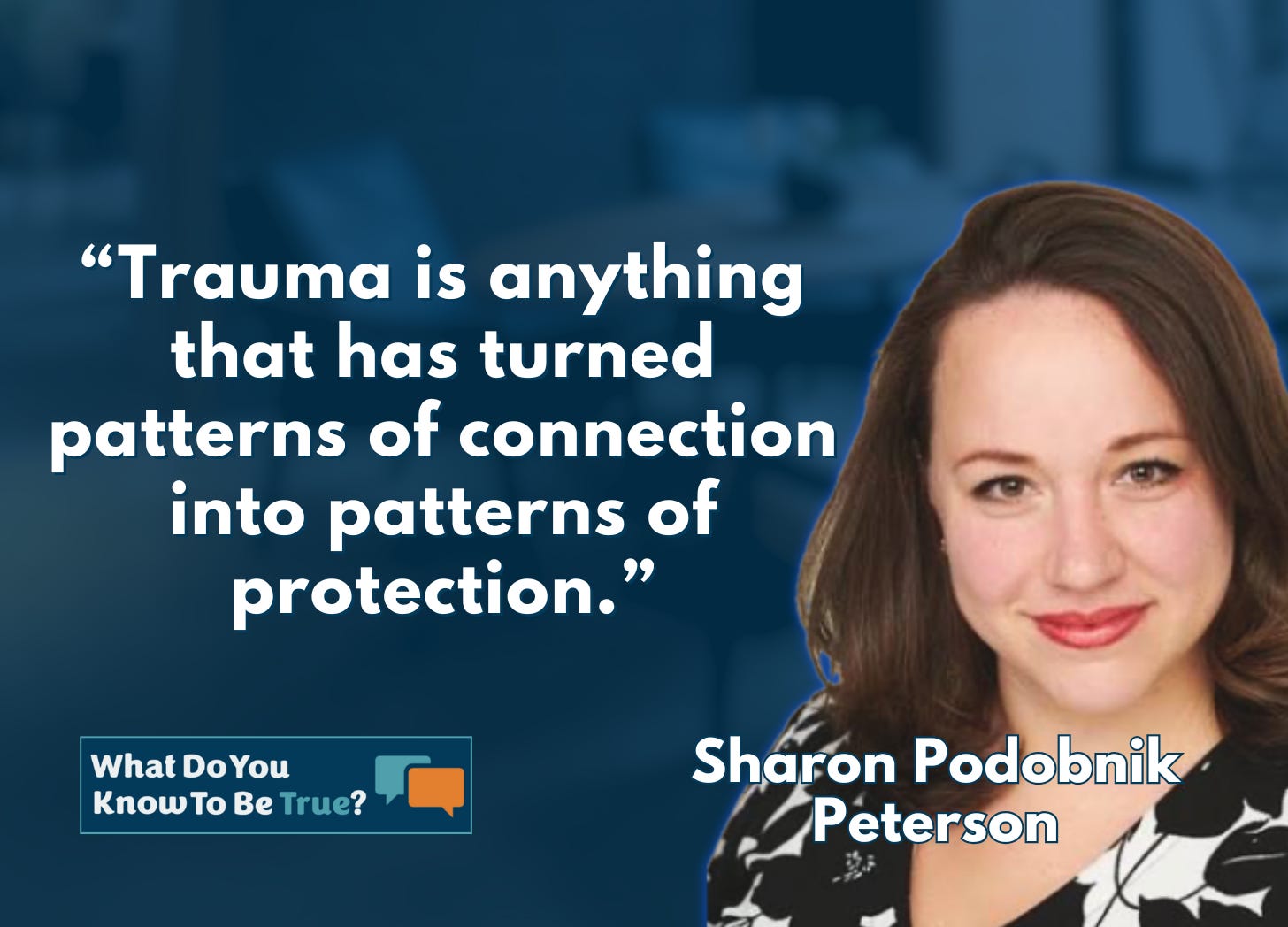
The latest conversation in the What Do You Know To Be True? podcast, “ Leaders Who Spot This Pattern Transform Their Teams” with Sharon Podobnik Peterson is available on YouTube, Apple, or Spotify.
Here are three takeaways I took from the conversation.
Sharon shared a symptom of a trauma response is “anything that has turned patterns of connection into patterns of protection.”
Translation: when someone gets defensive with you, they haven’t decided to be difficult. Their nervous system has decided you’re no longer safe. As she put it, “if there’s defensiveness, we’re already disconnected.”
If the person and relationship is important to us, we can learn ways of co-regulation to help create the safety and the space to invite the other person back to connection with us.
Sharon brought up the “un-ripened theory of leadership development” where it compares how we develop leaders to factory farming.
We pull tomatoes off the vine early and pump them up so they look ripe on the shelf, even though they are not ready to eat. The theory goes on to say we do the same thing to people.
We coach leaders to stand tall, make eye contact, and look the part, without ever building the nervous system capacity underneath. Sharon says that gap is “incredibly metabolically taxing to our nervous systems.” No wonder so many capable leaders are burning out while pretending to look like they have it all figured out.
Sharon’s superpower is ‘Holding space and being willing to see the full complexity of a person, place or thing,’ and it leads her to be enthusiastic about curveball questions and challenges to anything she believes to be true.
So, when I asked Sharon what she knows to be true about her own superpower, her answer was one word: “Nothing.”
Not because she doesn’t know herself. Because the whole point of her work is resisting easy, tidy answers about anything. While that might sound exhausting to some, to constantly be questioning the assumptions and beliefs we hold, it is stimulating and energizing to Sharon.
It reminded me of the idea that the ability to learn, unlearn, and relearn is the most valuable skill of the 21st century. Sharon’s superpower is ready to perform and engage in these uncertain and evolving times.
When it comes to trauma-informed leadership, how can you better show up for others so as to not re-activate trauma responses, but through co-regulation, create the conditions for others to do their best work and be their authentic selves?
👉 I’m Curious: When you seeing someone acting surprisingly protective or defensive, what co-regulation practices do you employ to try to lower the temperature in the room? Drop it in the comments, I’d love to learn what you do.
The latest conversation in the What Do You Know To Be True? podcast, “ Leaders Who Spot This Pattern Transform Their Teams” with Sharon Podobnik Peterson is available on YouTube, Apple, or Spotify.
What Do You Know To Be True? is your invitation to be inspired to become more of your possible self by discovering your superpower, unlocking your potential, and creating your impact in the world.
Hi, I’m Roger Kastner. I work with individuals, leaders, and teams to design new ways of thinking, behaving, and working to unlock challenges, achieve goals, and live into their potential and possible selves.
The podcast is available on YouTube, Apple, Spotify, and the What Do You Know To Be True? website.
No posts
Comments
Nothing yet. Say the first thing.
Sign in to join the conversation.