
A few weeks ago, psychotherapist, author, and TEDx speaker Kerry-Lyn Stanton-Downes joined me to talk about relational capacity: our ability to stay genuinely connected with others, especially when it’s hard.
At the end of the conversation, Kerry-Lyn offered something very generous: to come back and answer questions submitted from the audience.
She called it “getting relational with the audience.” And that’s exactly what it was.
She provided wonderful responses to submitted questions from the community, I slipped in a question that I had been ruminating on since our first conversation. And her answer was as powerful for me as I thought it would be.
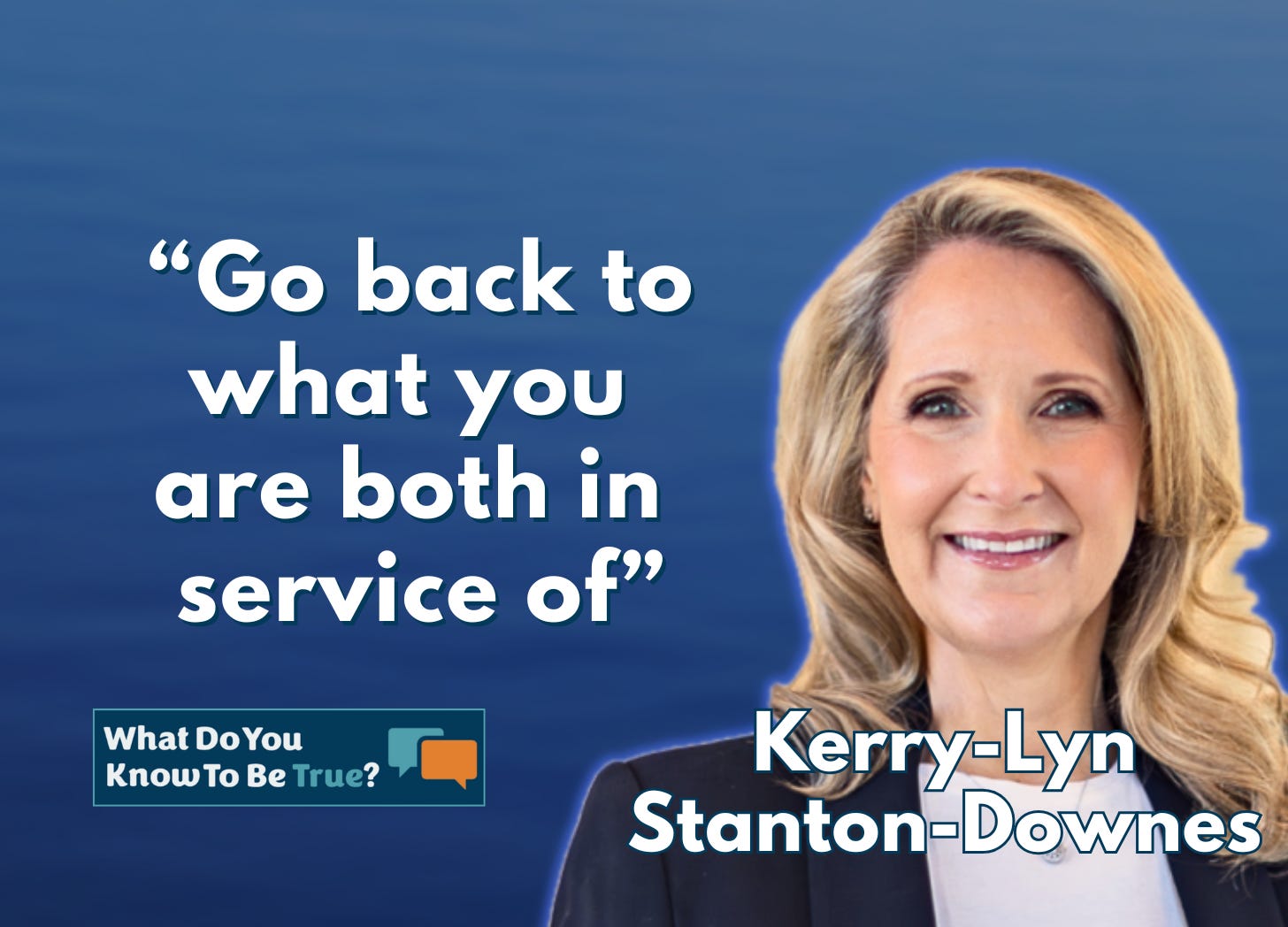
The latest conversation in the What Do You Know To Be True? podcast, “Difficult Conversations: Your Questions on Relational Capacity” with “Kerry-Lyn Stanton-Downes” is available on YouTube, Apple, and Spotify.
Here’s the scenario I brought to Kerry-Lyn: I’m in a room with a leader or colleague. We’re developing a solution. They’re advocating for an approach I believe, based on my experience, won’t work. I start building my case. And somewhere in that process, I stop thinking about the person in front of me and start thinking about all the people who will be affected by the wrong decision.
I feel like I am doing the right thing, but at the cost of the relationship. So I asked Kerry-Lyn, is there a way I can be right AND stay in relationship?
Kerry-Lyn started her response by giving us a sign to look out for when we are concerned about building a case versus building a bridge.
She told me to watch for the moment I start using the word “but.”
“But that won’t work”
“But what you don’t understand”
“But that’s not enough”
By the time I’ve stuck my “but” out, I’ve left relational curiosity and started building a case.
And what Kerry-Lyn recommend we do when we realize we’ve gotten lost the sauce of being right surprised me: get vulnerable. Out loud.
Kerry-Lyn suggested saying something like, “I notice I’ve moved to a position of defense” and then she names it to the room, laughs at herself, and invites everyone back to shared goals.
That move, naming her own state rather than managing the other person, is disarming. It shifts the conversation from opposition to collaboration. And it pulls directly from her eight principles of relational capacity. She moved through all eight of them in one response.
The answer to “being right or being in relationship” isn’t to choose one.
It’s go back to what you’re both in service of and do it from a place of openness. That’s where the better answer lives.
In Rumi’s words, which Kerry-Lyn quoted: “There is a field beyond right thinking and wrong thinking. I will meet you there.”
I found my own buts coming up as she spoke. Which told me I needed to sit with this some more.
Yes, well…community members and former guests submitted great questions, here are the three we covered in the conversation.
Former guest, Wynne Leon, asked how leaders can build relational capacity without making it feel like another task for their teams.
Kerry-Lyn’s answer is one every leader should hear. The power differential doesn’t disappear because you want it to, and pretending otherwise makes it harder, not easier.
As she put it…
“Pretending it not almost makes it worse for the relationship, because then the team is managing both the differential and the denial of the differential.”
Real relational leadership lives in the small moments: a 30-second reflective pause in a meeting, saying “I don’t know, would you be willing to explore that with me?”, may repair a small rupture in real time. Not the offsite. Not the vulnerability circle on demand.
“It’s not the big gestures, it’s the tiny little gestures that are important.”
Former guest, April McCormick, asked how to compassionately point out when someone needs to regulate themselves.
Kerry-Lyn’s short answer: don’t.
She shared a personal story about a climbing instructor who told her to “calm down” mid-climb when she was stuck.
Kerry-Lyn is a psychotherapist. It still sent her system into overdrive.
Why? Because “that’s more about our nervous systems rather than their nervous system.”
The move that actually works is to regulate yourself first, then get curious.
She offers this question as a replacement for any intervention:
“That sounds important to you, what’s the one thing about that that you want me to hear?”
That question gives the other person permission to settle themselves. And it reminds us that when someone brings us their dysregulation, they’re bringing us their need.
Former guest, Mark Meadows, asked which cultures has Kerry-Lyn studied to understand how relational capacity might be similar or different elsewhere.
Kerry-Lyn’s answer started with her being born and growing up in Africa, where she learned African practice of Ubuntu (“a person is a person through the other person”). She went on to talk about the Maori, the Bhutanese, and communities in Italy and Greece, places where relational capacity is baked into daily life and rituals.
Her core observation: “relational capacity is not a personal achievement. It’s a shared infrastructure.”
The cultures that have kept it alive treat it as infrastructure, building their days and rituals around it. Meanwhile, we in the West built our days around productivity and assumed relationship would happen in the leftover time. There is no leftover time anymore. Maybe there never was. But it’s always been a choice.
Think about a moment, at work, at home, anywhere, when you were so committed to being right that you lost the thread of the relationship.
👉 I’m Curious: What was the signal that told you you’d crossed that line? And what did you do with it?
Drop your answer in the comments. This is exactly the kind of conversation Kerry-Lyn had in mind when she offered to come back.
The latest conversation in the What Do You Know To Be True? podcast, “Difficult Conversations: Your Questions on Relational Capacity” with “Kerry-Lyn Stanton-Downes” is available on YouTube, Apple, and Spotify.
What Do You Know To Be True? is your invitation to be inspired to become more of your possible self by discovering your superpower, unlocking your potential, and creating your impact in the world.
Hi, I’m Roger Kastner. I work with individuals, leaders, and teams to design new ways of thinking, behaving, and working to unlock challenges, achieve goals, and live into their potential and possible selves.
The podcast is available on YouTube, Apple, Spotify, and the What Do You Know To Be True? website.
No posts
Comments
Nothing yet. Say the first thing.
Sign in to join the conversation.