
When I inspected my beehives today before winterizing them, I saw plenty of diploid female workers and their queen, but where had all the male haploids gone? They are a story for another day, but their absence set me thinking about the critical state of ploidy honed by evolutionary genetics in living organisms, and the avoidance of mistakes that cause infertility or miscarriages.
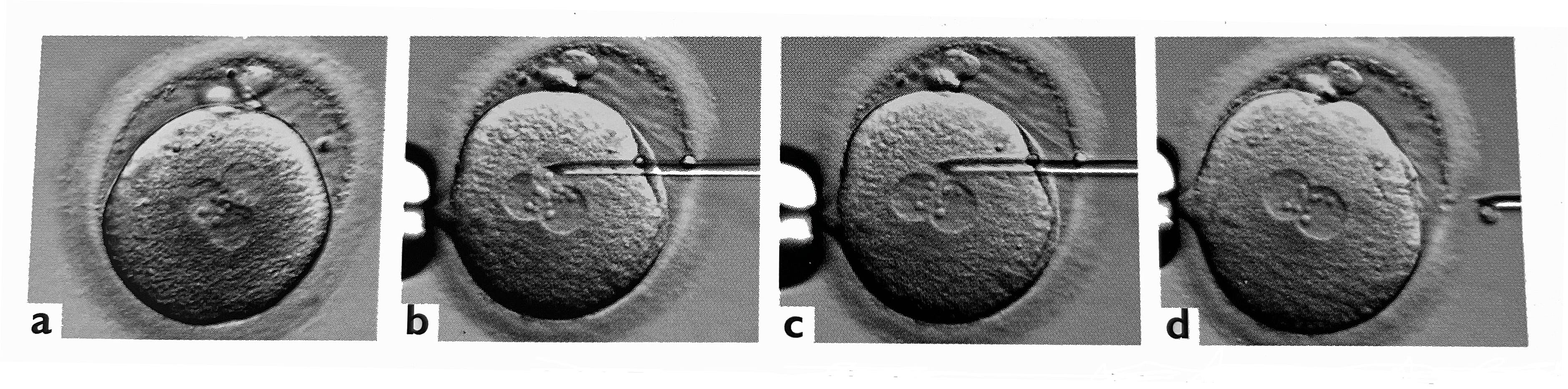
Readers of misleading headline news might be startled into thinking Chinese scientists used microsurgery to remove a single extra chromosome (aneuploidy) from an ICSI fertilized human egg when they had in fact aspirated an entire set of maternal chromosomes from an egg containing three pronuclei (3PN). It is still a newsworthy attempt to avoid triploidy. The patient delivered a healthy boy with a diploid karyotype after embryo transfer. This appears to be the first birth. Lucinda Veeck illustrated the technical feat in 1999 in one of her embryology atlases* (pictured above).
Roughly 5% of zygotes conceived in vitro have 3PNs, easily recognized before the first cleavage division and potential triploid pregnancies fated to end in miscarriage or “moles.” Few circumstances justify ploidy rescue, but all seven zygotes in the Chinese case had 3PNs for a woman with a history of repeated pregnancy losses. Given the stakes, I wouldn’t count on this abnormality self-correcting.
Not all animals are persnickety about ploidy. Salamanders are triploid and have to negotiate meiosis with an extra set of chromosomes in novel ways. On the other hand, haploidy is universally lethal in vertebrates (except their gametes) because without backup genes on a homologous chromosome, harmful mutations get expressed. Drone bees don’t seem to pay this price in their short lifespan.
Diploidy is mandatory in mammals for other reasons, mainly genomic imprinting and balanced gene dosage for assembling protein complexes, etc. They explain why losing or gaining even a single chromosome (monosomy or trisomy, respectively) is catastrophic in pregnancy, with few exceptions, Down’s syndrome being the obvious one (my inaugural graduate project). A lower (though variable) impact of an extra chromosome 21 compared to larger autosomes is evidently due to fewer protein-coding genes. The viability of sex chromosome aneuploidy is a special case because only one of the large X’s is active in cells.
Let’s digress for a paragraph to consider the feasibility of going further than removing a supernumerary set of chromosomes. Can trisomy-21 cells be “cured” at the zygote stage or later? I can’t imagine physically plucking the surplus chromosome out of a cell without causing harm from the intense light for showing fluorescent markers or collateral damage to the spindle. However, it isn’t bonkers to dream of correcting aneuploidy in somatic cells in vitro, although this shouldn’t raise hopes for people with Down’s syndrome. For example, one of the trio chromosomes can be neutralized by inserting the XIST gene responsible for X-inactivation. A better alternative is chromosome snipping with a nuclease to target a specific chromosome for cleaving multiple megabase-sized chunks of DNA. These strategies, although proven in principle, face a near-vertical slope to application because they require genome modification, which is less than fully efficient and often has off-target effects. And it is too late to repair brain architecture after birth. Treatment needs to be delivered in the early stages of neurulation and before the blood-brain barrier stops the large molecular actor.
Preimplantation genetic testing (PGT-A) in IVF cycles has long been a standard of care, although not without controversy. I wrote a warning in Nature almost 20 years ago, not then or now, a lone skeptic: “Genetic test may lead to waste of healthy embryos.” The standard method of FISH for counting fluorescent dots on chromosomes didn’t seem up to scratch for the high stakes. Misdiagnosis lowers the chances of pregnancy by discarding healthy embryos or allowing true aneuploids to pass and spontaneously abort later or need chorionic villus screening.
The problem is compounded with mosaicism, first disclosed in FISH studies. Human embryos are notoriously susceptible to mistakes of chromosome segregation every time they cleave into two, especially before cell cycle checkpoints are operational and the zygotic genome is activated. Embryos can have weird karyotypes—chaotic or mixoploid—but the more clinically significant are mixtures of diploid and aneuploid cells. A 2011 review of 36 studies identified an average of 72% of embryos as mosaic, the majority diploid-aneuploid, even before techniques available for checking all chromosomes! Surely biologically implausible? A group of molecular biology methods called comprehensive chromosome screening brought the estimate way down after analysis of all 24 chromosomes and segmental (partial) aneuploidies. The incidence of mosaicism at birth is 2% although it is higher in the placenta (tellingly). What’s going on?
The great majority of pure aneuploidies are lost early in pregnancy. But mosaics may revert to normal by selecting diploid cells and eliminating the others or only the offending chromosome. John West in Edinburgh brings clarity to the complex lineages and fates of these embryos, which are hard to study in living human animals and for which animal models are inadequate. An intriguing new study using advanced imaging analysis of live human embryos adds to the suspicion that aneuploid cells are shunted aside to harbor in placental lineages, which would challenge the reliability, even the validity, of PGT-A applications. As ever, one question leads to another and to pleas for more research.
• What is the true incidence of mosaicism?
• Is it more common in assisted reproduction than natural cycle fertility?
• How often do heteroploid cells self-correct?
• Are aneuploid cells preferentially allocated to placental lineages, and if so, how?
*Image from Atlas of Human Gametes and Conceptuses. Parthenon, 1999, p. 165. The embryo continued to cleave after aspirating one of the three pronuclei in a human zygote.
No posts
Comments
Nothing yet. Say the first thing.
Sign in to join the conversation.