
Hey there!
You know more about your topic than most people ever will.
And that’s exactly why your course keeps getting bigger.
Every time you sit down to outline it, you think of another piece someone needs. Another mistake they’ll make if you don’t warn them. Another step you can’t leave out. The outline grows. The module count grows. And somewhere around Module 7, you start wondering if anyone is actually going to finish this thing.
They won’t. And it won’t be their fault.
In today’s edition, I’m breaking down why the “give them everything” instinct backfires, what to build instead, and a 20-minute exercise for finding the one stuck point your course should actually solve.
Let’s get into it.
When I talk to experts who are building their first course, I hear some version of the same thing.
“I want to give them everything they could possibly need to succeed.”
I get it. You’ve spent years figuring out what works. You have a whole process, a signature framework, hard-won wisdom from working with real people. And now you’re putting it into a course. Why would you leave anything out?
Here’s the thing. MORE is not BETTER when it comes to learning.
Piling on too many strategies, too many steps, too many “but wait, you also need to know this” modules doesn’t set your clients up for success.
It almost certainly ensures they’ll fail.
And here’s the painful irony. The coaches and consultants who make this mistake aren’t doing it because they’re lazy or sloppy. They’re doing it because they care. They want people to succeed so badly that they can’t bring themselves to leave anything out.
But caring too much about what you give people, without caring enough about what they can actually absorb, doesn’t help them.
People can only learn so fast.
Overload someone with information and they don’t just slow down. They stop. They fall behind in Week 2 and feel guilty about it. They set the course aside for a weekend they never find. And a course someone doesn’t finish produces exactly zero results.
No results means no testimonials. No testimonials means no word-of-mouth. No referrals. No repeat buyers.
The massive, comprehensive course you built to guarantee their success ends up producing the opposite.
This isn’t about your clients being lazy. It’s about how humans actually learn. We need time to absorb. We need to practice. We need to get a win before we’re ready for the next challenge. Stack too much on top of that and none of it happens.
The goal of a course is a result. Not coverage.
I was creating a test prep course for the SAT. Three sections of that test I could have covered. Critical reading, math, and the essay.
I chose one: the essay.
Why? Because the essay was where my students were scared. They’d sit down to write and freeze. They didn’t have a system. They were winging it, crossing their fingers, and hoping for the best.
So I built a small course around one skill set. The specific, teachable steps that would let someone sit down, follow a clear process, and produce a high-quality essay in 25 minutes. Every time.
That was the whole course.
Could someone benefit from learning the other two sections too? Sure. But this one course took a student from “I’m going to screw this up” to confident and prepared. That’s a real result. That’s a valuable outcome.
One slice. Still tasty.
Jari Roomer is a productivity expert and prolific course creator. He built a comprehensive course covering his entire system for helping people get more done.
It launched to crickets.
Hardly anyone bought.
So Jari broke it apart. He turned the big course into a series of smaller courses, each one solving a specific problem.
They sold.
Why?
Because not everyone had ALL the problems his big course was designed to solve. But plenty of people had ONE of those problems. And they were happy to pay to fix that one thing.
The comprehensive course was trying to be for everyone. The mini-courses were each for someone.
That difference shows up in your sales numbers.
Sean D’Souza teaches a 14-step process for writing articles. He covers the whole thing in a three-month course in which you get feedback five days a week.
Clients who used to struggle for hours to produce one article, graduate with the ability to produce a high quality article in 90 minutes or less.
He also sells mini-courses: one on writing headlines, one on outlining, one on storytelling.
Each one is valuable on its own. Each one makes you a better writer. You don’t have to go through all 14 steps at once to get something genuinely useful from his work.
Comprehensive is not the only way.
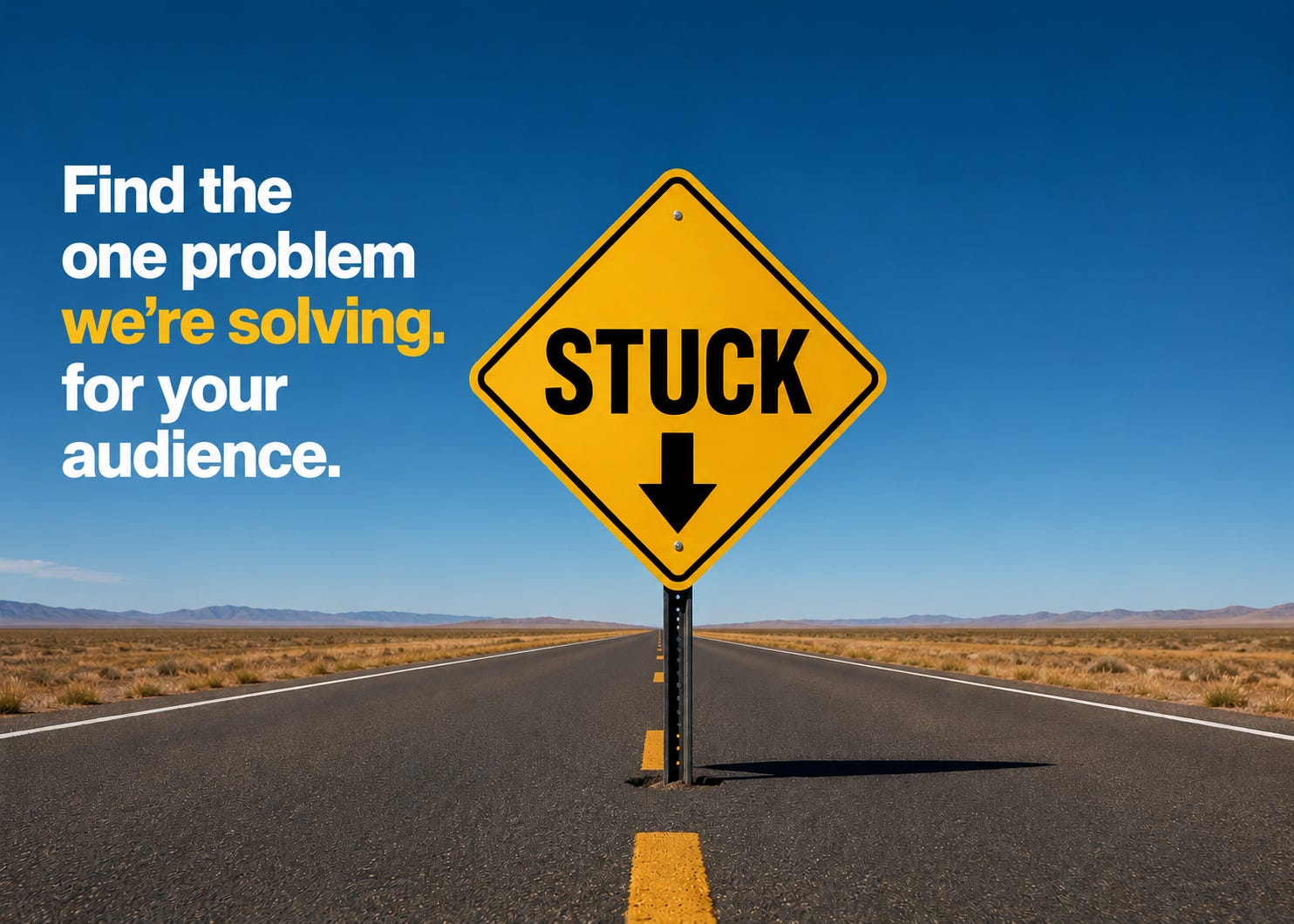
Think about your own clients. Think about the outcomes you help people achieve. There are steps involved. And somewhere along that path, there’s a point where people consistently get stuck. Where they hit a wall and don’t know what to do next.
That stuck point is a course.
Not the whole map. Just the place where people keep getting lost.
Try this.
List out every outcome you’ve helped a client achieve. Write them all down. Don’t edit yourself. Just list.
Now circle the three that sound juicy. The ones people WANT, not just the ones they technically need. The kind that, if you told someone at a dinner party you helped people achieve this, they’d put their drink down and say “wait, tell me more.”
Pick one.
Now list what a person actually has to DO to make progress on that outcome. The real steps. The ones your clients go through when they work with you.
Somewhere in that list is a place where people get stuck. Where progress stalls. Where they need help and don’t know where to turn.
That’s where your course begins.
You don’t need to teach everything. You just need to teach THAT.
The coaches who make the “whole enchilada” mistake aren’t wrong to want their clients to succeed. They’re wrong about what success requires.
Your clients don’t need everything. They need the right thing at the right time.
Give them that. One focused, teachable, genuinely useful thing. And they’ll finish. They’ll get a result. And they’ll come back for more.
One slice is still tasty.
Rodney
If you want a clear, repeatable method for building a focused course like this, the Atomic Course Blueprint is 33 pages with everything you need to get from idea to finished course. There’s a 60-day Smiley Guarantee, so you can try it completely risk-free.
Check it out here: https://roddaut.gumroad.com/l/atomic-course
Comments
Nothing yet. Say the first thing.
Sign in to join the conversation.