
You’ve validated the idea. You’ve surveyed your audience. You’ve told yourself you’ll start “when things slow down.”
And somehow, months later, the course still doesn’t exist.
Here’s what I’ve learned after building courses myself and helping dozens of others do the same: validation isn’t what gets a course finished. A deadline is.
There’s a version of validation that’s useful. Surveying your list, putting up a waiting list page, getting a few people to say “yes, I’d pay for that” — these are smart moves. They reduce risk. They give you signal before you invest months of work into something nobody wants.
But here’s what I’ve noticed: most course creators don’t fail because they skipped validation. They fail because they validated, got a decent signal, and then... kept waiting.
Waiting for more certainty. Waiting for a better time. Waiting until the idea felt more fully formed.
The truth is, no amount of signal replaces the forcing function of a real deadline.
When I built the Atomic Course Blueprint, I gave myself 30 days to finish it.
I was also writing daily build-in-public updates, posting every weekday about my progress. I was writing a weekly newsletter. And I was running a course at the same time.
By any reasonable measure, I did NOT have the bandwidth for this project.
But I had a deadline. And that changed everything.
I got it done in 30 days.
Then I did the same thing with my iPARA course — how to organize your digital life for action. Same approach. 30 days. Daily progress posts. Done.
Would I have finished either of them without the deadline? I’d like to think so. But honestly? Probably not. At least not that fast. And probably not at all.
Because without a deadline, other things creep in. Client work. Family. The inbox. The next shiny idea. A deadline doesn’t make you more talented — it just removes all the decision-making about whether today is the day you work on it. Today is the day. You committed.
A mentor of mine kept asking me to put on a webinar for his audience. And every time he asked, I’d say yes, go sketch out some ideas... and then gradually let it drift away.
Then one day I just picked a date 30 days out and told him: “How about this date?”
He said yes.
The moment he said yes, I started working. Not sketching. Actually working.
And when that date arrived? It was the worst possible week for me to deliver a webinar. The worst. If I hadn’t already committed — if people weren’t already expecting it — I would have easily cancelled.
But because the deadline was real, and because other people were counting on me, I showed up and delivered it.
That’s the power of a commitment with a date attached to it.
Setting a deadline isn’t just picking a date on your calendar and hoping for the best.
It means asking yourself a few hard questions:
How many minutes a day can I realistically work on this? And more importantly — when are those minutes going to happen? For me, it’s either early in the morning before the house wakes up, or at night. I have a wife. I have two daughters. The time has to come from somewhere.
What has to stop so this can start? A deadline only works if it changes your behavior. If you just stack the new project on top of everything else, the deadline becomes a wish.
What’s the smallest version of this that would actually be finished? One of the biggest mistakes I see is people scoping a project so large that a 30-day deadline is a joke from the start. If your course is going to take six months no matter what, you don’t have a deadline problem — you have a scope problem. Shrink it. Build the smallest version that delivers real value. You can expand it later.
This is the objection I hear most often. And I get it.
Here’s how I think about it: validation and deadlines aren’t opposites. You can do a quick gut-check — put up a waiting list, send a survey, gauge the response — and then set a deadline for building the thing.
But at some point, you have to make a decision. And the longer you wait for certainty, the more time passes, the more momentum dies, and the more the project quietly gets shelved.
The real question isn’t “do I have enough signal?” It’s “can I afford it if this doesn’t work out exactly as planned?”
If the answer is yes — if the scope is manageable, if the time investment is reasonable, if a quiet launch wouldn’t break you — then set the deadline and build it.
Because there are upsides to finishing things that don’t show up in sales reports. Clarity. Momentum. Opportunities you couldn’t have predicted. I’ve seen people write books that didn’t sell well, and those books got them onto podcasts, which led to clients, which led to revenue they never expected. You don’t always know what finishing something will unlock.
Validation is a risk management tool, not a permission slip. Use it wisely — but don’t let it become a reason to delay indefinitely.
What actually gets courses finished is a real deadline with real accountability behind it.
Pick a date. Tell someone. Organize your hours around it. Then build.
The Atomic Course Blueprint is a 33-page guide that shows you how to create a small, high-value course without the usual overwhelm.
The premium version includes a 23-day step-by-step plan — so you can set a deadline and know exactly what to do each day to hit it. No guesswork. No blank-page paralysis.
Still here?
Merci.
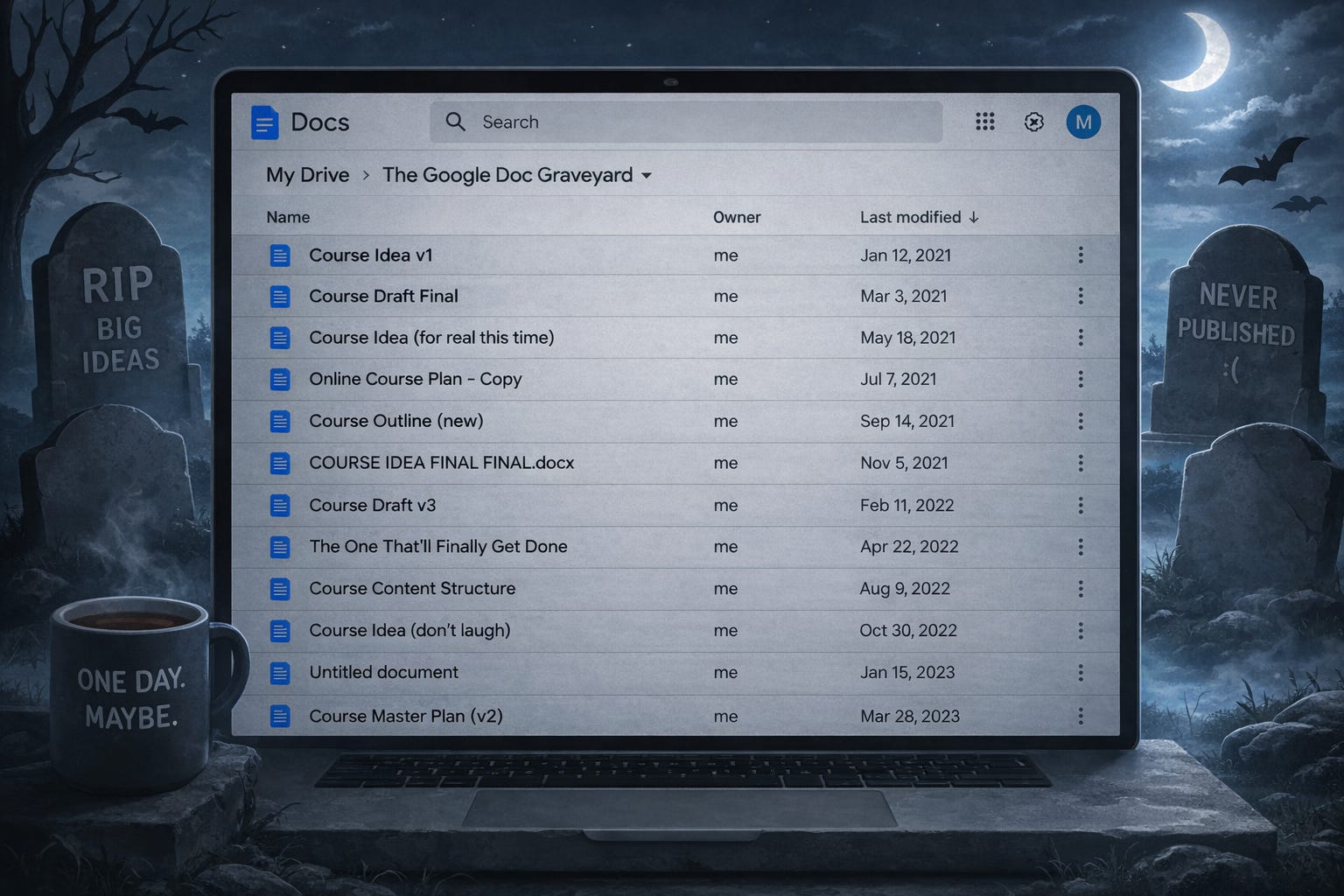
One thing you can do for me is reply to this email and tell me: do you have a course idea that’s been sitting in a Google Doc waiting for you? I read every reply, and your answer might inspire a future article.
Comments
Nothing yet. Say the first thing.
Sign in to join the conversation.