

Dear Senators and Congressmen investigating the next Global Financial Crisis (GFC): the below image / timeline should serve as Exhibit A as definitive proof the ratings process is 100% broken and absolutely feeding the many bubbles across global fixed income markets. Since the last GFC, we have learned absolutely nothing.
This timeline reflects a suspciously timed series of CLO methodology updates from Fitch and Moody’s that materially relaxed rating standards.
In this article I discuss the nature, impact and timing of the changes and include my full response to Moody’s RFC.
Thanks for reading Rod’s Substack! This post is public so feel free to share it.
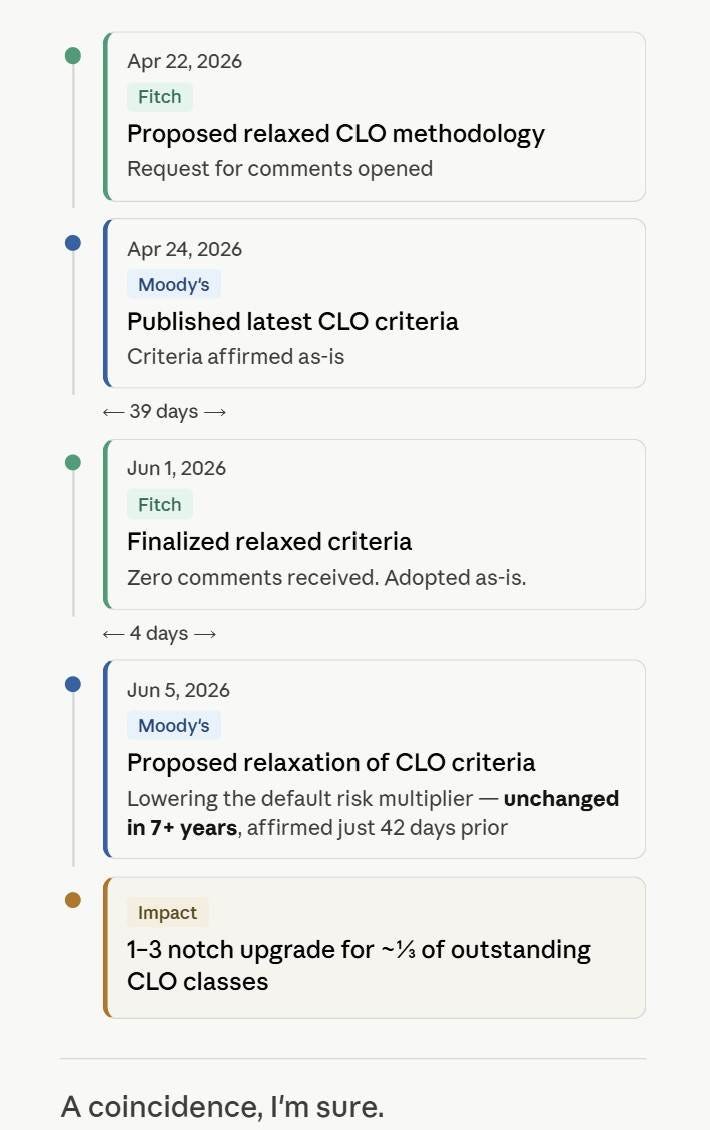
On June 5th, around one month since publishing their latest CLO methodology in late April, Moody’s triggered a red alert for me by publishing a proposed update to their methodology via a Request for Comment (RfC). I saw this as unusual. Material methodology update intervals can normally be measured in years not days. As I feared, this change resulted in a material relaxation of their criteria.
Such moves don’t happen in a vacuum. When I saw Moody’s announcement, I recalled that Fitch just 4 days prior to Moody’s RfC announced their own relaxed CLO criteria. Did Moody’s coincidentally relax their criteria 4 days after Fitch finalized their relaxed criteria? Was this a genuine organic change in approach? Or was this an act motivated by profits and market share? While I obviously can’t know for sure what motivated Moody’s sudden change in methodology the coincidence in timing with Fitch’s action does raise the specter of competitive relaxation.
In my view, this was no coincidence. While few would be surprised by the fact that rating agencies lower their standards to win market share, the fact pattern in this case makes this a more likely textbook case of market share driven criteria relaxation.
Of course, Moody’s change was peppered with credit rationale and backfilled with data to support their argument. They can’t and wouldn’t simply relax criteria to compete with Fitch’s move. They needed to create a pretext to justify the move.
This sequence of rating methodology changes should raise a 5 alarm fire for anyone who considers ratings integrity with even a modicum of importance.
In terms of magnitude of the rating action see below from Fitch:
Fitch estimates between 5% and 15% of its CLO note ratings may change because of the new criteria, with all rating changes expected to be positive.
Moody’s for their part projected a 1 to 3 notch upgrade for 1/3 of outstanding classes.
More important is the impact these changes will have on new CLOs - to be consistent the new criteria as applied to new deals will likely improve the capital structure of new deals, thereby improving the CLO arbitrage leading to more deals and better pricing for Leveraged Loans. I discuss this in more detail below.
The failure of rating agencies to act, enables more reckless Broadly Syndicate Lending (BSL) and as long as the RAs stand down from taking necessary action, the day of reckoning will be delayed. Rating agency blind obedience to profits and market share above all else creates the illusion of stability and feeds the growing bubble.
CLOs act as silent jet fuel for the entire private equity ecosystem.
BSLs don’t exist without CLOs. Private Equity doesn’t exist without BSLs. CLOs are the fragile foundation on which trillions of private assets are built.
By way of analogy the easy criteria for subprime and option arm mortgages created a larger, illusory “healthy” mortgage market and contributed to the appearance of a healthy real estate market. The inflating of a bubble creates an illusion of health during the build phase. Had the bubble been identified and stopped earlier (eg 2004) the much larger bubble origination vintages of 2005-2007 would not have happened and the fallout would have been much more benign. And maybe if action was taken in 2004, there would not have been a GFC.
I include my letter in full below but here is a summary:
Deteriorating metrics not mentioned: As I pointed out in my letter to Moody’s, two assumptions – loan recoveries and default correlations - have gotten materially worse and these factors remain unchanged. Despite loan recoveries reaching a 10 year low in 2025 (according to Fitch) the rating agencies continue to use legacy recoveries that are completely out of touch with today’s reality. Correlation assumptions are the most important input allowing Single B junk loans to be spun into risk free AAA bonds. This is particularly important in light of software exposure and potential convergence of AI risk.
Timing of action: I asked Moody’s to explain the timing of their action coming so soon after their latest published criteria. As I note in my letter, one component of their criteria that eased - lowering the default stress multiplier - had been in place unchanged for at least 7 years (I have their 2019 criteria around the time I started deep diving and reverse engineering Moody’s CLO model).
Impact on New Issue credit support: Relaxation of criteria improves the economics for originating BSLs and improves refinancing of existing loans as CLOs are now cheaper to issue (ie more AAA and AA securities means lower overall cost of BSL funding). As I noted above, this helps grow and prolong the bubble. This is an optical illusion that will result in a greater fallout in GFC 2.0.
As Moody’s only mentioned the impact on existing ratings I suggested they include the impact on credit support requirements for new deals. In my letter I included results from our own replication of Moody’s model (link here) which revealed a 5% drop in AAA credit support.
Moving from covenanted collateral to actual collateral: Historically Moody’s modeled CLO collateral using the covenanted collateral attributes rather than actual. They did this because CLO managers may currently have more conservative collateral but had the option to manage collateral closer to the riskier edge of the permitted covenanted criteria.
Moody’s decided now was a good time to give the active CLO manager the benefit of the doubt and use the actual collateral rather than the collateral permitted. It is already a risky prospect to assign a AAA rating to an actively managed blind pool. Moody’s has now removed another guardrail from an already dubious rating process.
See my full response below for graphics and added detail.
July 4, 2026
I am a 30-year Wall Street veteran currently running my own research and analytics platform called The People’s Economist (TPE). I worked for Moody’s during 1997-2000 covering RMBS including the predecessor to the subprime RMBS deals that contributed to the Global Financial Crisis (GFC). I also rated resecuritizations of RMBS securities until that structure was replaced by the ABS CDO, another culprit of the financial crisis. I still hold shares in Moody’s from when I worked there.
Since 2020 I have been researching, critiquing and commenting on CLOs. A research paper I wrote on CLOs was published in the Journal of Structured Finance in 2020.
I have reviewed your latest CLO methodology Request For Comments. Other than the fact that I find the easing of standards poorly timed, below are some specific concerns, comments and questions.
1. Timing of Proposed Changes: Prior to the June 5th proposed CLO methodology changes, your latest CLO methodology was published on April 24, about 1 month before the latest proposed changes. It would be helpful to provide some insight on the timing. Specifically, what changed in the last month that justifies such a dramatic relaxation of ratings criteria?
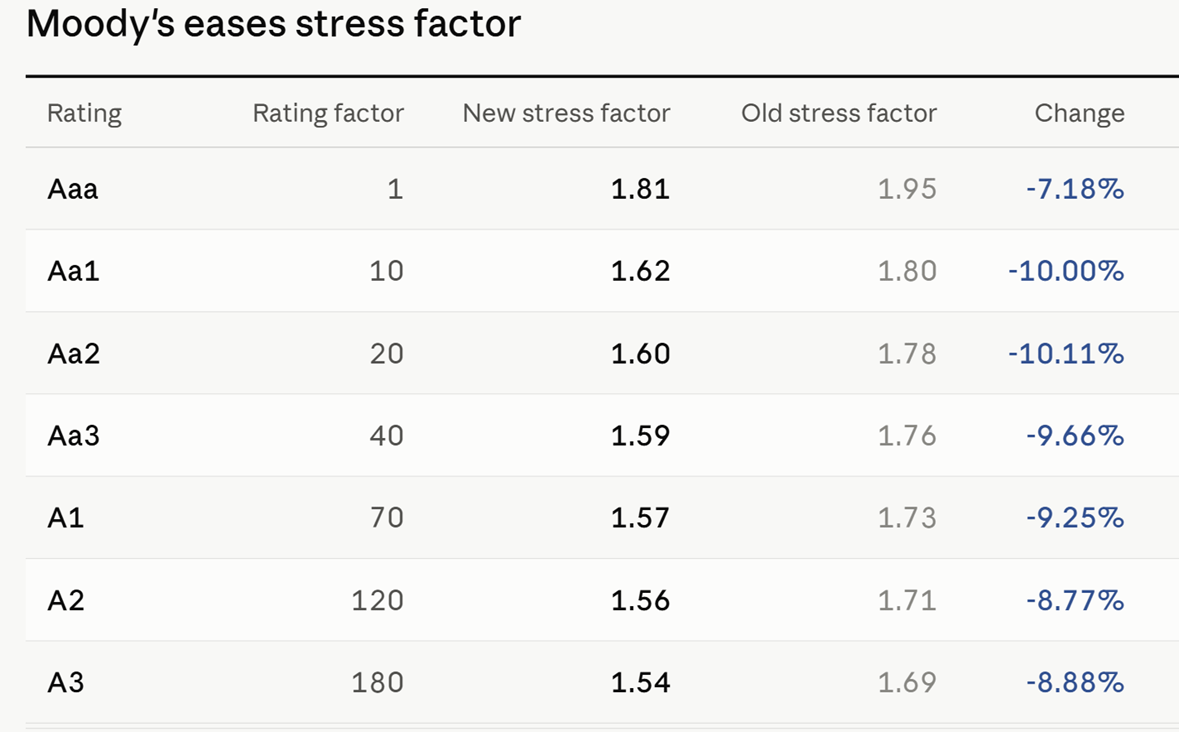
For example, your default probability stress dropped from 1.95 to 1.81 for AAA from the April update. It’s hard to understand the timing of such a change considering that the numbers were just affirmed on April 24, and the 1.95 multiplier is itself a figure that has been in place since 2019 if not earlier.
As the prior stress factors weren’t included in the proposal I have included the old vs new stress factors in the table below.
2. Can you explain why your model update doesn’t include increasing correlation risk given the convergence in software risk? It’s rare that I see any change in correlation assumptions when that is the single most important input enabling Single B assets to support 70% AAA debt. In my view, correlation should be a dynamic factor updated regularly. Can you provide insight as to why correlation assumptions aren’t updated?
3. Impact on Credit Support for new deals: The proposed methodology change indicated a 1 to 3 notch upgrade for 1/3 of outstanding classes. This is clearly a relaxation in your methodology. Is this expected to be reflected in lower credit support for new deals?
It’s important to disclose the expected impact these changes will have on credit support on newly issued deals as well as the impact on your market share.
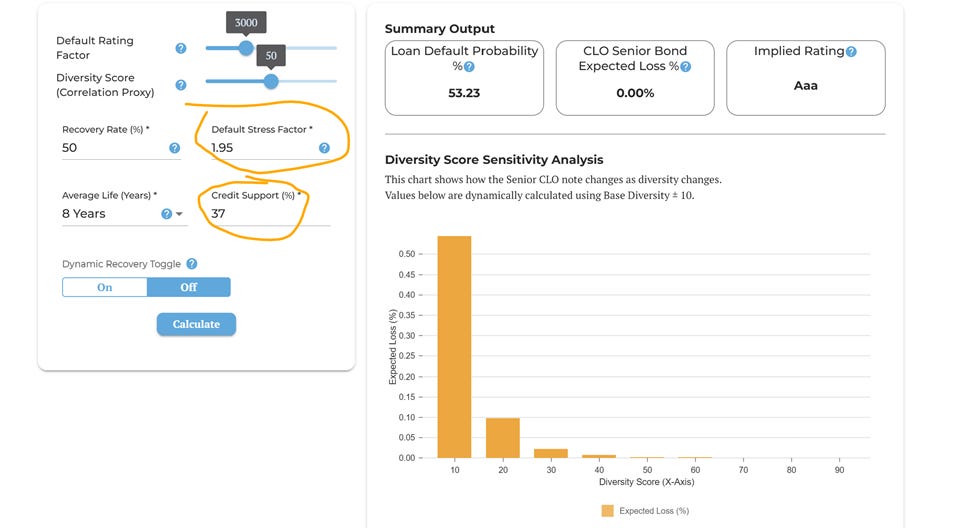
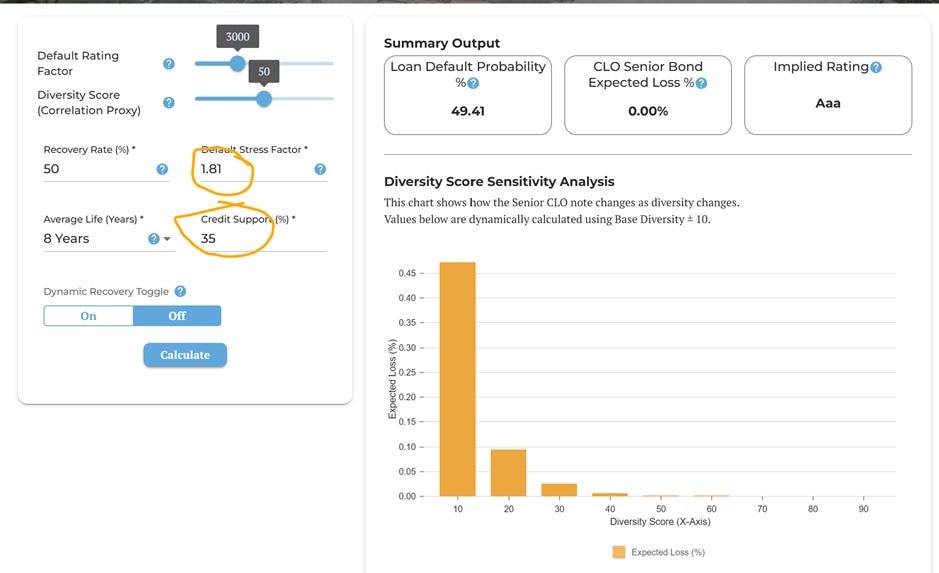
At TPE we have developed a simple, open-sourced version of Moody’s BET CLO model. Our model indicated that just the change in the default stress multiple alone (not including the other changes) could result in a 5% drop in required AAA credit support. See below images. While TPE’s CLO model is an abstracted simplified version of the full CLO cash flow model, I think it’s important for Moody’s to include a similar indication of impact on newly issued CLOs. The actual results will vary but directionally, reducing the multiplier will certainly lower credit support requirements for newly issued CLOs.
It is critical to understand the model impact not just on outstanding ratings but on the structure of new issue deals going forward.
Our CLO model can be accessed here:
https://www.tpehub.com/clo-rating-calculator
Credit Support Required Using April 2026 Default Multiplier
Credit Support Required Using June 2026 Proposed Default Multiplier
4. Recovery Rates: Your model update doesn’t consider the sustained and dramatic drop in recoveries compared to modeled assumptions. With the widespread use of covenant lite loans and the visible consequences of Liability Management Exercises, I would think that Moody’s should include reduced recovery assumptions into the CLO model. In fact, a review of the recovery table in your June 2026 methodology update looks identical to the recovery rate assumption table from your 2019 methodology.
Given the decline in recoveries and the real degradation in collateral attributes can you explain why the recent deterioration hasn’t been reflected in a change in recovery rate assumptions in your methodology?
This is a systemic drop that clearly represents a material deviation from modeled assumptions. As but one example I note the following headline, from another rating agency from April:
“U.S. First-Lien Recoveries Fall to Decade Low in 2025”
5. Switch from covenanted collateral to actual: One aspect of the criteria weakening is the proposal to switch from covenanted collateral attributes to actual collateral attributes. My understanding is that the purpose of using covenanted attributes is that actual current collateral attributes may be more conservative than the covenanted metrics, and since the CLO manager may manage the portfolio to the riskier edges of the permitted covenanted criteria, Moody’s traditionally assigned ratings based on the covenanted attributes rather than the actual. Why would Moody’s decide that now is a good time to ignore portfolio quality drift that may result from active CLO management?
6. Overall, it’s quite surprising to see a methodology change that only relaxes the criteria given the obvious deterioration and growing risks in collateral performance.
No posts
Comments
Nothing yet. Say the first thing.
Sign in to join the conversation.