
This article was largely completed before news broke last week that Jane Street Group (JSG) lost $15B in July and refinanced $15B in public debt to private debt. The news dropped a couple of hours after I did a podcast where I warned of risks associated with Jane Street (and SoftBank).
The spin on the refinance was the joy of privacy but I suspect the reality was that the loss would trip a covenant in the public debt. This has all the earmarks of a bailout or distressed refinance. I don’t believe the refinance and $15B loss are a coincidence.
In case you wonder whether the market is rigged, S&P and Fitch confirmed their ratings in the face of the refinance but in their press release said nothing, not a word about a $15B loss. You would think that a $15B loss is vaguely relevant to the rating and the lack of a mention can only mean one of two things: the ratings agencies didn’t know or they knew and didn’t disclose. Either is bad.
In fact in their credit confirmation note, Fitch touted JSG’s “strong earnings generation.” Seriously? Nothing about a $15B loss? This is abject failure by Fitch. S&P also noted JSG’s “track record of strong profitability.” No mention of a record loss.
S&P rates JSG BB and though the outlook is positive, the warning below, before the latest refinance and loss news, seems to be a red flag:
“JSG continues to expand at a very fast pace, as seen in a surge in the total size of its balance sheet, margins posted to prime brokers, and value-at-risk on trading positions, indicating the firm’s comparatively higher risk appetite versus that of peers in our view. We think such a growth focus can manifest a number of risks, including regulatory risk.”
S&P’s warning of surging assets and risk appetite is particularly notable in light of this week’s news and makes one wonder why they would have a positive outlook.
Moody’s hasn’t updated their Ba1 ratings since the latest news. Perhaps Moody’s was disinvited to the rating party because they thought that a $15B loss was worthy of a downgrade.
Moody’s did take action on July 22 – they changed the outlook to positive. 2/3 of the way through Jane Street’s worst month.
Further, none of the Rating Agencies seemed too concerned over recent revelations of JSG’s practices such as accusations of manipulation in India and Crypto insider trading, both discussed in more detail below.
Notably, Moody’s set the following thresholds for downgrade.
“• A sustained decline in the liquidity buffer
• A sustained increase in the ratio of long-term debt to tangible equity
• Increase in risk appetite or a significant risk management or operational failure.”
Recent events should have triggered some of these downgrade concerns.
The ratings are critical as whoever is going to buy the new private debt will do so, in part, based on the ratings.
The loss raises the urgency of my argument that Jane Street is systemically important and their massive revenue (greater than Goldman and the 2 Morgans) can’t be explained away by market making and quant arb. There must be more to the story. And so there is. Much of it I reveal below to the extent it’s available from public sources.
This is a story every American needs to understand. This is a story that strikes at the heart of the market machinery and whether Jane Street’s practices hurt the average retail investor. Jane Street is one of the most critical market actors in the US both as market maker and as an Authorized Participant (AP) in the booming ETF market.
This is my second article recently featuring Jane Street. Writing 2x about Jane Street in one week wasn’t on my bingo card. But here we are. In an article last week, I wrote about their participation in a CoreWeave data center deal and the suspiciously curiously timed Fitch upgrade of Jane Street from junk to Investment Grade (IG) in the middle of the troubled CoreWeave deal where Jane Street played a critical role.
Connecting several recent stories and analyzing the Jane Street’s SEC filings and two very public lawsuits, I have become deeply concerned that something is wrong at Jane Street. And perhaps that means something is wrong with the overall market writ large.
What if much of the US stock market volatility wasn’t the organic forces of supply and demand (or fixed income or Silver or Gold or Crypto markets)? Has Jane Street migrated from market making and quant arb to more dangerous methods such as large directional bets or poorly hedged arbs? Or worse, as the Indian manipulation allegations and Crypto insider trading lawsuit suggest. I discuss these in more detail below. India brought some serious receipts on the manipulation side and the evidence presented in the insider trading lawsuit is compelling, though Jane Street denied both.
Perceptions of market manipulation was a driving force behind the MEME stock movement – ie concerns that the market is rigged against retail led armchair retail traders to turn the tables on the perceived market manipulators – short sellers in that case.
There are few market actors that are as critical to market functioning as Jane Street. Attention must be paid.
The first yellow flag for me was Jane Street’s role in the spectacular collapse of the AI focused Situational Awareness fund. Jane’s Steet’s $2.5B investment would seem to be outside their wheelhouse of market making and quant trading. According to the WSJ, Jane Street’s SA investment grew from $2.5B to $10B and dropped back down to $3B after the July crash.
Notably Jane Street rode the AI wave far beyond SA. In addition to SA, there is Jane Street’s very large relationship with CoreWeave which I wrote about in my prior article - in Apr 2026 they executed a $1B investment plus a $6B compute commitment. Jane Street also invested in Anthropic, initially as part of the liquidation of the FTX fund, but also in a more recent fundraising round. According to the Wall Street Journal, JSG has amassed a $20B portfolio of private assets. That large a commitment to illiquid assets is far afield from JSG’s historical comparative advantage.
The combined ~$30B exposure mentioned above, is separate from the large public bets that JSG placed across the AI landscape which I discuss in more detail below.
I found something surprising, maybe troubling, in a recent JSG 13G filing. 13G filings are required for passive investors who cross the 5% ownership threshold. Specifically on Aug 4th, Jane Street reported holding 7.4M shares in memory chip maker Sandisk. The 5% reporting threshold includes shares held and call options expiring in 60 days.
Looking at Jane Street’s 13F quarterly holdings report, reveals that JSG held shares + calls in Sandisk equal to 3.9M shares in Q1. Therefore, between Mar 31, 2026 and the 13G filing on August 4, JSG increased their Sandisk holdings 2x their (from 3.9M to 7.4M). That would coincide with the period leading into the Situational Awareness melt down.
Further, between Q1 and Q2, JS bought more calls, shares and puts on Sandisk.
I can’t tell whether this was a directional bet, but when JSG crosses 5% threshold in one quarter with a company as large as Sandisk it begs the question – what was JSG’s trading strategy and was the implosion at SA a motivating force in Jane Street’s trading (either defensive or offensive).
I discuss Sandisk in more detail below.
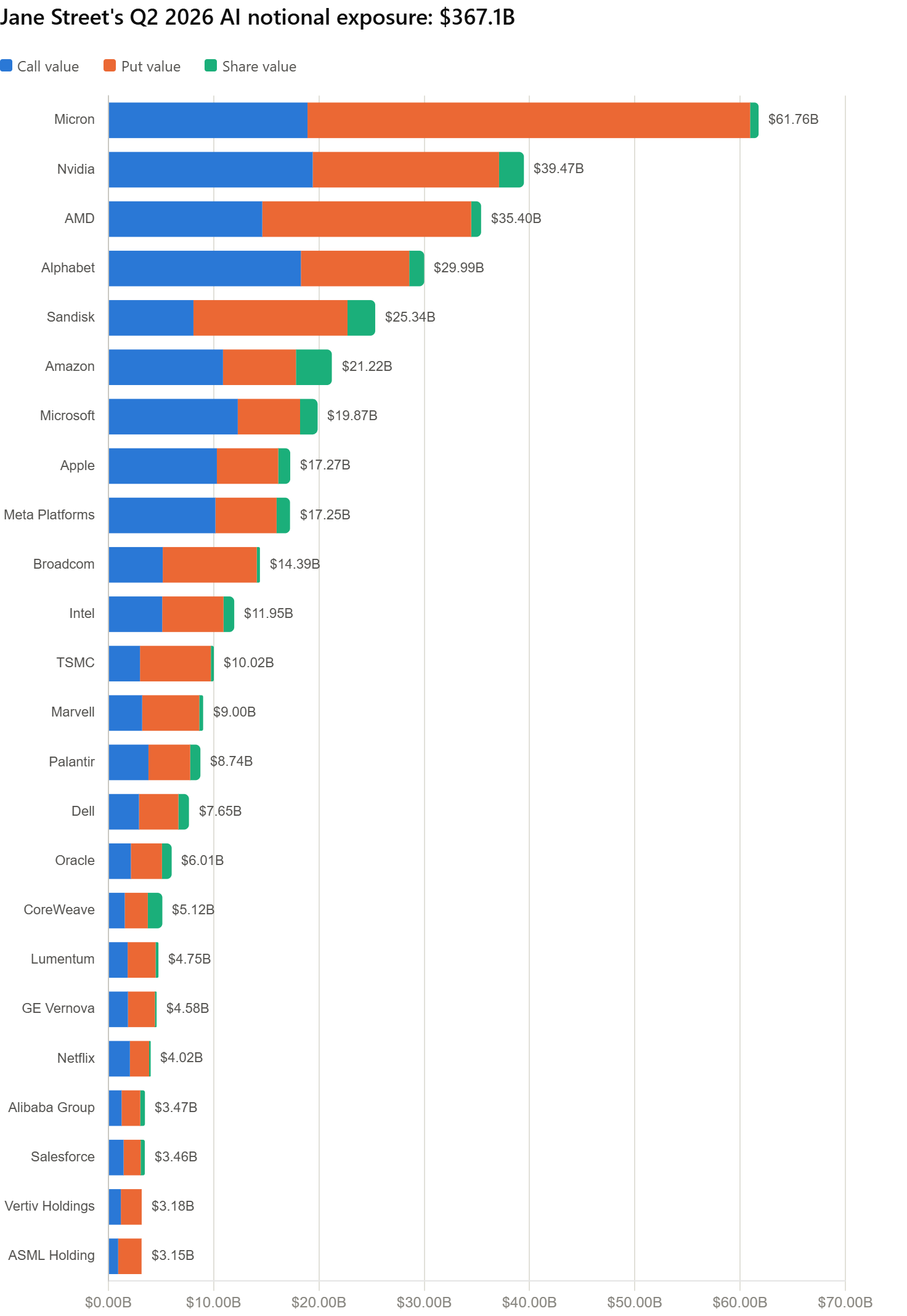
Based on their 13F just released Friday Aug 14, the chart below reveals Jane Street’s top 25 AI related exposures totaling $367B. As the chart reveals, most of the positions were options positions. The total notional is obviously not meant to indicate a direction bet but rather as a proxy of the size of their exposure. The filing doesn’t include option strike price or expiration so assessing the true net long / short is difficult but simply netting the puts, calls and shares reveals multi billion long or short bets at the individual company level.
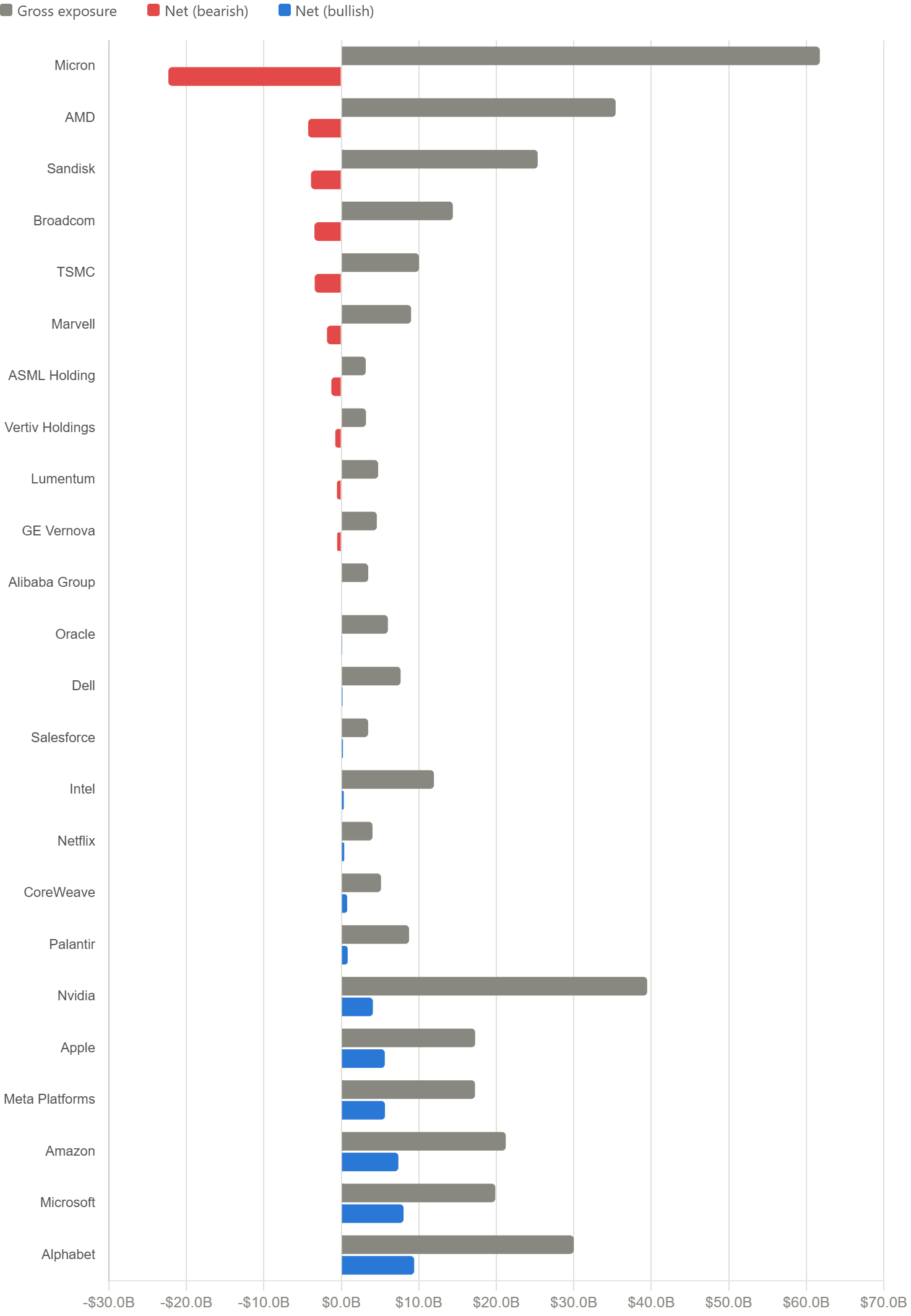
The below chart shows net bullish/bearish positions for JSG as of Q2. Note the outsized bearish position on Micron.
It’s difficult to precisely characterize positions as bullish or bearish. Rather my goal is to show the large amount of capital that JSG wielded in the middle of an intensely volatile time for AI related stocks.
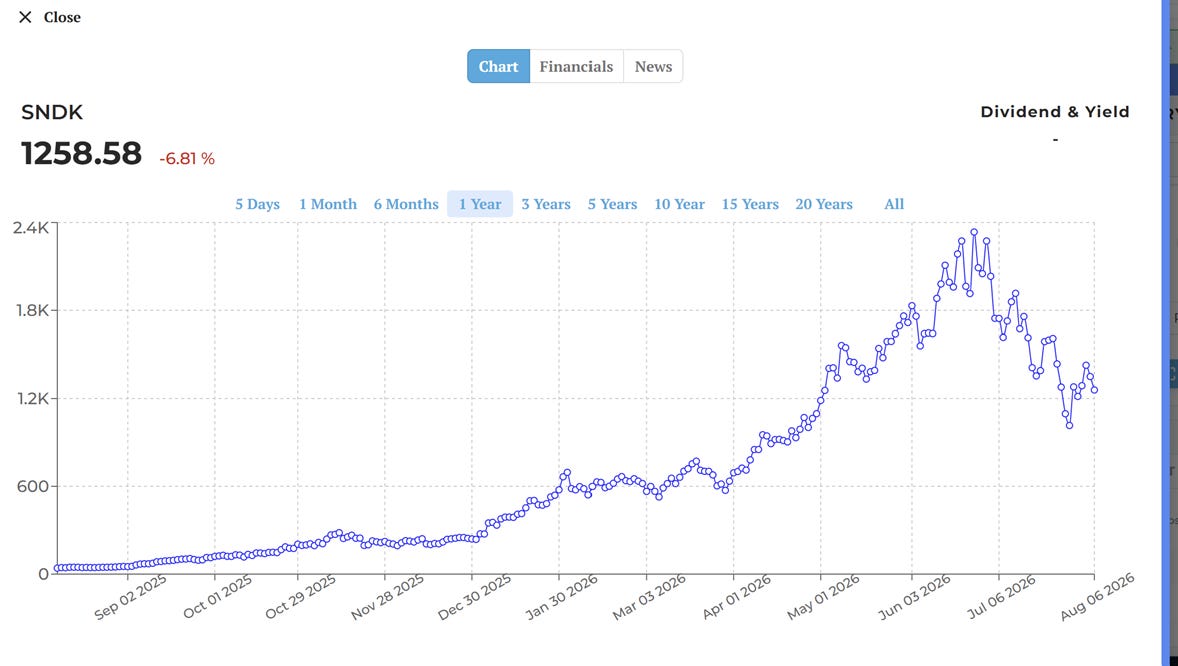
Sandisk’s price soared 4X to 2400 from earlier in the year and subsequently dropped 50% to 1200. This could trigger enormous losses even for a reasonably hedged position. Also, I think it’s important to ask the question: Did JSG’s trading itself contributed to Sandisk’s price volatility? Not to mention the other AI stocks mentioned in this article.
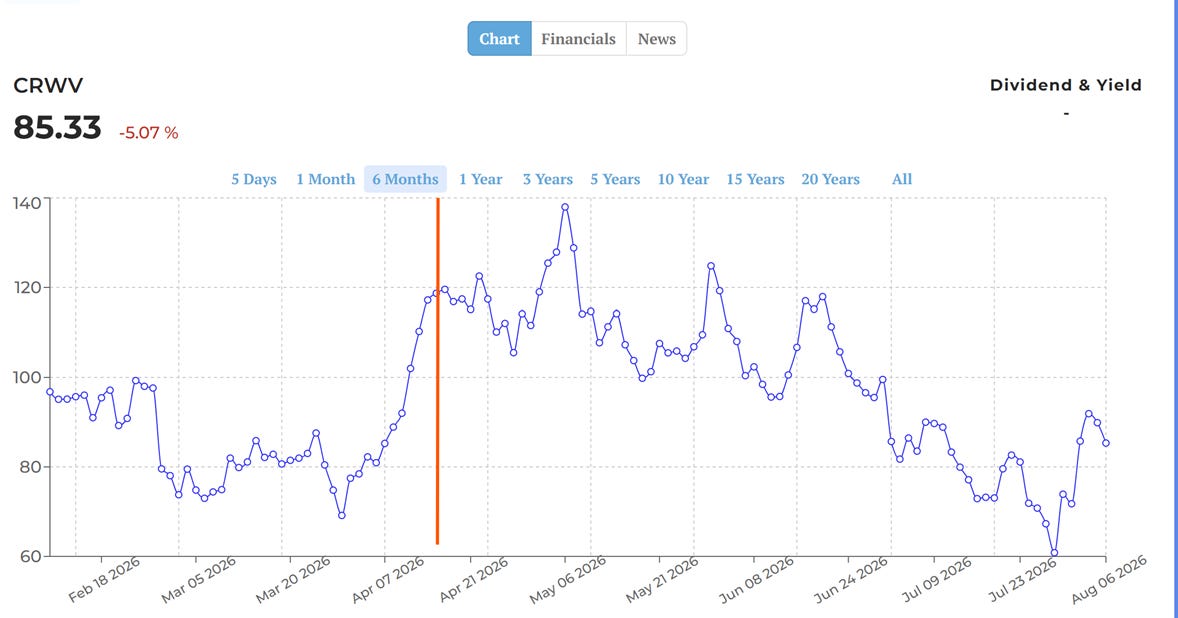
For CoreWeave we know JSG committed to the purchase in April and based on prices around that time, Jane Street’s CoreWeave shares were down 30%. (85 currently vs 120 around the time the purchase was announced). Though it’s difficult to confirm actual losses since, as the above chart shows, JSG had a fair amount of exposure to CoreWeave via put options.
Source: TPEHUB
Jane Street had more than just a passive investment in SA. According to the WSJ:
“Jane Street has invested alongside Situational Awareness in venture deals in addition to allocating to its hedge fund. The two firms were the lead investors in a February round for MatX, an upstart AI chip maker, and are investing in a new round for Fluidstack, a provider of AI cloud computing.”
Situational Awareness also had large positions in Sandisk (and many other AI related shares that JSG also had exposure to).
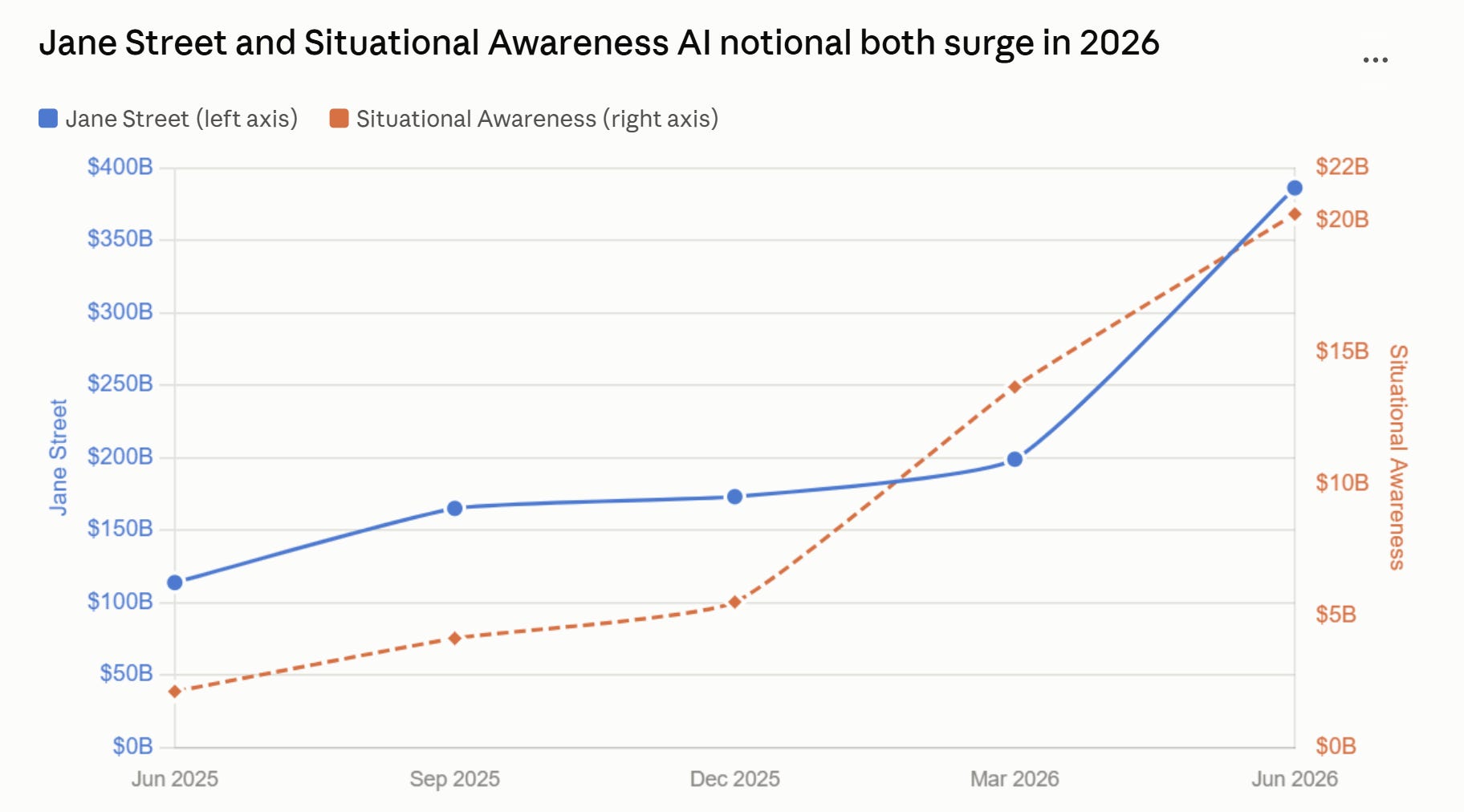
And as the chart below shows, exposure to AI related stocks exploded for both JSG and SA throughout 2026 particularly in Q2.
Case Study: Sandisk
The truth is I don’t have data to confirm this. But I have enough data to track the overlap of trades between JSG and SA, of which there are many. Also, as JSG invested in SA it’s likely they would get non-public confidential reports. While SA is required to publicly report quarterly holdings, JSG as an investor may get investment reports from SA with far more detail and frequency. JSG would also likely be involved as SA faced a margin call cliff. It’s also likely that SA would have approached JSG for more capital. In light of JSG’s $15B loss, if JSG traded in coordination or against SA it either didn’t pay off or the benefits were swamped by JSG’s overall positions.
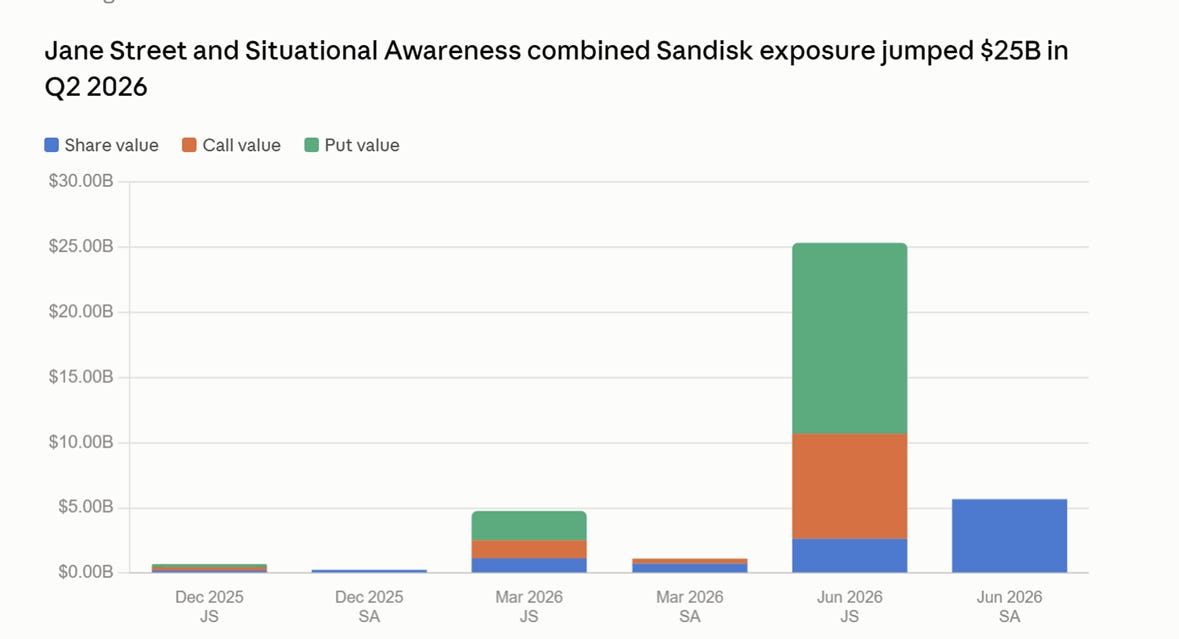
The chart below using positions in Sandisk reveals one example of how JSG and SA’s positions changed during the quarter in question. The chart reveals that both JSG and SA increased exposure to Sandisk from virtually zero in Dec 2025 to $35B combined. SA’s increase was mostly in shares, while JSG’s increase was a combination of shares, calls and puts.
Jane Street isn’t just a prop trading firm – they are a critical part of the equity and debt market financial plumbing. Jane Street is a behemoth in market making and is one of the largest Authorized Participants (AP) in both fixed income and equity ETFs. One source put their market share in Fixed Income ETFs trading at 41%.
APs play a critical role in creating and redeeming ETF shares - exchanging baskets of underlying securities for ETF shares (or vice versa) - which keeps the ETF’s market price aligned with the value of its underlying holdings. Without APs ETFs don’t work – full stop.
This could all very well be just another finance story if it weren’t for two recent unrelated allegations that raise troubling questions about Jane Street’s practices. The two cases suggests that Jane Street’s special advantage goes beyond the best quant models and fastest computers. In these two cases Jane Street is accused of market manipulation and insider trading. Two distinct ways to gain a market advantage that have nothing to do with arbitrage and quantitative models, market making skills or an army of PhDs. These are just allegations with JSG having denied both.
As an MBA student at Duke University in 1985 I was fascinated by risk arbitrage which involved the simultaneous buying and selling of two companies involved in a merger. In the realm of Risk Arbitrage Ivan Boesky was the giant. I read his book of which I still have a copy. But it turned out Boesky’s special edge wasn’t an in-depth analysis of merger risk. His secret was simpler – insider trading - which he went to jail for. After the Boesky affair, I decided a career in risk arb wasn’t for me.
Boesky's downfall was criminal. The two cases filed against Jane Street so far are civil The SEBI (Securities Exchange Bureau of India) case is regulatory order and the insider trading case is a private lawsuit. Though the underlying conduct alleged in both cases isn't just civil - in both cases a criminal provision may be involved. SEBI's own statute carries a criminal provision it hasn't invoked, and insider trading, if it occurred, is a federal crime under U.S. law regardless of whether prosecutors ever pursue it.
Regarding the two cases against JSG, while I am not a lawyer, in both cases there seems to be compelling evidence. Of course, JSG denies both claims.
Even if JSG’s actions were legal (as they maintain is the case), it does suggest trading tactics that are not born from the minds of financial geniuses or lightning-fast computer trading platforms. Rather, it may have something to do with human beings looking for an edge. An edge that may disadvantage retail traders and many may consider unfair even if legal.
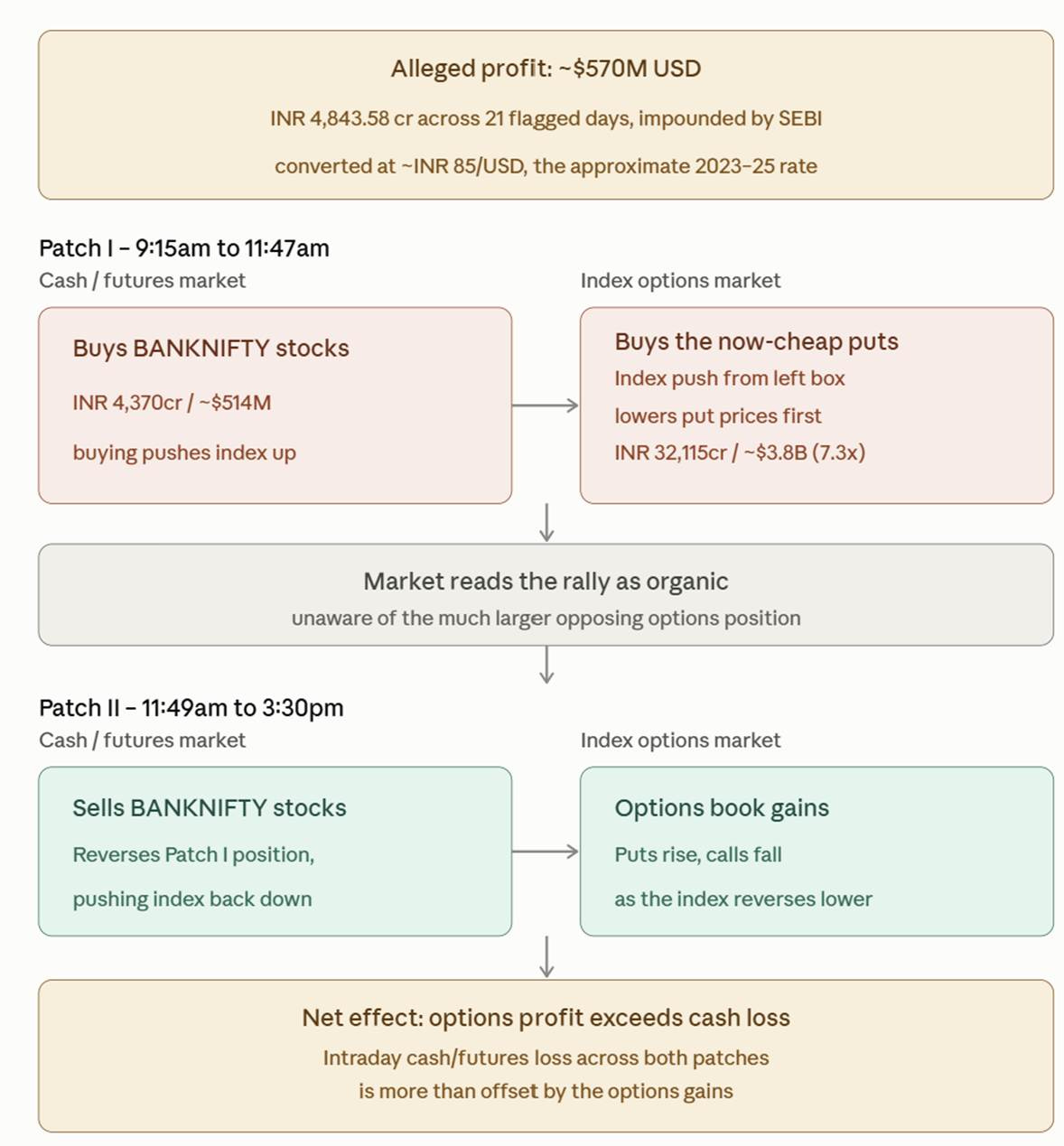
The SEBI lawsuit alleges that Jane Street aggressively bought shares and futures in the Bank 50 NIFTY index in order to artificially drive up the share price with the goal of reducing the cost of their real goal – bearish bets on the NIFTY via long puts and short call options. SEBI’s allegations followed an earlier caution letter to JSG in Feb 2025 not to engage in the type of trading they were ultimately accused of. So they were warned.
As part of the ongoing SEBI investigation Jane Street was required to post an impoundment close to the amount of the alleged ill gotten gains of $564M.
In India, the volume of trading is far higher in the options market than the stock market and therefore the cost of pumping the cash market is small relative the payoff in the far larger options market.
The Phase 1 goal (or Patch 1 in SEBI’s language), allegedly was to pump the shares while simultaneously buying ever cheaper puts and selling naked calls that expired on the same day. Patch 2 involved the dumping of the long shares and futures which drove the share prices down generating a small loss for JSG while at the same time unwinding the larger and far more lucrative bearish options position.
The below flow chart converted from a table sourced from the SEBI lawsuit reveals the core SEBI allegations.
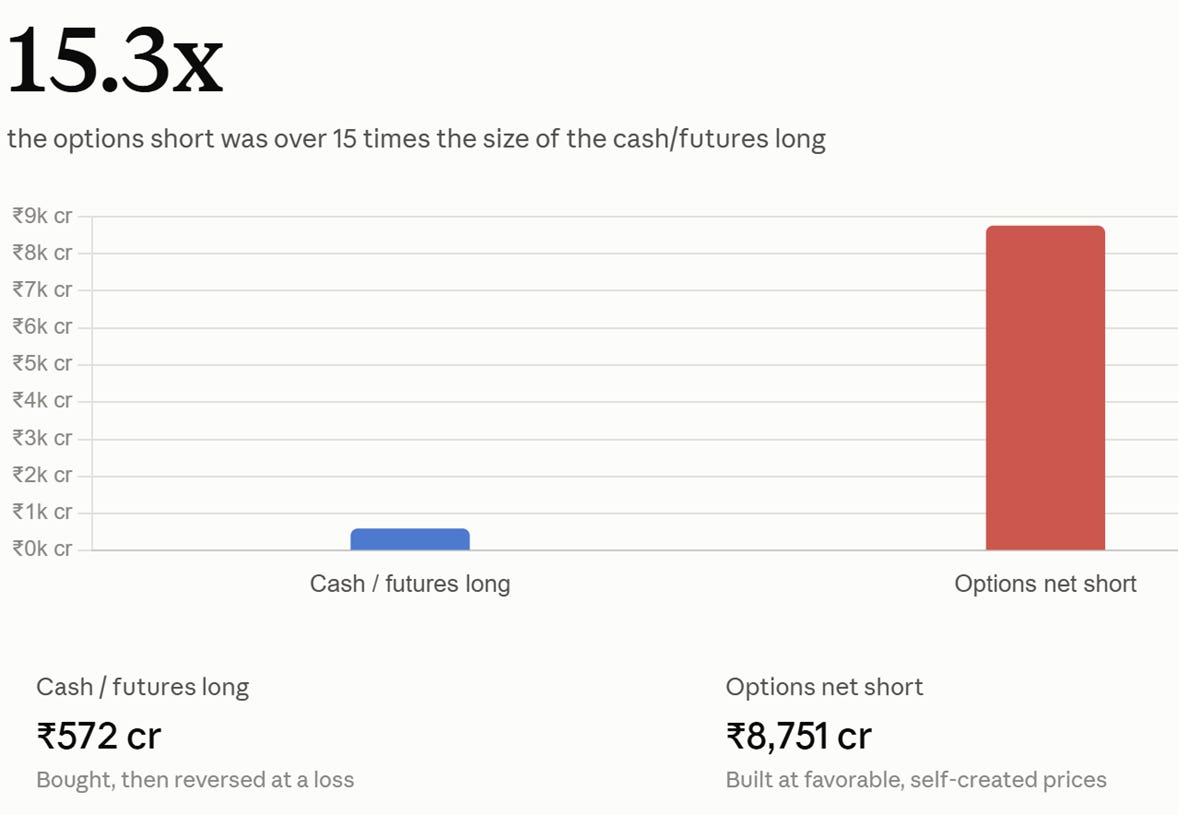
The bar chart below illustrates the massive difference in value between the long and the short. Traditional index arbitrage would tend to balance the long and the short. However, when JSG goes long in the thinly traded market while at the same time going bearish in a much larger size in the option market then clearly something beyond arbitrage is happening.
According to the Oxford Business Law Blog, the legality of the allegations may be beside the point:
“The implications of the Jane Street case go well beyond one firm. For high-frequency trading (HFT) firms, the order sends a strong message: strategies that cause measurable distortions to price discovery—even if profitable and seemingly lawful—may fall foul of market conduct rules if executed at scale with a manipulative effect.”
Another allegation against JSG relates to the Terraluna stable coin that collapsed in May 2022, leading to the Crypto winter and the spectacular collapse of FTX. In a filing in May 2026, the bankruptcy estate of Terraform (the firm behind the Terraluna stable coin) sued Jane Street alleging that they used insider information to trade in a way that accelerated the collapse of Terraluna.
Fun Fact: the collapse of Terraluna led to the downfall of Sam Bankman Fried’s FTX who started FTX after leaving Jane Street.
Stable Coins are pegged to 1 to 1 with the dollar. While normally the peg is achieved by holding dollar for dollar collateral such as US T-Bills, in the case of Terraluna it was an algorithmic stable coin – not a good design. Terraluna purported to maintain the peg by creating and destroying tokens based on supply and demand. The thought was this process would act as a stabilizer for the value of Terraluna.
It didn’t work out that way. The peg didn’t hold and Terraluna collapsed creating tens of billions of dollars in losses in its wake including FTX.
The “Bryce’s secret” referenced above refers to a chat established by Bryce Pratt a former Terraform intern who joined Jane Street in 2021. The lawsuit alleged that JSG used Pratt to reopen his channel of communications with his former colleagues and to obtain critical insider information that JSG used to their advantage. The suit alleges that JSG used this information to unwind a long position and create a short into the meltdown of Terraluna. JSG is also accused of deleting wallet records that could link them to the trade.
As stated in the lawsuit:
“Its abuse of material non-public information from insider allowed Jane Street to unwind hundreds of millions of dollars in potential exposure at precisely the right time, mere hours before the Terraform ecosystem collapsed.”
“Using that insider information, Jane Street sold off its UST at the opportune moment—on May 7, 2022—to maximize its own profits and avoid substantial losses. Within hours of Jane Street selling its UST holdings, UST was depegged from $1 and the entire Terraform ecosystem, including the UST and Luna cryptocurrencies, was in a death spiral.”
Jane Street’s defense is that their trades came after public information and that somebody can’t be sued when the companies own management itself perpetuated fraud (the Waggoner Rule).
Regarding the wallet deletion accusation the lawsuit references a Jane Street trader as suggesting “decommissioning Jane Street’s wallet.” As further evidence there is this:
“since May 2022, Jane Street has not accessed the wallet that it used to execute the trades that contributed to Terraform’s collapse.”
Jane Street is a systemically important market actor across equity, fixed income and commodity markets. Regardless of their official designation, this is a fact.
Jane Street’s massive revenues exceed that of the largest Wall Street firms including Goldman and the two Morgans. Such outsized revenues begs the question: How are they achieving such revenues?
Outsized bets on AI, their relationship with Situational Awareness and accumulation of $20B in private assets are strong indicators that Jane Street is making increasingly large and risky bets.
Accusations of insider trading and market manipulation can’t be ignored. Regardless of the fact that the allegations related to Crypto trading and activity in India, we can’t dismiss the possibility that Jane Street’s core activity in US markets may cross the line into practices that disadvantage retail traders - or worse.
No posts
Comments
Nothing yet. Say the first thing.
Sign in to join the conversation.