
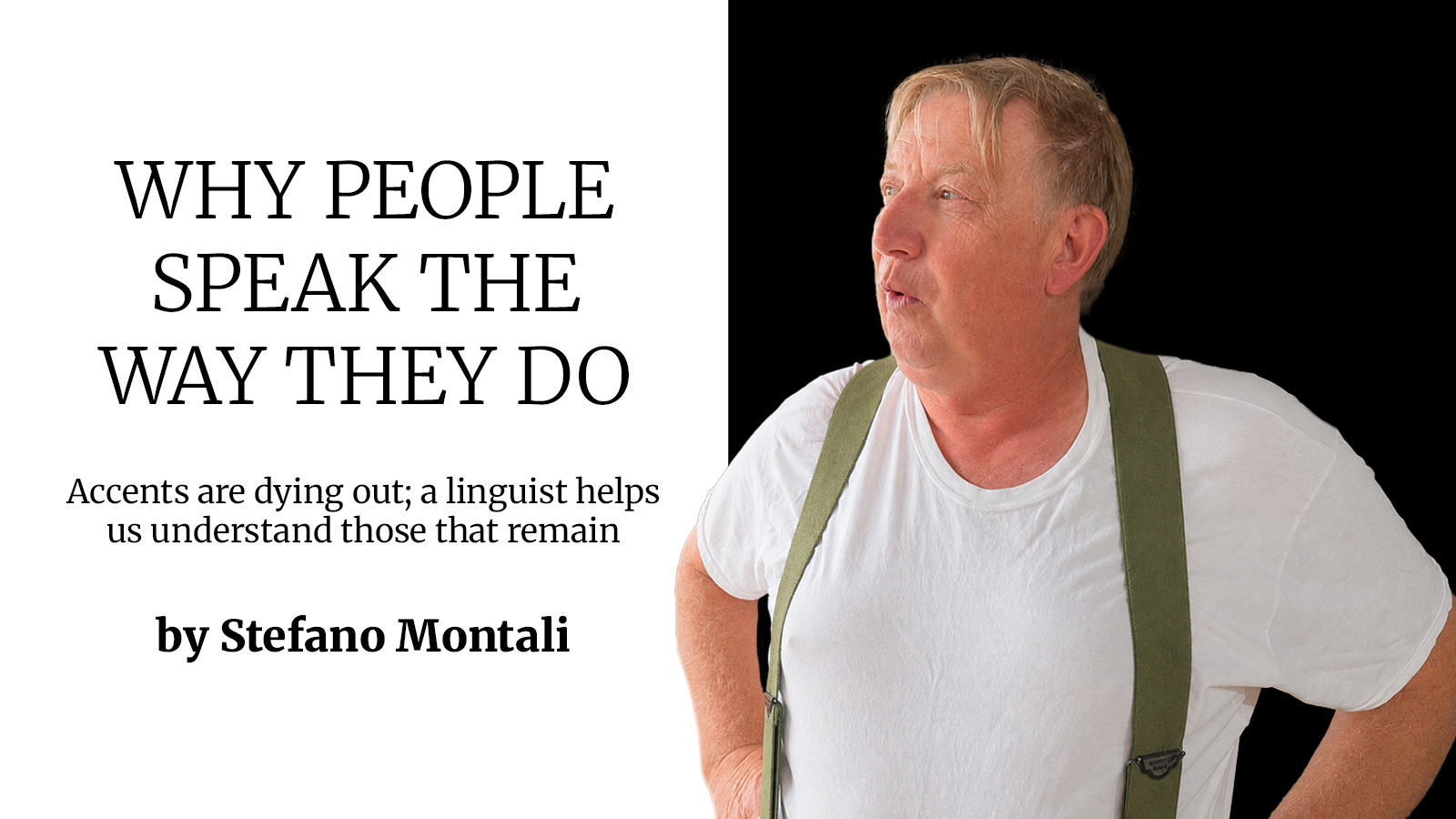
“Oh, you have to meet Tom,” a local farmer in Vermont’s Northeast Kingdom told me during a reporting trip a few weeks ago. I was up there to visit some of the area’s only remaining dairy farms and learn about life in the most rural part of America’s most rural state.
A few minutes later we were driving down a dirt road and descending the stairs of an old house into a dairy pen beneath it. An hours-old calf was lying by the door.
And standing there was Tom: A burly man with a big smile and bigger belly. My first thought was that he, with his faded white t-shirt, suspenders, and sun-kissed face, seemed pretty close to what I’d expected, but then he opened his mouth. Out came an accent straight from the Emerald Isle.
“Are you from Ireland?” I asked.

“No,” he laughed, “but I get that a lot. Born-and-bred Vermonter.”
I was shocked: Here was a man who’d barely left the state but spoke like he’d come from the other side of the Atlantic. After getting back to the office a few days later, I kept thinking about Tom and regional dialects and accents. Maybe all the talk about how social media and globalization are flattening cultures wasn’t fully accurate?
Wanting to know more, I reached out to Walt Wolfram, a professor at North Carolina State University, who’s run the North Carolina Language and Life Project for 32 years. As its head, Wolfram and his team collected more than 3500 interviews from all over North Carolina – considered the most linguistically-diverse state in America – and produced Emmy-award winning documentaries and oral histories.
He’s worked in sociolinguistics so long, in fact, that his first, sole-authored book in 1969 was originally titled “Detroit Negro Speech.”
“That’s how old I am,” he laughed. “It’s gone through about seven name changes since.”
Now 85 and recently retired, Wolfram told me that his interest in language came early, after his parents immigrated to the US in 1941 and settled in a German neighborhood in Philadelphia.
“Being German wasn’t very popular back then,” Wolfram said, “so I used to mimic all the American kids.” His now-wife, who was also a recent German immigrant, later told him that she fell in love with him because he sounded like a real American.
Wolfram – a delightful guy, prone to wearing colorful Hawaiian shirts – and I had a fascinating conversation about dialects. What makes North Carolina a trove of dialects? Why does Tom the dairy farmer talk as he does? In the interview below, we get into those questions and a whole lot more.

Comments
Nothing yet. Say the first thing.
Sign in to join the conversation.