

I’m in my third month as an MFA student, my latest life experiment. The other students are good at what they do, since they have been honing their art practice as photographers and filmmakers for years before arriving in this program. I know a little about a lot, including photography and film making, but not enough to master any one skill. I do know something about how curiosity can lead to a life of experimentation, and how experiments can build skills beyond mastery.
David Epstein, author of the book Range, provides timely assurance that the breadth of what you know is as powerful as the depth. It’s OK to be a generalist, he suggests.
Epstein doesn’t have anything against those who master a skill. He believes that it’s important to have both specialists and generalists. He says we need humans who excel at “mental meandering and personal experimentation.” And as Supreme Court justice Oliver Wendell Holmes said, “…all life is an experiment.” Indeed, it is.
We generalists are suckers for experimentation. Or, as my art school advisor said this month, an artist can be someone who improvises, not always the artist whose photographs are technically perfect, or painters who can capture an image or emotion with precision. Nothing wrong with those who specialize and achieve excellence in their field, but sometimes the ability to have a range of ideas and the ability to connect them, build on them, makes for experiments that add to our overall understanding of our world and ourselves.
When not groping my way through my art life experiment, I continue to read The Lunar Men by Jenny Uglow. The members of the Lunar Society were expert experimenters. During their years together (1730-1830), they had an insatiable appetite for experimentation as a way to gather knowledge. Their quest for knowledge felt magical. They emerged from a world of alchemy and natural potions to a more structured process of understanding the world. Science as we understand it now was still understood as knowledge, philosophy, and existed somewhere in between science and alchemy. Some of the experiments performed by the Lunar men seemed audacious, glamorous, and even magical. In a way, the Lunar men became sorcerers, conjuring natural phenomena to appear without a rational explanation.
They saw experimentation as a way to be playful, performing experiments in public and private for their own amusement and for others. They had a sense of humor about experiments. Uglow mentions an alleged use of a magnet by the Lunar men to disrupt a magic show, just for fun.
In their enthusiasm to acquire new knowledge about materials and phenomena, they made bold experiments, often risking the occasional blowing up of each other or unexpectedly electrocuting one another.
Consider the Lunar man, Joseph Priestley, discoverer of oxygen. He was lighting materials on fire for decades before making his famous discovery. While experimenting, he was also writing about religion, grammar, education, electricity, optics, and chemistry. He was a generalist, and as Uglow writes, “he felt that he was adding to a shared body of knowledge that would lead to a better future.” His fellow Lunar man, James Watt, an expert on steam power, origin of the word “watt” and “horsepower,” described Priestley’s way of experimentation as “his usual way of groping about.” It’s a relief to know that groping can lead to a discovery.
Another Lunar man, Richard Lovell Edgeworth, was an inventor who had time for four marriages and 22 children. That’s notable for something. His friend, Erasmus Darwin, joined him to create fantastic mechanical devices and modes of transport. In a way, they were both conjurers, coming up with magic tricks in the sense that they could come up with completely unexpected solutions to problems that didn’t exist at the time.
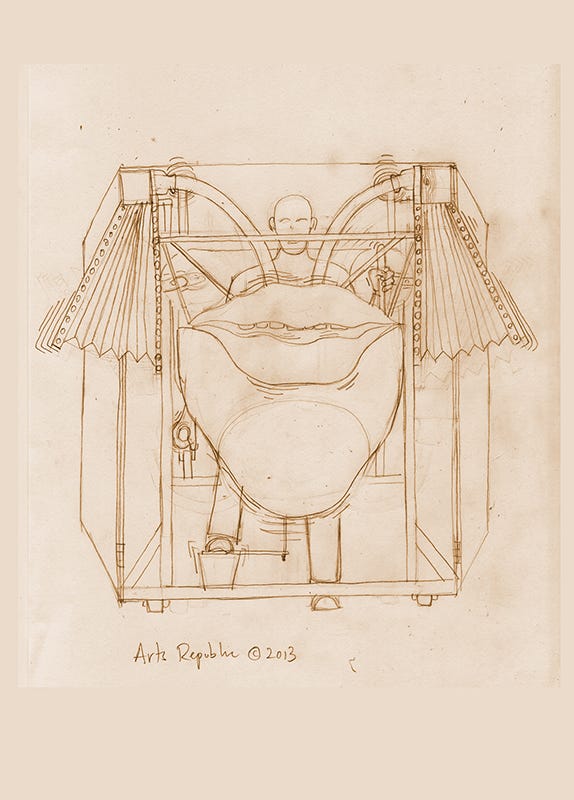
Both Darwin and Edgeworth designed models for new modes of transport. The other Lunar men did the same, as if under the same spell. Edgeworth came up with a carriage that carried its own road, in effect using iron rails that would be taken as the carriage passed over them, much in the same way as a Caterpillar tractor uses its treads. Darwin developed a more comfortable carriage suspension design using his patented spring wheels. Edgeworth designed a “walking table” which was really a rotating series of wooden legs carrying up to 4o men, according to a letter written by Edgeworth to Wedgewood in 1758. Both Darwin, Edgeworth, Boulton, and others were laying the groundwork for later improvements in road surfacing, carriage design, and propulsion, such as steam power. All of these inventions seemed impossible mechanical marvels, especially during a time when many of the necessary technologies to solve these problems hadn’t arrived. But these Lunar men were unstoppable and not hindered by the judgment of what would later become institutional, elite scientists.
Learning from these Lunar men, and my art school mentors and teachers, I now feel comfortable groping, experimenting, and seeing life itself as one grand experiment. One grand opportunity to improvise.
There are risks in not being an expert in a field, or knowing too little about a lot of things. In addition to blowing something up, I might be wasting time, mine and everyone else’s. Experiments, by their nature, often fail. I’m willing to risk some failure for the occasional course correction or insight that may lead to a new insight.
Join us for our next Lunar experience!

Read my books: Humans In Our Food / Food Routes / The New Wizard War / Meat, Commerce, and The City
Watch my films: Shelf Life / The Arc of Oblivion / The Long Coast: Stream on Amazon Prime or Apple TV
Comments
Nothing yet. Say the first thing.
Sign in to join the conversation.