
I’m speaking in person at two upcoming conferences in Canada — at Mad Pasts, Mad Presence at the University of Victoria in British Columbia on April 28th, and at Forced Treatments in Canada at the University of Ottawa in Ontario on May 14th. Both allow for online participation as well, and both promise many other interesting talks (and the Ottawa event will be completely bilingual French/English). More details about these conferences are at the end of this post. I’ll be tailoring my own presentations with specifics about psychiatric coercion in Canada, including discussing my January story about Canada’s first-ever nation-wide civil commitment data.
Following up on that, I recently obtained the latest data on forced psychiatric hospitalizations, for 2024/25, from nearly all provinces and territories across Canada. And something leapt out at me—a stunning trend that also appears in the best U.S. data.
I’ve been asking the nonprofit Canadian Institute for Health Information (CIHI) for any demographic information on patients that they could possibly gather alongside the raw numbers of detentions under civil mental health laws. Due to my experiences getting stonewalled by governments, I’d actually been suggesting to CIHI for about a decade that they were well-positioned to help gather important data on involuntary commitments. They started working with governments on this project several years ago and, this year, they were able to give me some initial demographic data—age group and “recorded sex or gender.” (CIHI says racial data has started to come in.)
First, let us take a pause here to, once again, fully recognize and absorb just this fact… that we so often do not have even this most basic level of knowledge about the people getting psychiatrically incarcerated and forcibly treated. It’s appalling. And it’s all the more an indictment of our society that so many politicians, journalists and commentators, mental health practitioners, and members of the general public defend and promote involuntary commitment practices when they can’t say virtually anything at all, statistically, about these people being stripped of their fundamental civil rights—let alone about what’s happening to them.
<aargh>
Moving on… I’ve posted the new Canadian data here.
The 2024/25 data from Canada show that there are continuing high rates of detentions compared to other, similar countries. My preliminary rough calculations do suggest a slight decrease in the rates per 100,000 population from the previous two years. (I’m working with a couple of academic scholars on a more detailed analysis of all of this data that CIHI has helped collect.)
Generally, rates of forced hospitalizations of males and females were approximately the same—although Canadian men were slightly more likely to get detained. The national recorded sex or gender across all age groups for psychiatric detainees was:
Men: 43,629
Women: 39,122
However, the recorded sex or gender for Canadian children and youth ages 0-17 detained against their will for psychiatric reasons were these:
Boys: 2,658
Girls: 5,354
There’s no big disparity in the number of male to female children in Canada. These numbers tell us that, in Canada, girls aged 0 to 17 are nearly twice as likely as boys to be hospitalized against their will for psychiatric reasons.
This huge 2 to 1 discrepancy is roughly consistent across the entire country, including in the northern, predominantly Indigenous territories. The only exception is three small provinces, all on the Atlantic coast, where the numbers of girls and boys getting forcibly hospitalized are equal.
What’s going on? These are staggering numbers reflecting a stunning, near nation-wide trend. But what IS the trend, exactly? What is causing this? Why are Canadian girls twice as likely to be incarcerated in psychiatric hospitals as boys?
I know of only one U.S. state that collects and publicly releases comparable data on the recorded sex or gender of children and youth getting forcibly hospitalized under civil mental health laws. Since Colorado started reducing the data it was collecting (that’s a story for another day!), Florida’s Baker Act Reporting Center regularly produces by far the most comprehensive reports on involuntary commitment in any American state.
After parents, journalists, and politicians started becoming aghast at the high rates of psychiatric detentions of children and youth in Florida, the Center has also released a special series of reports on the issue. Here’s one of the Center’s striking charts:
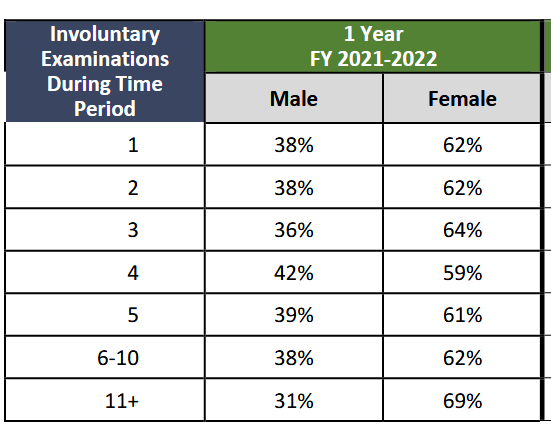
The Center’s 2023 Report on Involuntary Examination of Minors found that, looking across multiple years, “[n]early 66 percent of involuntary examinations of children (<18) are for females.” So, like in Canada, female children and youth in Florida are getting detained nearly twice as often as young males.
Unfortunately, the report authors barely discuss this eye-popping number. In their 2025 Report on Involuntary Examination of Minors, the Baker Act Reporting Center did note that their literature review found “studies reporting that males were at higher risk for aggression-related examinations, while females were more likely to be examined for self-harm behaviors.”
That may be part of the key. The 2023 Canadian Health Survey on Children and Youth, which included 11,899 respondents aged 12–17 years, found that females were 2.3 times more likely to have experienced suicidal ideation and 2.7 times more likely to have actually attempted suicide as were males of the same age.
We also know that suicidal feelings, suicide attempts, and self-harming behaviors are among the most common reasons people get committed. So, could this be why girls are so much more likely to be forcibly hospitalized than boys?
Perhaps. Could other factors also be involved? And even if we surmise that suicidal feelings are indeed the main driver, that only leads to more profound, still more disturbing questions. Why are girls in Canada and the U.S. much more suicidal than boys? What’s happening to them? What’s making them feel that way?
This is a broader cultural discussion that we clearly need—and this discussion should be much more deeply informed by the bleak reality of what we’re authorizing to be done to these children in the name of assisting them. More mental health practitioners themselves are trying to understand and grapple with the many studies showing that experiences of psychiatric hospitalization, both voluntary and involuntary, are linked to hundred-fold or more increases in suicides shortly afterwards, even among people who weren’t suicidal to begin with. So, have we started a worsening feedback loop? That is, it’s difficult not to wonder if hospitalizing these girls against their wishes has itself become a major driver expanding the problem— making them much more suicidal instead of less so.

Mad Pasts, Mad Presence brings together scholars, artists, activists, survivors, and community to reflect on the mad movement and legacies. This is a hybrid event. Please select the ticket type when registering. Tuesday, April 28-Wednesday, April 29 from 8 AM-5:30 PM Pacific time. In-person location: Clearihue building, Critical Humanities Commons, University of Victoria, British Columbia. The full program for this event is here, and registration is here. (I’m speaking at 8:30am Pacific on Tuesday, April 28th.)
Thursday, May 14, 2026 | 1:00 PM to 7:00 PM
University of Ottawa – Desmarais Pavilion, Room 12102
Online participation also available. In-person seating is limited.
Registration remains open until May 4.
This half-day of reflection and discussion will focus on psychiatric and addiction forced treatments in Canada. The event will include:
a presentation of the preliminary findings of the report Beyond Tomorrow: Psychiatric and Addiction Forced Treatments in Canada;
an overview presentation by Rob Wipond, author of Your Consent Is Not Required;
a panel discussion bringing together researchers, practitioners, and community voices;
a small-group discussion session, followed by a plenary debrief and a networking opportunity.
People outside the Ottawa–Gatineau region will also be able to participate by videoconference.
We also invite you to share this invitation within your networks with individuals and organizations who may be interested in these issues.
👉 To view event details and register:
We hope you will be able to join us,
Emmanuelle Bernheim, LL.D., PhD
Full Professor, Faculty of Law, Civil Law Section
University of Ottawa
Canada Research Chair on Mental Health and Access to Justice: https://sante-mentale-acces-justice.ca/fr
To consult my publications: https://uottawa.academia.edu/EmmanuelleBERNHEIM
Jean-Laurent Domingue, RN, PhD
Associate professor
Faculty of Health Sciences, School of Nursing
University of Ottawa
To consult my publications: Google Scholar
No posts
Comments
Nothing yet. Say the first thing.
Sign in to join the conversation.