
The Trump Administration’s strange new Department of Justice (DOJ) has suddenly and completely reversed course from decades of precedent, and has launched an assault on the laws that have helped tens of thousands of people get released from unnecessary long-term psychiatric institutionalization. These same laws have for decades buttressed the autonomy and independence of all disabled people. Disability rights groups are organizing to fight back.

First, the nice news: After twenty-three years of efforts, New York Lawyers for the Public Interest, Disability Rights New York, the Bazelon Center for Mental Health Law, and Mobilization for Justice announced in July, with fanfare, the conclusion of a seminal court case and settlement surrounding the unconstitutional confinement of people labeled with mental disorders.
According to their joint media release, the case began in 2003, when advocates challenged New York State’s “longstanding practice of placing people with serious mental illness in large, institutional ‘adult homes’—facilities of 120 or more beds—where residents lived in segregated, restrictive conditions that violated the Americans with Disabilities Act.”
Over the ensuing years, after the settlement of the case, more than 1,200 people were gradually moved out of New York nursing homes “to live independently, safely, and with dignity” in supportive housing.
Now, the not-nice reminder: Such abusive practices are still common in much of the country. A 2022 report from NRI, the research arm of the National Association of State Mental Health Program Directors, roughly estimated that 13% of people in nursing homes nation-wide may actually be people who are younger psychiatric patients. It’s but one part of the ‘vast underground’ of psychiatric beds that I have attempted to better quantify, to help build a more accurate picture of the true scale of psychiatric coercion and incarceration going on in America.
And now, the evil news: Much like my previous post about the British Columbia government knowingly ignoring constitutional rights for decades, the U.S. Department of Justice has begun working to undermine the very laws that the above settlement was based on.
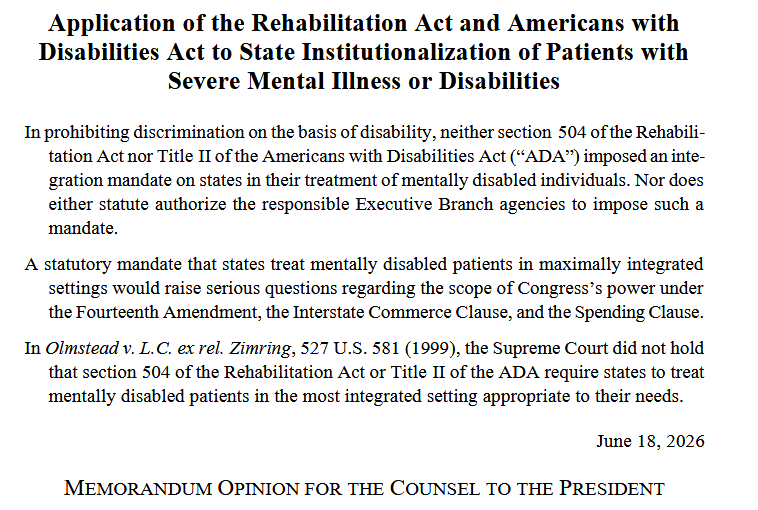
The DOJ put out a memo in June, in which Lanora C. Pettit, a new DOJ attorney, single-handedly re-interpreted decades of higher court and U.S. Supreme Court jurisprudence surrounding Title II of the federal Americans with Disabilities Act (ADA) and Section 504 of the Rehabilitation Act (RA).
Basically, these are the intertwining laws under which Congress established that people labeled with disabilities should not be unnecessarily incarcerated, but should instead be allowed and supported to live independently in communities to the extent that is reasonably possible for the individual. (A view most famously and definitively stated in the 1999 U.S. Supreme Court Olmstead decision.)
For decades, these laws have been used to pressure states to provide the kinds of affordable and supportive housing and community-based services that help disabled people live more independently.
And it’s important to emphasize again, these laws and rights apply to all people labeled with all types of disabilities, not only those labeled with psychiatric disabilities. But those with mental disorders appear to be the DOJ’s primary, immediate target. In the 39-page memo, Pettit cobbles together an often-confusing (sometimes contradictory and nonsensical) mix of dissenting voices, cautionary notations, and broad generalizations to arrive at the opposite conclusion to every preceding majority judgment:
“Olmstead did not hold that Title II requires maximal integration for patients with mental disabilities receiving state treatment. Rather, it held only that a state cannot institutionalize such patients without justification. What counts as adequate justification remains an open question.”
Pettit also emphasizes that “the risk of violent behavior” should not be the only “adequate justification” when considering long-term incarceration. She suggests any “heightened risk” that people may be “unable or unwilling” to take psychiatric medications should be a driving factor in indefinitely institutionalizing them.
Pettit adds that she recognizes “this view of Olmstead’s import is out of step with the common understanding of that decision within the federal courts.”
As readers of my book Your Consent Is Not Required may recall, there are concerns that the “community integration” achieved by Olmstead settlements has already sometimes ended up looking more like “detention in smaller facilities” such as coercive group homes and assisted living. This can come about due to intensive post-settlement, behind-the-scenes lobbying by corporate interests alongside entrenched political and mental health system disinterest in genuine de-institutionalization. Nevertheless, the DOJ altogether throwing out Olmstead-based legal frameworks and efforts towards real community integration merely paves a smoother, faster road towards mass coercive institutionalization in both smaller and larger facilities.
The Bazelon Center for Mental Health Law condemned the DOJ memo, calling its legal arguments “deeply flawed” and declaring that “well-established, long-standing” rights afforded to people with disabilities “cannot be changed by mere agency pronouncement.”
Nevertheless, many are worried that’s exactly what’s going to happen.
In an Associated Press story, Claudia Center, legal director at Disability Rights Education and Defense Fund called the memo “dark” and “awful.”
Many observers have pointed out that the impacts of the new DOJ view will mostly be on in-process and future developments and litigation. Some state governments will be inspired to use the memo as a basis for arguing against integration, while emboldened by the recognition that, unlike in decades past, the U.S. Department of Justice won’t be in court arguing against them.

In a story in Disability Scoop, Alison Barkoff, a George Washington University professor who previously served as the Justice Department’s special counsel for Olmstead enforcement, said the DOJ and Health and Human Services (HHS) will likely soon amend the official regulations related to the ADA and RA to align with this new interpretation. That, and how the DOJ responds in litigation proceedings, could have huge impacts.
“The fact that the United States is taking the position that there is no longer an integration mandate will likely impact the many Olmstead settlement agreements, investigations, and individual cases that DOJ and HHS’ Office for Civil Rights are involved in,” Barkoff told Disability Scoop. “This memo also sends a message to states that they can reverse course on the decades of progress on implementing Olmstead and instead unjustifiably institutionalize people without fear of enforcement by the United States.”
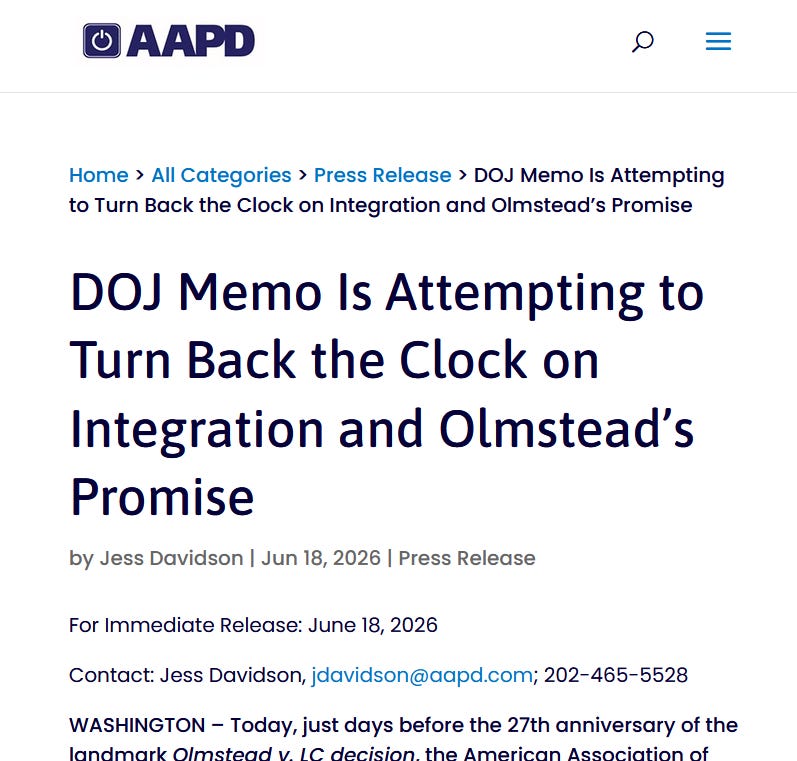
In its own press release, the American Association of People with Disabilities stated, “the fact that their [the Department of Justice’s] conclusion is unjustified and incorrect doesn’t change the fact that they will seek to use said interpretation to hurt disabled people, lock us away, end our autonomy over our lives, and in many cases, end our lives altogether.”
On Wednesday, August 19 at 1pm pacific, 4pm eastern, the American Association of People with Disabilities, Bazelon Center for Mental Health Law, the Center for Public Representation, and the George Washington University Hirsh Health Law and Policy Program are co-presenting a free webinar about these issues and the importance of taking action:
The webinar will address the importance of the Supreme Court’s Olmstead decision and the rights that disabled people have under the ADA and Section 504 to live in their own homes and communities, how recent threats may affect these rights, and what you can do to protect them. The “integration mandate” of the ADA and Section 504 is one of the most fundamental rights that disabled people have, and it is critical that we take collective action to preserve it.
Registration for their webinar is here.
No posts
Comments
Nothing yet. Say the first thing.
Sign in to join the conversation.