

Back in 2020, I had the privilege of serving on a Louisiana state task force charged with writing a plan to eliminate the state’s carbon-dioxide emissions by 2030. (This was back when our governor accepted climate science.)
There were lots of technological options on the table, including solar, offshore wind, nuclear, and “carbon, capture, and storage,” also known as “CCS.” The last, which many laypeople were just starting to hear about, describes a process where fossil-fuel burning facilities strip away the heat-trapping carbon they produce and pump it underground for permanent storage.
No one had ever accomplished this at scale before (and still hasn’t), but the oil-and-gas producers and the chemical companies were pushing the idea. So we on the task force—which was made up mostly of non-scientists like me—decided we needed to know more.
That year, a research program at Princeton University was making news with the release of what would become an influential policy paper on carbon reduction called, “Net Zero America.” It outlined a series of “pathways” for cutting carbon emissions based on various technologies, including CCS. So we invited one of the lead authors to present his team’s findings.
At the time, the document was at the “interim” stage, to be revised for final publication in upcoming months. I found the report to be comprehensive, user-friendly, and extremely informative. The authors acknowledged some funding from oil companies— ExxonMobil and BP—but I kept an open mind.
At our meeting, the presenter suggested CCS was a technology Louisiana might consider, especially on the coast where the refineries were. That confused me because, reading ahead, I had noticed a chart appearing to show that most of Louisiana was deemed to be “unsuitable” for CCS on account of “environmental and cultural” concerns.
I asked the presenter why we should consider CCS when his own report described our area was environmentally “unsuitable” for this technology. I directed him specifically to this page (which I’ve marked with red circles).
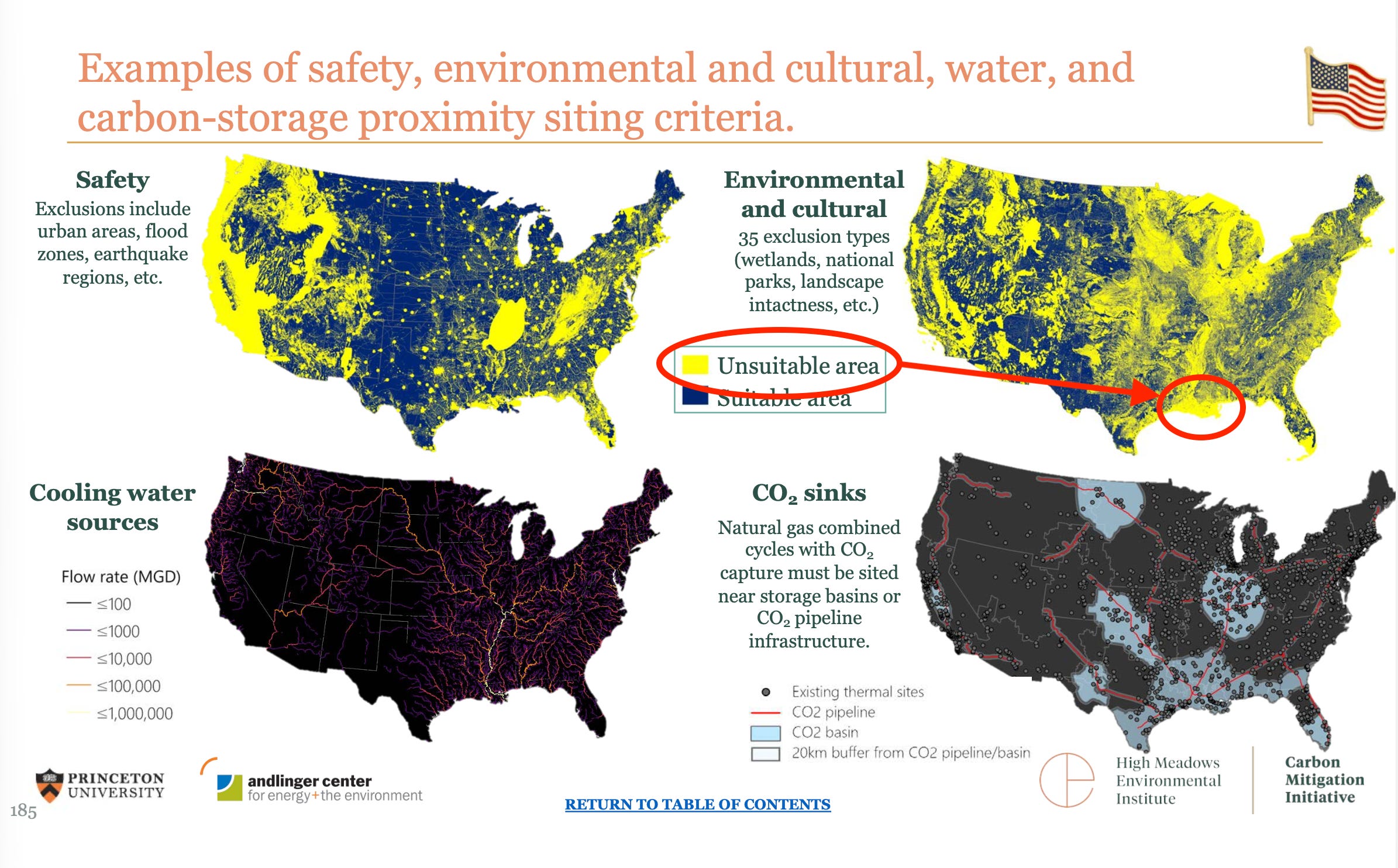
The author seemed surprised and admitted this was not a chart he had personally prepared (which, incidentally, I totally get. I’ve been in that situation too, more than once.) But he said he did believe Louisiana was suitable for CCS and that he would make some inquiries and get back to us.
Weeks later, the Princeton team contacted us to say that Louisiana was, in fact, suitable for CCS and that the task force questioner—me—had misread the chart.
When I followed up to ask what part of chart I had misunderstood, I was told only that the the chart’s data would be laid out more clearly in the final version so as to avoid misinterpretations like mine.
Princeton released the final version a year later, but the chart about CCS and Lousiana’s environmental suitability had not been clarified.
It had simply been removed.
I have no idea why that page was removed or why the interim draft marked Louisiana as environmentally “unsuitable” on a page dealing with CCS. (For what it’s worth, the final report does describe Louisiana as “unsuitable” for “emerging technologies (e.g. advanced nuclear).” See p.157.)
And I’m not saying the oil companies’ funding had anything to do with this episode.
But after this incident, I did begin to question the role that funding from the fossil fuel industry plays in producing so much of the current research on climate change and carbon reduction.
Here was a celebrated report from some of the top researchers in the world (including a Nobel laureate), housed at one of the world’s stellar universities. And yet the report was funded in part by an industry whose very existence depends on policymakers like me believing certain things about their activities.
I wasn’t sure I could trust it.
I think of this now because of two recent news stories that show, from top to bottom, the ways in which our schools have been captured by carbon interests.
First, an expose in ProPublica, details how fossil fuel companies have been funding climate at top universities for decades, amplifying research favorable to our dependence on oil, gas, and coal.
According to ProPublica:
The research produced by those schools in turn shaped global climate models, as well as the policy and technology solutions adopted by governments around the world.
Ultimately, [such research] fostered a misperception that climate change could be solved without dramatically curtailing fossil fuels — a notion that has delayed emissions cuts by decades.
Corporate funders sponsored entire centers, paid the salaries of researchers, kept offices on campus and in some cases had veto power over projects.
Companies maintain they are supporting innovation and needed science. Universities say that with safeguards, sponsorship enhances research programs while preserving academic independence.
In particular, ProPublica’s investigation focuses on a highly influential climate paper published 22 years ago by a university research center. That paper, known as “Wedges,” was partially funded by the oil industry and leaned heavily on CCS in addition to other technologies as a way to beat back climate change. PropPublica’s investigation asserts that the “Wedges” report was “significantly shaped by the British oil giant BP — one of the single global entities most responsible for causing climate change.”
The university behind the research? Princeton.
Second, some public school districts, including in Louisiana are adopting lesson plans developed by ExxonMobil to introduce students to CCS technologies and to show how it can be deployed to slow climate change. This, despite the fact that the technology has so far failed to demonstrate its effectiveness in permanently storing waste or that its adoption would reduce carbon emissions to any substantial degree.
Exxon’s material does admit that carbon-reduction strategies can have downsides. Students are reminded, for instance, that windmills can kill birds.
Also, the lesson explains that CCS isn’t suitable for every geology, though “it is on the Gulf Coast.”
Just ask the folks at Princeton.
ADDENDUM: I’m not going to leave you without some good news! Some of you will remember my earlier post on a proposal by Air Products Blue Energy to produce hydrogen and ammonia and then inject its carbon waste beneath Louisiana’s treasured Lake Maurepas. Environmental groups had opposed the project as a false solution to the climate crisis and argued it would allow instead the fossil fuel industry to continue polluting while causing new risks to people and the environment.
Earlier this week, Air Products announced it was canning the project.
According to the New Orleans Advocate,
Air Products said the project wasn’t going to pay off the way it needed to. The cancellation is part of a series of canceled projects that will cost the company up to $2.9 billion, before tax savings.
Remember this: nothing is inevitable.

Comments
Nothing yet. Say the first thing.
Sign in to join the conversation.