
I spent Tuesday evening and Saturday morning judging the regional round of the Presidential AI Challenge, a national program where students and educators build, propose, or teach AI concepts, then present to a panel and defend their work under questioning.
I was one of four judges for the West Region, Educator Track. My assignment: feasibility and scalability analysis. Translated: I’m the person who asks “ok but does this actually work outside your specific situation.”
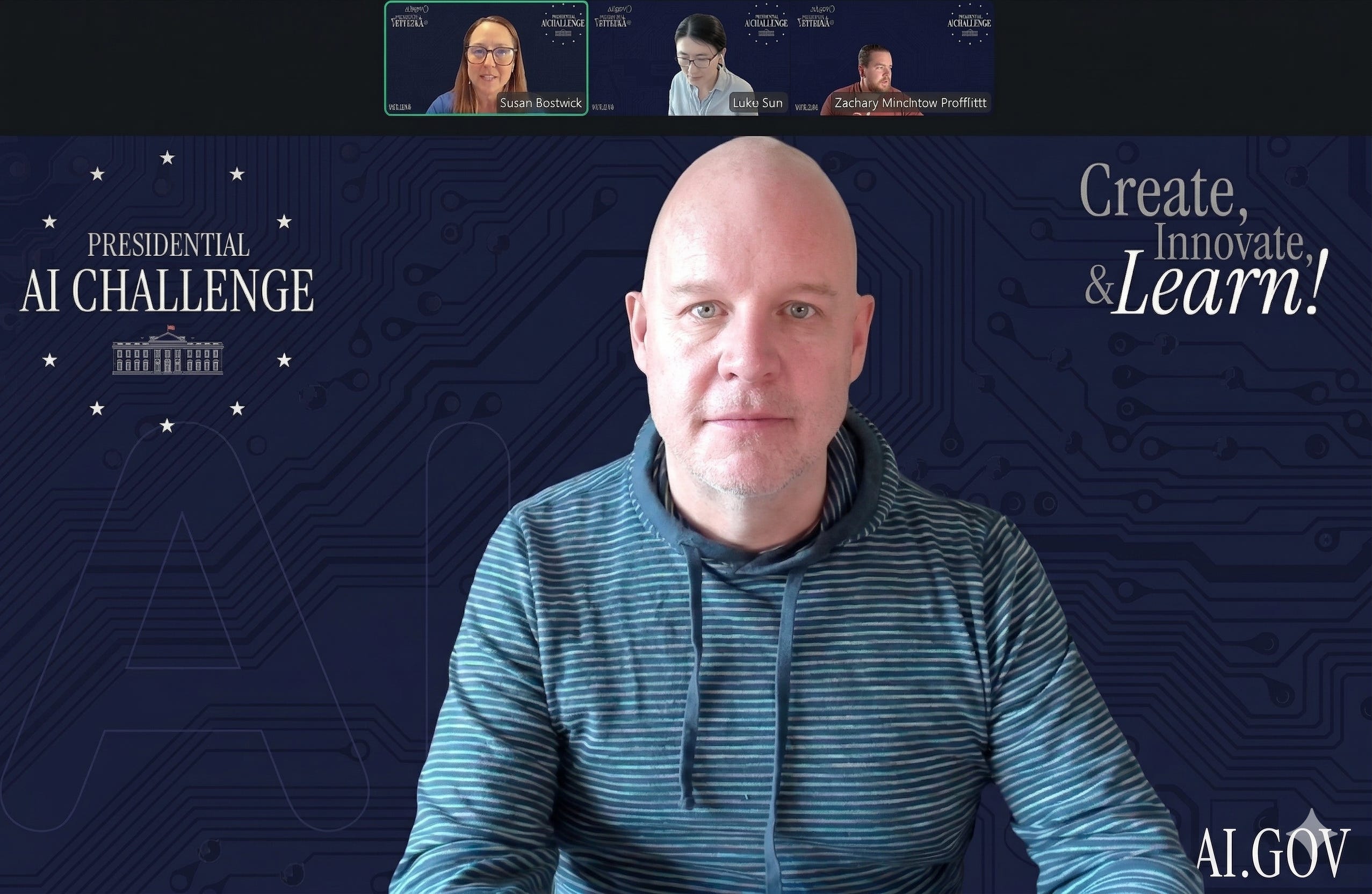
I went in expecting to evaluate student projects. What I actually spent those hours doing was listening to people (some of them 15 years old, some of them teaching kindergartners in rural Montana) wrestle with the exact same questions I deal with at SANS every single week.
When should we trust AI output?
Who does our system fail to serve?
What breaks when you move from a demo to a real deployment?
What’s the actual cost of running this at scale?
Six submissions. The range was staggering.

Four high school students in San Diego built a working Progressive Web App called Resourcify for people experiencing homelessness for the first time. Not a proposal. Not a pitch deck. A deployed application at resourcify.db-hub.me with image analysis powered by Google Gemini, geolocation, weather-aware recommendations, offline-first architecture with service workers and IndexedDB, and experimental mesh networking for areas with no connectivity.
One design decision worth noting: they deliberately chose a rule-based system over AI for their benefits eligibility checker because precision and explainability mattered more for vulnerable populations than using the fancier tool. That’s a tradeoff I’ve seen senior engineers get wrong.
During Q&A I pushed them on scalability. They’re rate-limited at 100 requests per 15 minutes, which means about 10 concurrent users. California has roughly 180,000 people experiencing homelessness. I ran the numbers before the session: deploying Resourcify statewide would cost maybe $16,000 to $28,000 a month in API fees.
That’s nothing. The state spent over $24 billion on homelessness programs between 2019 and 2024.
The API cost isn’t the barrier. The rate limiting, the geographic portability (their recycling feature uses California-specific CRV values), and the concurrent load during crisis scenarios are the real constraints.
When I asked about cost, one student estimated “$200 a year for a server.” He was thinking about Heroku hosting, not API consumption from Google Places at $17 per 1,000 requests. (He’s 16. Most startup founders I’ve met don’t know their real API costs either.)
But here’s what he got right: when I asked about fallback if the AI ceiling gets hit, he immediately said “let the user type in their belongings manually and get recommendations from that.”
That’s graceful degradation.
He’s thinking about what happens when the system fails, not just when it works. The cost estimate will get better with experience. The instinct to keep serving the user when a component breaks is harder to teach.
Tami Redinger teaches K through 7 in a one-room classroom in Havre, Montana. Her entire AI tech stack: Quick Draw with Google and Google Teachable Machine. Total cost: zero dollars.
(I went to a three-room K through 6 school myself growing up. I still don’t know how my teachers did it.)
Tami had her students play Quick Draw, then examined why the AI guessed what it did. Showed them that most people draw a house as a pentagon with a rectangular door and square windows, so the AI was trained on that narrow representation. Asked them to draw their actual houses (apartments, different shapes) and the AI failed to recognize them. Then she named it: “we’re basically training it to be biased.”
Then she had students train their own image classifiers using Teachable Machine to sort space photos into categories: stars, planets, galaxies. She set it up so the classifier would confuse galaxies and stars. Because galaxies contain stars. The training data overlaps. And she did this intentionally.
A student asked: “Why does it keep thinking the galaxy is stars?”
That question, from a kid in rural Montana, is the same question that AI governance teams at large companies are working through right now about their own production systems. When your training categories aren’t cleanly separable, your classifier gets confused.
Tami engineered the confusion on purpose, then used it to teach about how AI systems fail and why human verification matters.
She also had her advanced students adjust the learning rate on their models and observe how faster training produced more errors. She paired her one kindergartner with an older student. She differentiated instruction across eight grade levels in real time with no aide, no co-teacher, and no budget.
When I asked her what she’d tell another rural multi-grade teacher who’d never taught AI, she told me she’s already mentoring one. A teacher who was, in her words, “pretty scared to even use it.” Her advice: go to some training, realize how much AI you already use in daily life so it stops feeling scary, then start with Quick Draw and work up to Teachable Machine.
That’s the scaling strategy.
No vendor partnerships, no state approvals, no grants. One teacher showing another teacher how to start. And I think that model reaches more classrooms than most statewide initiatives.
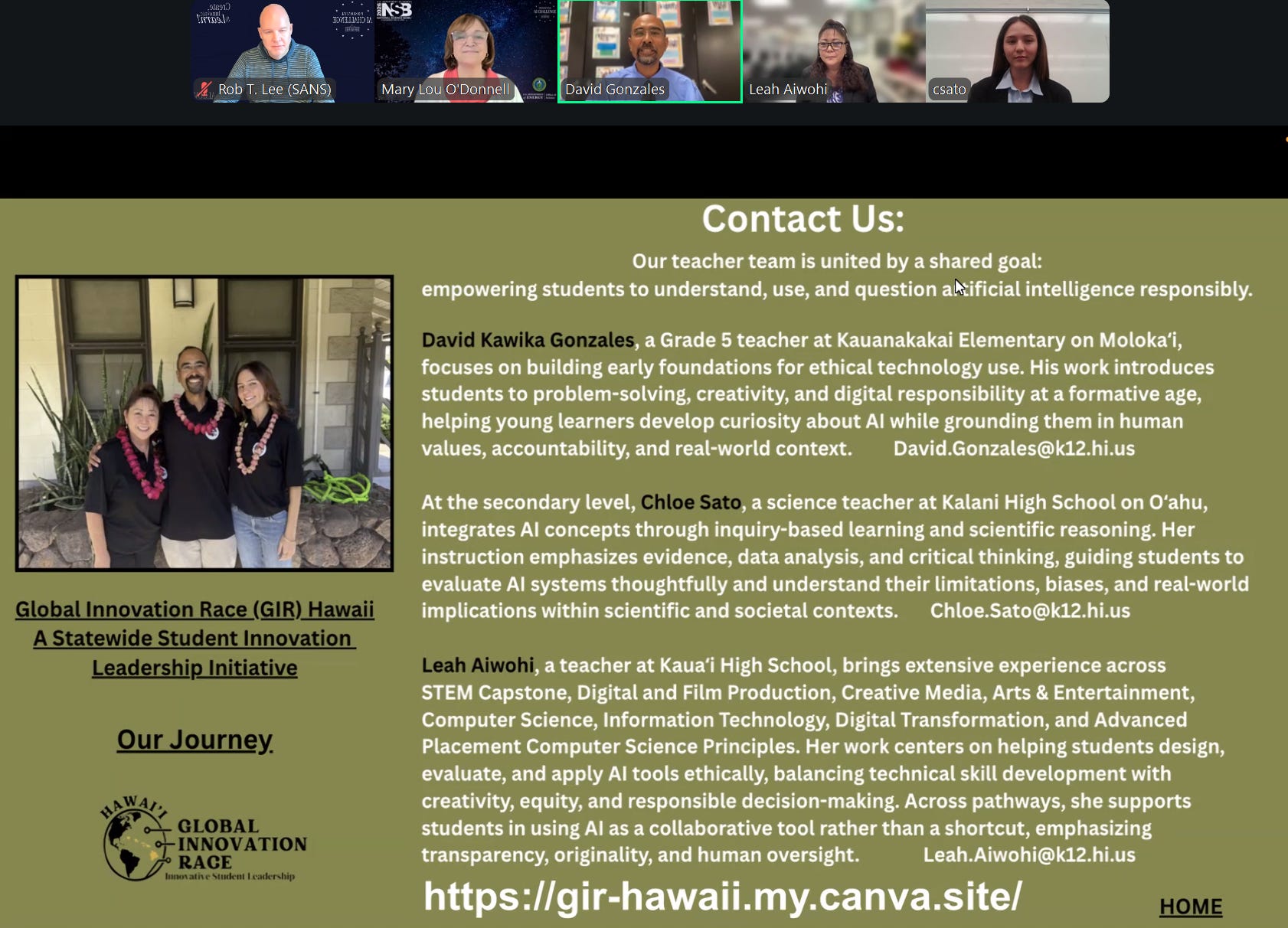
Three educators across three Hawaiian islands (Molokai, Oahu, and Kauai) built a program called the Global Innovation Race that trains high school students as “AI Ethics Ambassadors.”
They started with 15 students representing each of Hawaii’s complex areas, grew to 29, and their goal is representation at all of Hawaii’s public high schools. They got state DOE approval for student access to Gemini. They navigated Hawaii’s data governance requirements to unlock AI tools on the school network (which were blocked by default).
The institutional backing is real. The Deputy Superintendent of Academics in Hawaii supports the program personally. Three of their student teams made it to the regional finals. That’s not a pilot. That’s traction.
When I asked about the bottleneck to reaching all their high schools, one of the educators said “I don’t think there’s a bottleneck.” Every scaling initiative has bottlenecks. Not being able to name yours is its own kind of signal.
But when a different judge asked what they’d change, the same educator gave an honest answer about remote engagement being hard across islands and needing to check in with student teams more frequently.
That’s the real bottleneck.
She named it in one answer and denied it in another. I think the ambition of the vision sometimes runs ahead of the honest assessment of the constraints. But the fact that they’ve built this across three islands with three educators who aren’t in the same room together for most of the project is itself a kind of proof.
I spend most of my time at SANS thinking about how to close the gap between the people who understand AI and the people who need to.
What I saw judging this challenge is a version of that same work happening in classrooms.
A teacher in Montana with a Chromebook and zero budget is teaching the same concepts about AI bias and training data failure that we cover in SANS courses for working professionals.
Four teenagers in San Diego are making architectural tradeoffs about when to use AI and when not to.
Three educators in Hawaii are building a statewide network of students who understand that AI is, in their students’ words, “a power tool that requires a safety manual.”
These aren’t future problems being addressed by future professionals. These are current problems being addressed by people who happen to be in school right now.
I didn’t go into this expecting to learn anything. I went in expecting to evaluate. I should know better by now.
The Presidential AI Challenge is worth paying attention to. Not because it produces polished projects (some of the submissions were a single page of narrative with no formal lesson plan), but because it puts students and educators in a position where they have to confront the hardest questions about AI in front of people who are going to push back.
And the ones who showed up, even the ones whose cost estimates were off by orders of magnitude, even the ones who couldn’t name their own bottleneck, demonstrated something I don’t see enough of in professional settings:
The willingness to say “I don’t have that answer yet, but here’s what I’m figuring out.”
That’s the whole thing. That’s the skill. Everything else is implementation detail.
If you’re involved in AI education at any level, from kindergarten to enterprise, this program is worth knowing about. And if you’re a judge next year, say yes.
Rob T. Lee is Chief AI Officer & Chief of Research, SANS Institute
Comments
Nothing yet. Say the first thing.
Sign in to join the conversation.