
We’ve been without power for a week since the tornado landed a mile north of the house.
Everyone is alright, but no video this week and the essay never made it to a proper keyboard.
A special thank you to Sarah for all of her hard work keeping the generators running and the solar batteries charging while I was working overnights. Really, thank you for keeping our home a safe and well lit place during this crazy week.
On to our scheduled essay.
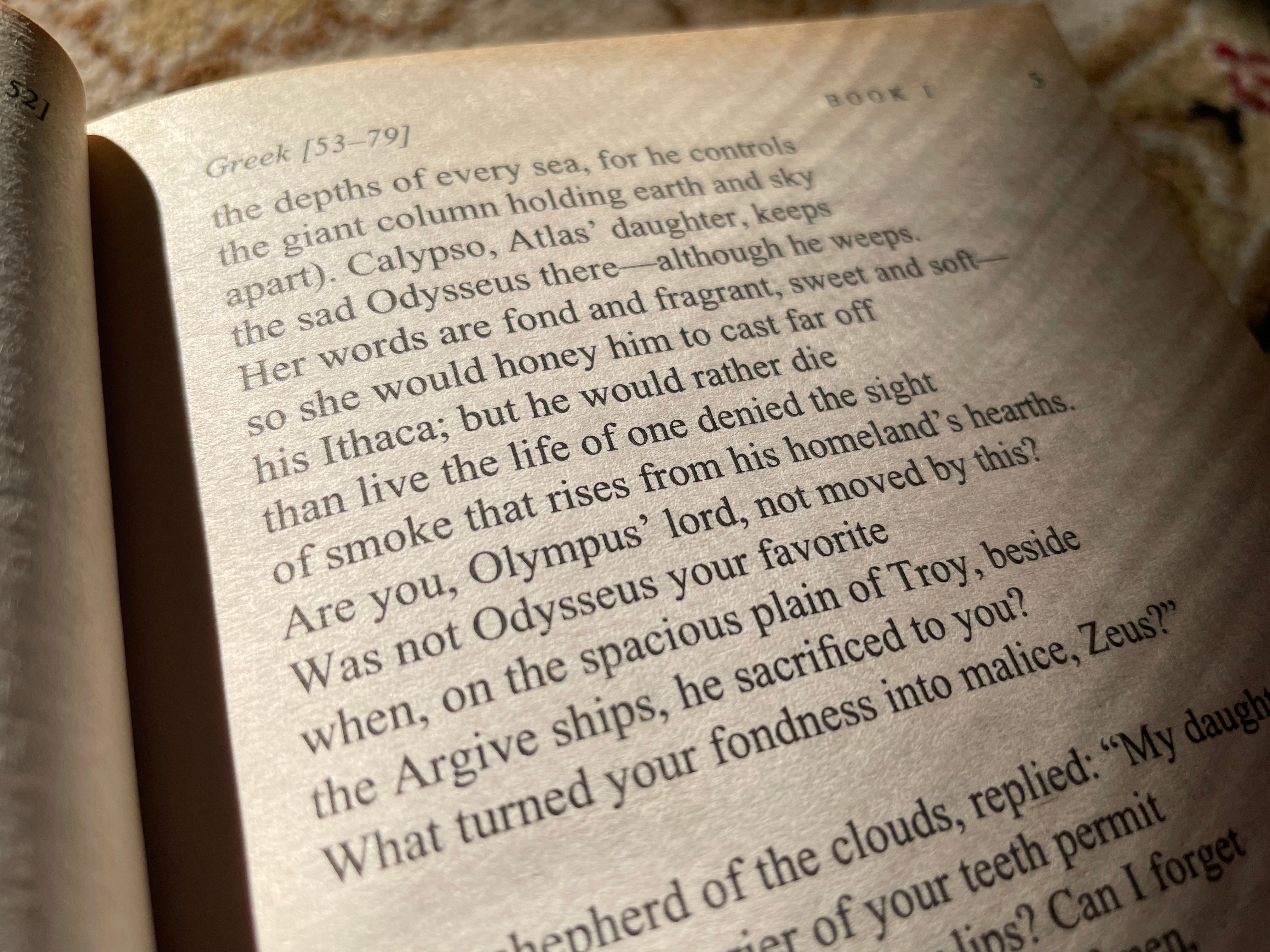
A lot of people talk about the Odyssey — and other epics — starting in the middle of the action.
In medias res.
It’s a great tool for making the story feel huge! But there is another tool hidden right in the beginning which several of my favorite stories use — the title crawl.
“The title crawl” lets the author drop the audience into the middle of a huge world without confusion.
Whether you decide to use it or not, the title crawl is such a fun — and apparently ancient — tool to have in your kit.
So, what do I mean by title crawl? Where do I see it? What are its uses for us? We’ll hit all of this and hopefully have a new perspective on this tool.
The title crawl doesn’t eliminate questions. It replaces bad questions with good ones.
No “where am I?” No “what’s going on?” Just “will these characters get what they want?”
How does the title crawl do this?
A long time ago in a galaxy far, far away…
I’m sure you recognize that most famous title crawl from the epic space opera “Star Wars.” But do you remember what came next? A whole lot of exposition about the empire, Darth Vader, and the rebellion. But all of that exposition dumps us right into that world with the context of the massive events that are taking place. Right after that we are thrown into a space battle and a deadly fight on a rebel ship as it’s boarded by Lord Vader and his imperial troops.
We’re thrown into a world that is in the middle of massive events which we now have context for thanks to the title crawl. That tool allows us to be dropped into a specific story within that world without feeling lost.
In fact, we can jump right in with good questions instead of confusion. “Is Vader going to find who he is looking for? Are the droids going to escape? Does the rebellion have a chance?” Not “Who’s the guy in black? Are the people on this ship good or bad? Why are they fighting?” Curiosity, not confusion.
What does this have to do with Homer’s Odyssey?
“Muse, tell me of the man of many wiles, the man who wandered many paths of exile after he sacked Troy’s sacred citadel. He saw the cities — mapped the minds — of many; and on the sea, his spirit suffered every adversity — to keep his life intact; to bring his comrades back.”
That’s Homer’s first couple lines translated by Mandelbaum. We’re given the context that there is a wily man who sacked Troy — a huge event — and that he wandered through a tough journey on the open sea while learning much on every stop he made. The next few stanzas give us context of the gods, their anger, and what they’ve been doing to Odysseus and his lands and the other Greeks after the Trojan war.
We get the context of the Greek world and then the addition of what has been happening to the character Odysseus. Very similar to what we got from “Star Wars.” Where else do we get these context-dumping title crawls?
*Blade Runner* has an opening text card that fills us in on the world and the replicants. *Gladiator* tells us about Rome battling on the frontier of Germania. I think Mad Max opens with a title card, too.
These are different from prologues or quote openings.
*The Fellowship of the Ring* gives a full narrated sequence by Galadriel which feels more like a prologue than a title crawl.
The movie *Conan the Barbarian* gives us a short text that is meant to invoke the emotions we are about to witness and experience. Fitting that it is similar to the short intro of the *Iliad*.
Then title crawl context cards are different from prologues in that they are much, much shorter and often give a wide scope of the world surrounding the story. They’re different from a “cold open” in the regard that they don’t present an inciting incident of any sort.
So, why bother?
Depends on what you want your reader to feel! I love that they give me the feeling that I’m about to jump into a huge story! A prologue can feel, for me, too disconnected to keep up the pace or feel like a totally different story. Cold opens are great but can give way too much confusion if you’re dropping us into a totally alien world.
Do you want to give us any more context than Alaska and a year? Do I want to get into a world that has lost so much connection with its spirit?
Yes or no, it’s a fun tool to try and easy to cut.
Talk next week,
Blake.
No posts
Comments
Nothing yet. Say the first thing.
Sign in to join the conversation.