
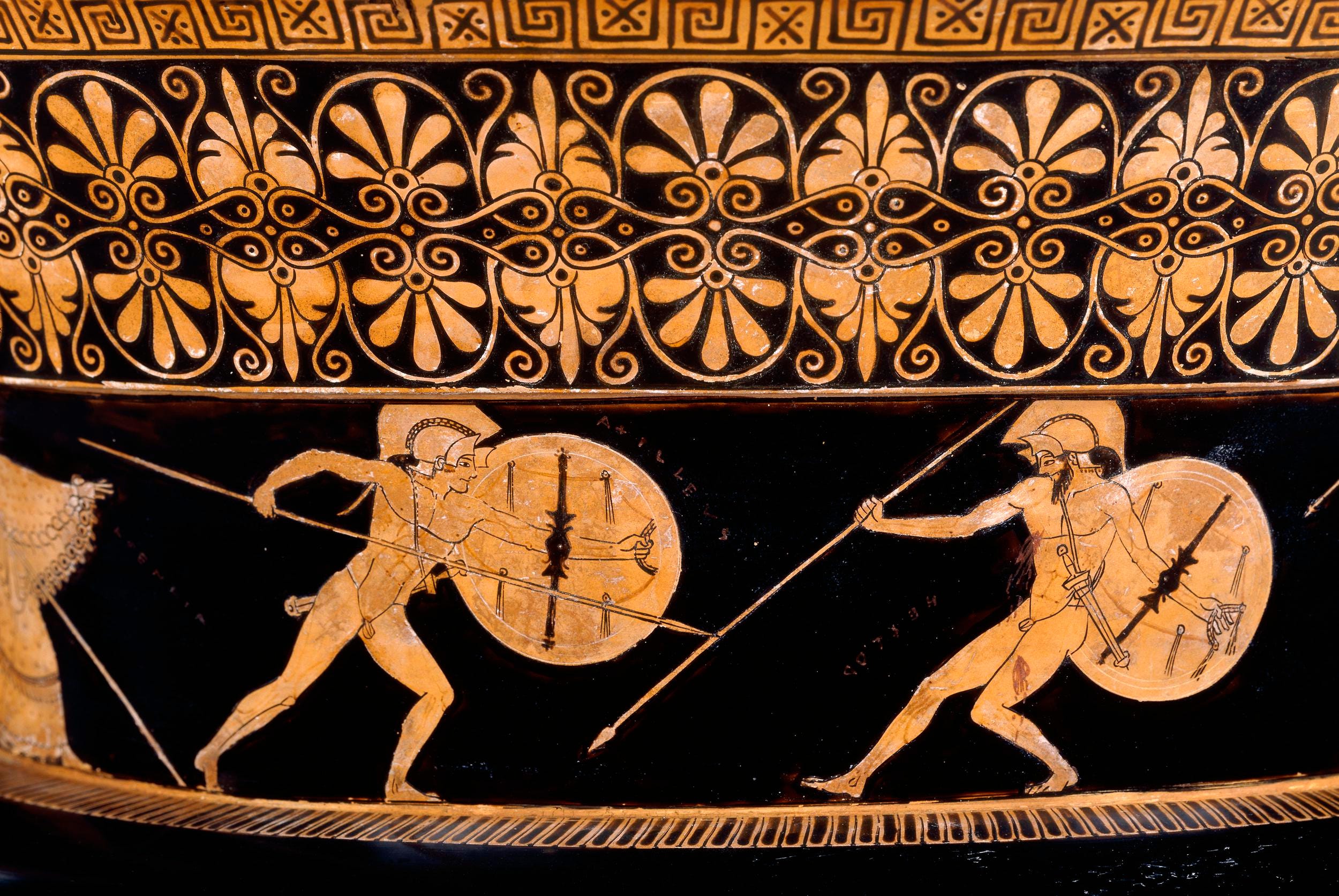
Hi everyone. Hi Ben. This is going to be a little different than our normal content around here. I’m cementing my learning by “teaching” what I glean from books I read.
Today, we are starting with The Iliad and “teaching” what I’ve learned from it to my great friend Ben. He’s an excellent writer, director, and dad. I love working with him on my writing and reading what he writes. He teaches me a lot and I’m hoping I can repay him.
So, the Iliad.
Today we are only covering what I’m calling “the violence thesaurus”, but here is what I want to cover over the next few weeks because these things impacted me as both a writer and a human.
1. The Iliad as a violence thesaurus.
1. Epithets / titles and epic weight
1. The flat arc VS a moment of change
1. Why Achilles doesn’t kill Priam
1. The cost of duty
1. Powerful warrior ≠ Hero
Another thing, before we go on, is this epic self selects its audience. So, I’ll tell you here forward is going to focus on rage and violence and duty.
But especially rage.
If you’re not interested in graphic violence spurred by rage, this poem and my thoughts on it may not be for you. And that’s okay. We can catch up with The Odyssey or King Arthur and his knights. There’s a good chance I’ll cover Babe the Gallant Pig, too. If this one isn’t for you, no worries.
Rage. Sing to me oh muse of Achilles’ rage. The very first line, the first word, is rage. Yes, Achilles is one of the protagonists, but the story is about burning rage that is most frequently seen through his lens. But nearly all (maybe all(?)) other characters experience true rage in this epic. Homer doesn’t flinch when he shows the brutal truths of this human emotion.
How did Homer depict rage so clearly and thoroughly over an entire epic without it getting stale? The language used across translations and over time, including both the Butler and Fitzgerald’s translation of The Iliad, has some of the most intense, varied descriptions of violence I’ve ever read. They’re specific and brutal and as hard to read as they are to look away from. An ancient chariot wreck you can’t take your eyes off. The language used to describe the deaths in battle are so vivid that it transports you as the reader right to the shores of Troy more than 3,000 years ago. Book 17 has some particularly gruesome moments.
“But the act cost him his life at the hands of man-killing Hector, who struck him underneath his jaw and ear. The spear smashed his teeth, roots and all, splitting his tongue in half.” Fitzgerald, book 17.
You can see it, all of it, in detail. It’s horrifying and you can’t look away if you want to finish the story.
Hector is full of rage and grief as he sees the carnage of the battlefield as the most intense fighting is taking place over dead Patroclus’s body while the Trojans try to steal Achilles’ armor that Patroclus was wearing. It’s a fascinating choice here, putting rage together with grief. Some people criticize The Iliad as being a total glorification of war, but they seem to overlook the word grief.
Yes, Achilles wants to achieve glory through bloodshed which is achieved through war. He’s not exactly the shining hero of this story. He turns the tide of the war and pushes the scales to an eventual Greek victory, but that doesn’t happen in this story. The Greek army wins after the events of The Iliad and that’s because of Odysseus and his clever plans. Odysseus wins the war.
Several times over in this book the men talk about how they wish the war was over, how they wish it never had to be, and the respect they have for the abilities of their enemies.
So, to try and extinguish the raging war, they fight as hard as possible to win and end it.
Here is Butler in book 17. Side note: I don’t like Butler’s Romanization of the pantheon but that’s just my problem as a novice. “Euphorbus was drawing back, and Menelaus struck him about the roots of his throat, leaning his whole weight on the spear, so as to drive it home. The point went clean through his neck, and his armor rang rattling round him as he fell to the ground. His hair was like that of the Graces, and his locks so deftly bound in bands of silver and gold were all bedraggled with blood.”
Butler again later on when Achilles has returned to the battle: “He struck him in the belly near the navel, so that all his bowels came gushing out onto the ground, and the darkness of death came over him as he lay gasping.” And “Achilles cut his head off with a blow from his sword and flung it helmet and all away from him, and the marrow came oozing out of his backbone as he lay.”
More from Butler when Hector is almost killed in a chariot wreck: “He missed him [Hector], but struck his charioteer and squire Eniopeus son of noble Thebaeus in the breast by the nipple while the reins were in his hands, so that he died there and then, and the horses swerved as he fell headlong from the chariot.”
The effort put into the visceral imagery echoes the effort every warrior is putting in to end this war.
These visuals are coming from a supposedly blind bard. My guess is that Homer was blinded by a wound he suffered in a battle as a young man. In those days, it was common for all Greek men to take up arms and fight. That all sounds so specific to have come from someone without direct experience.
So, why all this focus on violence for me? Other than how well it puts my reading experience right on the battlefield, and how much true fear it invokes, there is a staggering variety in these vivid images.
Do I ever want my readers right on the battlefield? Yes. Do I want them to feel fear and dread? When the time is right, for sure. Do I want my action to be vivid and fresh? Of course.
Now, if I need something violent to befall one of my characters but I want to add a layer of metaphor to the action, I now have a full thesaurus of violence I can pull from to inspire my action. If I’ve got a big talker who’s words caused a lot of trouble, maybe he’ll get impaled through the mouth and lose his teeth and split his tongue in half. Maybe the coward has his back bone severed and what little marrow there is oozes out. Perhaps the liar who spilled his guts will spill his guts! Or, it can just root you in the physical space among the nameless dead in the horror of the battlefield. Armed with all of these examples, you now have the option of how you want to present your violence and choosing why.
So, Ben - and everyone else - that is some of the violence in The Iliad. The next closest thing that comes to mind for me is Blood Meridian, maybe? The specificity there makes me think of what a wolf or a bear might do to a man’s leg and what a bullet might do to that animal’s head. Maybe what a broken ship mast could do to a man the same way a spear might. Or, perhaps a Kaiju’s claw acting like a sword.
We don’t need every story to be overly violent. Some stories don’t call for violence at all. In fact, a couple of the children’s projects I’m working on specifically avoid any violence what so ever. But, I’m glad to have a deeper well of knowledge to pull any of these resources as I need them in my other work.
Hopefully you got something out of this the same way that I did. Maybe it will inspire you to inspect the book yourself. I’ll catch you on the next one where I look at the motif of epithets and titles and why I think they’re such powerful tools.
Happy Friday and see you next week.
PS - Just another week to submit your short scifi stories to Panopticon Volume 3! They need a glimmer of hope, less than 5,000 words, and the subject line should read “Panopticon Volume 3 Submission” with your name and title. Please send a docx to Panopticon2032 at protonmail dot com
Final due date will now be July 4th, because happy birthday, America.
No posts
Comments
Nothing yet. Say the first thing.
Sign in to join the conversation.