
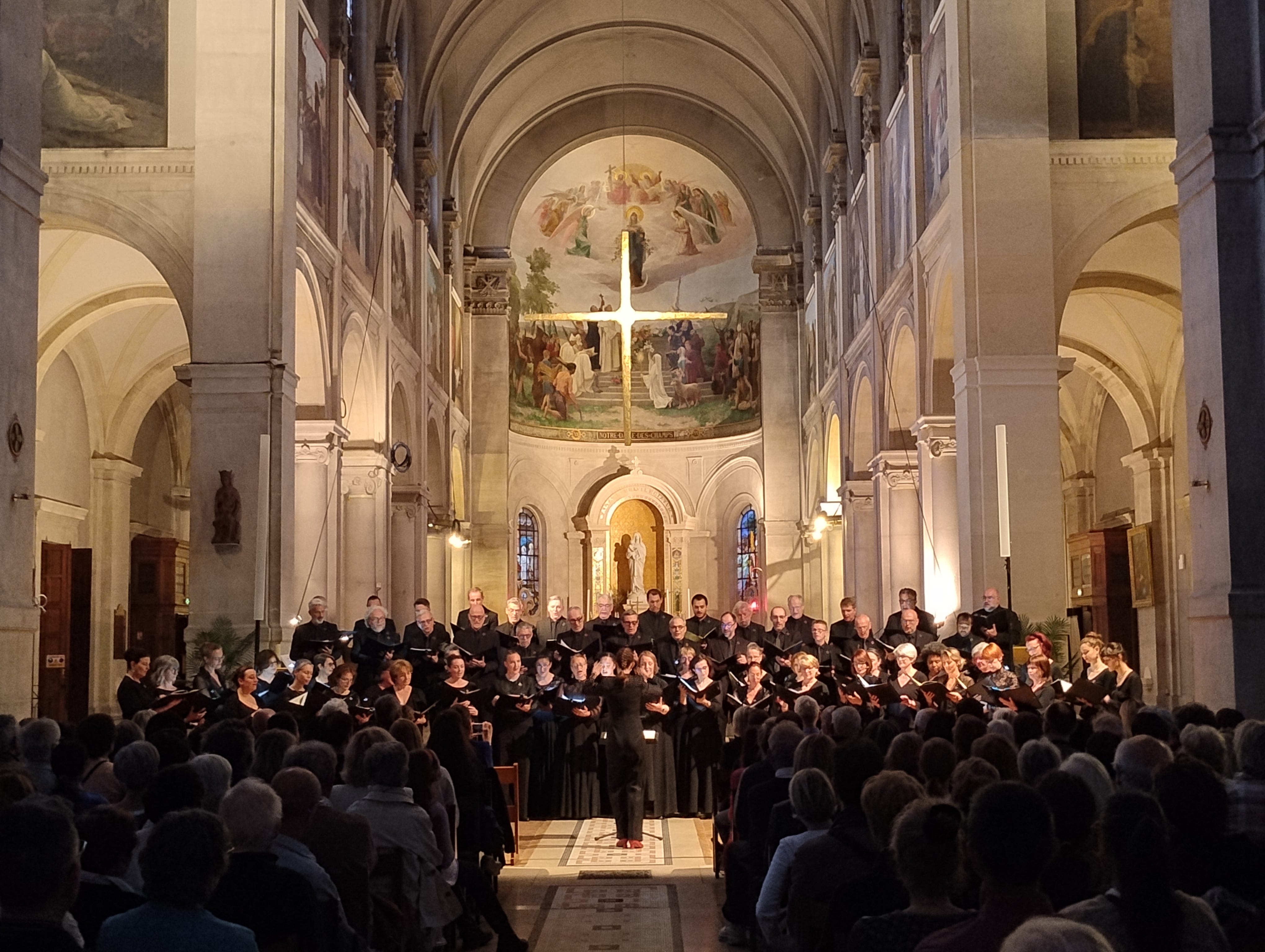
When liturgical texts were first sung, in the earliest centuries of Christianity, this union formed into Plainchant; it created something more than the sum of its parts.
Plainchant drew on Jewish cantillation traditions and Greek musical practice. Sung liturgical text produced something different from a text that was once read silently or a melody sung or hummed without words. With the rhythm of language, it functions the same way that melody works. Melody operates by creating expectation through pattern, as does language. And through language, we can shape melody. It lifts the language in plainchant to something like an incantation rather than a statement. But neither the text or the music exists in plainchant simply because it depends on the other.
Many say that plainchant reveals the text’s inner meaning. But that depends on what kind of evidence you’re prepared to accept. Within text, we know there are hidden meanings and consequences. In music, language lassoes abstract emotions and anchors them to a specific human narrative. We experience this most directly in popular songs that move and change people’s lives every day.
It seems that within the union of words and music, especially in certain songs, they fit as though they were not just made for each other, but they are of each other.
If this is the case, does this value prove that words have an inbuilt musicality, or does it show how we are simply inventive and adaptable beings? If there is a hidden musical value in our words, why and how did it get there? Or has it always been there, and it’s just a structural element of our speech?
The rhythm of breath, the pulse of our heart, the way infants respond to spoken and sung patterns and melody, might suggest that the music in our language is not some add-on effect, but part of the substructure of humans.
With pitch, stresses, and duration, which every language physically has, we use these as grammatical tools to change the meaning of words. So, what we say falls into a musical pattern, which can then be notated, transcribed and repeated. That pattern needed a way to be understood by everyone; for this, we created musical notation.
The musical staff system emerged as a practical solution for notating chant. However, in doing so, many say that it has helped reveal the inner meaning of the liturgical text through its sung version. It’s not just seen as an extension of the music. In Western Plainchant: A Handbook, by David Hiley, he argues that the melodic setting of liturgical text is not just ornamental but interpretive. But Augustine (354 to 430 CE) remains the most quoted on the subject. In his Confessions he writes that the sung texts moved him to tears. He believed that the practice of singing scripture allowed it to enter the heart more deeply than reading alone.
Plainchant is a mysterious and captivating combination of text and music. The voice alone has done something to the text that the text cannot do on its own, which Augustine hit on. For centuries after him, the fusion of musical and theological thought has been treated as an integrated discipline. This fusion shaped European ideas about beauty, transcendence, and meaning in ways that have outlasted the explicitly religious context. I’d say there are many who love plainchant just for the sound alone; maybe most, today.
The notational technology that arose from capturing plainchant became the known method to transmit all composed Western music as a reproducible, preservable object. Historically, these were so beautifully preserved; it reflected how seriously the union of words and music was treated. These illuminated manuscripts had the words lined with neume, which are the square-shaped precursors to modern musical notation.
However, outside the invention of musical notation, does this co-constitution, if it exists, offer us any proof on how music unshackles language? More in part two.
No posts
Comments
Nothing yet. Say the first thing.
Sign in to join the conversation.