
Thank you for subscribing to my posts. If you’re not yet a paying supporter, please consider becoming one. That’ll allow you to DM me with questions and comments. Your contribution will help cover the cost of the data I use in my posts, which I fund out of my own pocket. Thanks so much for your support and feedback!
Running out of fiscal space isn’t fun. It means difficult decisions have to be made to bring a country’s public finances under control and get debt down. In theory, this isn’t complicated. You can raise taxes, cut spending or sell government assets and use the proceeds to pay down debt. The problem is that - in practice - none of these things are easy or popular, so governments have a massive incentive to kick the can down the road and pretend like everything’s fine. All this is a bit like the “five stages of grief,” which start with “denial” and end with “acceptance.” Except that - when it comes to fiscal policy - in most cases “denial” lasts until there’s a crisis.
All this is deeply irresponsible. At its most basic level, this is an intergenerational issue because - if we keep racking up debt - future generations will have to pay it off. So we’re literally living beyond our means at the expense of those who have no say in the matter. When governments do things to obfuscate on all this, that’s deeply wrong and needs to be called out. Japan’s caps on long-term government bond yields and its interventions to stop the Yen from falling are precisely this kind of obfuscation. Their purpose is to perpetuate a broken status quo and delay needed adjustment. In Europe, whenever the ECB calls rising yields “fragmentation” and a threat to monetary policy transmission, it’s the same thing. What the ECB is really saying with this stuff is that markets are irrational and it knows best where the yields of highly indebted countries should be. That’s an absurd claim and deeply dishonest. Which brings us to Treasury Secretary Bessent who announced bigger buybacks of longer-dated debt - an effort to artificially cap yields - and said rising yields don’t reflect fundamentals. In one swoop, the US managed to emulate Japan and the Euro zone. Just not in a good way.
When countries run out of fiscal space, they start playing games to obfuscate and distract. This involves shortening the maturity of their debt issuance, leaning on their central banks to cap yields and speaking dismissively about “irrational” markets. None of this is about one particular administration or government. It’s much more systemic and is basically about powerful vested interests fighting to stay in charge. That’s how Germany keeps turning a blind eye to the ECB operating far outside its mandate, how Japan blunders from one intervention to the next and how the US deficit is equally out of control under Republicans and Democrats. This is much more systemic than one political party or another.
Today’s post looks at the games countries play as they run our of fiscal space. I’ll start with shortening the maturity of debt issuance, then I’ll talk about governments using their central banks to cap yields and I’ll round things out with all the dismissive talk of “irrational” markets. None of this is new. We’ve seen it all before. The only thing that’s certain is that all this stuff means one thing: the clock is ticking down on a building global debt crisis.
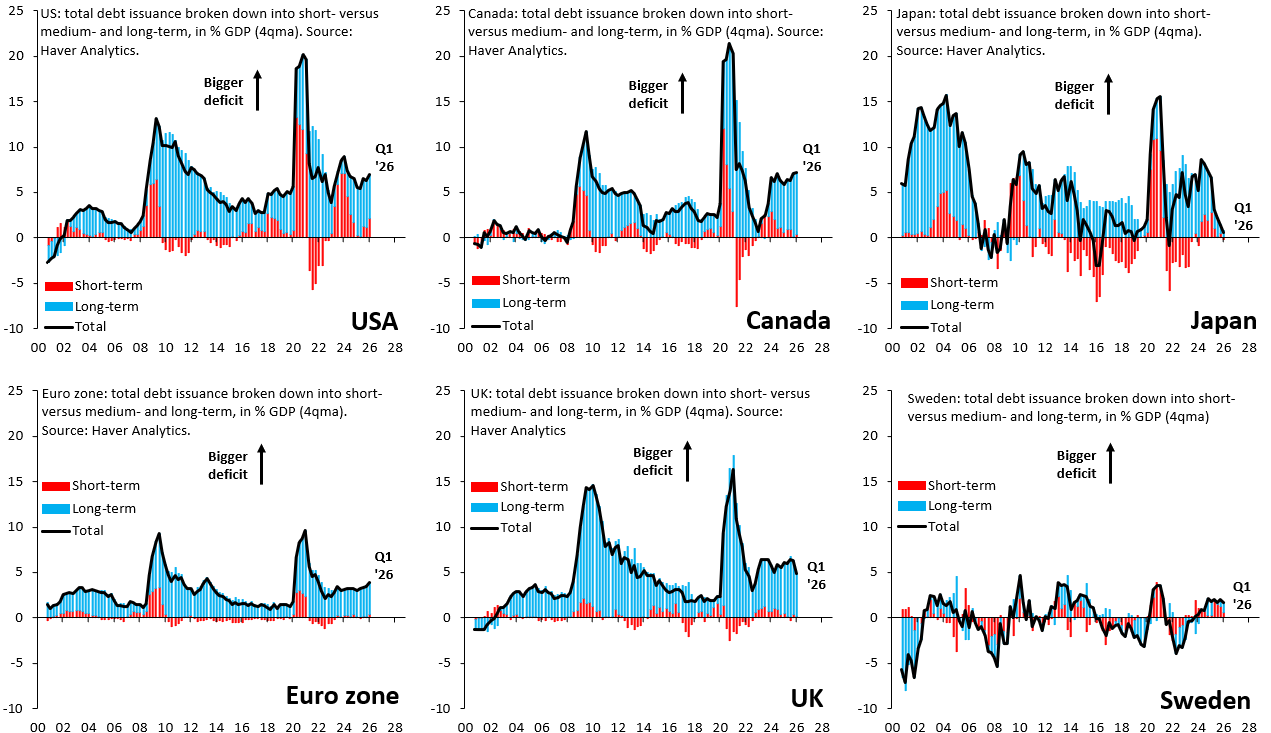
Shorten the maturity of debt issuance: the charts above show total net new issuance of debt broken down into short- (red) and long-term (blue) debt for the US (top left), Canada (top middle), Japan (top right), the Euro zone (bottom left), the UK (bottom middle) and Sweden (bottom right). Countries often shift debt issuance to the short end of the curve during shocks. That explains the spikes in the red bars during the global financial crisis and COVID. But the red bars are increasingly common in recent years, when there’s no crisis in sight and debt issuance is running way above its pre-COVID norm. That’s par for the course when countries run out of fiscal space because markets demand higher risk premia and steepen the yield curve. Rather than do what’s right, i.e. fix broken fiscal policy, governments shorten the maturity of debt issuance in an effort to buy time. That obviously isn’t something you can do indefinitely. At some point, you’ll be issuing all your debt at the short end of the curve, so this way of gaming things has been exhausted. I show Sweden as an example of a country where fiscal policy isn’t broken. Sweden actually balances its budget over time and debt stands at 37 percent of GDP. There’s still countries that run good fiscal policy, which is why they’re now part of the “debasement trade.”
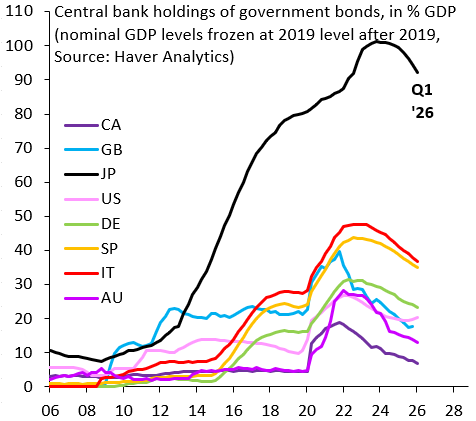
Lean on your central bank: the chart above shows holdings of government debt by the world’s major central banks. When QE first got started during the global financial crisis, it was intended as an extension of normal monetary policy when policy rates couldn’t be cut any further, i.e. it was intended as a countercyclical tool that would be unwound once the economy recovered. That unwinding never happened. Central banks have become a permanent repository for government debt, which is a form of financial repression and is why “shadow yields” are so much higher than actual yields all over the place.
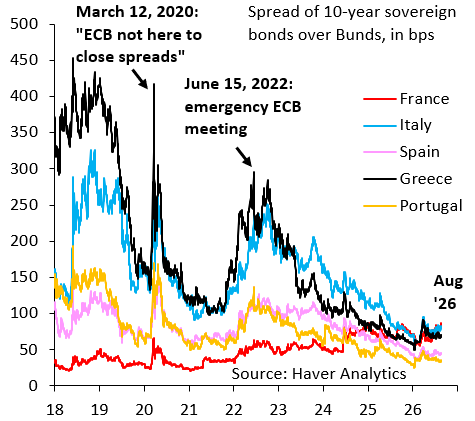
Dismiss markets as irrational: Treasury Secretary Bessent is an understudy to the ECB in this regard, given that the ECB calls rising yields for high-debt countries “fragmentation,” which is just a fancy way of saying markets are irrational and it knows better. At the ECB, Isabel Schnabel is the main proponent of all this. In June 2022, just as global yields and periphery spreads (see the chart above) were rising in the post-COVID inflation scare, she gave a speech on “fragmentation” that laid the groundwork for a new tool (TPI) allowing the ECB to cap yields on a permanent basis when it deems those disconnect from fundamentals. There’s so much that’s wrong with this and - needless to say - it’s way more wrong for a central banker to be saying this than for a finance minister like Scott Bessent.
As governments run out of fiscal space, they start playing all kinds of games to kick the can just a little bit further down the road. This stuff is dishonest and harmful. The reason it’s happening in greater frequency all over the place is because we’re in the early stages of a global debt crisis. So it’s no surprise that gold and other precious metals are taking off, including after this week’s buyback announcement. Things are going to get worse before they get better.
No posts
Comments
Nothing yet. Say the first thing.
Sign in to join the conversation.