
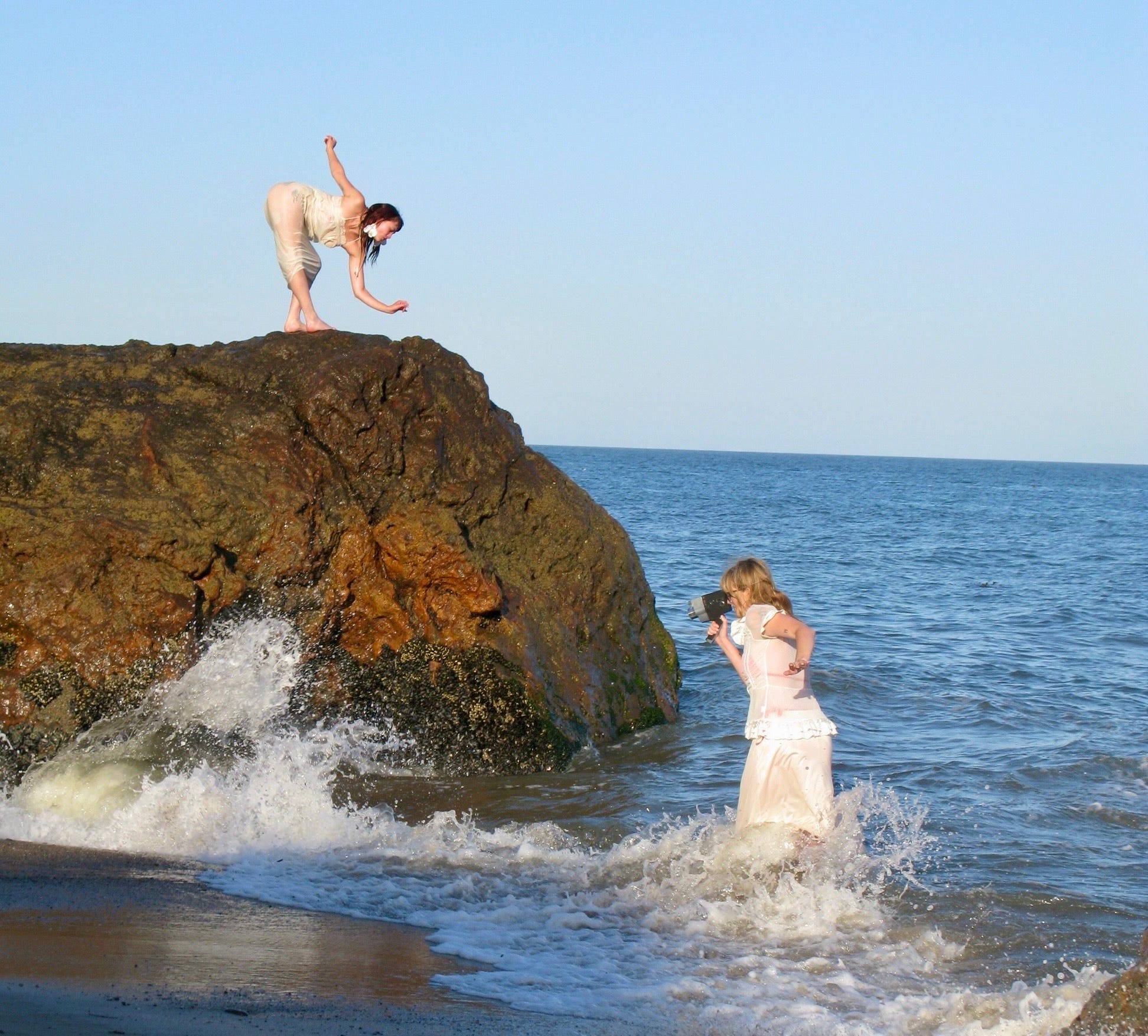
I’m so excited to share a new voice with you all today. Back in the day, like waaaay back in the day, I went to college with a friend everyone called Copley. Sure, she had a first name, but no one ever used it.
Life since then has been what life always is: fast. One minute it’s 1991, we’re at the bars, playing lacrosse, making friends, making memories. The next, folks are married or deep in careers and we’re scattered about the country. For lots of those “salad days” friendships, social media has kept the thread alive. We watch each other’s kids grow, graduate, and celebrate milestones. Maybe social media is not all bad?
One day, Copley posted that her daughter had published a book of poetry, and I immediately reached out. As someone who’s spent cough-mumble-years trying to get my own work into the world, I wanted to help surface hers. That’s how I connected with her daughter, McKenna Matus.
Out of one conversation, I learned that McKenna is talented, thoughtful, and generous in the way she shares her story. In short, she’s a lovely kid. Yes, I’m aware I’m calling her a kid and she’s older now then when I was running around town with her mom, but let’s not worry about that right now.
McKenna’s navigating life with Bipolar II disorder, which means she knows firsthand the work it takes to support her own mental health while still creating beautiful art. I’m thrilled to share her words with you here and help launch her Substack.
Take it away, McKenna.
After my third time in intensive psychiatric care, I vowed to myself that it would be the last time. I made a pledge to do whatever it took to become happy, stable, and successful.
I needed to be okay.
A conglomeration of trauma, lack of self care, toxic people/environments, and my omnipresent Bipolar 2 diagnosis shattered me. The process of picking up the pieces of my own mind and body and putting them back together was grueling, triggering, exhausting, and still has to happen in small ways every day for the rest of my life.
I’ve been lucky enough to have access to life changing mental health resources including EMDR, weekly therapy, trauma groups, in (and out) patient hospitalizations, and my delicious cocktail of antipsychotics and antidepressants, which, combined with the philosophies I hold dear to my heart (Buddhism and Transcendental Meditation), have helped me fight the fight to win the battle.
The words below are my ponderings on the universal truths that have helped guide me to a (mostly) happy and healthy life. I hope that someone somewhere, whether Bipolar, depressed, anxious, schizophrenic, BPD, ambiguously mentally ill, or just not fucking happy, could feel some relief from learning about the tools of survival that freed me from my own mind.

How can you become whole if you’ve never been broken?
A shattered sense of self can feel like devastation, but it also makes us indefinitely malleable. Breakage creates opening.
In Buddhist philosophy, the concept of the Self is understood as a composite of five aggregates, known as Skandh1 as, which collectively encompass the entirety of an individual’s mental and physical existence:
Rūpa (the body and physical matter)
Vedanā (sensations and feelings)
Saṃjñā (recognition and perception)
Saṃskāras (thoughts, emotions, and patterns)
Vijñāna (consciousness and awareness)
The Self can also be fragmented.
This occurs through obstructing vessels such as oppression, trauma, and disability that can hinder our shattered state further, creating more cracks. If not for these cracks, though, there would be no way for the light to come in; the harmonic polarity of not being able to have the light without the dark. For how else can it shine through?
In this disturbing, distracting, destructive, and disruptive age fueled with energetically dark technologies and Machiavellian world leaders alike, it is imperative to pay attention to what is real.
For me, reality lives in connection: moments of beauty, glimpses of truth, a sense of Soul. Within that connection lies pure consciousness—a state of inner illumination that exists differently within each of us.
Pure consciousness can come to fruition in whatever form our awareness is capable of holding — be it a memory, a place of serenity, or an imagined space of peace. For most, it appears as a biome that functions in a cyclical everlasting loop of life; the ocean, a desert, a forest…
When you merge pure consciousness with daily perception, you create a refuge—a sanctuary stored in the mind that you can return to at any time.
Accessing it isn’t instant. Like any skill, it requires repetition, patience, and practice.
The process consists of holding an image in your mind that brings you the most peace, serenity, and tranquility.
The more the mind intensifies its focus on the image, the wider our consciousness expands. You begin to gain more control over your ability to conjure and control your consciousness. This is the process of grounding.
Grounding as a practice can ignite a recession of negativity (as negativity and depression function as conduits to mind control), eventually lifting it away almost completely to release the conduit flow of creativity.
Grounding can:
Calm a fight-or-flight response
Re-center the Self with clarity
Weaken the pull of negativity and distraction
Restore access to creativity and presence
Using grounding as a tool and practice ingrained into your everyday life is the gateway drug to the process of transcendence, as defined by Transcendental Meditation scholars as, “a state where the mind is completely silent yet wide awake.”
Prior to complete transcendence, one might feel separate and distinct from the collective consciousness, when in actuality, we are all interconnected. I couldn’t come this far without quoting one of the few people in this world who truly lived a grounded, transcendent, and incredible life, the legendary David Lynch, “We don’t all have to have the same understanding…but if it’s real and true, it all connects.”
The more connected we become to our pure consciousness, the more expansive our mind’s ability becomes. Pure consciousness is dynamic peace.
And what is the goal of life, if not to find your definition of peace?

Thank you, McKenna, for sharing such a powerful and lovely piece. If you want to keep reading her work, subscribe to her Substack and IG.
And as a bonus, in our chat about collaborating for this post, I couldn’t help myself and was all, “Ooh, you should also be on Well..Adjusting.” So make sure you follow Well…Adjusting because McKenna’s episode is dropping this week.
It’s a fantastic conversation about what it means to live with a good grip on your mental health while still wanting to level up, to add more focus, more balance, and more space for creativity.
It’s honest, funny, and hopeful. So be sure to follow Well…Adjusting and keep an eye out for that episode. You won’t want to miss it.
However, the Self is neither reducible to any single aggregate nor equivalent to the mere sum of their totality.
Comments
Nothing yet. Say the first thing.
Sign in to join the conversation.