
Hey there!
this is the third interview of my interview series with founders and commercial leaders of manufacturing technology companies. I will share these interviews regularly with you. The interviews consist of a written summary below including a link to the full transcript.
Enjoy reading - and as always, sharing and feedback is a gift.
Robin
Got a friend or colleague interested in the future of manufacturing? Help me spread the word by sharing the newsletter if you like it!
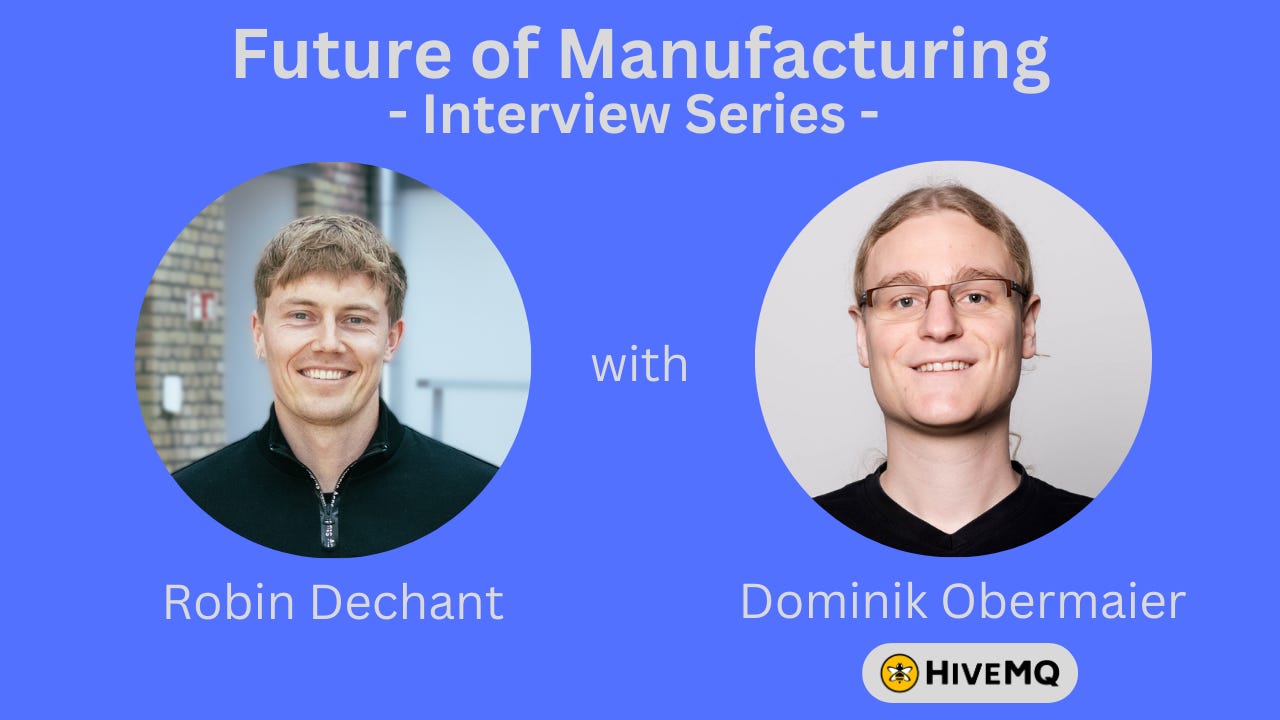
In this interview, I sat down with Dominik Obermaier, Co-Founder and CTO of HiveMQ.
HiveMQ, founded in 2012, connects smart devices—like cars and factory machines—so they can share data instantly and securely. They do this using a technology called MQTT, which allows millions of devices to communicate securely and in real-time. HiveMQ's platform makes it easy for enterprise companies to control and monitor their devices, which is super important for things like smart homes, connected cars, and automated factories.
Dominik and I talked about bootstrapping HiveMQ for several years, how to win large customers, how to expand to the US and on the current state of AI. Below you can find a summary of the interview. You can find the interview transcript here. Thanks again Dominik for the fruitful conversation and for sharing your journey.
“Money is a tool for building something awesome for your customers. There is no prize if you have an article about how much money you have raised, it doesn’t help your customers..”
👉 Insights: be the number one expert in the world on something to have a reason for people to listen to you. This is critical in the early days when you have little proof
👉 Customer-first: spend as much time as possible with customers to understand their needs and challenges. Focus on delivering exceptional value and support to your customers, as this builds trust and long-term relationships
👉 Develop strong brand equity: consistently create valuable content and engage with your target audience to build brand awareness and credibility
👉 Bootstrap when possible: bootstrapping allows entrepreneurs to focus on building a sustainable business model and making long-term decisions without the pressure of external investors. This approach fosters financial discipline and aligns with building a company with solid foundations
👉 Work hard: be prepared to work hard and invest significant time and effort to make a meaningful impact. Work-life balance is a misconceptions, to be successful you just need sheer will and big time investment
HiveMQ initially focused on being an enterprise MQTT broker, addressing challenges like scalability, high availability, and security. They saw MQTT as a suitable communication protocol for IoT due to its low bandwidth requirements and ability to scale to a large number of devices
The first prototype of HiveMQ was built in a few months, and they secured their first customer, BMW, with a $50k deal
The company decided to bootstrap, valuing cash flow breakeven, profitability, and efficient growth. Bootstrapping allowed them to focus on building a sustainable business model and making long-term decisions without the pressure of external funding
In the early days, HiveMQ had a strong focus on brand equity and consistent content creation. Dominik released at least one blog post every week in the first years. Writing these blog posts was time-consuming, often taking several hours. However, it was crucial for providing value and establishing HiveMQ as a thought leader in the space
Educating through content: initially, the focus was on educating the market about the benefits of MQTT technology rather than directly selling the product. Building strong brand equity was crucial, achieved through consistent content creation, such as weekly blog posts
Community engagement: engaging with the developer community was important for spreading awareness and gaining early adopters. This included participating in conferences and giving talks to increase visibility and connect with potential customers
Customer relationships: Building strong relationships with potential customers and understanding their needs was key to gaining trust and credibility. Dominik spent as much time with automotive OEMs as he did in the office
Expertise: be the number one expert in your field and provide real value to potential customers. Demonstrating deep knowledge and understanding can help earn trust and credibility. Dominik was often the youngest person in the meeting room but his expertise helped him a lot to gain trust
Build relationships: spend considerable time with potential customers, understanding their needs and challenges. Establishing strong relationships and finding allies within the organization is crucial
Navigating politics: recognize that large organizations have complex political dynamics. Building a network of supporters across different levels of the organization is essential for success
Brand and awareness: invest in brand building and marketing to create awareness and interest in your product
Cultural differences: the US market has distinct cultural and business practices compared to Europe, with decision-making being more people-centric and faster-paced. Founders should be prepared for the challenges and differences in business dynamics
Different sales approach: the sales process in the US is more emotional and less tech-based, requiring an understanding of local vocabulary and sports references with baseball being a good example
Local presence: establishing a local presence and hiring US-based talent is important for effectively engaging with customers and navigating the market
Higher costs: factor in that operating in the US involves higher costs for living expenses and travel. This has impact on your funding strategy and timing on expansion
General importance: hiring is the single most important decision, especially for early hires and during scale-up phases
His biggest hiring mistake: not being clear on the profile he is looking to hire paired with an urgency bias in hiring, leading to hiring suboptimal candidates. It's better not to hire than to hire the wrong person due to time pressure
Use a framework: employ a structured hiring framework or methodology (eg. the WHO method) to ensure a thorough and consistent process. This will help you to avoid urgency-bias or lack of clarity on profiles
Leadership development: focus on developing internal talent and promoting from within, alongside hiring externally when necessary
Convincing VPs: to attract top talent, especially at the VP level, ensure you have a strong package and leverage good recruitment agencies
Current state: what is currently labeled as AI, particularly large language models, is primarily an interface technology and not the full potential of AI. There is a risk of disappointment if manufacturers expect large language models to drive significant ROI without focusing on data and practical AI applications
Current challenges: the real challenge in manufacturing is accessing and standardizing data, which is crucial for applying AI effectively
Real AI impact: true impact of AI will be significant in the next decade, but it requires a focus on practical applications rather than hype. The industry needs to have the fundamentals of data access in place to benefit more from AI
Thank you for reading The Future of Manufacturing! Subscribe for free to receive new posts and support my work.
No posts
Comments
Nothing yet. Say the first thing.
Sign in to join the conversation.