
Three stripes of bold colour. Simon thinks it’s enough to make you hoark, with the caveat that he lacks any formal training in art appreciation. That minute security guard Rajiv has stepped in from the adjoining room. Rajiv always made Simon think of the Gurkhas, although by his turban he is a Sikh, maybe Punjabi, and not Nepalese. He walks to the archway between the two halls of the National Gallery.
“Raj, you know much about the Newman, what it cost, what it’s worth?” The guard starts slightly, squints, reveals a mouth of bent and damaged although glistening ivories, “But, I’m with security, I’m not your art guy.”
“Right.”
Simon is disturbed that a couple, art lovers, have matching t-shirts on, emblazoned with an architectural drawing of the National Gallery, his in blue, hers in pink.
From another direction a group of a dozen with their guide stroll over to the middle of the Newman room. Half sit down on their portable foldable seats (supplied by the gallery). The rest stand.
“Voice of Fire,” she begins, “was controversial from the start. Tell me, what’s your first impression? How does it make you feel? What’s the impact of this work viewing it up close?”
She quiets down for two seconds, and without scanning for responses, continues on: “It’s at first very simple, isn’t it, like something your six-year-old could have done on the front lawn if given two cans of paint, a roller, and a big, friendly canvas. That’s what many said when this piece first arrived here. Some saw it as a scam.” You could hear her silent tut-tut.
From the front of the gathered group, an elderly man in a buttoned-up beach shirt says: “How much did it cost?”
“And that was indeed one of the issues raised at the time, wasn’t it? But let’s remember now that this — let’s call it a Masterpiece — was purchased by your National Gallery for pennies thirty years ago. Advocates would call that a real steal. But it wasn’t what much of the public said then. An added controversy was that someone discovered the piece had initially been hung upside down.”
And three people at once blurting: How can you tell?
“So, what is it worth...?” asks the old man, insisting.
“Some say millions and millions, now,” she answers. “If you sold it.”
“Let’s keep it!” says the same inquirer. Simon has had enough and strides over into the group.
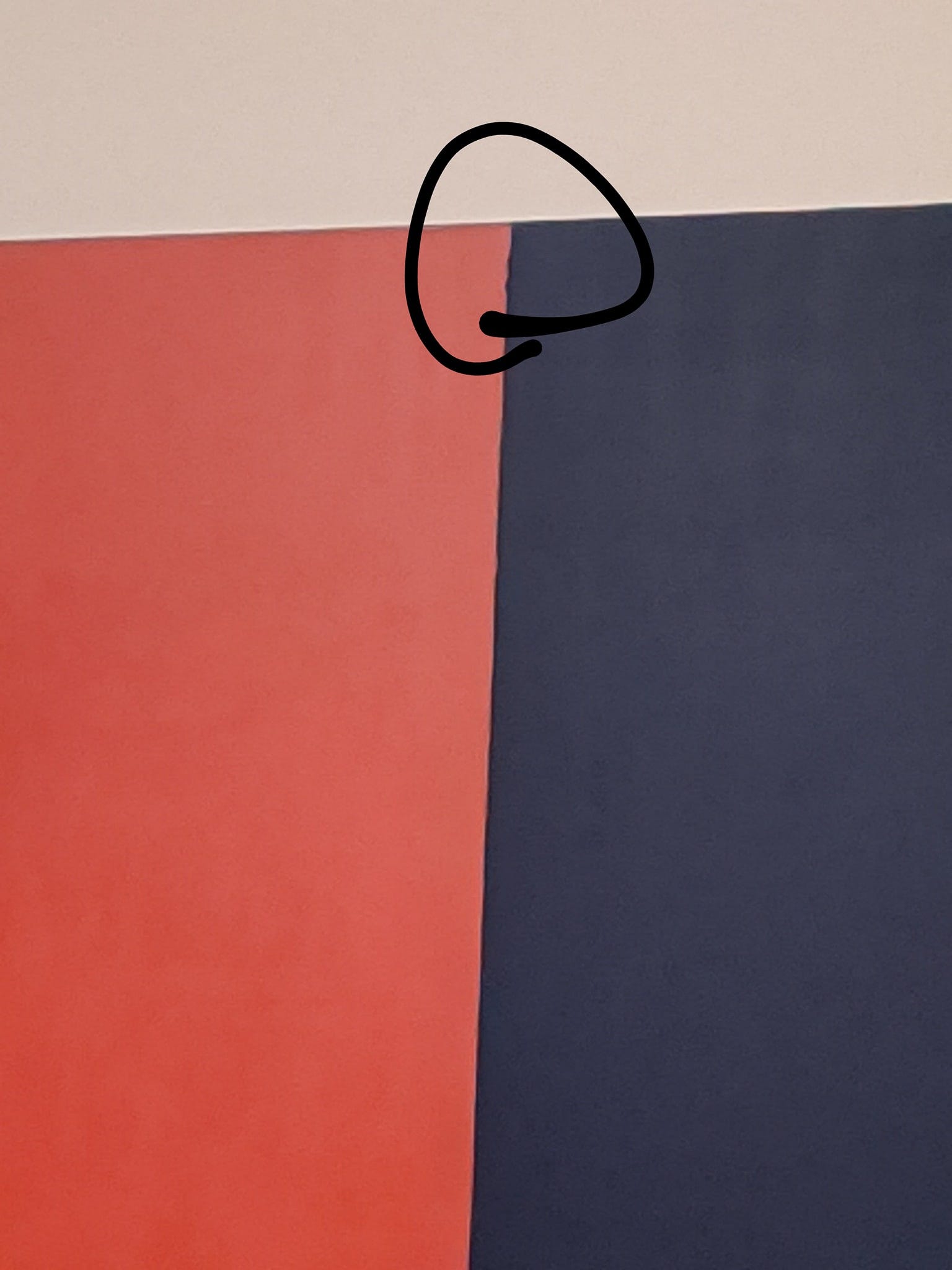
“Excuse me,” he interjects. “But that drip.”
“What’s that, sir?” and the guide turns to face this interloper who had not paid for her services.
“That drip at the top. What’s its meaning?”
Everyone twists their collective head upwards to find the drip. There it is near the top of the right stripe of blue, overlapping into the middle stripe of red. You can see it if you look hard enough.
“That,” she says, “is probably a paint roller failure. It wasn’t intentional.”
“That,” Simon says, self-satisfied, “is my point.”
Some confusion, now, about which point Simon is making but the gallery guide is catching his drift, and her eyebrows curl in a frown. She’s a pro. Says something perfunctory about art not being about perfection but impact, and do these eighteen feet (five point four eight six four meters) of visual drama tear at us viscerally or not? Do they prostrate us. That is the only judgement that matters, she says. Everyone seems to agree that there is a gut reaction, damn the original monetary cost, forget about the drip, don’t be an asshole. Et cetera.
“And, sir, if you please, this is a private group, and you didn’t subscribe, am I right?”
Simon bows an abject apology, and steps away, walking to where Rajiv has been watching and listening.
“Worth it you think?”
Rajiv says “Well lots of people come visit it, and I can’t say I understand it, myself. But I’m no art expert, so...”
Simon pats him on the shoulder, Be brave Raj, he says, and wanders into another room, leaving the guard, the art group and their guide behind. Shortly, they collect their seats and move on too.
Simon wanders into another hall of contemporary pieces. One of them is catchy. It’s a white ceramic urinal, a conceptual work rejuvenated by Marcel Duchamp, and called Fountain, with R. Mutt 1917 written across it with a magic marker. This was one of Duchamp’s “Readymades” and the National Gallery was quick to purchase two of them back in 1971. One as a spare, apparently.
Avant Garde. This isn’t just one of your tavern tall upright urinals, though, it’s one of those smaller ones that you use without too much wall space being used up, often found in fancy restaurants or in a higher rank of public place. More subtle.
Kudos to Duchamp, thinks Simon. People will talk and tut and tut.
He wanders around and around and comes into another hall in which resides “Firuzabad (Variation) I”, created by Frank Stella. This one is also captivating and takes up the full width of a wide wall. It’s a set of several curved geometric shapes, mostly half-moons of many colours banded within three interlocked circular shapes. Striking, flashy, exhilarating. Simon walks up for close inspection and moves back to get full exposure of the work, then walks up again, just as the art group and their guide enter the room and gather around him. They set down and spread open their folding seats.
Simon moves back a bit to give them space and nods familiarly to the guide. She is stern. But this time they are invading his viewing space, so he sticks around, all ears, no obligation to leave.
“This is a piece by Frank Stella,” she begins. “What are your thoughts on it? Does it affect you differently than the others...? How does it make you feel?”
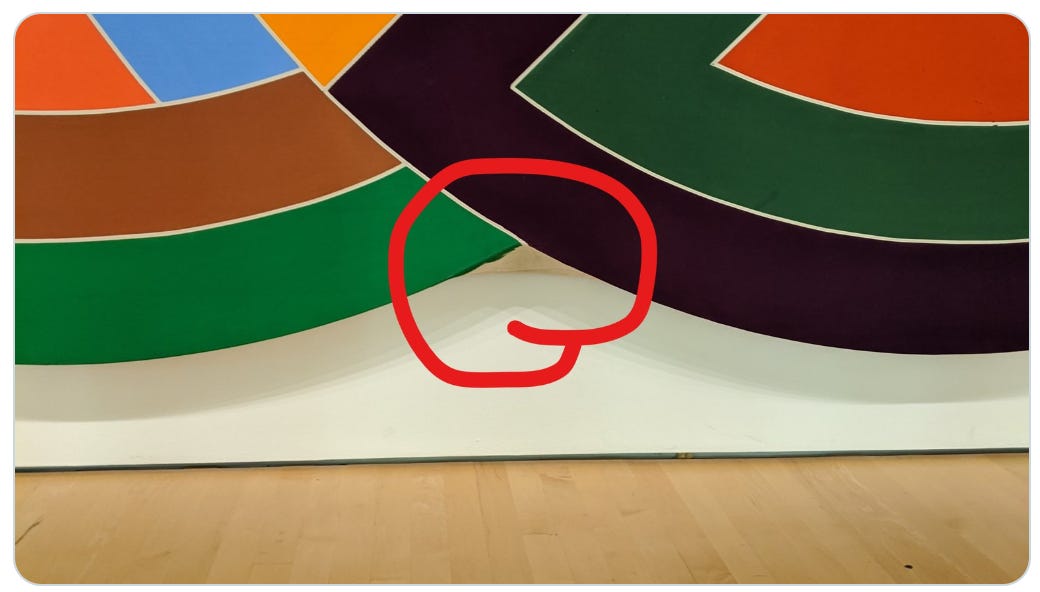
Simon likes Stella’s swirls and bold colour but it is no Rembrandt, and vice versa. A different elderly man who had walked up close and looked down, raises his hand. There’s a spot there, he says, near the bottom just left of centre, it doesn’t seem to be complete. He seems perturbed. Simon, delighted, feels like giving the gentleman a fist bump. The guide is silent, then she grimaces. Any other comments? The old man continues, “Do you think he meant to paint that part green, but forgot?”
“I don’t know.”
Simon picks up his cue and says It Must Have Been Intentional. It is a work of art, and nothing is left to chance. Frank Stella had endless time to complete it. There are no mistakes in art, so what is the meaning of this unpainted nugget?
The guide was willing to put up with the misguided senior’s ignorance, but not the interloping Simon and his provincialism, or is it guile?
“Well,” she says, “Mr. Newman died several years ago, but I think Mr. Stella is still alive. WHY DON’T YOU ASK HIM YOURSELF if he will come back and finish the job!” She is angry, but contained, and there is suffocating silence until the moment that Simon punctures it. “OK, I’ll send him an email and see what he says.”
No one believes he will, of course, and they will never meet up again. It’s idle talk. They don’t know Simon.
….
Back home the next day, Simon looks him up. Frank Stella is alive and maybe living in New York City, no surprise there. No email to be found. Twitter? Yes, there he is, and Simon constructs a tweet and attaches the photo he’d taken, a close-up:
@FrankStellaArt Frank, I visited your painting at the National Gallery of Canada, “Firuzabad (Variation) I”, and was most impressed. A small section at centre, bottom edge between a green and black strip remains unpainted. Will you touch-up at some point?
Simon sends it into the ether.
He goes out for a snack. He likes a place close to home, Elgin Diner, unpretentious comfort food, hot chicken sandwhiches, great milkshakes in a metal can; pictures of Marilyn and Marlon, a menu scribbled on a chalk board. Soups of the day are tomato and chicken noodle. Nothing fancy.
Over there on one wall is also a cheap framed print of Edward Hopper’s Nighthawks, which is spectacularly well-suited, in this place: He likes the jade green and the stools, the girl in the red blouse, the man with the pointy nose smoking a cigarette. But most of all the clean lines, the possibly nighttime, possibly late daytime lonely exterior and the yellow lit interior with those two huge coffee urns in one corner. The swinging traffic door to the kitchen. The cook, with a classic cap on a near bald head. Both male customers with 1950s fedoras, pre-Kennedy for sure. Hopper is said to have invented this diner out of his imagination but based it on a joint in Greenwich Village, near where he lived. People have spent a lot of time and energy trying to track down its whereabouts. It’s an ongoing mystery.
The painting leaves Simon with a feeling he wants to continually return. There’s the diner food, too, so there’s an apt excuse. The regular waiter catches him eyeing the Hopper. He adjusts his waiter apron and pulls from it his pen and pad. “What you have?” The daily special.
….
Later that day, Simon is astonished but pleased to see that Frank Stella has already responded, albeit somewhat obliquely, by encouraging him to look at the works of another contemporary artist. Do you like these? Frank asks Simon.
Simon takes a look, yah some, and tweets in reply: Some of it for sure. (It’s not Hopper, he wants to add, but doesn’t.)
Getting no further feedback from Frank, he sends out another tweet reiterating the original theme,
@FrankStellaArt My recent inquiry about your piece in the National Gallery of Canada (incomplete paint coverage) is a real question. Any thoughts about that blank spot?
Nothing. Very unsatisfactory. Frank Stella even seems to have deleted his own initial reply. Thin skin. Simon scowls. He decides not to inquire further.
…
Two months later, Simon is back at the Gallery and checking in on the Impressionists and the Canadian rooms. He doesn’t feel attracted to the Emily Carrs nor much of the Group of Seven, even though he is supposed to, for patriotic reasons. He likes the European Impressionists more, especially the French, although not all of them.
Then, nearby, he sees the tour guide from earlier days, and she is walking right towards him. “Sir,” she says, “good to see you are back, and I hope you are not avoiding non-representational art!” Not at all, says Simon. It’s just some that turn me the wrong way.
She says: “Art is subjective, isn’t it...? And I’ve thought about your offer from before and am curious to know if you ever reached out to Frank Stella about his incomplete work [she puts air quotes around this]. And did he respond?”
Simon considers this for a moment. What to say? “No, I never bothered. It wasn’t my place to make fun, was it. Brilliant artist and such.”
“I can imagine how you felt, in the shadow of a master like that,” she says, smiles and turns. “Too bad.”
She walks quickly away. There is no opportunity to pursue this further, not that Simon wants to. He instead pivots back to the Lucius O’Brien which he’s been inspecting, an obvously traditional landscape that he likes.
Satiated, Simon heads out by way of the contemporary hall so he can cut to the staircase. There under an archway checking his smart phone, is Rajiv again, still guarding the collection. “Hey,” he bellows over, “we paid $1.8 million for the Newman, back in the nineties.”
“What a rip-off.”
“But it’s worth forty million.”
“Wow, what a deal.”
“Do you like it?”
“I do now,” Rajiv says, briefly rolling the pads of his thumb and forefinger together as would a small-town banker, then goes back to his phone.
Postscript:
Edward Hopper died in 1967. Marcel Duchamp in 1968. Barnett Newman in 1970. Frank Stella in 2024.
No posts
Comments
Nothing yet. Say the first thing.
Sign in to join the conversation.