
In last month’s post I said I would try and write a ghost story for Halloween. I haven’t done that, but I have written about some fairly eerie music, which certainly feels suitable for late October, so I hope that’s spooky enough for you.
I’ve had two albums on constant rotation over the last few weeks: Joanne Robertson’s Blurr, which was released in September, and The Violet Hour by the Clientele, originally released in 2003, but due to be reissued on vinyl in November.
The suitably named Blurr is a collection of some of the most brilliantly vague music I’ve ever heard. When the song ‘Gown’ came out as a lead single I mistakenly thought that the entire album was available and I pressed play on Tidal (I’ve left Spotify at long last) while I went about my day. It took me about half an hour to realise that I’d been listening to ‘Gown’ on a loop. The song is so gentle, so close to barely existing at all, that it registers more as a mood than as a piece of music with a melody and words.
Now the album is actually out I’m amazed by how it feels different every time I listen to it. It’s like the songs have changed, or new ones have appeared in the darkness since last time; or is it that they feel so ghostly that they seem to slip beyond definition, beyond what memory can preserve? It gives the impression of an album that is constantly dreaming itself into existence.
I love the Pitchfork review of Blurr in which Emma Madden writes:
It is scarcely conceivable that Robertson recorded the album within the confines of a room, constructed from earthly material, somewhere inside a city.
I think of Loveless in a similar way. Whenever I listen to it, and imagine My Bloody Valentine recording it, it’s like everything is out of focus. It feels hard to imagine that anything was sharp, definite, real during its creation.
The more I listen to Blurr the more I pick out familiar landmarks in the songs – the lilting melodies, the gorgeous addition of Oliver Coates’s strings, which are remarkably at one with the reverb-heavy guitar and voice. Indeed, despite Robertson’s words and music and Coates’s arrangements seeming to come from different sound worlds – and, I’m guessing, having been recorded in different places – there’s a homogeneousness to the whole. To put it another way, you might not expect a chamber orchestra to sit so well with the almost-not-there sound of Robertson playing and singing to herself, but it does; the combination creates a new sonic environment, one which, as Madden notes, sounds like it exists beyond the veil of the everyday.
The fret squeaks of Robertson’s guitar and the rough-around-the edges playing and recording of her songs (at one point you can hear what sounds like a mic or a guitar being unplugged) are exaggerated and elongated with copious reverb. Those kind of imperfections could sound wrong in a less controlled environment – they could take you out of the hypnotic state that Blurr induces in the listener – but, strangely, they only seem to reinforce the hermetic atmosphere of the album. Those noises become something like artefacts of ambience – lens flare, a voice heard in a dream. The mood is never broken.
I first got into the Clientele in 2018 (which was rather late for me), but it felt like I’d known them all my life. Their music felt immediately familiar, not least because singer and guitarist Alasdair MacLean has the knack for writing songs that sound like you’ve heard them before; songs that, because of their inscrutability (which is sometimes due to the lo-fi way in which they were recorded, and sometimes due to… something entirely ineffable), actually sound like the process of trying to remember them. Like Cameron Winter or Cindy Lee, MacLean writes boldly sincere melodies that feel uninhibited by the anxiety of influence of 70 years of rock music. They are songs that have something of the naivety of an art form in its first flush of youth.
The Violet Hour is a record that sounds almost transparent. The vocals are so quiet it’s like they’re about to disappear completely. As ever with the Clientele, the effect is not dissimilar to ambient music. It’s not so much about the individual songs as the overall mood – a feeling of something like disintegration. The songs sometimes seem to blur(r) into one another, and the production is so swathed in reverb that you can lose your bearings. Suitably, the album ends with a song called ‘Policeman Getting Lost’, and you can picture the titular officer stumbling through the fog like a character in one of Robert Aickman’s ‘strange stories’. With songs called ‘Missing’ and ‘Everybody’s Gone’, it’s an album that’s haunted by absence, and I’m reminded of Mark Fisher’s definition of ‘the eerie’ in his excellent book The Weird and the Eerie: something where there should be nothing, and nothing where there should be something.
There are all the usual things one could write about the Clientele. When I worked on a podcast with the band, I made a list with my friend Kate (who guested on an episode) of words to avoid: liminal, hauntological, crepuscular etc. But it’s hard not to think of adjectives like that when you listen to a Clientele album. Their songs seem to evoke a mood, a setting, that, despite the gauziness of the music, is so vivid you can see it. The autumn leaves and dimly-lit streets, the parks of London, the sighing motorway, the rain (the endless rain) – all done out in nicotine-tinged John Atkinson Grimshaw colours (indeed, the eerie green cover of The Violet Hour seems to come directly from his palette).
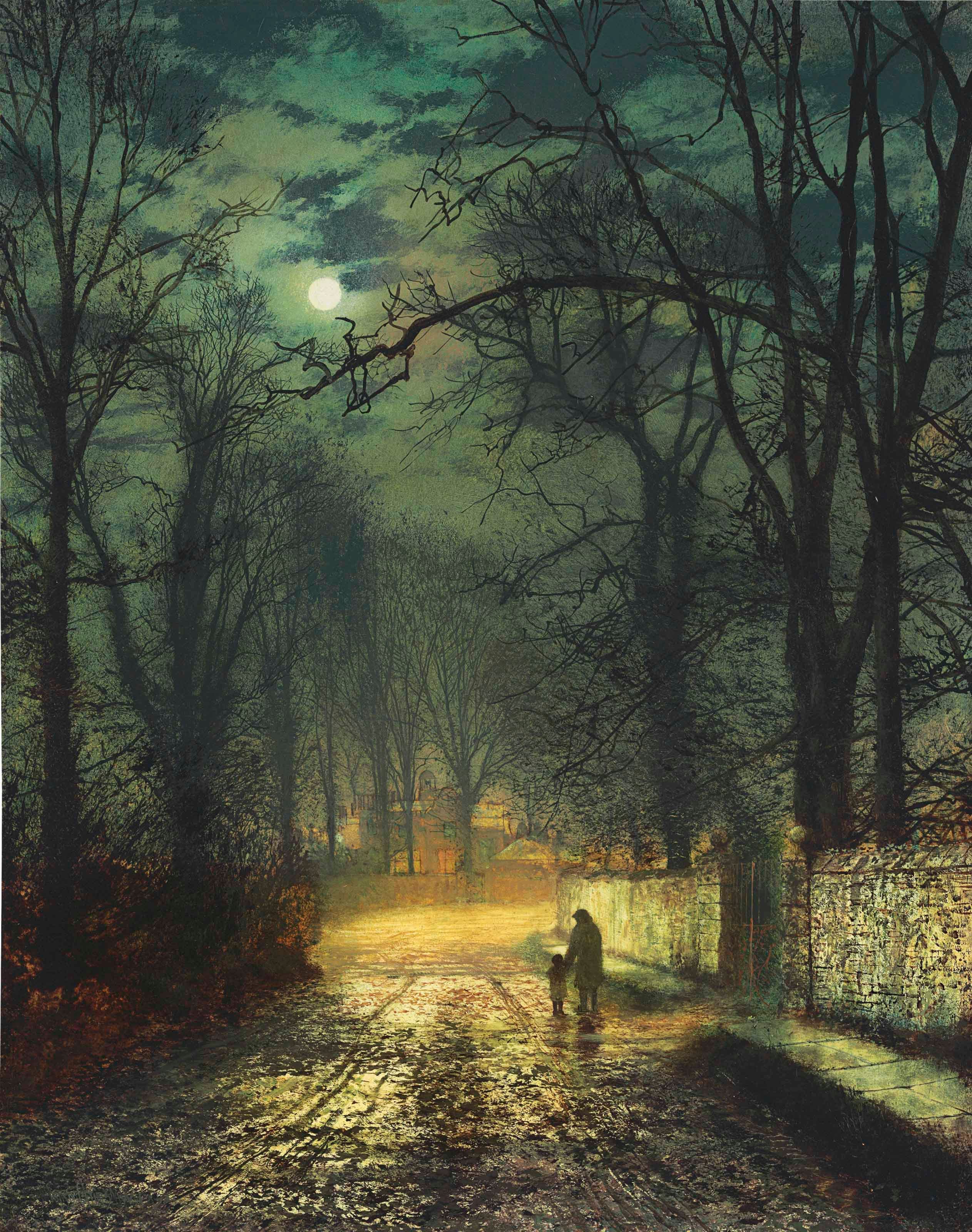
I was delighted when I read this review of the Clientele’s mini album Minotaur, because it captures the evocative scene setting of the band’s music brilliantly:
It’s the same gorgeous, heartsick-sounding, consciously nostalgic, folk-ish rock you can imagine jangling from some shy bookworm’s transistor radio in the brief period between Rubber Soul and the Summer of Love.
Rather like the way in which different people claim that they have seen the same hallucinatory figures after taking some profoundly mind-altering drug (Terence McKenna said that after ingesting DMT you’re more than likely to be greeted by ‘self-transforming elf machines’), I read that Minotaur review and thought, yes, I saw the shy bookworm too! I smelt the fug of smoke in his student digs and looked out at the same wind-picked sky!
Listening to The Violet Hour now, I find it almost impossible to believe that it came out in 2003. Like Loveless and Blurr, it’s a record that feels like it is not ‘constructed from earthly material’ – and not tied to a particular point in time either. With its tape hiss and buried vocals, it’s noticeably out of joint with the prevailing trends of the early 00s. Weren’t we all listening to Permission to Land by the Darkness and boogieing to ‘Hey Ya!’ in 2003? It feels like it should have come out in the dimly-lit 80s or early 90s, a time I can barely remember because I was only a child. 2003, on the other hand, is pin sharp in my memory. I can vividly recall the texture of my life back then – out of university and about to start an MA (on Shakespeare – watch out job market!). Train journeys, gigs, jobs, friends, evenings in the pub, the unusually hot summer… These memories are so crystal clear that I feel like I could walk back into the Highbury Vaults now and continue a conversation I was having back then as if I’d just popped to the bar (and as if none of the intervening disasters and wrong turns had happened yet).
Or is that just an illusion? How well do I really remember 2003? When I go through my photographs from that period they look like relics from a distant age. Before the advances in readily available digital photography, cheap disposable film cameras had their own in-built nostalgia, colouring everything like a half-forgotten dream.
As I write this, memories from that time drift to the surface. I remember walking through an unfamiliar part of Jericho in Oxford. I didn’t really know where I was going, I was just following my nose, walking to get lost. There’s a kind of wild magic about Jericho: the canal, the hidden pubs, the tower of St Barnabas church, which feels like it’s been transplanted from Renaissance Florence. No wonder it’s a key location in Philip Pullman’s His Dark Materials multiverse. I had absolutely no idea where I was – it felt like I was deep in terra incognita – but I couldn’t have gone far because when I happened to look left up the street I was crossing I saw shops and cafes that I recognised on Walton Street (very much home turf). It sounds like an insignificant thing, but it felt magical, like I’d found a portal between worlds. It was an eerie moment. Something where there should have been nothing – familiarity when I expected unfamiliarity. That’s a very Violet Hour kind of memory, isn’t it?
Also around this period, I remember spending an evening with a friend who introduced me to Gravenhurst, the musical project of Nick Talbot. Much later on I would end up playing bass in Gravenhurst, and Nick would become a dear friend. I remember listening to Flashlight Seasons one afternoon as I walked around Bristol in suitably gloomy winter weather, bare trees black against the white sky. The lyric, ‘I have the ghosts of autumn murders walk me home’, struck me as impossibly vivid and evocative; a short story in a single line, with a hero who is, perhaps, a slightly more macabre incarnation of the shy bookworm from Minotaur. Another Violet Hour moment in short.
One more 2003 memory. I had a job interview at a bookshop one afternoon and afterwards I had to get to my evening shift doing data entry in an office on an industrial estate in an area of Bristol called St Philip’s Marsh. I decided to walk it. I’m absolutely abysmal with directions and this was long before smartphones, and so, like the policeman in the Clientele song, I got completely lost. I remember walking past the magnificent houses on Clifton Down and thinking, how on earth did I get here? Google Maps tells me that the walk should have taken around 45 minutes. Looking at the route I probably did take (including the completely unnecessary diversion into Clifton) I can see that I walked roughly six miles and it would have taken me over two hours. I remember feeling helplessly dislocated from the city that I called home. And, again, there was that curious mixture of familiarity and unfamiliarity as I struggled to make sense of my surroundings. I don’t remember what music I was listening to while I went about my accidental urban exploration, but, by now, you can probably guess what would have been appropriate…
Let’s skip ahead to the present day. Recently I was listening to The Violet Hour while I walked around a very familiar part of Elephant and Castle. I feel like I know this area so well that I can recognise certain cracks in the paving stones. I was walking for its own sake, as I had been in Jericho all those years ago, when I decided to turn down a street I’d never really noticed before. After a few minutes, I came across a beautiful community-run garden. It felt like I’d stumbled upon Frances Hodgson Burnett’s secret garden, or that I’d found the elusive door in the wall from the H. G. Wells short story. There was even a geodesic dome of which Paul McCartney would have been proud. For a moment it felt like the city was inventing itself just for me. As if, solipsistically speaking, the garden didn’t exist until I came across it.
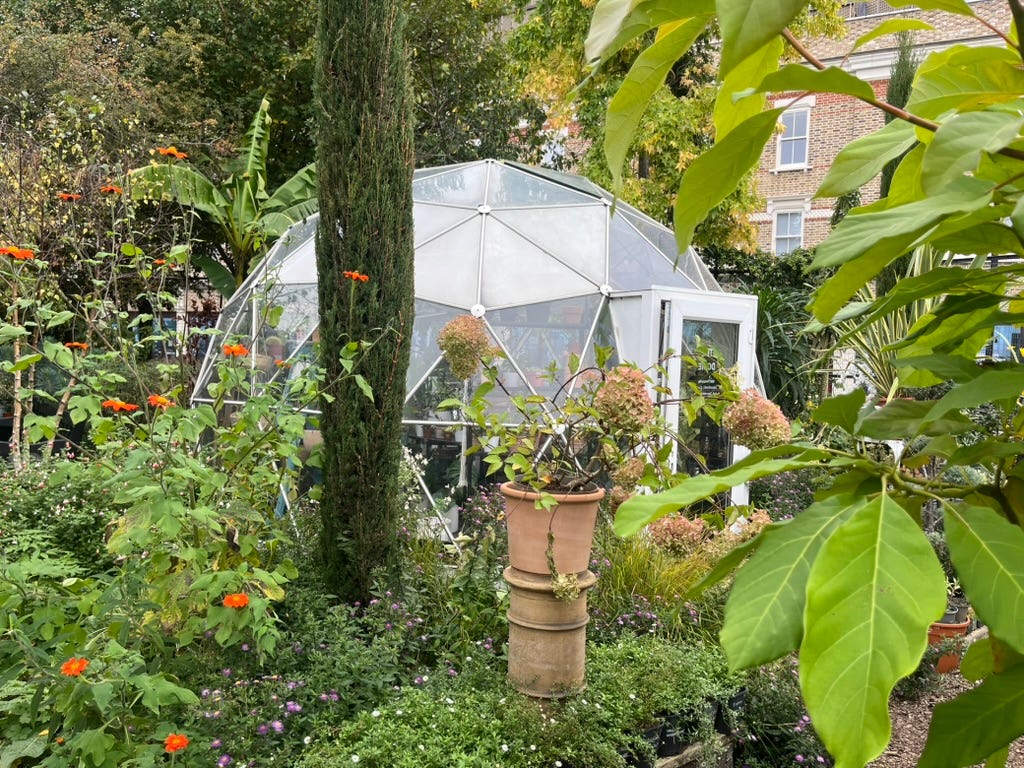
I started to daydream about how real our sense of time and space actually is (what else are you meant to do on your lunch break?). What if, as Elliott Smith once sang, your memory works in reverse? What if, in 2003 while I was getting lost in Oxford and Bristol, and listening to Nick’s beautiful and eerie music, I was somehow remembering listening to The Violet Hour in Walworth Garden in 2025?
I enjoy entertaining this fantasy and the way it makes sense of The Violet Hour time-slipping out in 2003. The illusion is that a form of magic is possible. I know that Walworth Garden didn’t materialise when I happened to walk past it. I know the Joanne Robertson album doesn’t change every time I listen to it. I know it’s impossible that in 2003 I could remember listening to The Violet Hour in 2025. But in that in-between zone, where music takes on a strange power, it feels like I can glimpse a version of reality where that magic is real.
This is getting long, so I will continue it in next month’s post.
Incidentally (and if you’ve got this far, fair play), I really ummed and ahhed about whether to refer to the ‘the’ in the Clientele with a capital or lowercase ‘t’. I opted for lowercase, based on the fact that, after much debate, it was decided by a majority of Wikipedia editors that the ‘the’ in the Beatles should be lower case. The internet used to be quite a nice place, didn’t it?
If you want to support this monthly Substack, or my music, or my podcast, please feel free to donate here:
No posts
Comments
Nothing yet. Say the first thing.
Sign in to join the conversation.