
You can’t turn on a television to any broadcast station in Baton Rouge these days without seeing five or six spots touting the value of the massive $50 billion Meta data-center project in Richland Parish, east of Monroe. I’m sure they are running these ads in other markets, too.
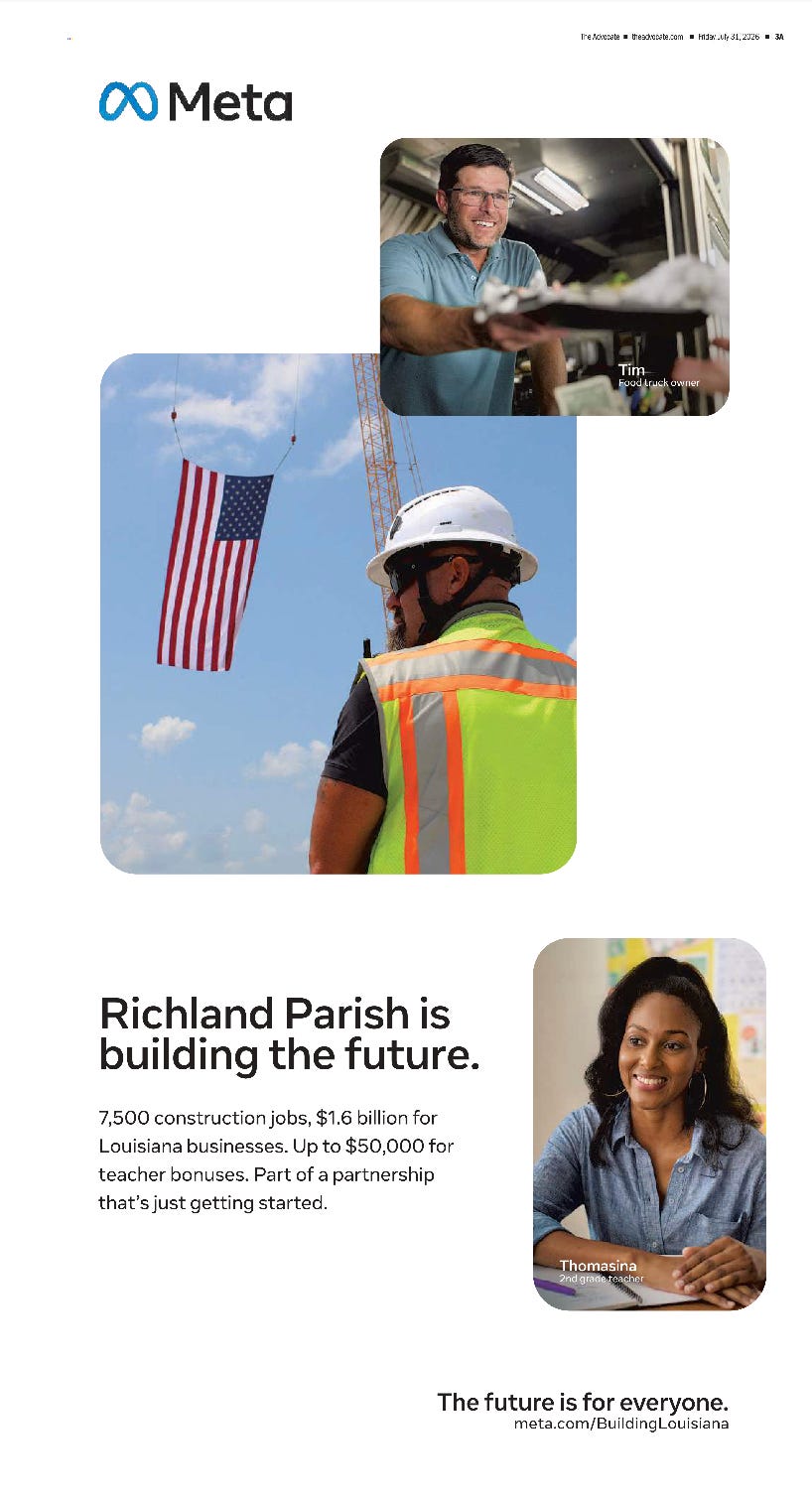
The company has also been running full-page newspaper ads to highlight the project’s benefits.
On the face of it, this campaign might seem nothing out of the ordinary. Businesses advertise all the time. But all businesses that advertise have something to sell, usually a product or service.
So, what is Meta trying to sell us?
There’s no Meta product these ads are offering that you and I can buy online or in a store. I suppose we could buy some Meta stock, betting on the project’s success to deliver a tidy windfall.
That’s what U.S. Rep. Julia Letlow, the Republican nominee for Bill Cassidy’s U.S. Senate seat, did shortly after signing a non-disclosure agreement (NDA) with the company. Using her apparent insider knowledge of the company’s plans – information she agreed not to share with us – she bought Meta stock.
Insider trading? If not technically, it sure smells like it.
According to several media reports, State Sen. Jay Morris of West Monroe also appeared to take advantage of insider information to reap a windfall by selling land to the company after he sponsored a bill in the state Legislature that helped the company and paved the way for the project.
But if Meta is giving inside information to politicians, what do ordinary people have to gain from the project? What tangible thing is Meta trying to sell to you and me?
In all my years around Louisiana politics, I’ve never seen a company that claimed to be bringing a bunch of jobs and investment to the state feel obligated to spend so much to persuade the public of their worth.
In every other case I can recall, the investment spoke for itself. There was a deal, a press conference, a groundbreaking, a job fair, and a grand opening.
The economic activity, if real, spoke in ways an ad never could. And if the jobs and tax revenue did not materialize, no amount of flashy TV spots and newspaper ads could make them a reality.
There’s no need to spend millions telling the residents of a state that you’re there to make life better for them if you’re genuinely there to do so. The only reason I can imagine a company like Meta would need to spend gobs of money on ads is if the worthiness of its project is in serious doubt.
And it certainly is.
As The Lens of New Orleans reported earlier this week:
Meta has not agreed to cover all of the costs of powering this data center project. That means Louisianians could get stuck footing the bill for their ten new polluting, expensive gas plants, including the seven at issue in this proceeding.
This is partially because Meta and Entergy structured their deal with flexibility to allow Meta to walk away from the data center before all the infrastructure is paid for, leaving ratepayers to pay for remaining costs. But even if Meta is truly in it for the long haul, ratepayers are still set to subsidize the operating costs at the new plants.
Expert testimony filed by Current Energy Group (CEG) on behalf of UCS and AAE shows that Entergy’s claimed “benefits” are premised on an unreasonably optimistic set of assumptions and quickly turn into higher ratepayer costs — potentially billions of dollars — once key uncertainties, such as data center demand and fuel costs, are examined. Further, Entergy’s analysis of power grid reliability was wholly inadequate for a project of this scale, failing to consider solutions that could have reduced both costs and emissions.
To be specific about the scale, Meta wants the data center’s peak computing electricity demand to grow to about 5,000 MW, roughly the average load of New York City. Yet, just like last year’s case, the tech company is refusing to come to the table and answer any questions that would shed some much-needed light on this proposal. Let’s recap what’s actually being proposed.
In light of these enormous risks, Meta wants you and me to be dazzled by short-term gains and to forget about the massive long-term risks.
Politico reported on all this ad spending late last year, noting that the data centers face a serious public perception problem: People don’t trust the companies to protect them if their projects go bust.
Tech companies and lobbyists are investing millions of dollars to tackle a new political problem for the industry: Data centers, the lifeblood of the growing artificial intelligence economy, are becoming toxic with voters.
Alarmed by elections that candidates won by campaigning against new data centers, the industry is taking out ads and funding campaigns to flip the narrative and put data centers in a positive light — spinning them as job creators and economic drivers rather than resource-hungry land hogs.
The new campaigns mark a sharp change for an industry that has long relied on tech’s image as an engine of growth and development. They signal how concerned the tech sector is becoming about data centers in the 2026 midterm elections.
A new AI trade group is distributing talking points to members of Congress and organizing local data center field trips to better pitch voters on their value. Another trade association, the Data Center Coalition (DCC), nearly tripled its lobbying spend in the third quarter of this year from the previous quarter, according to U.S. lobbying disclosures.
The social media giant Meta, with billions invested in its own fleet of data centers from Stanton Springs, Georgia, to Richland Parish, Louisiana, has been running a multimillion-dollar ad campaign depicting data centers as a boon to agricultural towns in Iowa and New Mexico. It has spent at least $5 million nationally in the past month on TV ads plugging Meta’s $600 billion pledged investment in tech infrastructure and jobs.
In other words, these ads are also a tacit admission that the public has little trust in Gov. Jeff Landry and the other public officials championing this deal. Just look at how Letlow and Morris rush to profit from it.
The whole thing stinks of self-dealing and overly optimistic promises of jobs and economic activity. But behind the curtain lie enormous risks that Letlow, Landry, Morris, Meta, and Entergy won’t worry about if this project goes belly up. They’ll be laughing all the way to the bank while the common folks shoulder massive increases in their electric bills.
The bottom line is this: If the Meta project in Richland Parish is so obviously wonderful, Meta wouldn’t need to sell it to us like soap or cereal.
There’s one more reason I believe Meta is spending huge amounts on these ads: They hope to buy the support or silence of the TV stations and newspapers that air those spots.
Local news media organizations, especially newspapers, are desperate for ad dollars these days. Meta hopes these organizations don’t risk losing that ad revenue by running negative stories about the project or by publishing investigative pieces like the one that appeared in the New York Times a few weeks ago.
Here’s a link to that story. You should read it.
Louisiana media organizations — like the Baton Rouge Advocate, Louisiana Illuminator, WRKF radio, WWNO radio, and The Lens — have been particularly aggressive in covering this story.
Let’s hope they all hold the line — and have more company.
Comments
Nothing yet. Say the first thing.
Sign in to join the conversation.