
If I could hand you a single number — calculated from labs you probably already have — that flags your risk of diabetes, cancer, and dying early, would you want to know it?
That’s the promise behind a new meta-analysis in Frontiers in Endocrinology, which pooled cohort studies on a marker called METS-IR — the Metabolic Score for Insulin Resistance (Frontiers in Endocrinology, Aug 2, 2026). METS-IR is calculated from four everyday values: fasting glucose, triglycerides, HDL cholesterol, and BMI. No specialized insulin assay, no fancy clamp study — just routine panel data run through a formula. It’s designed to estimate insulin resistance, the metabolic dysfunction I keep coming back to as an upstream driver of chronic disease.
The results are striking. Across six studies of type 2 diabetes, people in the highest METS-IR category had roughly four times the risk of developing diabetes compared with the lowest (HR 4.03), and each one-standard-deviation rise in the score carried a 48% higher risk — with a dose-response curve that steepened as the score climbed (Frontiers in Endocrinology). For all-cause mortality, pooled across 13 studies, each one-SD increase was tied to an 8% higher risk of death in a roughly linear fashion. The links to cancer were weaker and messier, but pointed in the same direction (Frontiers in Endocrinology).
Here’s why this matters for how you think about your own health. Insulin resistance is not a footnote to metabolic disease — it may be the trunk from which diabetes, cardiovascular disease, and possibly cancer branch. And you don’t need an exotic test to get a read on it. A score built from glucose, triglycerides, HDL, and BMI captures a meaningful slice of that risk. Two of those four inputs — triglycerides and BMI — are highly responsive to how you eat and move. The score isn’t destiny; it’s a dashboard light.
The honest caveats matter. This is observational, pooled data — it shows association, not causation, and cohort studies carry confounding and heterogeneity. The authors themselves note the cancer and mortality signals are weaker and “merit further validation in large-scale, long-term follow-up” (Frontiers in Endocrinology). METS-IR is a screening estimate, not a diagnosis, and no single number should drive a medical decision on its own.
But the through-line is exactly the one I want you carrying into your next lab review: insulin resistance is measurable, it’s upstream of the diseases most of us fear, and — unlike your birthday — it’s movable. A striking companion cohort out the same week found METS-IR was an independent predictor of new-onset hypertension, reinforcing that this one metabolic axis radiates into blood pressure too (American Journal of Hypertension, Aug 14, 2026).
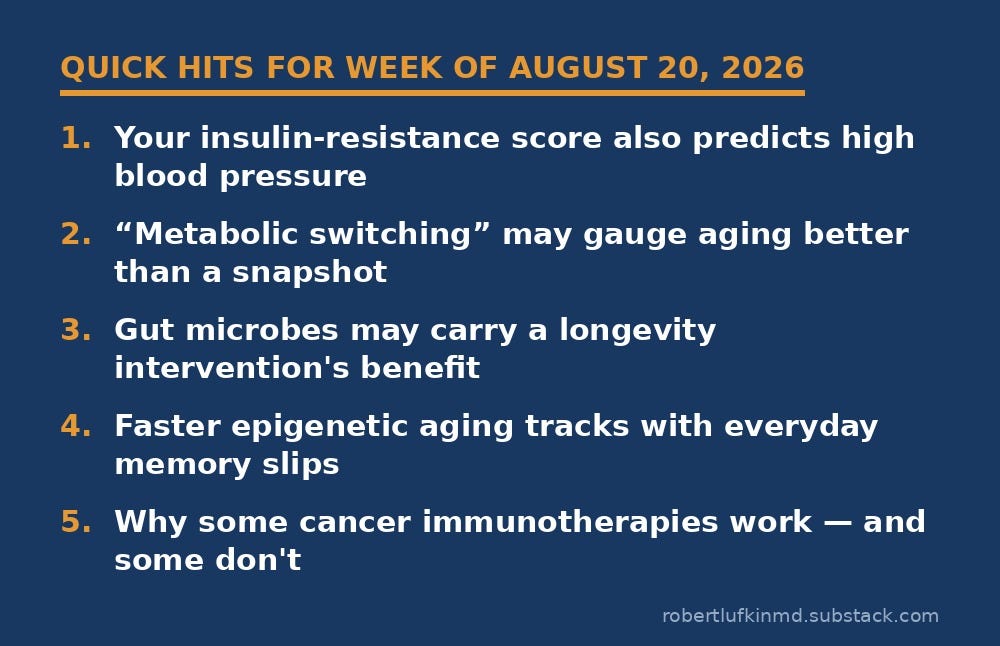
1. Your insulin-resistance score also predicts high blood pressure. In a 6-year cohort of 4,866 Chinese adults (China Health and Nutrition Survey), METS-IR independently predicted new-onset hypertension, with risk rising steadily as the score climbed. Same metabolic axis, another downstream disease (American Journal of Hypertension).
2. “Metabolic switching” may be a better aging gauge than a single snapshot. An NUS Medicine study (PLOS One) tracking one researcher in real time found his metabolic flexibility — how fast the body shifts between fuel sources under stress — improved from >24 hours to 16.5 hours, with resting heart rate dropping from 65 to 46 bpm and sleep lengthening. An AI “healthspan copilot” pegged his biological age near 32, about 15 years below chronological. An n=1 proof-of-concept, but a compelling case for measuring resilience, not just static markers (Medical Xpress, Aug 13, 2026).
3. Gut microbes may carry a longevity intervention’s benefit. In The Journals of Gerontology: Series A, researchers report that gut microbial load mediates the lifespan-extending effect of Korean red ginseng in fruit flies — a reminder that many “longevity compounds” may act partly through the microbiome, not directly on our cells. Fly data, early stage (Journals of Gerontology, Aug 17, 2026).
4. Faster epigenetic aging tracks with everyday memory slips. Also in Gerontology: Series A, an analysis from the National Study of Daily Experiences links epigenetic age acceleration to more self-reported daily memory lapses — an early human signal connecting the molecular pace of aging to how sharp we feel day to day. Observational (Journals of Gerontology, Aug 17, 2026).
5. Why some cancer immunotherapies work — and some don’t. A Karolinska Institutet study (Nature Communications) found that immunotherapy targeting tumor-associated macrophages only works when those cells carry a functional TLR9 receptor system; without it, the macrophages stay immunosuppressive. Adding TLR9-activating agents boosted the effect. Mostly mouse work with supporting human tumor-sample analysis — but a step toward predicting who responds (Medical Xpress, Aug 14, 2026).
The lead and the first hit are two windows onto the same organ of disease: insulin resistance. One number — built from glucose, triglycerides, HDL, and BMI — foreshadows diabetes, hypertension, and, more weakly, cancer and death. The other three hits circle the same idea from different angles: aging is best understood not as a fixed clock but as a dynamic, measurable, and partly modifiable process — how fast your metabolism switches fuels, how your microbiome shapes your response to interventions, how your molecular age shows up in daily cognition, and how the metabolic state of immune cells decides whether a cancer therapy lands.
The unifying message is the one at the heart of metabolic medicine: the diseases we file separately — diabetes, hypertension, cancer, cognitive decline — share metabolic roots, and those roots are readable in ordinary labs and responsive to ordinary levers. Diet, movement, sleep, and muscle aren’t soft “wellness.” They’re how you move the numbers that predict your future.
I go deeper on insulin resistance, metabolic health, and the science of healthspan every week on the podcast and here on Substack. Subscribe (it’s free) so the next Brief lands in your inbox — and next time you get labs back, ask about your triglyceride-to-HDL ratio and your metabolic risk. It’s one of the most actionable conversations you can have with your doctor.
Live well, longer,
Robert Lufkin, MD
This newsletter is for educational purposes only and is not medical advice. Nothing here is intended to diagnose, treat, cure, or prevent any disease. The studies described are early-stage — several are observational or preclinical (cells, animals, or single-subject) and none should change your medical care. Talk with your own physician before making any changes to your medications, supplements, diet, or health regimen.
No posts
Comments
Nothing yet. Say the first thing.
Sign in to join the conversation.