
Here is a question I keep coming back to: what if cancer and aging aren’t two separate battles, but two faces of the same metabolic problem?
A new study out of UC Berkeley makes that idea concrete. Writing in the journal Aging, Zachery Robinson, Irina Conboy, and colleagues describe a low-dose, three-drug cocktail they call DMA — dichloroacetate, metformin, and a ten-fold-reduced dose of navitoclax (a BCL-2/BCL-xL inhibitor) — that selectively kills both senescent “zombie” cells and cancer cells while sparing healthy tissue (Technology Networks; Aging, DOI 10.18632/aging.206399).
The logic is elegantly metabolic. Both senescent cells and many cancer cells share a weakness: damaged mitochondria, distorted energy metabolism, and a shrunken ability to tolerate any further hit to their ATP supply. DMA leans on exactly that. It depletes ATP in cells that are already living on a metabolic razor’s edge, while healthy cells — with their intact metabolic flexibility — simply compensate and carry on. In the dish, the combination selectively wiped out senescent cells and knocked down the viability of cervical, breast, and colorectal cancer lines, including breast-cancer cells that resist navitoclax on its own. It spared healthy fibroblasts, neural precursor cells, hepatocytes, and largely preserved muscle-precursor cells (Technology Networks).
Then they moved to old mice. Treatment started at roughly 18 months of age. Short bouts improved treadmill endurance without increasing frailty or sapping strength. Longer intermittent dosing extended average post-treatment survival by about 102.6 days — a 41.7% increase over untreated controls after treatment began, and shifted circulating inflammatory proteins back toward a more youthful profile (Technology Networks).
Why does the low navitoclax dose matter? Because full-dose navitoclax can clear senescent and cancer cells, but it frequently causes thrombocytopenia — a dangerous drop in platelets — which has hobbled its use in the clinic. Pairing a one-tenth dose with two cheap, familiar metabolic drugs (metformin and dichloroacetate) sidestepped that toxicity in the mice (Technology Networks).
Now the honest part. This is a mouse-and-dish study — preclinical, full stop. No human efficacy or safety data on the DMA combination exists yet. Metformin and dichloroacetate being “already used” tells us nothing about whether this specific three-drug regimen is safe or effective in people. And the authors themselves flag the need for testing in models of spontaneous cancer and age-related disease before anyone gets excited (Technology Networks).
But the conceptual payload is what I want you to hold onto: cancer and aging cells can be attacked through a shared metabolic vulnerability. That is a metabolic-health thesis, tested at the level of the mitochondrion. And it reinforces something you can already act on — the metabolic terrain of your cells, shaped by how you eat, move, and sleep, is not a bystander to aging and cancer. It’s the battlefield.
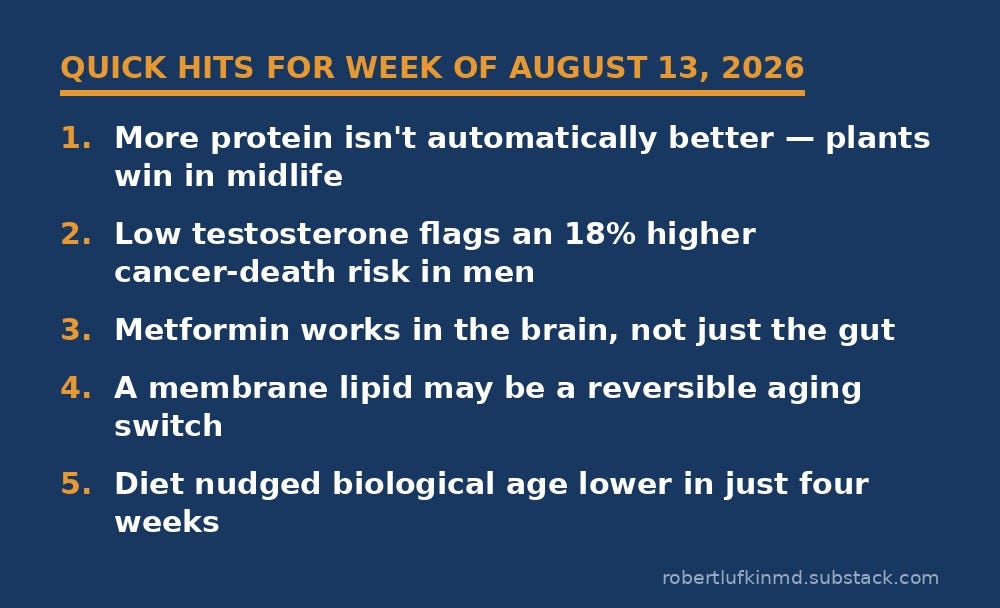
1. More protein isn’t automatically better. A University of Wisconsin–Madison systematic review in Cell Press Blue concludes that lower protein intake — particularly from animal sources, particularly in midlife — is linked to improved metabolic function and longer life, especially in sedentary adults, while excess animal protein tracks with higher mortality and cardiovascular risk. Plant protein looks protective. The caveat: this is not a license for the elderly or chronically ill to under-eat protein and lose muscle (Consensus Research Library).
2. Low testosterone flags cancer-death risk in men. An individual-participant meta-analysis in The Lancet Healthy Longevity (24,510 men, ~277,000 person-years, 2,847 cancer deaths) found that men in the lowest testosterone quintile had an 18% higher risk of cancer death versus the highest, with risk rising below ~8.6 nmol/L; low dihydrotestosterone carried a 21% higher risk. Association, not causation — low testosterone may be a marker of underlying metabolic ill-health as much as a cause (PubMed).
3. Metformin works in the brain, not just the gut. A Science Advances study (July 2026) found metformin acts directly on the ventromedial hypothalamus — a brain hub for whole-body glucose control — rather than only in the liver and gut as long assumed. It reframes an old diabetes drug as a central-nervous-system metabolic lever (Yehey summary).
4. A membrane lipid may be a reversible aging switch. Researchers at the Leibniz Institute on Aging, publishing in Nature Communications, report that declining phosphatidylcholine drives fragmented, dysfunctional mitochondria with age — and that feeding aging C. elegans phosphatidylcholine or its precursor choline restored youthful mitochondrial structure within two days. It’s a worm study, but it points squarely at the mitochondrion as a modifiable target (ScienceDaily).
5. Diet can nudge biological age in four weeks. A University of Sydney trial in Aging Cell found adults aged 65–75 lowered biomarker-based “biological age” after just four weeks of dietary change, with the strongest effect from a lower-fat, higher-carbohydrate omnivorous pattern; those eating close to their usual diet saw no change. Early signal, short duration, small — but a reminder that the aging clock is at least partly responsive to the fork (ScienceDaily).
Look at these together and one word keeps surfacing: metabolism. The lead attacks cancer and senescent cells through a shared energy weakness. The protein review, the testosterone signal, the brain-metformin finding, the phosphatidylcholine switch, and the four-week diet study are all, at bottom, stories about how well your cells make and manage energy — and how that machinery either protects you or fails you as you age.
This is the core of the metabolic-health lens I keep returning to. We tend to file “cancer,” “frailty,” “diabetes,” and “aging” in separate drawers. The biology increasingly refuses to cooperate with that filing system. Mitochondrial function, insulin signaling, and inflammation form a single connected web — and the levers that move it are unglamorous and familiar: how you eat, how much you move, how you sleep, and how well you protect your muscle. None of these papers is a prescription. Together they’re a map, and the map keeps pointing to the same territory.
If you want the longer conversations behind these ideas — metabolic health, cancer as a metabolic disease, and what the aging science actually supports — that’s what I dig into every week on the podcast and here on Substack. Subscribe (it’s free) so the next Brief lands in your inbox, and share it with someone who’s still filing these problems in separate drawers.
Live well, longer,
Robert Lufkin, MD
This newsletter is for educational purposes only and is not medical advice. Nothing here is intended to diagnose, treat, cure, or prevent any disease. The studies described are early-stage — many are preclinical (cells and animals) and none should change your medical care. Talk with your own physician before making any changes to your medications, supplements, diet, or health regimen.
No posts
Comments
Nothing yet. Say the first thing.
Sign in to join the conversation.