
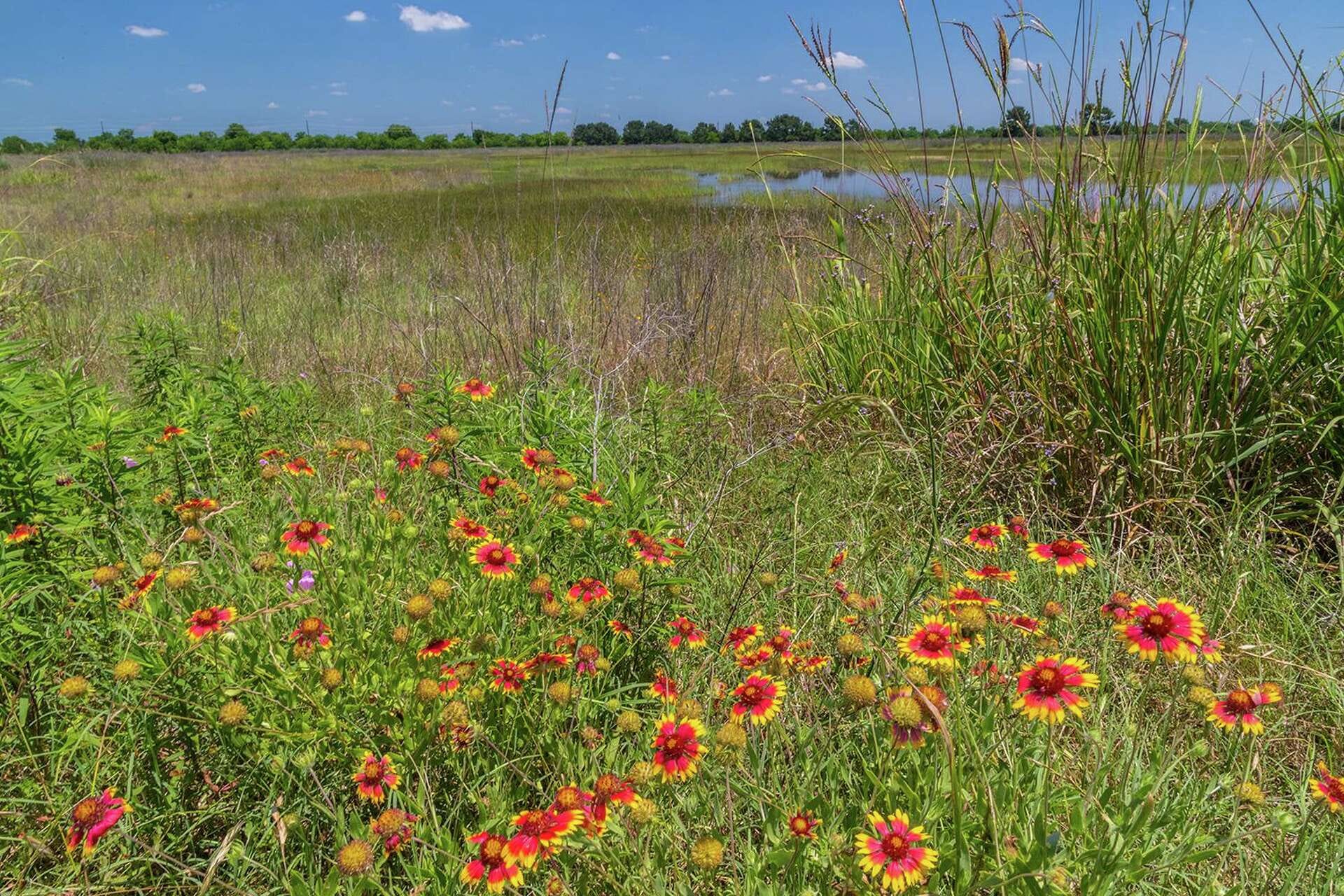
Part two of “Following the $332 Million,” a weekly series on Fulshear’s proposed budget. Last week: the $126 million wastewater program. This week: the smallest of the four big capital numbers — and why the drainage budget only makes sense once you see the system it sits inside, from developer-built detention ponds to Bessie’s Creek to an 11-acre patch of never-plowed prairie.
Every town in the Houston region measures itself against the rain. It is the one force here that does not negotiate, does not wait for the capital plan, and does not care where the city limits are.
Which brings us to the smallest of the four big numbers in Fulshear’s proposed five-year capital plan: $23 million for drainage, sitting alongside $126 million for wastewater, $94 million for streets, and $46 million for facilities and parks. If your first reaction is that $23 million seems light for the thing that decides whether water comes into living rooms — I understand the instinct, and this installment is about why the number is less alarming than it looks, and where the honest worries actually are.
But first, as always in this series: the mechanism.
On flat coastal prairie, stormwater engineering comes down to two verbs: convey and detain.
Conveyance is what most of us picture — ditches, storm sewers, and channels that move water away from streets and slabs. But conveyance has a dark side: moving water away faster means delivering it downstream faster, and on a creek system, one neighborhood’s efficient drainage is the next neighborhood’s flood peak.
That’s why the second verb exists. Detention means digging basins that catch the surge, hold it, and release it slowly — deliberately making the water late. The rule of modern development in this region is that new projects are generally required to detain their own runoff so that the peak flow leaving the site is no greater than before the first slab was poured. Every master-planned community you drive past is dotted with those ponds. Developers build them because they have to, at their own expense, subdivision by subdivision.
Hold onto that fact, because it reframes the whole budget line: the city’s $23 million was never meant to fight the rain alone — it’s the connective tissue in a system where most of the detention is built and paid for by someone else.
The city’s dollars go where the private obligation doesn’t reach: the older parts of town that were built before detention rules existed, the places where separate developments’ systems meet, and the channels that knit it all together. That’s the context for the plan’s named project — the Eastside Tributary Drainage Project, a carryover priority that was already in construction planning in the FY2025-26 budget and continues in this one. The published documents don’t yet break out its share of the $23 million, which is one of the details I’ll be looking for in the budget book as the hearings approach.
A meaningful share of the water leaving Fulshear is headed for one place: Bessie’s Creek, the 106-square-mile watershed straddling Fort Bend and Waller counties that eventually hands its water to the Brazos. Watersheds, unlike budgets, ignore city limits — what happens on a pasture in Waller County and what happens in a Fulshear cul-de-sac end up in the same channel.
Readers of this newsletter have met this creek before. Earlier this year I wrote about the 11.5-acre Bessie’s Creek project — land inside the 100-year floodplain doing double duty as detention basin and habitat preserve — and about the two prairie openings of 2026: the Katy Prairie Welcome Center at Indiangrass Preserve, and Williams Prairie, an 11-acre remnant just north of town that has never met a plow. The argument of that piece bears repeating here, because the budget makes it concrete: engineered detention and preserved prairie do the same hydrological work. Slow the water, hold the water. A basin does it with excavation and outfall structures; a prairie does it with root systems many feet deep and soil that drinks. One shows up as a line item. The other works for free, forever, if you leave it alone.
That’s also the lens for a smaller item moving through council this summer: a grant application to the Texas Parks and Wildlife Department for Bessie’s Creek Park. If it lands, state dollars would stretch what the city spends on floodplain land that serves as park, preserve, and sponge at once — three budgets’ worth of work from one piece of ground.
And one complication, in the interest of honesty: Bessie’s Creek has a water quality problem as well as a water quantity job. TCEQ and the Houston-Galveston Area Council began developing a formal cleanup plan for the creek in 2024 — a TMDL, or total maximum daily load, the state’s mechanism for waterways that fail standards — because of elevated bacteria from human and animal waste. Stakeholder meetings are underway now. A creek can hold the floodwater beautifully and still not be safe to wade in, and as more of Fulshear drains toward it, the city’s stake in that cleanup only grows.
So where should a skeptical reader actually focus? Three places.
First, drainage is the easiest line to cut. It produces no ribbon-cuttings, and in a dry year it looks like money spent on nothing. This city has already shown it will defer capital lines when budgets tighten — a $12 million diversion lift station and a $428,000 pavement program were both pushed out of last year’s budget. Nothing in this plan is guaranteed until the bonds are sold and the contracts signed. If drainage lines start slipping to “future years” in September, that’s the tell worth watching.
Second, what you’re buying is odds, not certainty. No detention basin makes a town flood-proof; it makes a given storm less likely to reach a given slab. That’s genuinely worth paying for — it is, in effect, the cheapest flood insurance the city can buy — but anyone promising more than better odds is overselling.
Third, the system’s performance depends on rules as much as money — the detention requirements imposed on each new development, and the county and regional processes that manage the channels the city doesn’t own. A $23 million city program inside a well-regulated watershed is worth more than a $50 million program inside a poorly regulated one.
It’s tempting to rank the budget’s priorities by the size of the numbers, and by that measure drainage finishes last. But the relevant question is never how the $23 million compares to the $126 million. It’s whether the whole arrangement — developer-built ponds, city-built connections, county channels, and preserved prairie quietly holding water north of town — keeps making the rain arrive downstream late. The budget line is just the part of that system the city pays for directly.
The August and September hearings are where these lines survive or slip, and the ask is the same as last week: show up at City Hall, fill out a card, and you get your minutes. A good question this time: which drainage projects in the five-year plan are funded in year one, and which are penciled into the out-years? The answer will tell you how firm the $23 million really is.
Next week, the one you’ve been waiting for: the tax rate — and how much of the increase on your October bill is really the parks bond you voted for, versus the cost of running the city.

We are grateful to welcome the Peschke Wealth Management Group of Raymond James to our team of sponsors. Peschke Wealth Management takes a team approach to financial planning, providing a broader scope of experience than you will likely find in any one person. Clients are our main priority, which is why we work to understand your unique circumstances and ultimately create a distinctive plan that provides a roadmap for your financial journey.
Supporting Our Local History. All proceeds from “About Fulshear, Texas” sponsorships go directly to the Fulshear Historical Association, a registered 501(c)(3) nonprofit dedicated to preserving and celebrating the rich heritage of our community.
About Fulshear, Texas, is the area’s authoritative hyper-local media ecosystem. Our Substack newsletter achieves a 60%+ open rate, our Facebook presence (@About Fulshear Texas) generates over 35,000 monthly views, and we have launched a community podcast. We reach more than 8,000 unique individuals monthly, with 53.5% residing directly in Fulshear. The core demographic is affluent homeowners aged 35 to 54—representing peak household earning years, established homeownership, and the population most likely to refinance, purchase investment properties, or refer neighbors and colleagues to a trusted lender.
How this post was made: drafted with AI assistance, then researched, edited, sourced, and fact-checked by me. Errors are mine — reply, and I’ll correct them. For more details, click here.
No posts
Comments
Nothing yet. Say the first thing.
Sign in to join the conversation.