
A reader’s letter connects one of the frontier’s most notorious outlaws to the families we’ve been writing about all year — the Fosters, the Briscoes, and yes, the Fulshears. The story of how his descendants got here is a story about what land can do for a family’s name.
Every so often, a reader sends me something that makes me set aside whatever I was planning to write next.
This week it was a letter from Susan Hayden of Richmond, Virginia, who has been following this column from a distance most of us would envy — about 1,200 miles. Susan is descended from a Fort Bend County family that arrived in the 1840s, and her family tree runs straight through several of the founding families we’ve covered in this space. It also runs through someone I never expected to write about here.
Her ancestor’s father was a river pirate. Not a colorful exaggeration passed down at family reunions — an actual, historically documented river pirate, and arguably the most notorious one who ever lived.
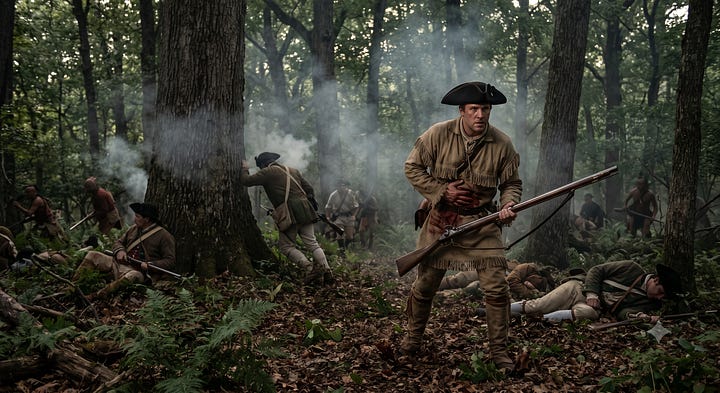
Samuel Mason was born in Virginia in 1739, and the first half of his life gave no hint of what the second half would become. He served as a militia captain on the Virginia frontier during the Revolutionary War and was wounded while surviving an ambush near Fort Henry in 1777. He was, by the standards of his day, a patriot.
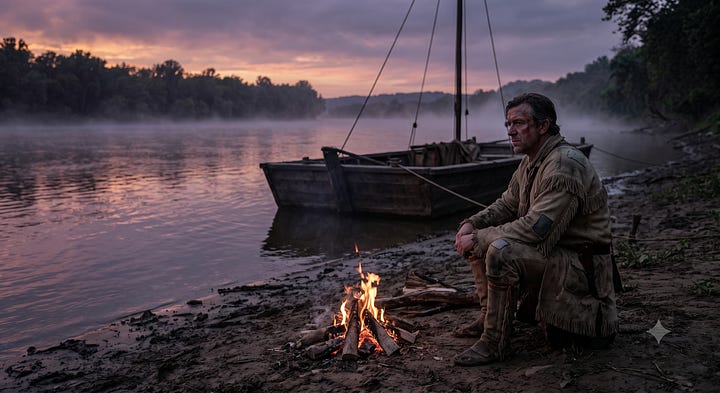
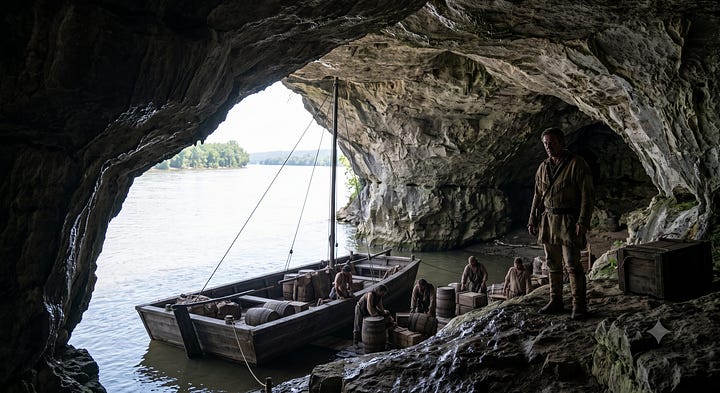
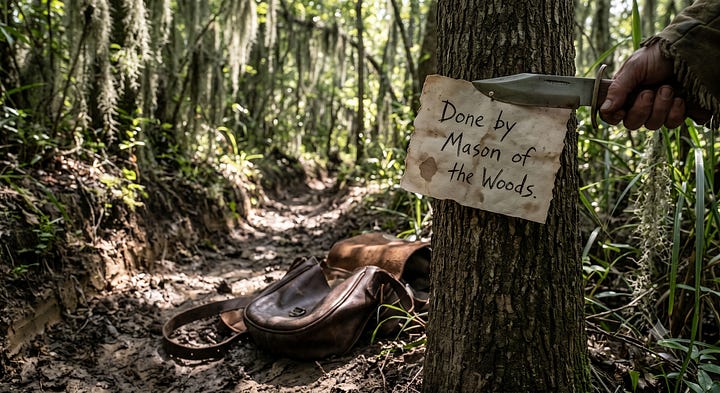
Then things went wrong, gradually and then completely. After the war, Mason drifted west and downward. By 1797 he had set up at Cave-in-Rock, a huge natural cavern on the Ohio River, where his gang preyed on the flatboats carrying settlers and cargo downriver. When vigilantes pushed him out, he moved south and became a highwayman on the Natchez Trace, robbing travelers through the Mississippi wilderness. He had a habit of leaving a calling card at the scene: “Done by Mason of the Woods.”
It ended the way these stories usually end. Spanish authorities arrested Mason and his family in 1803 near present-day Caruthersville, Missouri. Among the items inventoried at his camp were $7,000 in banknotes and — there is no gentle way to say this — human scalps. He escaped during a transfer upriver, was shot in the process, and died sometime that year under circumstances historians still argue about. Two of his own associates turned up with his severed head to claim the reward, and were hanged themselves.
His sons — John, Thomas, Magnus, and Samuel Jr. — had been swept up in the family enterprise and in the arrest. And then, as far as the history books were concerned, they simply vanished.
This is where Susan’s letter picks up the thread that the historians dropped.
According to her family’s research, Samuel Mason Jr. — a younger son of the pirate — settled in the Vicksburg area of Mississippi, married Mary “Polly” Searcy, and raised a family. And in the 1840s, he did what thousands of families in the worn-out cotton lands of the old Southwest were doing: he moved to Texas, bringing his grown children with him to Fort Bend County.
Think for a moment about what that move meant for this particular family. In Mississippi, the Mason name carried a weight that money couldn’t lift. Texas offered what the frontier has always offered — not an erasure of the past, exactly, but a place where the past had to compete with what you did next.
What the Masons did next was buy land, marry well, and become exactly the kind of respectable planter family their grandfather’s victims had been.
I want to be careful here. Most of the genealogical detail in what follows comes from Susan’s research rather than from records I’ve independently verified, and she herself keeps her Ancestry tree private “to avoid sharing any mistakes” — an honesty I appreciate and will try to match. But the outline checks against sources I do know, and it fits the documented history of this county remarkably well.
Samuel Mason Jr. and Polly raised at least five children who left their mark on Fort Bend County and its neighbors: sons Thomas and Dorsey, and daughters Susannah, Eliza, and Rosanna. Per Susan, the family held a number of land tracts across the area — some of them, notably, carved from original Foster grants.
Regular readers will remember the Fosters. John Foster held one of the largest land grants in what became Fort Bend County — on the order of 11,000 to 12,000 acres — and his son Randolph, Stephen F. Austin’s scout, took title to his own league of roughly 4,400 acres in 1824. When families like the Masons arrived in the 1840s, a generation after the Old Three Hundred, this is how they got their start: not with a grant from Mexico, but with a deed from a colonist’s family. The first generation got the land; the second generation sold pieces of it to the newcomers. That quiet transaction, repeated hundreds of times, is how Fort Bend County filled up.
The Mason daughters’ marriages read like a map of the early Brazos settlements. Susannah married James Montgomery Briscoe — and if that name sounds familiar, it should. I wrote earlier this year about the Briscoe family of Fulshear, whose line runs from a Fort Bend plantation established in the late 1830s all the way to Governor Dolph Briscoe. The Briscoe Family Cemetery Association, which still maintains the family burial ground on FM 723, records her as Susan Hibernia Mason Briscoe. The pirate’s granddaughter married into one of the most storied families in Texas.
Rosanna married a Kincheloe — a name that traces to William Kincheloe, an Old Three Hundred colonist who settled two leagues where Wharton now stands and whose corn crop famously kept Austin’s starving settlers alive in 1823. Eliza married a Nolan. As Susan notes, the family’s footprint was wider than Fulshear proper — these were tracts scattered across the old plantation country of the lower Brazos. But the pattern is the point: within one generation of arriving, the Masons were woven into nearly every founding family in the region.
And then there’s the tie that lands this story squarely in our town.
In 1848, Thomas Mason — Susan’s great-great-great-grandfather, who already had a family — married Louisa Estes Coburn in Washington County. Louisa came with connections of her own. Her sister Josephine Estes married a Thomas Hunter, a surname regular readers will recognize from Randolph Foster’s marriage into the Hunter family. And Louisa’s daughter from her first marriage, Lavinia Colburn, married a man named Graves Fulshear.
Graves was one of the three sons of Churchill Fulshear Sr., the Old Three Hundred colonist our town is named for. Along with his brothers Churchill Jr. and Benjamin, Graves served as a scout for the Texas army during the Revolution — the three of them were on duty when Santa Anna crossed the Brazos on his way to San Jacinto. According to Susan’s research, Graves and Lavinia had at least two children before he died. Which means there are descendants of the town’s founding family whose family tree also includes, a few branches over, the outlaw of Cave-in-Rock.
Every founding-family story we’ve told in this column connects to the others eventually. I did not expect a river pirate to be one of the connecting threads.
Susan’s letter closes with a genealogist’s careful observation: she does not believe Samuel Mason Jr. and Polly are buried in the Briscoe cemetery, which, in her reading, “seems to have started with James Briscoe’s sons.”
The cemetery association’s own records back her up, and they refine something I wrote earlier this year. The oldest documented grave there belongs to Annie Chilton Briscoe, who died in 1881 — a generation after James Montgomery Briscoe and Susan Mason Briscoe themselves died in the early 1850s, when cholera swept through the Brazos settlements. Where the older generation rests, including the pirate’s son and his wife, appears to be an open question. So does the resting place of Thomas Searcy Mason — Susan’s direct ancestor, the same Thomas who married Louisa in 1848 — who died of illness in 1852, in the same sickness years that took the Briscoes.
It would be dishonest to pretend we can close those questions from here. Unmarked graves on private land, plantation burial grounds lost to the plow — this is the ordinary fate of the first generation of Texas settlers, respectable and notorious alike.
Here’s what stays with me about Susan’s letter. Samuel Mason of the Woods is in the history books because of what he took. His son is in the deed records because of what he built. One generation was the frontier at its most lawless; the very next was the frontier doing what it did best — letting a family trade a name for land, and land for a new name.
The relevant question about families like the Masons was never where they came from. It was what the county let them become.
If your family’s story runs through Fort Bend County — whether it connects to the founding families or arrived generations later — I’d love to hear it. Reader letters like Susan’s are how this column gets better, and how the record gets corrected. My thanks to her for a story I couldn’t have found on my own.
Sources and further reading: Susan Hayden’s family research (shared by correspondence); the Handbook of Texas entries on Churchill Fulshear Sr. and Jr. and William Kincheloe; the Journal of the American Revolution’s 2025 study of Samuel Mason; the Briscoe Family Private Cemetery Association; and this column’s earlier pieces on the Foster, Briscoe, and Fulshear families.

Supporting Our Local History. All proceeds from “About Fulshear, Texas” sponsorships go directly to the Fulshear Historical Association, a registered 501(c)(3) nonprofit dedicated to preserving and celebrating the rich heritage of our community.
About Fulshear, Texas is the area’s authoritative hyper-local media ecosystem, reaching more than 8,000 unique individuals monthly across Substack, Facebook (@About Fulshear Texas), and our community podcast.
How this post was made: drafted with AI assistance, then researched, edited, sourced, and fact-checked by me. Errors are mine — reply, and I’ll correct them. For more details, click here.
No posts
Comments
Nothing yet. Say the first thing.
Sign in to join the conversation.