
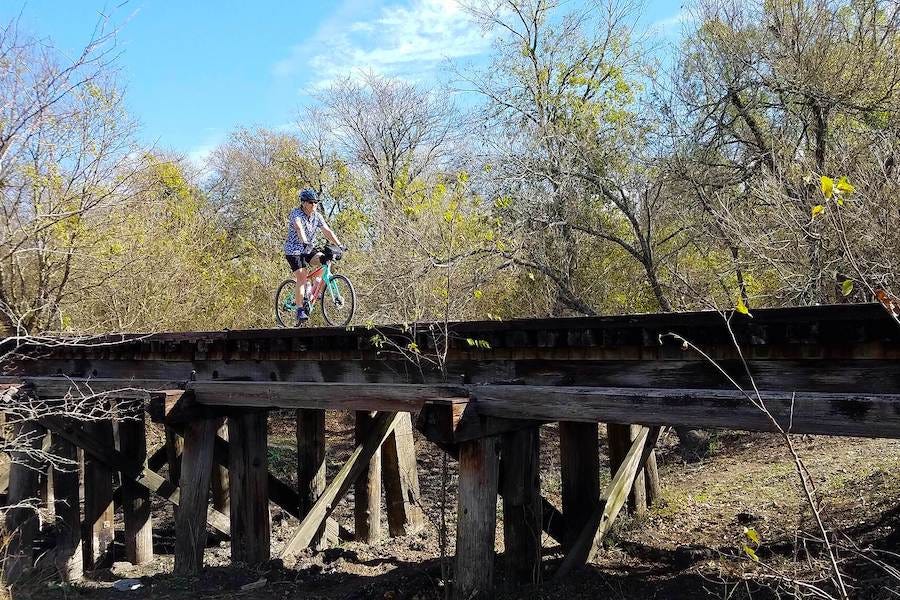
Since January, the Rails to Trails project has quietly assembled the two things every trail needs to run: a fundraising vehicle and seed money. Here’s what’s moved, what hasn’t, and why the first visible progress is happening at the far end of the corridor from Fulshear.
Since I wrote about the 1093 Rails to Trails project back in January, several readers have asked me some version of the same question: is anything actually happening out there?
The short answer is yes — just not where you can see it from Fulshear, and not in the form most of us picture when we hear “trail project.” Nobody is pouring concrete. What the project’s Local Government Corporation spent the first part of 2026 doing is quieter and, I’d argue, more important: building the financial machinery that determines whether this trail ever gets built at all.
A quick refresher for newer readers. The 1093 Rails to Trails project aims to convert roughly 31 miles of the abandoned San Antonio & Aransas Pass rail corridor — the line that runs alongside FM 1093 and helped put Fulshear on the map in the first place — into a shared-use hiking and biking trail stretching from Fulshear west through Wallis to Eagle Lake, crossing Fort Bend, Austin, and Colorado counties along the way.
The Fort Bend County Toll Road Authority acquired the corridor easement from METRO back in 2015. In 2022, the participating cities and Austin County formed a Local Government Corporation — a legal structure that lets multiple governments act as one entity for contracting purposes — to run the project. A Vision Plan, developed with help from the National Park Service, followed in June 2024. Since then, the work has been organizational: committees, cleanups, and the slow business of turning a plan into a funded project.
According to the LGC’s first-quarter 2026 newsletter, last year’s work was mostly muscle. The Texas Conservation Corps helped clear invasive vegetation along the corridor, and cadets from the Texas Challenge Academy pitched in on cleanup projects in Eagle Lake and Wallis. Unglamorous, yes. But an overgrown corridor can’t be surveyed, engineered, or shown to a grant committee, so the brush-clearing is a prerequisite for everything else.
Here’s the piece of news I find most interesting. The LGC is developing a Request for Proposal — the formal document governments use to solicit competitive bids from contractors — to salvage approximately 8.3 miles of steel rail between Eagle Lake and Chesterville, at the western end of the corridor.
Why does that matter? Because old rail is scrap steel, and scrap steel is worth money. The hope is for salvage proceeds to serve as seed funding for trail development. In other words, the first dollars for this trail won’t come from your taxes or a bake sale — they’ll come from selling the railroad to build its replacement.
There’s a certain poetry in that. The rails that built these towns get one last job: paying for what comes next.
To be fair, the newsletter attaches no dollar figure to the salvage, and scrap values move with the steel market. Until bids come back, nobody knows what 8.3 miles of old rail is actually worth. But as a mechanism, it’s the most concrete funding development in the LGC’s four-year history.
The second development: the LGC is finalizing an agreement with FRIENDS of the 1093 Rail Trail, a 501(c)(3) public charity that will serve as the project’s fundraising arm.
If you’ve followed my coverage of other local projects, you know why this structure matters. A government corporation is built for contracts, not donations. A 501(c)(3) can accept tax-deductible gifts, court corporate sponsors, and apply for the many foundation grants that only fund charities. Nearly every successful rail-trail in the country has a Friends group doing exactly this work. The project is also now accepting donations directly through PayPal, with contributions earmarked for trail construction.
Here’s the honest part. All of the visible activity — the cleanups, the salvage RFP — is happening at the western end of the corridor, thirty-some miles away. If you’re waiting to see progress where the old line crosses Fulshear, you’ll be waiting a while.
That’s frustrating, but it’s not a bad sign. It’s the plan working as designed. The Vision Plan always called for building in phases as funding allows, and Fulshear’s segment has its own complication: the planned Westpark Tollway extension. As City Manager Zach Goodlander put it back in 2023, the city has to be strategic and avoid “spending dollars to make pedestrian improvements in an area where it’ll get immediately torn up in the near future for the tollway.” The relevant question for Fulshear was never when do we get bulldozers — it’s whether the project survives long enough, financially and politically, for our segment’s turn to come.
On the political side, one thing I flagged in January is worth watching. The first-quarter newsletter’s masthead lists Austin County, Eagle Lake, Fulshear, and Wallis. Weston Lakes — whose potential withdrawal from the coalition I wrote about last time — does not appear anywhere in it. I want to be careful here: an omission from a newsletter is not an announcement, and I’ve seen no formal statement either way. But it’s a detail I’ll be keeping an eye on.
The LGC is recruiting volunteers for four specific roles: adult chaperones for Texas Challenge Academy cadet workdays, help managing map records, community coordinators to build business partnerships, and liaisons to work with TxDOT, Fort Bend County, and the Brazos River Authority.
The next board meeting is Monday, September 14, at 4:00 p.m. at the Wallis City Complex Community Center, 6810 Guyler Street in Wallis — about a half-hour drive down 1093, or a click away via the Zoom link on the project’s website, 1093railstotrails.weebly.com.
Thirty-one miles of trail will take years and millions of dollars this project doesn’t yet have. But in the past eight months it has acquired a fundraising arm, a seed-money mechanism, and a corridor clear enough to work in. Projects like this one don’t fail in dramatic votes; they fade when nobody shows up. September 14 is a chance to show up.

Supporting Our Local History. All proceeds from “About Fulshear, Texas” sponsorships go directly to the Fulshear Historical Association, a registered 501(c)(3) nonprofit dedicated to preserving and celebrating the rich heritage of our community.
About Fulshear, Texas, is the area’s authoritative hyper-local media ecosystem. Our Substack newsletter achieves a 60%+ open rate, our Facebook presence (@About Fulshear Texas) generates over 35,000 monthly views, and we have launched a community podcast. We reach more than 8,000 unique individuals monthly, with 53.5% residing directly in Fulshear. The core demographic is affluent homeowners aged 35 to 54—representing peak household earning years, established homeownership, and the population most likely to refinance, purchase investment properties, or refer neighbors and colleagues to a trusted lender.
How this post was made: drafted with AI assistance, then researched, edited, sourced, and fact-checked by me. Errors are mine — reply, and I’ll correct them. For more details, click here.
No posts
Comments
Nothing yet. Say the first thing.
Sign in to join the conversation.