
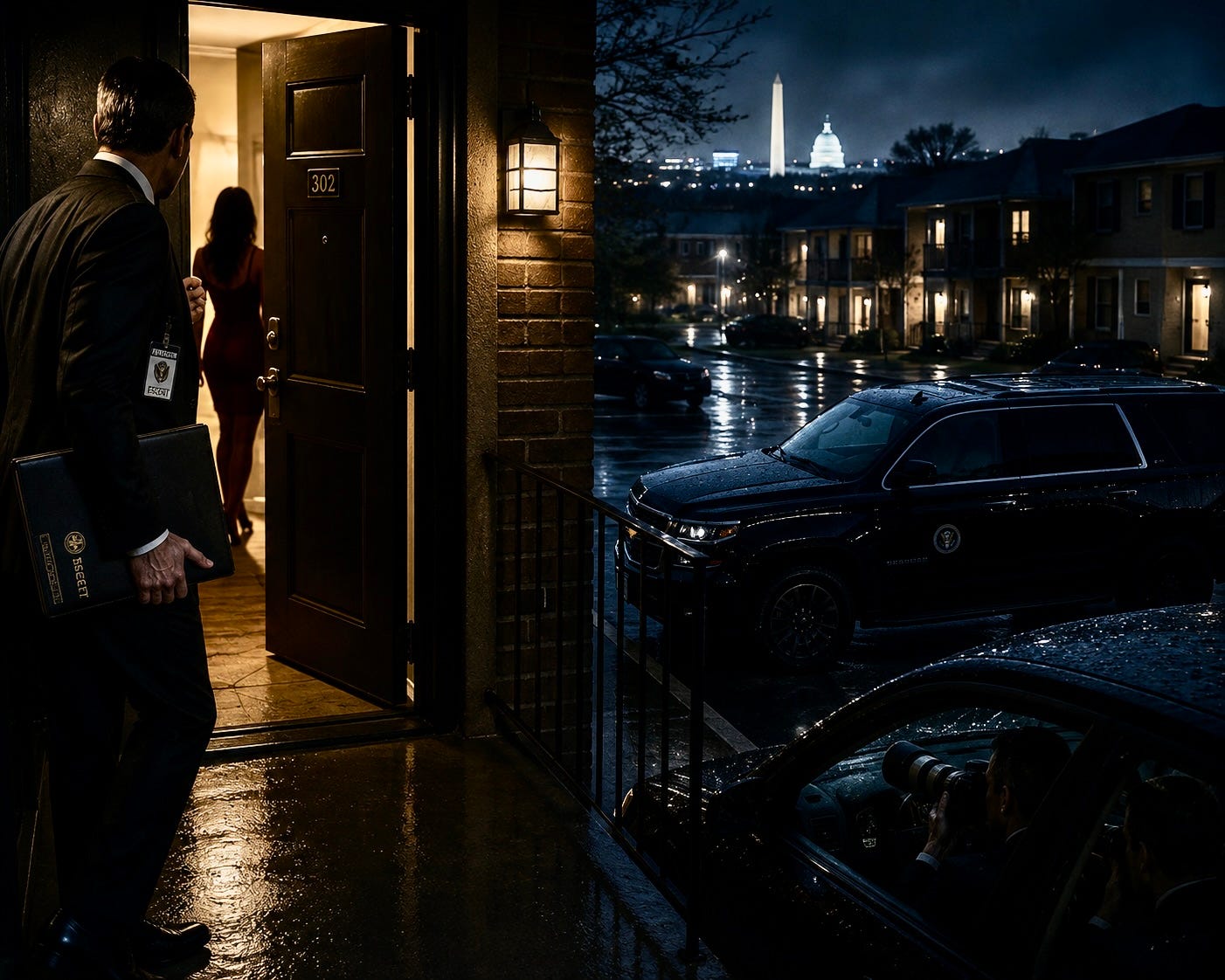
There are certain stories that arrive in Washington with a tremendous bang and depart on tiptoe.
This is one of them.
In November 2023, the United States Department of Justice announced that federal agents had broken up a network of high-end brothels operating in Massachusetts and Northern Virginia.
Brothels are not exactly unknown to civilization.
Nor are politicians, military officers and government contractors unknown to brothels.
What made this particular arrangement interesting was geography.
The Virginia establishments were in Tysons and Fairfax—the well-upholstered suburbia inhabited by the Pentagon, CIA and defense contractors.
According to federal prosecutors, their clientele should have set every counterintelligence alarm in Washington ringing.
It included military officers, government contractors with security clearances and elected officials.
And then something curious happened.
We never learned who they were.
“Brown Eyes Girls”
This sophisticated operation was principally run by a woman named Han “Hana” Lee, along with Junmyung Lee and James Lee.
In Virginia, women were advertised through a website called Brown Eyes Girls VA, presented as Asian models available for nude photography.
Apparently, quite a number of Washingtonians suddenly developed an interest in portraiture.
Appointments cost between $350 and $600 an hour.
But here is where the story becomes considerably more interesting.
The customers were vetted. by management. Yes, a prospective client was required to provide identifying information in exchange for an appointment.
Real name. Telephone number. Email address. Employer. Sometimes even a reference.
Stop there for a moment and imagine you are a counterintelligence officer.
You discover a private organization operating discreet sexual services within easy reach of Washington that assembles a database containing the identities, telephone numbers, email addresses and employers of men who include military officers and others holding United States government security clearances.
What is your first question?
How about: Who else had access to the database?
And: Where did the women come from?
And: Did anyone ever attempt to exploit the information?
And: Why did we hear so little about any of this afterward?
The Oldest Trick in the Book
Espionage is largely about human weakness.
Money. Vanity. Ideology. Resentment.
And sex.
Intelligence services have understood this since intelligence services existed.
The Russians gave sexual entrapment its own vocabulary: the honey trap.
East Germany’s Stasi cultivated Romeo agents.
The Chinese services have been repeatedly used intimate relationships to gain proximity to useful targets.
Western services are hardly strangers to the possibilities. Former CIA official Miles Copeland once gave me an unpublished manual titled The Cupid Game about what he called “the CIA’s super-secret research into The Love Weapon.”
It’s very simple: A married man does not want his wife, employer, commanding officer or security-clearance investigator to discover where he spent Thursday afternoon.
The Curious Silence
Federal investigators possessed enough information to identify customers through surveillance, telephone records and interviews. And they publicly acknowledged that military officers and security-cleared contractors were among them.
Yet the names remained hidden.
The operators became the story. The customers became ghosts. Kind of like the Jeffrey Epstein operation.
Han Lee eventually pleaded guilty and, in March 2025, was sentenced to four years in federal prison. Prosecutors said the organization had generated more than $5.6 million from approximately 9,450 scheduled encounters.
That is not a few lonely fellows wandering in from the rain.
In Massachusetts, A Peek Behind the Curtain
Something revealing happened on the Massachusetts end.
Lawyers representing 28 alleged customers fought to keep court proceedings secret.
One can understand why. Public exposure can demolish a marriage, a career and a reputation before breakfast.
But the Massachusetts Supreme Judicial Court ultimately decided that the hearings should be public. The court recognized another consideration: The public has an interest in knowing what happens when influential people become entangled in a criminal investigation.
Yet the Virginia side—the side sitting in the shadow of the Pentagon and America’s enormous national-security establishment—remained remarkably indistinct.
Which leaves a question.
What Happened to the List?
Washington loves lists.
Donor lists. Christmas-card lists. Embassy reception lists. No-fly lists. Watch lists.
Somewhere in the evidentiary entrails of this investigation is another sort of list: men who submitted their identities and employment information to obtain sexual services.
Some, according to the Justice Department, occupied sensitive positions.
What happened to those names? Were the security-clearance holders reported to their agencies? Were their clearances reviewed?
Did FBI Counterintelligence examine whether any foreign intelligence service had created or penetrated the operation?
Was the customer information checked against intelligence databases?
Did anybody ask whether photographs or video existed?
Were any of the women interviewed from a counterintelligence perspective rather than just a prostitution investigation?
Perhaps all of this occurred quietly. Much of it appropriately would.
But if so, the public record offers precious little indication.
And that is what makes this story interesting.
Not what we know. What we don’t.
The Washington Way
There is a temptation to call this a cover-up.
But there is another phenomenon, subtler and far more common.
Institutional evaporation.
A story/court case appears. It contains uncomfortable facts. The uncomfortable facts point toward powerful institutions.
No one officially suppresses it.
No mysterious man from Langley telephones an editor.
The news cycle simply moves along. The prosecution narrows. The media narrative quickly shifts to the next scandal.
The uncomfortable facts are never answered. And the public forgets there was a question.
Even though the important part of the Northern Virginia brothel case is not prostitution, but access to military and intelligence officers, security-clearance holders and politicians.
The Russians have a word for this: Kompromat.
Compromising or incriminating information that can be used as leverage to induce a secret-keeper to share his secrets with a foreign intelligence service.
The brothel is now closed.
Its operator is in prison.
Case closed.
But somewhere, one imagines, there was once a rather interesting customer list.
And in Washington, the most interesting list is the one nobody wants you to see.
No posts
Comments
Nothing yet. Say the first thing.
Sign in to join the conversation.