
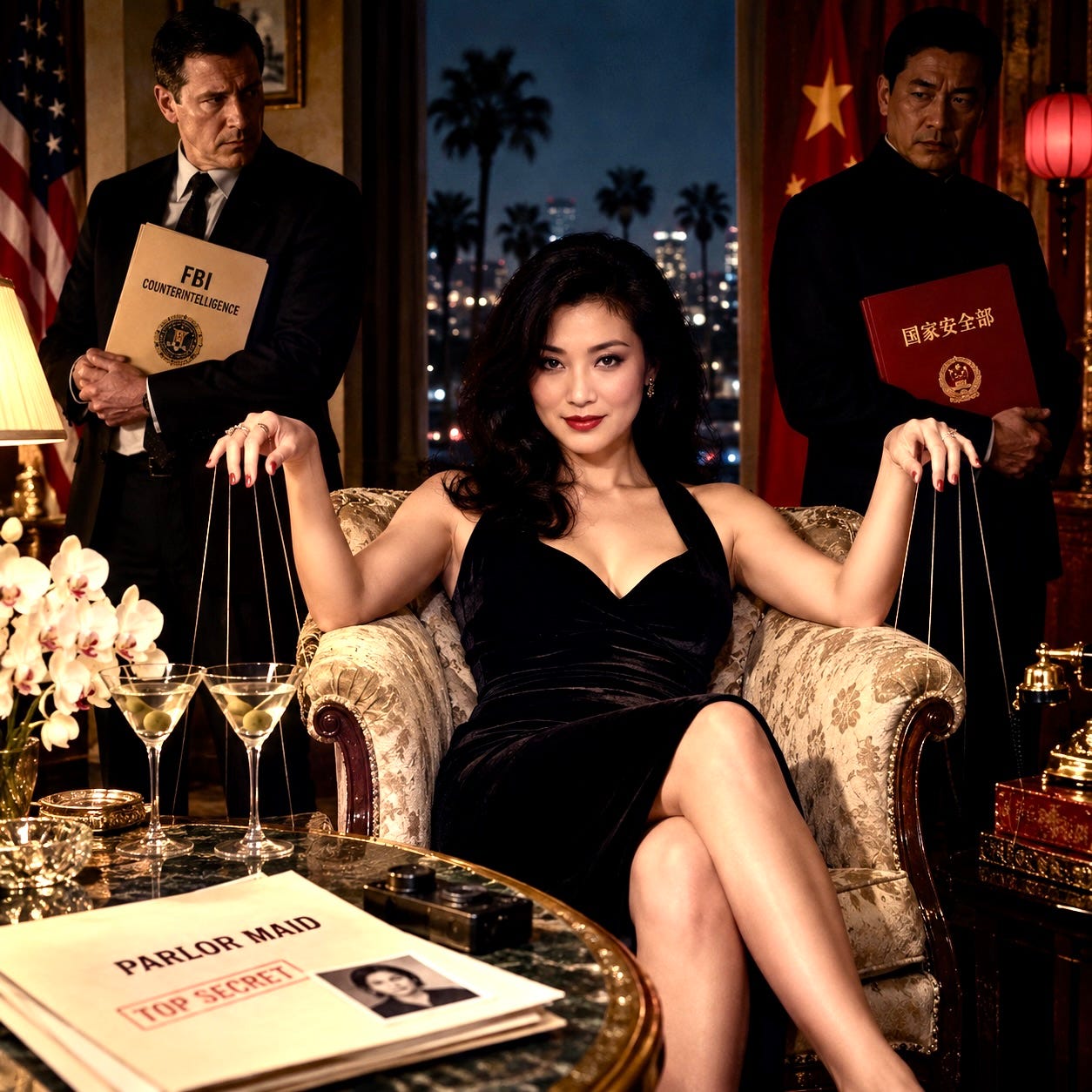
If the Fang Fang affair seems familiar, it should.
We’ve seen this movie before.
Different woman. Different city. Different targets.
But the choreography is remarkably similar.
A socially adept Chinese woman enters the orbit of ambitious or strategically useful Americans.
She charms. She cultivates. She develops access.
Personal relationships blur into professional ones.
Sex enters the equation.
And somewhere pulling the strings is Chinese intelligence.
The point is not necessarily to steal a classified document.
That is the Hollywood version.
The more sophisticated objective is access.
Access to people. Access to offices. Access to conversations. Access to the people who will someday have access.
Fang Fang cultivated politicians.
Parlor Maid did something considerably more audacious. She cultivated the people whose job was to catch her.
Her name was Katrina Leung. And for 20 years she occupied one of the strangest positions in the history of the FBI.
The Bureau recruited her to penetrate Chinese intelligence.
Chinese intelligence recruited her to penetrate the Bureau.
And she was sleeping with her FBI handler.
Then she slept with another FBI agent.
Both G-men worked Chinese counterintelligence.
The FBI Gets a Maid
Katrina Leung was a wealthy, socially prominent Chinese-American businesswoman in Los Angeles.
Well connected. Charming. Politically active. Comfortable among diplomats and useful senior officials.
Precisely the quality Christine Fang would demonstrate a generation later.
Not the woman lurking outside the secure room. The woman everyone is delighted to invite inside.
In 1982, FBI Special Agent James J. “J.J.” Smith, a veteran China counterintelligence officer, recruited Leung as an FBI asset.
The Bureau gave her a cryptonym: PARLOR MAID.
The concept was rather clever.
Leung possessed access to Chinese officials.
The FBI wanted intelligence about Chinese operations in America. So it encouraged her relationships with Chinese intelligence.
Let them recruit her. Let them believe she belonged to them.
She would actually belong to us. Classic double-agent tradecraft.
What could possibly go wrong?
Quite a Lot
Over 18 years, the FBI paid Parlor Maid $1.7 million in fees and expenses.
Information attributed to her reached the highest levels of the American government.
And she became one of the Bureau’s premier sources on China.
There was only one slight complication. Her handler was sleeping with her.
Smith and Leung maintained an intermittent sexual relationship extending across much of their professional association.
This was not encouraged by the FBI employee handbook.
Smith sometimes debriefed Leung at her home. And because he was her handler—and felt rather comfortable there—he sometimes brought classified documents. Then left them unattended.
According to the government’s subsequent case, Leung secretly copied some of them.
This is generally considered suboptimal source handling.
Then There Were Three
If the story ended there, it would already deserve a miniseries.
It doesn’t.
Another FBI agent named William Cleveland had also worked Chinese counterintelligence.
Cleveland knew Leung. Very well, as it turned out. He too had a sexual relationship with her.
So let us diagram the operation.
The FBI recruited Katrina Leung.
The FBI encouraged Katrina Leung to develop relationships with Chinese intelligence.
Chinese intelligence cultivated Katrina Leung.
Katrina Leung slept with FBI Agent Number One.
Katrina Leung slept with FBI Agent Number Two.
Both agents were involved in Chinese counterintelligence.
And apparently neither initially knew the other was sleeping with her.
This is less Tinker Tailor Soldier Spy than Noises Off.
One imagines Beijing receiving the reports. Anything new from the FBI?
The Telephone Call
Then something happened that should have ended the comedy.
In the fall of 1990, U.S. intelligence intercepted a telephone conversation between a woman in Los Angeles and a Chinese intelligence contact in Beijing. The following spring, Cleveland heard the recording and recognized the woman’s voice.
Investigators tried to determine her identity. Cleveland recognized the voice.
It was Katrina. Parlor Maid. The FBI’s prized source.
This presented the Bureau with a rather serious counterintelligence question.
Had the FBI successfully recruited a woman who had penetrated Chinese intelligence?
Or had Chinese intelligence successfully recruited a woman who had penetrated the FBI?
There was also a more immediate problem. The agents confronting this question had neglected to mention something. They both had slept with her.
One of the great rules of intelligence work is: Tell headquarters anything the opposition could use against you.
An affair with the suspected double agent qualifies. Yet the relationships were concealed… and, unbelievably the operation continued.
Yes, the warning signs existed by 1990. Yet Leung remained an FBI source for years afterward.
Think about that.
An extraordinarily sensitive human source.
Suspected unauthorized contact with Chinese intelligence.
Handled by an FBI agent having a sexual relationship with her.
Also sexually involved with another FBI counterintelligence agent.
Potential access to classified material.
And the arrangement continued.
This is the moment when bureaucracies become fascinating.
Institutions are very good at discovering threats that originate outside themselves.
They are considerably less enthusiastic about threats that require admitting: We created this one.
Then Came Robert Hanssen
In February 2001—eleven years later!—the FBI suffered one of the most humiliating moments in its history when Robert Hanssen, a veteran FBI counterintelligence official, was arrested for spying for Moscow.
He had been spying—from inside the Bureau—for 22 years (intermittently).
Suddenly, FBI leadership developed a keen interest in the possibility that its own counterintelligence operations might have some problems. A novel concept.
Parlor Maid was given another look.
A new FBI agent assigned to the case, Steve Conley, began examining the relationship more skeptically.
By late 2001, Leung was under serious surveillance.
FISA coverage. Telephone monitoring. Emails. Faxes. Physical surveillance. Secret searches.
The results were not reassuring. Investigators searching Leung’s home discovered copies of classified documents.
The government alleged that she had taken material Smith brought into her residence and copied it without authorization. Some of the information could potentially reveal FBI investigations, personnel and operations.
Now consider the counterintelligence implications.
The FBI had deliberately placed a source close to Chinese intelligence.
That source had intimate access to her FBI handler.
Her handler brought classified material into her home.
She copied it.
And she maintained contacts with Chinese intelligence she had not reported to her FBI handlers.
The Perfect Penetration
Foreign intelligence services dream of penetrating the FBI.
It is designed to be difficult.
FBI employees undergo background investigations. Security clearances. Polygraphs.
Continuous scrutiny.
So perhaps the easiest way to penetrate the FBI is not to recruit an FBI agent. Perhaps you recruit the person the FBI agent has already recruited.
Better still, perhaps she sleeps with him. Better still again… two of them.
No burglar alarm protects against someone who has been given the key.
Who Was Running Whom?
This is where Parlor Maid becomes something larger than a sex scandal.
Suppose Leung was providing genuine intelligence about China to the FBI.
Fine.
Suppose she was simultaneously providing FBI information to China.
Not fine.
But there is a third possibility, far more disturbing.
What if some of the intelligence she supplied to Washington was information Beijing wanted Washington to believe?
That is the nightmare of every double-agent operation.
A penetration agent can steal your secrets.
A controlled source can do something potentially more damaging. She can corrupt your understanding of reality.
Chinese intentions. Chinese military capabilities. Chinese intelligence priorities. Chinese political maneuvering.
If Washington policymakers relied upon reporting from Parlor Maid, and if any of that reporting had been manipulated by Beijing, then China wasn’t merely learning what America knew. It may have been helping decide what America thought it knew.
Disinformation.
Counterintelligence at a considerably higher level.
And Then the Case Collapsed
In 2003, the FBI arrested Leung and Smith.
At last, one might imagine, the whole extraordinary business would be explained in court.
It wasn’t.
The prosecution against Leung largely collapsed after a federal judge found serious prosecutorial misconduct involving the handling of the case and dismissed the principal charges.
After further litigation, Leung eventually pleaded guilty to lesser offenses.
Smith also resolved his case through a plea to a reduced charge.
No great espionage trial. No definitive public accounting.
No final revelation explaining precisely what Parlor Maid had done for Beijing, what Beijing had done with her, and for how long.
The curtain came down with the central mystery intact.
Very Washington.
Honey Trap, Reconsidered
We’ve been looking recently at honey traps.
Fang Fang and the cultivation of politicians—particularly, Eric Swalwell.
But Parlor Maid is different.
She didn’t merely compromise someone possessing secrets.
She compromised the people responsible for protecting the secrets.
The Parlor Maid School
Parlor Maid did not end with Katrina Leung.
Successful intelligence services learn. They study what worked. What failed.
Which personalities responded. Which vulnerabilities opened doors. Which approaches frightened targets away. And which made them lean closer.
That is why the Katrina Leung affair becomes more interesting when viewed not as an historical curiosity but as a prototype.
Because two decades later, some of the same ingredients keep appearing.
Prominent Chinese woman.
American political or government target.
Social access. Flattery. Fundraising. Romance or sex. Professional opportunity.
The target believes he is cultivating the relationship.
The relationship may actually be cultivating him.
From Parlor Maid to Fang Fang
Consider Christine Fang.
She arrived as a student.
Then she began meeting politicians. Not powerful politicians. Promising politicians.
Foreign intelligence services are interested not only in who possesses power today. They are interested in who might possess power tomorrow.
Eric Swalwell was a young local politician when Fang Fang entered his orbit.
She helped with fundraising. She networked. She developed relationships. She helped place an intern in his congressional office. And according to the newly released FBI material, Swalwell later acknowledged having “physical relations” with her on a handful of occasions.
Years later, Swalwell would sit on the House Intelligence Committee.
Get there early.
Today’s useful acquaintance becomes tomorrow’s important official.
Not unlike compound interest from a bank, access compounds.
Chinese intelligence understands and appreciates this.
And Something Else
Intelligence collection often begins with information the target does not consider secret.
Who dislikes whom? Who is likely to be promoted? Which official drinks too much?
Whose marriage is failing? Who needs money? Who feels overlooked?
Who wants to become governor? Who wants to become president?
None of that is classified.
All of it is intelligence.
The Long Game
Western political culture operates on extraordinarily short horizons.
Election cycles. Cable-news segments. Tomorrow morning’s poll.
Chinese intelligence plays a longer game.
You do not necessarily cultivate someone because of what he can provide today. You cultivate him because of where he might be ten years from now.
This is why young politicians are attractive. So are junior diplomats. Military officers halfway through promising careers. Graduate students headed toward government. Scientists whose research is becoming important. Congressional staffers.
People on the escalator.
The secret is finding them before they become powerful.
Vanity
Money is useful in recruitment. Sex is useful. Ideology occasionally works.
Few people recognize flattery as payment.
You’re fascinating.
Your analysis is brilliant.
You should be in higher office.
My friends in Beijing would very much like to meet you.
You understand China better than anyone in Washington.
No envelope changes hands. No crime occurs. The highly-flattered target merely begins looking forward to the next dinner—and more flattery.
The most effective seduction is not necessarily sexual.
It is attention.
The successful intelligence cultivator remembers birthdays. Asks about children. Knows which wine you prefer. Laughs at stories your wife stopped finding amusing fifteen years ago.
And above all… wants to hear what you think.
This can be intoxicating to powerful men.
It can be even more intoxicating to men who expect to become powerful.
That technique predates China.
It predates the CIA.
Parlor Maid demonstrated how extraordinarily effective it could be against two FBI counterintelligence agents who should have known better.
Perhaps expertise creates its own vulnerability.
The counterintelligence officer knows what a recruitment operation looks like. Therefore, he assumes he will recognize one.
The politician knows people want things from him. Therefore, he assumes he can manage them.
Everyone believes himself to be the sophisticated party.
The Chinese Bamboo
There is a temptation to imagine espionage as theft.
Steal the document. Steal the technology. Steal the secret.
But the more sophisticated operation may resemble gardening.
Plant relationships. Water them. Wait.
Intelligence services are patient.
And the Chinese have always understood bamboo.
For years, the important growth is the part you cannot see.
Then suddenly… it’s everywhere.
No posts
Comments
Nothing yet. Say the first thing.
Sign in to join the conversation.