

President Theodore Roosevelt was thinking of Lincoln Steffens when he coined the word muckraker. It was not intended as a compliment.
Steffens wore it as one anyway.
At the turn of the twentieth century, Steffens became America’s most feared investigative reporter.
Writing for McClure’smagazine alongside Ida Tarbell and Ray Stannard Baker, he exposed political machines, municipal corruption and the unholy alliances between elected officials and the moneyed interests that quietly owned them.
Wall Street loathed him. Readers adored him.
His reporting helped define a new kind of journalism: one that didn’t merely report events but followed the money, named names and aimed a spotlight in dark corners occupied by the powerful.
It is difficult to imagine such journalism flourishing in today’s corporate media landscape, where many of the institutions Steffens would have investigated now own the newspapers, television networks and digital platforms that shape public opinion.
Ironically, Steffens himself had been born into privilege.
His father prospered in Sacramento, where the family mansion would eventually become California’s Governor’s Mansion.
Lincoln could easily have joined respectable society. Instead, he spent much of his life investigating it.
Part of the explanation for this lay in childhood.
He was a dreadful classroom student—not because he lacked intelligence but because his curiosity refused to march in formation. Had he been born a century later, he would most certainly have been labelled ADHD and handed medication to improve his attention span.
But his attention span wasn’t broken.
It simply refused to focus on the narratives educators thought important.
Steffens wanted to know what was really happening. And that restless curiosity eventually became his profession, where he questioned the narrative provided by officialdom.
Late in life, he concluded that education often had to be undone before genuine understanding could begin. He wanted to call his memoir My Life of Un-learning. His publisher, however, insisted on a safer title: The Autobiography of Lincoln Steffens.
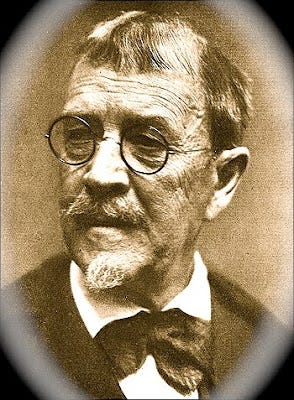
Published in 1931, it became an immediate bestseller.
Bohemia
By 1927, having just turned 60, Steffens had grown tired.
He’d spent decades chasing corruption through America’s biggest cities. He no longer wished to board another train in pursuit of another crooked mayor or another robber baron. He wanted somewhere quiet enough to make sense of the life he had lived.
He found it on California’s central coast.
Carmel-by-the-Sea was then proudly known as Bohemia.
It attracted painters, poets, novelists, iconoclasts and delightful misfits who valued conversation more than status. Here, amid cypress trees, sea mist and cottages that looked as though they’d wandered out of a Grimm fairy tale, Steffens discovered precisely what every exhausted truth-seeker eventually craves:
Perspective.
He bought a modest cottage on San Antonio Street near the ocean and christened it The Getaway.

It became far more than a house.
Its living room evolved into one of Carmel’s informal literary salons.
Ernest Hemingway dropped by. John Steinbeck came calling. Sinclair Lewis joined the conversation. Ideas flowed as readily as drinks. (Although publicly known as a teetotaler—with a disdain for alcohol-fueled backroom politics—Steffens discreetly indulged.)
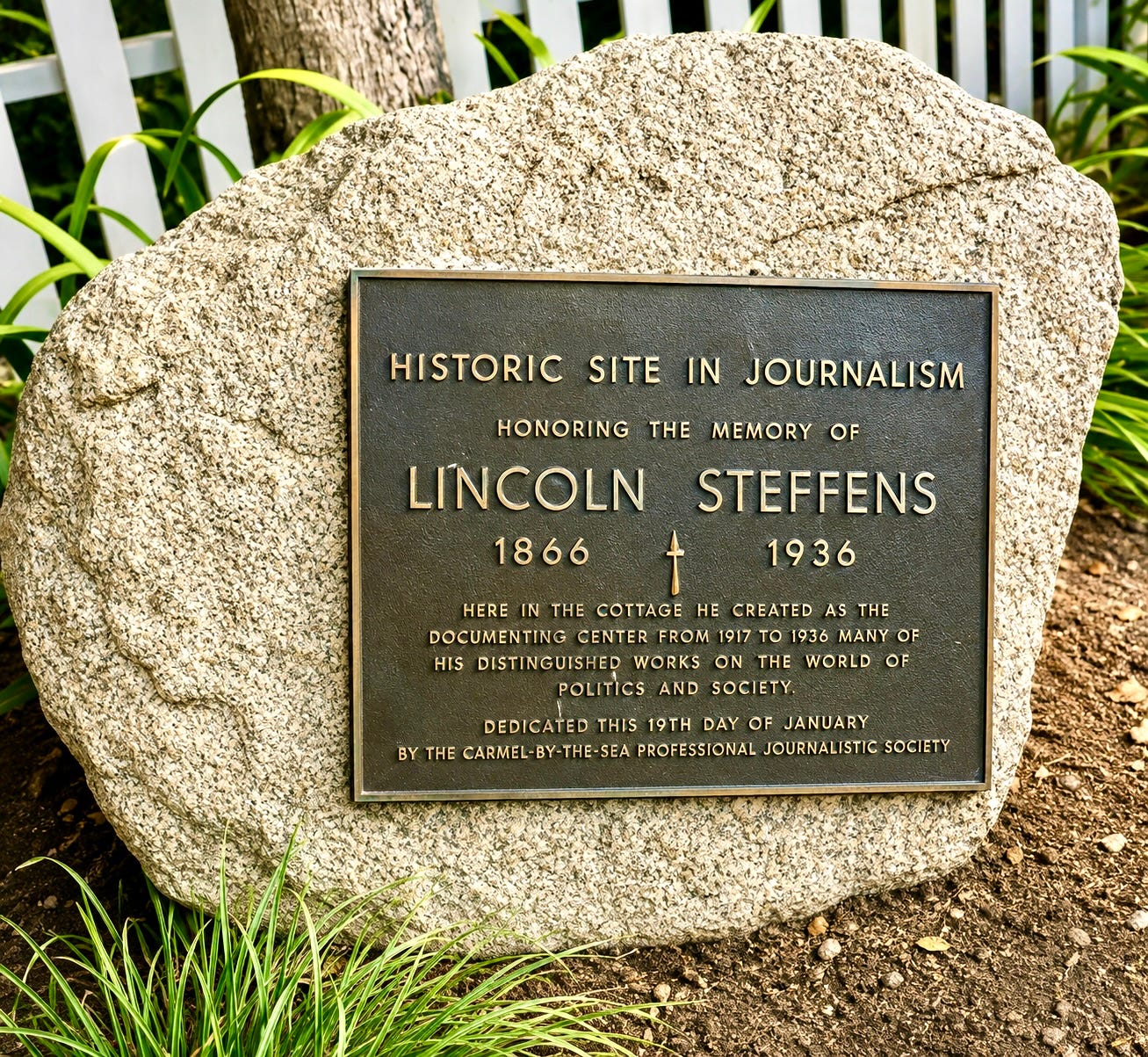
Steffens spent his remaining years writing, reflecting and entertaining fellow curiosity seekers until his death in 1936.
His choice of Carmel was no accident.
After spending a lifetime exposing civilization’s machinery, he chose to retire somewhere that still valued imagination over ambition, creativity over material wealth.
There is an irony here.
Ninety miles north sits San Francisco’s famed Bohemian Club, founded by artists but eventually colonized by financiers, industrialists and presidents—the very establishment Steffens had spent his career investigating.
Carmel’s Bohemia moved in precisely the opposite direction.
Or at least it did back then.
Today, many of the painters and writers have been replaced by affluent retirees and second-home owners whose investment portfolios probably resemble those of the captains of commerce Steffens once pursued.
The cottages remain enchanting. The conversations (last week, anyway) revolve around high-value historic automobiles, and portfolios.
Lincoln Steffens believed that most people needed un-learning before they could begin learning.
A century after he settled in Carmel, that may be truer than ever.

No posts
Comments
Nothing yet. Say the first thing.
Sign in to join the conversation.