
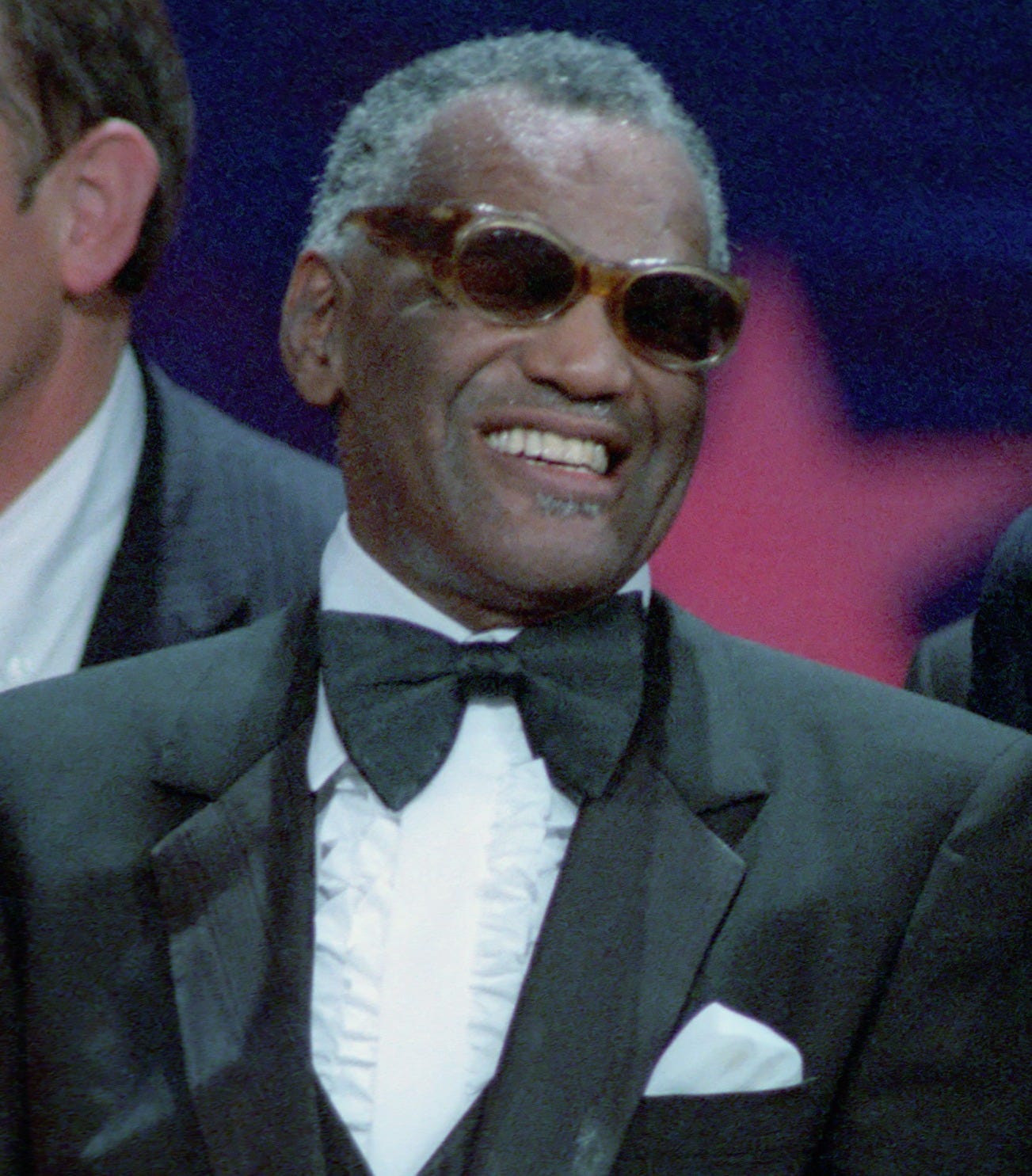
It’s a little frustrating for me to read through this transcript of my interview with Ray Charles. My problem isn’t that it didn’t deliver what Keyboard required, but rather that it did and little else. Had the assignment come from a magazine with a broader readership, I could have allowed the conversation to roam more freely or directed it into areas beyond what kind of an action he liked on his pianos.
So, knowing the parameters, I enhanced my awareness of his unique accomplishments with some deep-dive research. His autobiography Brother Ray gave me direction; you’ll see here that I pulled quotes from it that could give a particular keyboard spin to some of my questions. The fact that he was best known as a vocalist allowed me to ask about the relationship between vocal and instrumental expression. And I found details I pulled from his catalog that I could use in encouraging him to address our readership from a different perspective.
Then there was the inescapable fact that this was Ray Charles. There’ve been only a few times I’ve been intimidated by the presence of a public figure. One of them happened the afternoon that Pete Seeger unexpectedly dropped by the Keyboard office. Then there was that time backstage at the Grammys when I found myself standing next to Julian Lennon and Leonard Bernstein discussing something I obviously wasn’t intended to hear.
But then there was Ray. No other voice had smashed genre barriers as thoroughly as his, first erasing the line between black gospel music and secular, if not suggestive, lyrics. Then he found common ground between R&B and country music, albeit in the slick, string-washed sound then prevalent in Nashville. Few life stories were as inspirational as his, and no other performers rivaled his determination to succeed.
In a sense, then, having to focus on a relatively narrow subject was actually helpful, especially since we had only half an hour together. We spoke just after his performance at the Paul Masson Vineyards in Saratoga, California. I’d been standing on the side with his road manager, whose name I forget, a couple of feet from his big band. Toward the end of the show, he looked at his watch and chuckled.
“Ray must be having a great time tonight,” he said. “He’s stretched his set out by thirty seconds or so.”
Which says something about his superhuman determination and discipline. In Brother Ray he wrote about how at age six or so, when he could no longer see, he vowed never to rely on a cane or a dog to get around. He trained himself to understand space by going into an empty room and hurling a tennis ball against the wall until he was able to catch it purely by sound and reflex. Someone in his band told me that he liked to relax by playing chess. He couldn’t legally drive but he learned to tune up his own car. (And apparently he did do a little illegal driving, when circumstances allowed.)
I was running passages from his book through my mind when his road manager indicated that Ray was ready for me. We went backstage to a plain dressing room door, knocked and I went in. He was sitting in a folding chair, waiting for me. I bet he knew how many seconds had passed since he’d alerted someone to fetch me.
****
You’ve said in other interviews that you believe your singing has changed a lot over the years. Would you say the same about your piano playing?
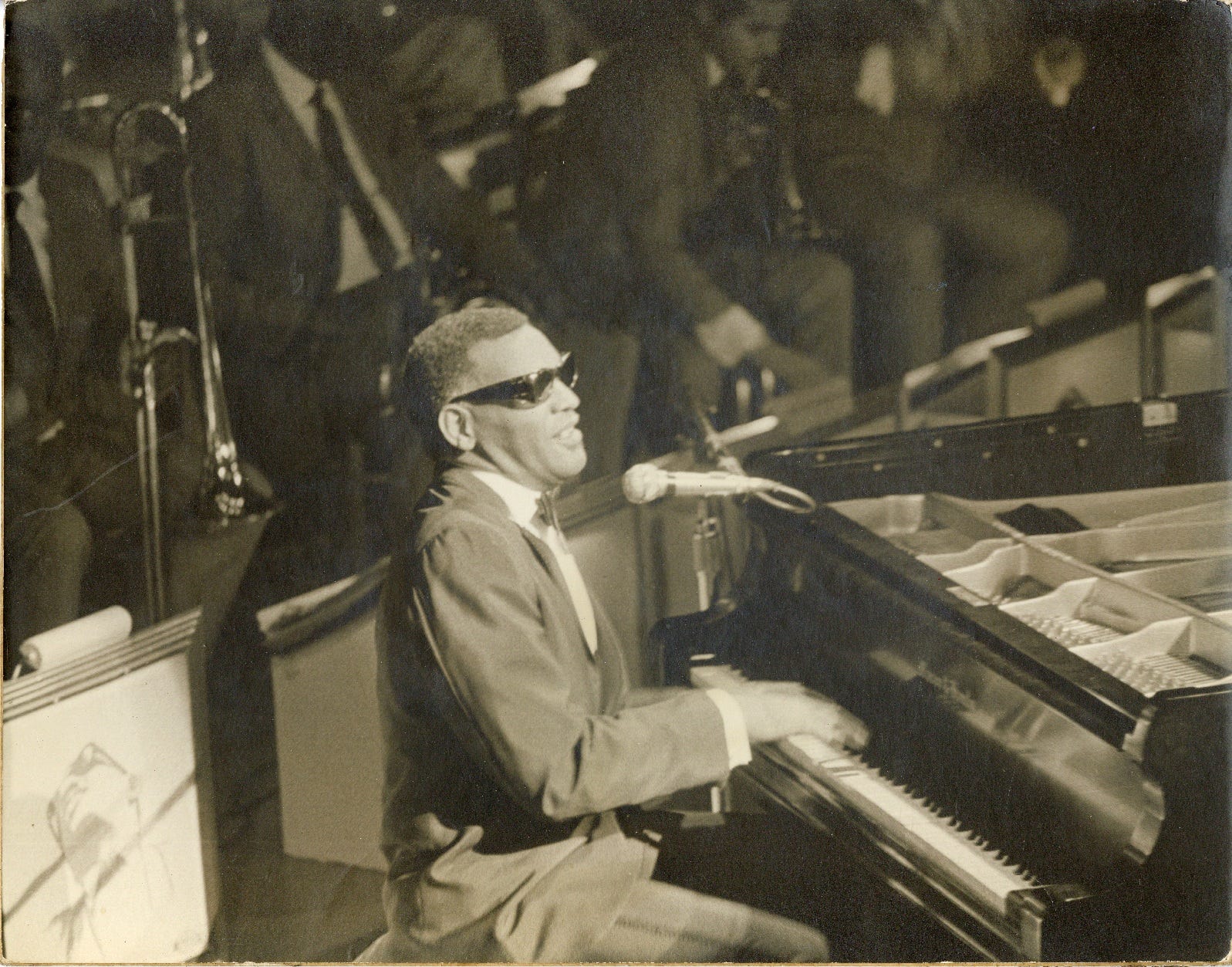
Well, I sincerely hope that my piano playing has changed the same as my singing, because I’d hate to think that I haven’t reaped something from all this practicing I do. I’ve learned how to do a lot of things that used to be difficult in a more simple way, in a way that’s easier for me, so that one does not struggle. The idea is for the people to say “Oh, wow, that didn’t look like nothin’” when you play. You should make it look easy, like when Hank Aaron hits a home run or Willie Mays catches a fly ball. That’s how it’s supposed to look.
So how has your piano style changed?
It’s not my style that’s changed, now. It’s maturity I’m talking about. I hope I still play in the same vein, with the same type of feeling, that I’ve always had. You know, I love Nat “King” Cole as a pianist. The world knows that, because I tried like the Devil to emulate him. But what I’ve tried to do is to play with feeling, just like I sing. I’ve always tried to do that, so I don’t think that’s changed. What may have changed is the fact that I can do more of what I think of with a lot more ease.
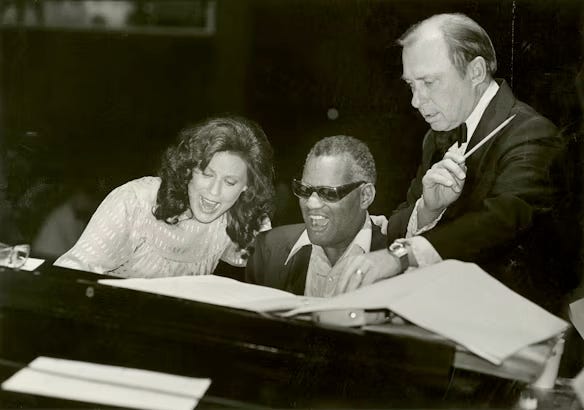
See, I’ve never been into just one particular thing, where you say, “I play all of one thing.” I’ve always involved myself in many different types of music. I like to play jazz. I love it! Yet on the other hand, I like to play the blues. I like to play and sing love songs – in my way, not as a country western singer, because I love that music. The thing for me is, I don’t think I’ve changed in what I do. It would be silly to change my style or my method of doing things, because they work for me. I mean, Coca-Cola don’t change its ingredients, because they work! You don’t give it up when it’s workin’ [laughs]!
When you say practice, do you mean you actually practice, or do you mean that you just play all the time?
I’m not going to tell you I play all the time! That would be a lie, so I’m not going to say that. But I play as often as I can. I try to practice some every day. But you must remember that I’m on the road a lot, so that ain’t always feasible. You can’t play the piano every day; you can’t lug around a Steinway or something.
Do you have a particular favorite piano?
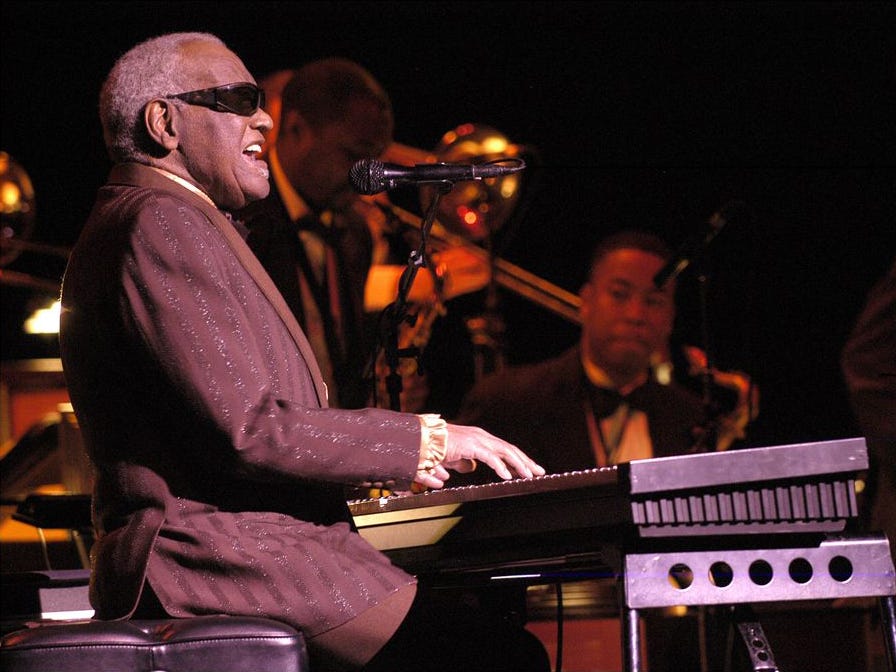
I have a favorite, but I don’t want people to get into a big thing over it. I like to think that I’m the kind of pianist who can play anything, if it’s in tune [laughs]. It’s like a pilot who says, “if you’ve got everything that’s supposed to be here, then I think I can fly.” But like anyone else, I have my own preferences. I prefer Steinway. I play very hard on a piano; I’m very heavy-handed, so to speak. You know how secretaries push the little button back on their typewriters so that the keys are stiffer or softer? Well, if I had that kind of a thing on the piano, I’d push it so that the keys would be very stiff, because I play hard. That’s why I like Steinways. They can stand a lot of punishment. But I don’t go around demanding of everyone that they have a Steinway all the time.
Tonight, for instance, you were playing a Yamaha.
Yeah, that’s what I’m saying. I prefer a Steinway. I’ll say, “This is what I want. However, if you bring me any piano, I like to think that I’m pro enough to play it well enough to suit me.”
Many Steinways have very solid low registers. Do you look for a piano that lets you really project your left hand?
Basically, what I like is a piano that gives you an overall average sound. What I mean by that is that any note you hit should balance out, so that you don’t have hot spots in the piano. Some pianos will do that, where the bass is heavy and the treble will be very tinny, or something like that. I like a piano where the action is about the same all the way through. The hammers should be even, so that the top keys are not too bright and the bass keys are not too muffled, or vice versa. Any pianist will tell you that you can go into a music store and play fifteen or twenty pianos before you find that one that suits your particular sense of touch.
What about overall sound?
I like a more mellow sound, instead of a real bright, hard sound. I don’t want to call it a harsh sound, because that makes it sound like it’s bad. It’s just that some people like a harder sound. I’m the same way with electric pianos and microphones too. In most cases, I prefer working with a microphone that is something like the old mics, which were softer sounding. The newer mics, although they’re good, have a hardness about them. So there’s the same thing.
You once listed your four favorite pianists as Bud Powell, Art Tatum, Oscar Peterson and Erroll Garner. Does that same list still stand for you now?
Well, when you talk aboutArt Tatum, I don’t even like to use the word “technique,” but Art could play anything he wanted to. He’s one of the few people who I truly believe could play anything he thought of. Of course, Oscar is my man. He plays so much, sometimes it’s almost like he’s mad with the piano. I probably feel closest to Hank Jones after Oscar – I’m talking about today, you know, because I don’t think Bud is with us. And Peter Nero plays his buns off!
When you started working as a singer, was it harder to sing and play at the same time as well as you could when just doing one or the other?
Well, at the time I didn’t think it was hard for me, but I was young. You know, when you’re young, you can’t miss something you don’t know about. At the time I thought I was fairly good, but thank God I was around some musicians who knew that I was all right but I wasn’t as good as I thought I was. They corrected me, which I appreciated. I mean that sincerely; this is not a put-on.
I was around a piano player named Jimmy Teller, who played his buns off. I mean, he was a notorious piano player. He helped me a lot. He would tell me, “Hey, man, you know, you got to settle down. Play what you can play, and learn how to play what you play better.”
But to get closer to answering your question, I’ve always had faith – maybe “confidence” is a better word – in myself. I always thought that I could somehow do what I wanted to do if given the chance or if somebody would take the time to show me. Obviously, as I look back on my early days, I know that what used to be difficult for me to do, not only in playing the piano but in singing too, I can do now with a hell of a lot more ease. My fingers want to tackle what my mind tells me to do.
“I didn’t have any time to be afraid.”
You worked mainly in small combos back then. How easy was it for you to fit the piano into a big-band format later on?
I have to tell you that I was writing arrangements for big band when I was twelve years old – and by the time I was fifteen I was playing in big bands. I was thrilled to death because there I was, so young, around all these cats who could really play. And I adored them. I just loved them. I was so proud to be where I was that I didn’t have any time to be afraid.
I guess I’ve always been sort of bold. I’ve never had no fear about nothing. I’ve had things I’ve always wanted to do, where I’ve said that I’d pray to God to let me play in Carnegie Hall the first time. But I didn’t have no fear when the opportunity came up. Some people say, “I have butterflies in my stomach.” I never had them. Maybe there’s something wrong with me because I didn’t ever feel that way. I was one of those people who was always glad to do it. I can’t explain why. You had to chain me down, I’ get so excited! I was the same way with playing the piano. When I first got to working with big bands, all I wanted to do was to play. Let me hear that music!
How often did you perform only as a singer, without playing your own accompaniment?
It’s true that I was singing first, but I cannot imagine singing without playing. When something is interlocked, you cannot have one without the other. I am totally uncomfortable if I have to stand up and sing. I’ve tried it a few times, like when I’m a guest or something on somebody’s show. You do what you have to do, but, boy, I tell you, it is the most uncomfortable feeling I could get in my life, as far as really being out of tune. No, I like to play for my singing, because I know what I want to hear behind me.
Have you ever felt comfortable, though, in a situation where someone else is playing piano behind your vocal?
Well, yeah, there are piano players who can play better than me, but let’s face it, they do not know what I want to hear. I don’t care how good they are. You know, I love Oscar, but even he does not really know what I want to hear. You can have the best doctor in the world, but if you don’t tell him where you hurt, he don’t know! It’s the same thing here. I can really play better for me than anyone else.
If for whatever reason you had to give up playing for a while, how would that affect your singing?
I don’t think it would change my singing, only because I like to think that I’m a very determined person. It’s not to brag about myself; it’s just my nature, you know. I’ve had to overcome a few things in my lifetime, so, God forbid something happening to my hands, I think I could manage it if it did. You know what would happen if you were to lose your carburetor or your engine? It would have to affect something! No, I would have a terrible problem, but I could overcome it.
What about the reverse situation?
Well, see, I’m more known for my singing, but I’m a musician first, just like Nat Cole. The world loved him for his singing, but he was a hell of a pianist.
But you often do vocal overdubs on over instrumental tracks, with your piano part already recorded.
That’s a great question! I like that! What I do is, I do the piano track first, because I can sing in my mind as I’m playing. I know more or less what I want to sing; all I do is, I don’t let it come out of my mouth.
Which means you have no trouble when it’s time to add vocals.
Thank you! You got it, brother, right on the money [laughs]. Of course, I would imagine you could just go in and sing, and then play background to yourself after you’re through, but I haven’t done that. I always play the piano first.
I’d like to ask you about your Porgy and Bess album. You had some great keyboard players on that session – Joe Sample, Ralph Grierson, Paul Smith. Why didn’t you play their parts yourself?
You’re sort of right on that one, but not quite right. These guys were on the date, but I played too. That’s me on “It Ain’t Necessarily So.” Those guys never got in the way of nothing – they never overplayed – but on the songs where the piano was truly important to me, I played.
In your autobiography you mentioned that you studied piano with a Miss Garrett in St. Augustine, who taught you the Chopin “Minute” Waltz and the Rachmaninoff C# Minor Prelude. How much of that training carries through in your playing today?
You just happened to name two songs from my book, but like any classical students, we played many, many classical tunes because, as a matter of fact, you didn’t have jazz appreciation in school when I was a student. I’m telling you, either you played classical or you didn’t play! As a matter of fact, my teacher would get very annoyed with me. I was supposed to be practicing, and the next thing you know, I’d be playing boogie-woogie or something, and she’d say, “What?” I’d get in all sorts of trouble.
But I love classical music. I studied it and I did very well in it. I didn’t pursue it because I guess I was a rebel. In classical music, you play what the guy wrote and that’s the end of it. But I wanted to play what I thought. Classical music does teach you and help you to do what you want to do. It helps you so that when your brain tells your fingers to do something, you know how to play the things you want. And of course it helped me learn how to write arrangements and compose and do all that kind of stuff. So it was very advantageous to me. I listen to it and I enjoy it as much as anybody who appreciates that music, but I just don’t deal with it. It’s not my field, because I want to create what I’m doing.
Do you still play any classical pieces just for your own pleasure?
Very seldom. Sometimes I may fool around when I hear something and I want to try to figure out how the cat did it, but I can’t tell you that I run back to my classical roots and all that. It’s good enough for me to appreciate and love it and know what the people are doing, just like I appreciate opera when it’s done well. I’ll know what the singer is doing and what it takes to do it, but I wouldn’t tell you, “Oh, man, this is the way I spend my hours.”
Years ago, you did two instrumental albums, Soul Meeting and Soul Brothers, with Milt Jackson. Do you plan to do any more non-vocal projects?
I can’t say that I have a plan to do one. Most things I do sort of fall into place; they just come natural. I don’t plan to do an instrumental album, say, in the next year. But I think if the feeling struck me, I would do it. I’m what you call a self-producing artist. I produce myself. Nobody tells me what to record or what not to record, so I record what I feel like. If the spirit hits me to do an instrumental album, that’s what I’ll do. So there it is.
“Life does not always have to be complicated. What’s wrong with making a peanut butter and jelly sandwich sometimes?”
You played a lot of sophisticated changes on those albums. When you play much simpler voicings on a country-oriented session, do you ever feel like you’re having to scale down or compromise harmonically?
Why? Why? Life does not always have to be complicated. What’s wrong with making a peanut butter and jelly sandwich sometimes? You don’t always have to be a gourmet. If your friends are going to frown on you because you’re doing that, then that’s too bad. But I like to think that I’m a whole person. I really mean that. I’m not trying to be facetious, but I like to think that the things I do are simple. I do some very difficult things with my piano and my voice that may give some singers fits, but then I may sing something very simple and easy. The name of the game is to be able to fit whatever the situation calls for.
Do you record or play much these days on organ?
I don’t play organ too much now. I have a gentleman with me now who’s a very good pianist, James Polk, and he plays the organ with just as much stamina. When I run into guys who do things well, I try to let them do it. I want the public to know what’s happening with the people who are around me. I don’t have any hangups about trying to make sure that nobody will outstar me. I mean, I’ve been in this for thirty-five years; I’ve got no fear for my career [laughs].
You used to give Billy Preston a lot of solo space when he was playing organ in your band.
That’s right. I love him.
You’ve also recorded some jazz tracks on celeste.
Well, it’s a keyboard.
What attracted you to that instrument?
First of all, it’s the sound you’re dealing with, and the celeste has a pretty, very clean sound. When I was fifteen or sixteen, I remember there was a song that went [sings] “Dream when you’re feeling low.” They had a celeste playing throughout the first part of that song. I always thought it was pretty. Naturally I had never seen one at that time, but when somebody finally said, “Oh, this is a celeste,” I said, “Oh, yeah? Let me see that!” Let’s face it, if you’re a keyboard man, you’ve gotta be interested in keyboards. So I play the organ and all these different types of synthesizers.
Did you do the synthesizer part on “Compared to What,” from Brother Ray Is At It Again?
Yeah, that’s me.
What kind of synthesizer was it?
I’d be damned if I know, man. I don’t want to give you the wrong name, because I’ve got about five different types of synthesizers. I use a different one depending on the sound I want. Each one has its own characteristics. I find them a lot of fun, but they do not take the place of the piano. It’s like, they have synthesizers that they’ve written string parts for. You twist your buttons and it’s supposed to be strings, but you don’t get it. I have to tell you, I don’t like a steady diet of synthesizer because after a while I get so I can’t take it. For colors and getting certain things that you need, synthesizers are great. But there’s only so much you can do with an oscillator. When I want to hear a reed section or a violin section, I want to hear real reeds and violins.
So you’ve never used a synthesizer at a gig to cover what actual orchestral instruments played on an album?
I don’t think there’s a synthesizer in the world that can make a violin sound. I know some have come very close. Stevie [Wonder] has his Dream Machine [Yama GX-1], which is very good. But if you listen, you know it ain’t violins, honey. But I have to say one thing: They’ve got some drum machines now that are really something. Boy, I tell you, the drummers better watch it.
Have you used one yourself?
No, I will never go to nothing like that, because a computer can only do what you program it to do. I like to have my drummer create and think, and I know damn well that being a drummer, he can think of far more stuff than I can put in that computer. Why? I ain’t no drummer. Simple.
We recently ran an interview with Oscar Peterson in which he talked extensively about how involved he is getting with synthesizers and electronic music.
Oh, yeah? I got to have a long talk with that boy [laughs], because he was the guy who kept telling me, “Oh, I’ll never do that!” I can’t wait to see him! When I used to say, “Well, why don’t you play my electric piano?,” he’d always say, “Oh, man, no, no. I can’t play those things.”
I’ve got one last question. From what I’ve read, journalists often have a hard time resisting asking about your blindness. The subject has been milked for well over twenty years, but I haven’t heard anyone ask whether your loss of sight led to changes in how you heard sounds. In other words, did music take on a different meaning for you after you lost your vision?
No. You know, I appreciate that question. Thank God, the whole thing is very simple for me. When I was a kid and I did lose my sight, I was very young but I loved music. That’s something that losing my sight did not stop or hinder. I never felt in any way different about wanting to play music. That’s still how I feel today.
####
No posts
Comments
Nothing yet. Say the first thing.
Sign in to join the conversation.