
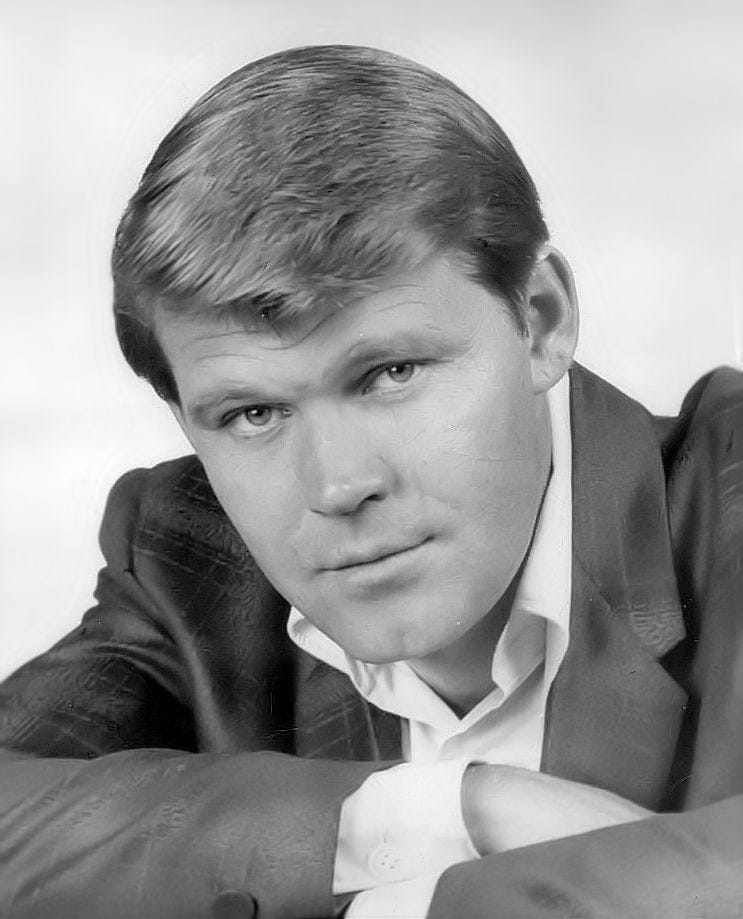
Several years after writing about Glen Campbell’s last album Adios for USA Today, I became one of the millions of people that fate had forced to take care of loved ones as they sank into the pits of dementia.
I mention this because at that timeI couldn’t yet fully appreciate what it took for Campbell’s family to comfort him as he succumbed to Alzheimer’s. You can learn about from books and grief counselors, then, as I did at the beginning of my caregiving experience. That’s not enough, though, if you don’t feel in your gut what this means. Nothing you read can prepare you for the emotional devastation that comes with it.
So what I wrote after doing these interviews was a little distant, a little “just the facts, ma’am.” Since the length stipulated by USA Today was extremely short, it kind of had to adhere to the old-school journalistic disciplines of objectivity and brevity. Looking back, I wish it might have been longer. And if I had to go through this incomparable trial, I wish it been before through what Glen’s wife Kim and producer Carl Jackson had to overcome as they put this project together.
I had interviewed Glen a few years earlier, while I was still on the Country Music Association staff. Because CMA refuses to give me permission to quote even from transcripts, much less articles, I did while on their payroll, I can only say that he was in the early stages of his ailment yet able to banter playfully and answer questions thoughtfully. My recollection is that we both laughed as we spoke over the phone, though he knew full well how this final journey would end.
When work began on Adios, he had faded deeper into the shadows. As I noted on USAToday.com, “Not so long ago, Glen Campbell’s music, acting and winning charm illuminated all of American popular culture … Today he is no longer able to talk or understand speech. But before slipping into this last stage, he did decide to record one more album.”
The key here is that Glen was the one who insisted on doing this benedictory project. Now I know how miraculous it was for him to do so. Even when he could no longer speak, he could still sing. That’s how he left us on Adios; the words came from Kim and Carl as they recalled the project to me.
****
How did everybody start putting this together?
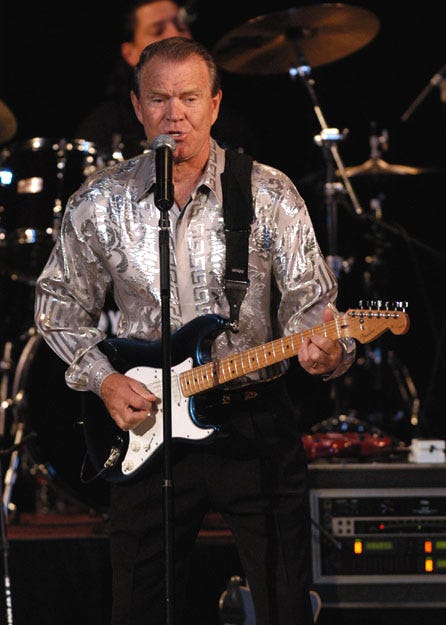
It was basically a family discussion. I went with Glen when I was eighteen years old. Ashley is my goddaughter. Glen is family. So it’s me and him and Kim sitting around and talking about music and songs that Glen loved but never had the opportunity to record. The idea just kind of popped up: “After the tour, why don’t you go in and cut some tracks? Glen can live with them for a while and then come in and sing them.”
We picked out the songs that Glen was familiar with — things like “Don’t Think Twice, It’s Alright.” Glen would play a little bit of that almost every time he picked up a guitar. So I cut the basic tracks ahead of time and did the vocals and let Glen live with that for a while. Then, when we were able to get in the studio, because of Glen’s familiarity with those songs, I just typed out the lyrics and we’d look at a couple of lines at a time. His melodic abilities were still completely there. He couldn’t remember lyrics but his perfect pitch and his feel for melodies were still engrained. He just killed each song. He sang the fire out of them.
Even though you only recorded a couple of lines or maybe an occasional verse at a time, his performance hangs together from start to finish.
Thank you. That means a lot to me. It comes from how much love was in the room. You’ve got to realize, I was probably the biggest Glen Campbell fan in the world even before I met him. When I did meet him, it was like instant family. We’ve been family all these years. I was so familiar with how Glen sang these songs. I did make a few suggestions but most of them were Glen-esque. For the most part, it was Glen standing there, just being Glen. He did have to read the lyrics but not in every case. He could remember the chorus to “A Thing Called Love.” And he remembered the melodies one hundred percent. And that great, natural vocal ability still resided in him.
We had so much fun in the studio. I can’t tell you what a joy it was. It’s something I’ll treasure for the rest of my life. Once again, Glen Campbell has poured blessings on me, ever since I was a kid.
It was fun but probably also bittersweet.
I guess at the moment we didn’t even think about the title being Adios. But, yes, it was bittersweet. We knew what was going on. We knew it wasn’t going to be able to go on much longer. With me and Kim being there with him, we were able to get more things than maybe we could have done otherwise. We laughed. We joked. It was family together.
How did Willie Nelson come into the picture on “Funny How Time Slips Away”?
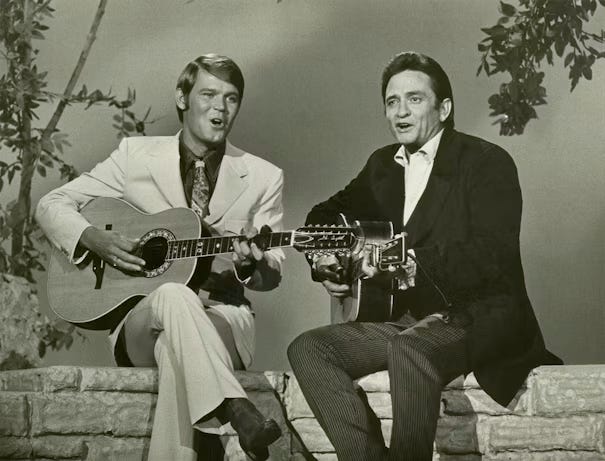
Well, Glen loved the song. When I was with him from 1972 to ’84, pretty often onstage he’d just start singing it and we’d come in. Once I got Glen’s vocals on it, I played them for Buddy Cannon, who is a good friend of mine. He produces Willie, Kenny Chesney and a lot of acts here in town. He was just blown away with Glen’s vocals, particularly on that song. He thought it would be a good idea if he let Willie hear it, because he’d written it and Buddy was working with him. Willie loved it very much. We just thought it would be cool if we could ask Willie if he wanted to join in, play some guitar and sing a little bit.
I went into the studio when Willie was in town. I had him sing the song all the way through too and play guitar on it, and I put it together. I made a duet out of it. That’s the way I wanted to approach it: Two icons going back and forth on such a great song. It’s pure Willie, from his playing where he’s trading off with me on the guitar licks, to his back-phrasing. And it’s pure Glen: He nails those high notes.
Did Glen play at all on the album?
Glen did not play on the album. That was more challenging that vocals at the time. He could still play a bit but it was hard for him to maintain a full song. It was much more difficult than vocals. I wish I could have gotten Glen on some of it but it just wasn’t possible at the time.
What does it mean to you that your song “Arkansas Farm Boy” is also on the album?
That means the world to me. I wrote that song after he told me the story of his granddaddy teaching him to play ‘In The Pines’ on a five-dollar Sears & Roebuck guitar. It gave me the idea for the song. I wrote it on a plane headed somewhere overseas in the mid to late Seventies. I recorded the song with John Starling and Emmylou Harris on an album called Spring Training back in 1990 or ’91. The album actually won a Grammy!
We did a demo with Glen years ago in the late Seventies or early Eighties. I even had Emmylou come in and sing on that. But it was never finished, never mastered and never put out. It did one around in our discussion of songs for this album. He started singing the chorus and I was like, ‘OK, we need to cut this!’ So to have him sing it now, in first-person about himself, it means the world to me. You can imagine hearing the words you put on the page sung by the guy you wrote them about.
****
What are your memories of how this project began?
We were just sitting around, reminiscing, telling jokes and laughing. We started thinking about our lives together and regrets that we hadn’t gotten into the studio and recorded some of the songs that Glen loved. These were his go-to songs. Any time that Glen sat down at home and picked up a guitar, these are the songs he would play for fun. ‘Don’t Think Twice, It’s Alright,’ ‘A Thing Called Love’ … We realized that he had never recorded them, so we thought, ‘Why not go into the studio, put some vocals on these tracks and see what happens?’ It was about helping Glen check off his bucket list.
Although Glen recorded his vocals in bits and pieces, each song flows like a complete take.
The vocals were pieced together, maybe one line at a time. But they weren’t pieced together in Glen’s heart and soul. They just poured out of his spirit. And he had been singing them for years, so he could come in at the middle of a verse and sing it with the same sentiment as the beginning of the verse. The lyrics touched his soul; that’s why he wanted to sing these songs. He could phrase and interpret a song like nobody else. More than fifty people recorded ‘Wichita Lineman’ but it’s Glen’s version that you remember because he sings it with so much emotion. He makes that story his own. I think he did that with all of these songs.
The way he sang “Postcard From Paris,” he makes me see the Champs Elysees.
That song makes me miss him so much. “I wish you were here.”
The very last vocal note of the album, on “Adios,” will make people cry because of its beauty as well as the meaning of the song.
Absolutely.
This must have been a bittersweet experience as well as a lot of fun.
It certainly was in the back of our minds because we knew that Alzheimer’s was beginning to take its toll. When you listen to lyrics like ‘everybody’s talking at me. / I don’t hear a word they’re saying, / only the echoes of my mind’ … I mean, Glen is suffering from aphasia now. He’s lost most of his ability to communicate verbally. But he’s content. He’s in his own world. I saw that approaching as I listened to him sing these songs in the studio, so they took on kind of a different twist. Yeah, it was bittersweet. But it was so beautiful to watch him enjoy singing and being in the studio. It lit him up like a Christmas tree, to do what he always loved with his friends and family.
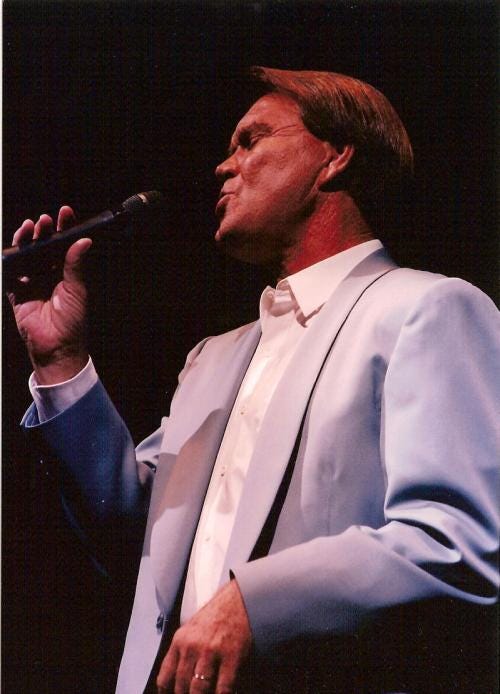
When he hits those high notes before the choruses on “Funny How Time Slips Away,” his voice is just stunning. He sounds like a young man releasing his debut album.
I agree. He’s amazing. He’s one of the best singers that ever lived.
What is his history with Willie Nelson?
When Glen had his television show, he would invite country music artists and give them exposure they’d never received before. He helped popularize country music and bring it mainstream. Glen was the first crossover artist. He and Willie go back to before Glen ever met me. I’ve been married to him for 35 years, so they go way back. I think at one time Glen even bought Willie’s publishing and then sold it back to him for nothing; he was just helping out a friend. They love each other. They were there for each other in good times and bad times. They always enjoyed each other’s company.
Did he smile when he heard Willie’s vocal on this track?
Well, that vocal got put on after Glen had done his vocals.
But what about when he heard the final mix?
Unfortunately, Glen has been in late stages of Alzheimer’s for the past two-and-a-half or three years. Nothing really connects with him. But thankfully, he had a great experience putting his own vocals on and connecting with that music. I think he would be so pleased and honored at the way Carl pulled it together and at the different artists who came and contributed.
It’s amazing to hear Glen, even in his state, connect with these lyrics and these notes. This just reaffirms that somewhere inside, he’s still there.
In the early middle stages they can still lead a very productive and fulfilling life. I always say to people who’ve been diagnosed, don’t despair. You still have a lot of life left to live. You should enjoy yourself, surround yourself with people you love and do what you love. That’s what Glen did. He didn’t isolate himself or go into hiding. I think he helped remove the stigma of the disease. I’m so proud of him.
Your daughter Ashley sang on this album too.
She did — and she played banjo. Carl is Ashley’s godfather, so he helped train her as a banjo player. I think she did him proud. Her own album will be released soon. She’s a great songwriter as well.
Talk about your help for those who care for Alzheimer’s victims.
I started a website called careliving.org. If you could plug that, it would be great. It encourages caregivers to take care of themselves while they care for the ones they love. It’s so hard on us, when we’re losing our loved ones. It’s so heartbreaking and depressing. So I want to encourage people.
####
No posts
Comments
Nothing yet. Say the first thing.
Sign in to join the conversation.