
“He who only knows his own side of the case, knows little of that.” — John Stuart Mill
By Robert Lynch
I started graduate school in 2006. Like a lot of anthropology departments at the time, Rutgers was split between the biological anthropologists and cultural anthropologists. Although we were all supposedly in the same department and were required to take some of the same classes, the differences could not have been greater. It was like putting the math and the art departments together except they hated each other.
In anthropology, graduate students have to do field research, and your first few years are spent figuring out a topic and where to go. I had come to Rutgers to study under Robert Trivers, a well-known evolutionary biologist who died a few months ago (here is a memorial I wrote), and I decided to do mine in Iceland, analyzing centuries of genealogical and genetic records to test hypotheses based on Trivers’ theories on parental investment and sexual selection. What was the trade-off between having more children and investment in each one (i.e. quantity vs quality)? How many kids should parents have when mortality was high (e.g. after a massive volcano) vs when it was low? How did a parent’s wealth and resources predict whether they invested more in boys vs girls?
In our second year, all the graduate students had to present their hypotheses at something called the Dissertation Proposal Defense. It was a crucial moment in the process of getting your PhD in anthropology. All of the biological anthropologists presented research questions that they were planning to test. My wife, for example, was planning to go to Kenya to study whether male olive baboons recognize and invest in their own offspring using DNA and thousands of observations of baboon behavior in the wild. It turns out they can and do. Another student, Drew Gerkey, was proposing to spend two years studying cooperation among reindeer herders in Siberia, using public goods games where people decide how much to put into a shared pot that grows and gets split evenly among the group. It turns out that these herders are some of the most cooperative people ever studied.
I was already used to the massive differences between the two wings of anthropology, and all the jargon (e.g. embodied subjectivity, intersectionality, structural violence, hegemonic knowledge production), but was still surprised when the cultural anthropology students went up one after the other and explained what they were going to find. Not what they were hoping to understand, or learn, or test, or discover, but what they were going to find. Here is an excerpt from a typical defense that was read1 to us called “Portside Synaesthetics: Sensing the Politics of Place”:
“Architectural models and projections in Marseille are experienced as uncanny, rather than as communicative… Based on the ethnographic evidence, I argue that there is progressive potential in taking seriously the impacts material ‘objects’ have on human ‘subjects.’”
There were no questions. No hypotheses. No data to be collected, let alone analyzed. There were claims about arguments being “based on the ethnographic evidence,” but no evidence was ever cited. Conclusions were drawn from a series of assertions. It sounded like they were all already done and weren’t seeking to learn anything at all. I remember asking one why they were even bothering to go into the field at all.
I had been trained to always ask what’s the evidence? My advisor would never let me get away with any vague bullshit about “the research says” or “studies say” — and would immediately interrupt me. What studies? He wouldn’t even give a result of a paper without explaining exactly what was being measured. Instead of saying that an Implicit Association Test (IAT) was a measure of unconscious biases, he would spend eight minutes explaining exactly what was measured — e.g. how quickly people categorized words and pictures associated with black people and white people, using a keyboard, alongside words and pictures widely seen as good or bad, like horrible versus beautiful. It was exhausting, but it was a discipline I never forgot. He actually wanted to know the answer. In short, he was curious. The idea that people might hold different beliefs, and that data could adjudicate between these beliefs was as foreign to my cultural anthropology classmates as “examining semiotic posttextual theory” was to me.
The founding premise of anthropology was audacious: you could actually go and find out what humans are like, rather than simply assume it from the comfort of your own tiny corner of the world. Franz Boas, the discipline’s American founder, rejected the racial hierarchies earlier scholars had simply assumed instead of testing, and demanded that anthropologists spend years in the field before making any claims about a culture.
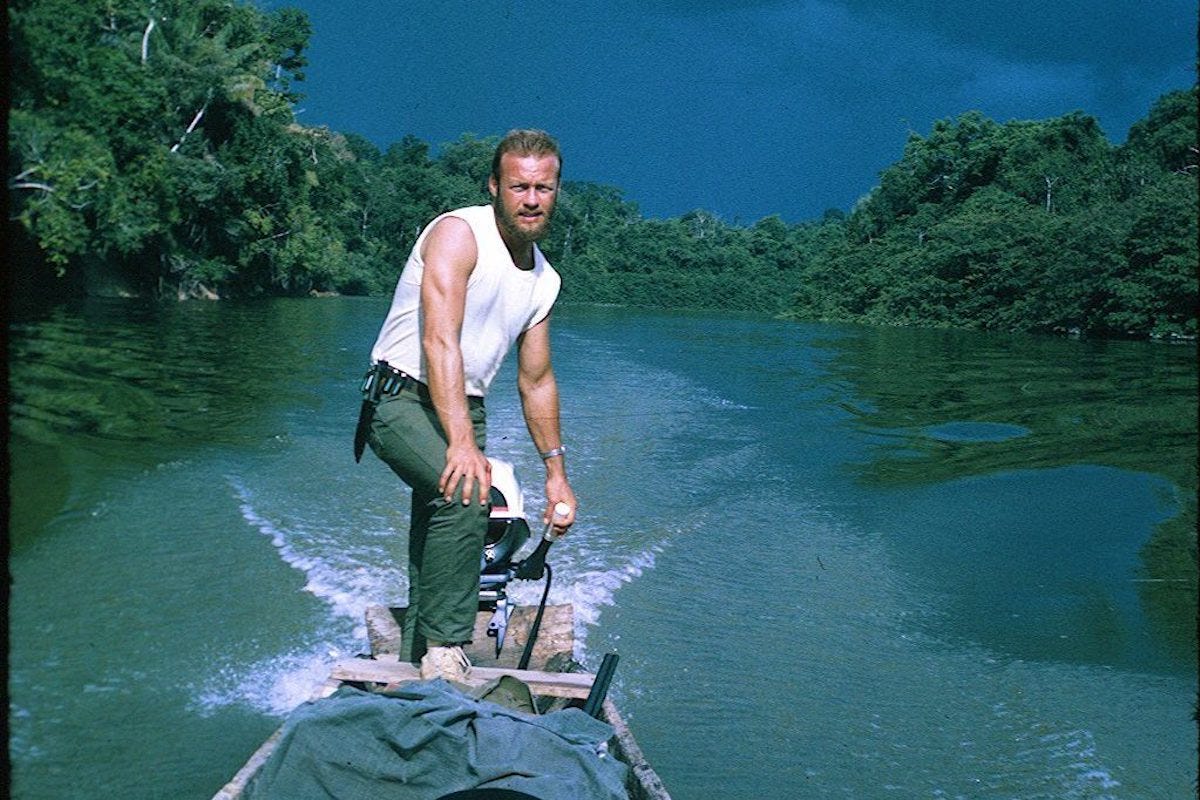
My postdoc advisor at the University of Missouri, Napoleon Chagnon, came straight out of that tradition. He spent more than a decade among the Yanomamö in the Venezuelan Amazon, testing fundamental questions about kinship, violence, and reproduction. He once told me he woke up in his hammock to find the village headman standing over him with an axe raised over his head ready to strike. Do more violent men have more wives and children? It turns out that, in Yanomamö villages at least, they do. I spent three years working and publishing with him, and in his day he was one of the most famous anthropologists alive — because that’s what anthropologists did in the 1960s and 70s. They asked the most interesting questions they could about humans and culture, then went and tried to answer them. Today, asking those same questions gets you labeled a racist or colonialist, and studying small-scale societies at all is dismissed as cultural voyeurism.
What are universities for? They used to be places where humans would search for truth. Karl Popper put it this way: “It is well worth searching for truth; and we do this chiefly by searching for mistakes, so that we have to correct them.” To my cultural anthropology classmates, people like Chagnon, Trivers, and Popper had it backwards. Truth wasn’t something you searched for — it was something you already knew, and the search itself, the demand for evidence, was just another tool for the powerful to oppress the powerless.
Carolyn Rouse is the president of the American Anthropological Association (AAA). Earlier this year, a Chronicle of Higher Education reporter gave her the chance to rebut a report on the State of Scholarship in the Humanities and Social Sciences that named anthropology the single most extreme case of politicized scholarship among the disciplines it studied. The authors charged anthropology with “a widespread deterioration in scholarly standards grounded in a pervasive repudiation of ideals of objectivity together with a toxic intellectual climate in which reasonable dissent on politically charged topics is routinely suppressed and punished.” By the time of the interview, Quillette had already published the report almost in full.
Rather than reckon with it, most anthropologists doubled down on the very claims the report had flagged as most absurd. No criticism I could offer — not this essay, not the report itself — was as damning as simply letting the discipline’s most august defenders speak for themselves. Perhaps the most self-incriminating moment of the interview came when the AAA president was asked whether she regretted her organization’s decision to cancel a panel discussion called “Let’s Talk about Sex Baby: Why Biological Sex Remains a Necessary Analytic Category in Anthropology” at its 2023 annual conference on the grounds that it would have harmed members’ “safety and dignity,” and that its premise contradicted “settled science.” Rouse said,
“All you need to do is literally type into Google and see that we know, factually, that there are different types of ‘sexes’ and ‘genders.’ You can have XY and you present as a woman, you can have XXY — they’re all variations, genetic variations. So the idea that there are two sexes is just factually incorrect, and to force biological anthropologists to teach that is the equivalent of turning an astronomy department into an astrology department. So I don’t know why we’re debating that.”
Rouse goes on to call the belief that biological sex is binary “nonsensical” — while admitting, in the next sentence, that she doesn’t actually know what people mean by the claim, or “why that matters to people so much,” calling the whole thing “very strange.”
What was strange, though, was that the president of a field built on the idea that people could be trained to understand beliefs they didn’t share, and make sense of worldviews unlike their own, couldn’t define the very position — one of the most widely held convictions in human history — she’d just dismissed as “nonsensical.”
Rouse’s response was the culmination of something that had been building in social science departments for the past two decades. In 2006, I was at a colloquium at Rutgers where the primatologist Ryne Palombit was giving a talk on infanticide in Chacma baboons, a lot of which was devoted to sex differences in baboon behavior. When it came time for questions, the chair of the department, a cultural anthropologist, raised his hand like someone about to blow a gaping hole through the whole talk, and asked, “What exactly do you mean by these so-called males and females?” The scientific answer is simple, and it’s got nothing to do with chromosomes.
Biological sex is defined by gamete size: males produce huge numbers of small, cheap sperm; females produce a small number of large, costly eggs. That asymmetry — called anisogamy — is what biologists use to tell males and females apart in every sexually reproducing species on Earth, and it drives the different evolutionary strategies of the two sexes. My PhD advisor, Robert Trivers, was at that colloquium and had worked out why this matters in 1972, in one of the most cited papers in biology. Explaining something that had puzzled biologists since Darwin, he famously wrote, “What governs the operation of sexual selection is the relative parental investment of the sexes in their offspring.”
It all begins with these differing initial costs, which lead to a cascade of evolutionary effects, which often result in fundamentally different developmental and behavioral trajectories for the two sexes. Because males can produce sex cells (i.e. sperm) cheaply, their reproductive success is largely limited by their ability to attract mates; whereas females, who bear the far larger cost of pregnancy, are limited by their ability to obtain resources. Whether you call the two groups A and B, Big and Little, or Male and Female, this foundational cell-sized difference in gamete size has profound effects on evolution, morphology, and behavior, and it sets the stage for characteristic, and frequently stereotypical, differences between males and females.
But Rouse knows none of this. She doesn’t just fail to understand the position she’s dismissing — she doesn’t even know her own field’s actual definition of the thing she’s talking about. Still, even setting aside the biology — Rouse isn’t a scientist, and neither are most of her cultural anthropology colleagues — there’s a more fundamental problem. When her interviewer, Stephanie Lee, pointed out that a 2022 survey of forensic anthropologists found 42 percent agreed sex is binary and 56 percent disagreed (hardly evidence of “settled science”), Rouse dismissed the survey outright: “I don’t believe in opinion research,” adding that forensic anthropologists are mostly coroners who “haven’t had advanced schooling.” That’s a strange stance for someone whose entire professional training is built around taking people’s stated beliefs seriously, asking them what they think, and treating their answers as data. It’s also wrong. As Conor Friedersdorf pointed out in The Atlantic, the survey’s own published data showed 57.9 percent of respondents held a doctorate and another 25.7 percent held a master’s — only 20.5 percent worked in a coroner’s office at all.
Rouse’s utter lack of curiosity about what other people think or believe was starting to look less like a series of bad answers and more like a personality trait. When Lee asked her about Joseph Henrich — the one anthropologist among the report’s authors, and the closest thing the field has to a Jared Diamond or Steven Pinker — Rouse said she’d never heard of him. Even after Lee mentioned Henrich for a second time — referencing the unreleased internal report on anthropology he was said to have written — Rouse called him one of “these people who are philosophers or whatever,” then retreated into her comfort zone and started riffing on the patriarchy, ancient Greek slavery, the oppression of women, and what social justice really means. She wasn’t even listening.
Rouse’s colleague at Princeton, Agustín Fuentes, took a different approach. Instead of ignoring the report, he attacked it. What he left out of his Chronicle op-ed, which called the report “politely worded McCarthyism,” was his own role in canceling the AAA panel on sex — a cancellation he describes as something that just happened. But it didn’t just happen. Fuentes was one of three anthropologists who wrote the letter that got the AAA to cancel the panel, arguing that “the overprescription of the idea of a biological binary for something like sex not only ignores the evidence, but goes against the most basic empirical underpinnings of our field.”
At another point, Lee asks Rouse whether she agrees with a previous AAA president, Akhil Gupta, who said in his 2021 presidential address that anthropology’s “political project is to challenge the culturally dominant commonsense of capitalist consumerism.” Rouse responds:
“Anthropologists love to disagree with one another, so I’m not gonna say I agree or disagree with Akhil… I’ve read it, I’ve quoted from it. But just because something’s quoted, there’s a whole context. There’s so much more than that. This is the problem with absolutist free speech. We talk in contexts. Speech is never free. Speech is always connected to something else.”
Not only does Rouse refuse to say whether she agrees with Gupta, she refuses to accept that a previous AAA president’s own public words even count as evidence of what he believes. This is Rouse’s get out of jail free card. If quoting a public statement made in a named presidential address and asking whether someone agrees with it is “the problem with absolutist free speech,” then no quote, from anyone, in any interview, can ever be fairly asked about. That’s not a nuanced point about context — it’s a universal solvent that dissolves the possibility of accountability itself. Does this mean we can never believe what people say? What’s the point of saying anything, including Rouse herself even answering these questions, if it can always be waved away as “lacking context” the moment it becomes inconvenient?
What is the point of a university? Of a field like anthropology? Are they supposed to be places grounded in humility and curiosity, where we try to understand the world and the people in it? Or are they just political action committees that already know the answers and only need to advocate for justice? Universities used to be places people went to find answers, not to confirm the ones they already thought they knew. The people who trained me were some of the most curious people I have ever known. They were people like Robert Trivers, whose observations of pigeons jockeying for position on a railing outside his Cambridge apartment window led to deep insights into parental investment and sexual selection — and why “male” and “female” were never about chromosomes. They were people like Napoleon Chagnon, who at age 26 crawled through a low gap in a palisade wall — built that way to expose anyone entering — into a shabono of “burly, naked, sweaty, hideous men staring at us down the shafts of their drawn arrows,” and lived with them for more than a decade.
Anthropologists never used to need to be reminded that the core of their discipline was curiosity. The Vanderbilt report accused them of losing it. An hour with its president was all the confirmation anyone needed.
In what seems like a deliberate attempt to make already tedious talks even more so, cultural anthropologists often read their presentations to the audience.
Comments
Nothing yet. Say the first thing.
Sign in to join the conversation.