
Good Morning Family, Friends, Colleagues,
I’m back: I was sidelined for several weeks by some persistent and complicated dental work. Thankfully, I believe I’m now on the right side of getting those problems resolved and I want to give much praise and thanks to the students and faculty at the Tufts University School of Dental Medicine - one of the most pluralistic, professional, and diverse communities I’ve ever encountered - who worked as one to identify and solve my issues and bring the promise of a smile back to my face.
Salamaat,
Robert
I didn’t know, and nobody told me and what could I do or say, anyway?-June Jordan
It was in 1968 that I arrived - accompanied by an intrepid and wonderful girlfriend - with just $40, two Nikon F camera bodies, three lenses, and a duffle bag containing all our essential belongings - at the Lebanese port of Beirut.
It was from that very port my father - in 1908, at age 9 - had traveled alone to America and gifted me with life, and it was to that land I traveled in 1968 to begin anew.
I returned to bear witness.
I would not have used such language then, but I recognize now I was being called to tell a story and arriving in Beirut at that time was the opening chapter in an imperfect life of trying to stand alongside people - many who looked like me - struggling for freedom, struggling to be free from American and Western imperialism and Israeli settler-colonialism - to understand its parallels, tensions, intersections, with other forms of oppression.
We had flown from New York - the first time I had ever travelled internationally - via Iceland, to Luxembourg, then hitchhiked – visiting museums and tourist sites and staying at youth hostels – down through Europe to Naples.
There, we boarded a freighter - booking steerage-class passage – bound for Beirut via a stop in Alexandria, Egypt. We found steerage so disgusting that we spent both our days and nights on the deck.
After leaving Italy we were befriended by a Kuwaiti family who had traveled to Europe to buy a new Mercedes. Their new car was secured to the freighter’s deck and they offered to let us spend our remaining nights on deck in the car.
One of the pleasures, I remember - beyond the companionship and uniqueness of the journey - was that after leaving Egypt our new Kuwaiti friends introduced us to fresh mangoes they’d purchased in Alexandria – how to cut them, how to eat them, how to savor each drop of juice.
Mangoes: to this day I’ve yet to taste a more delicious fruit.
Finally, we arrived in Lebanon and disembarked in the Port of Beirut. We were joyously met by aunts, uncles, and cousins greeting us in Arabic, French, and English; to this day I can’t remember if I had included in my telegram to Uncle Chahine - my father’s youngest brother - the fact that I wasn’t traveling alone, but they welcomed us as one.
As Uncle Chahine had some authority in Beirut - واسطة - we were quickly processed by immigration and customs and soon a convoy of Azzi kin and friends departed the port for home.
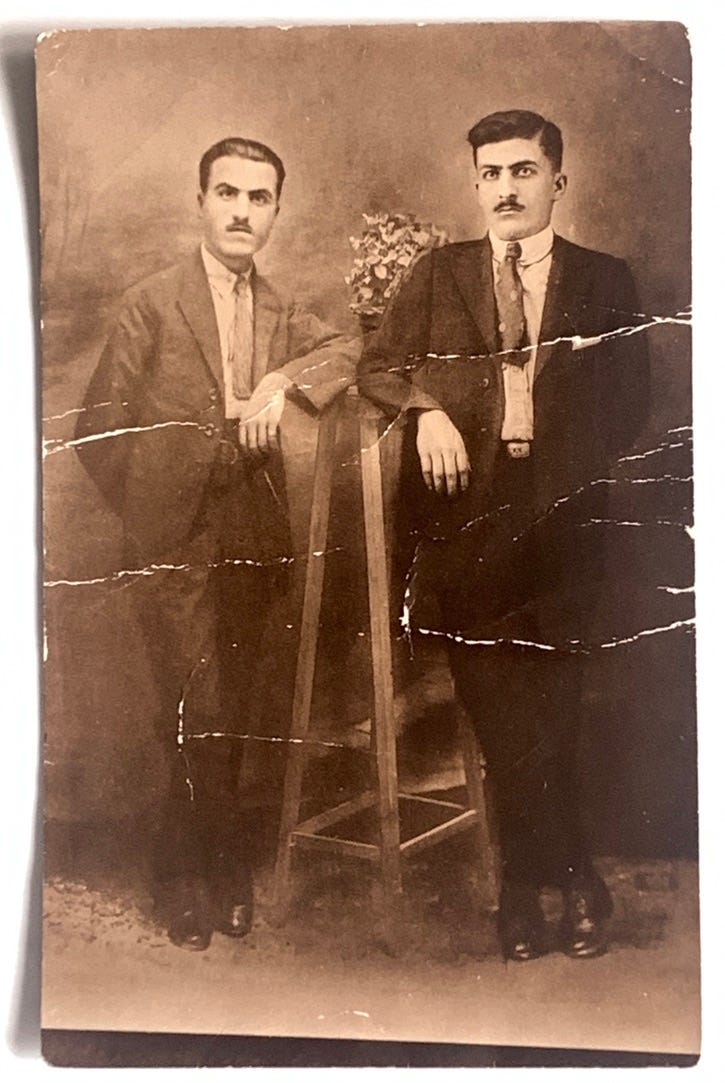
Lebanon quickly became my second home and remains so - even at a distance - to this day. Not only was it the land from which my father had traveled to America but intellectually it was central to all the issues that were increasingly important to me - issues that consume me to this day:
Identity.Culture.Justice.Colonialism.Arabs.Islam.Global South.Intersectionality.Equity.
In all the years I lived in The Levant - in all the years I traveled throughout the Middle East and beyond - in all the years since - Lebanon and Palestine has remained central to my experience. It was there I was welcomed as kin; it is there, along the shore, where part of me resides still.
We are as one.
It was there, too, I was first introduced to the structural dehumanization of the Other by colonial and imperial powers in ways I had not witnessed in my sanitized mostly-white New England upbringing ... introduced to the violence, the ignorance, the racism that consumes the west to this day.
This morning, as I struggle to find words to share about what I feel is happening in Palestine, Iran, and Lebanon - happening to people I love in lands that once sheltered, informed, challenged me - lands I believe love me still even in times of conflict, I find I need the poet June Jordan to guide me:
In 1982 American poet June Jordan (1936-2002) reached into her soul - a soul already scarred and scorched by racism in her own homeland - and bore witness to America’s complicity with Israel’s terrorism in Lebanon, in war crimes, in their complicity in the massacre of 1,000s of Palestinian refugees living in Sabra and Shatila refugee camp.
In Moving Home she wrote:
I do not wish to speak about the bulldozer and the
red dirt
not quite covering all of the arms and legs
Nor do I wish to speak about the nightlong screams
that reached
the observation posts where soldiers lounged about
Nor do I wish to speak about the woman who shoved
her baby
into the stranger’s hands before she was led away
Nor do I wish to speak about the father whose sons
were shot
through the head while they slit his own throat before
the eyes
of his wife
Nor do I wish to speak about the army that lit continuous
flares into the darkness so that the others could see
the backs of their victims lined against the wall
Nor do I wish to speak about the piled up bodies and
the stench
that will not float
Nor do I wish to speak about the nurse again and
again raped
before they murdered her on the hospital floor
Nor do I wish to speak about the rattling bullets that
did not
halt on that keening trajectory
Nor do I wish to speak about the pounding on the
doors and
the breaking of windows and the hauling of families into
the world of the dead
I do not wish to speak about the bulldozer and the
red dirt
not quite covering all of the arms and legs
because I do not wish to speak about unspeakable events
that must follow from those who dare
“to purify” a people
those who dare
“to exterminate” a people
those who dare
to describe human beings as “beasts with two legs”
those who dare
“to mop up”
“to tighten the noose”
“to step up the military pressure”
“to ring around” civilian streets with tanks
those who dare
to close the universities
to abolish the press
to kill the elected representatives
of the people who refuse to be purified
those are the ones from whom we must redeem
the words of our beginning...
Jordan’s witness continues - I continue - because those horrors persist to this moment. We are living in dark and dangerous times - there is so little light - and the pressures bearing upon us challenge our capacity to stand upright.
Nothing has changed except perhaps the feeling of helplessness many of us are bearing in the face of such unhinged inhumanity and cruelty increases daily.
It’s now over two and a half years since Israel embarked on its most recent chapter of genocide and ethic cleansing against the Palestinian people in Occupied Palestine, now just months after the United States and Israel embarked up its current chapter of war crimes against Iran, just months since the Israel invaded Lebanon.
Together they have caused such massive devastation, dislocation, pollution, massacres, grief, anger, and an economic disaster that will affect the lives and livelihoods of people around the world, especially in the countries of the Global South.
In Lebanon - my parents’ birth country -Israel continues executing mass atrocities, using weapons tax-paying American citizens have helped pay for, in full view of the world, killing defenseless civilians in densely populated neighborhoods, that has left 1,000s dead, many thousands injured, and well over 1,000,000 people - including some of my relatives and yours - displaced.
Nothing has changed.
I feel such weight, such heaviness - so overwhelming, so cruel - so unrelenting in its marginalization of the Other, in its attempts to erase the Other - to erase me - that I must call upon all of you - even you who don’t agree with me - that our very survival as believers, as witnesses, as photographers and writers, as lovers, as educators and activists, to speak up against injustice, against the silencing of our prophets and artists, or we are all at risk of erasure.
Jordan continued her witness in Apologies to All the People in Lebanon:
Yes, I did know it was the money I earned as a poet that paid
for the bombs and the planes and the tanks
that they used to massacre your family
But I am not an evil person
The people of my country aren’t so bad
You can expect but so much
from those of us who have to pay taxes and watch
American TV
You see my point;
I’m sorry.
I really am sorry.
Where is your witness?
Don’t be sorry.
It is your turn.
Today.
Be strong, my loved ones.
Keep your keffiyehs close.
Resist.
Salamaat,
Robert
Comments
Nothing yet. Say the first thing.
Sign in to join the conversation.