
How is it possible that a White American Christian of German ancestry plays Over the Rainbow on a Japanese bamboo flute, a Zen Buddhist instrument called a shakuhachi?
Ten years before I was born, the movie “The Wizard of Oz” appeared on American cinema screens. I identified with melancholy Dorothy (played by Judy Garland) as she sang Over the Rainbow while wandering among the farm machinery on her grandparents’ farm. Dorothy’s grandmother, Emma, had told her to "find yourself a place where you won't get into any trouble." Dorothy muses, "Someplace where there isn't any trouble.” She looks up into the menacing Midwest skies and begins to share her longing with her dog, Toto. “Someplace where there isn't any trouble. Do you suppose there is such a place, Toto? There must be. It's not a place you can get to by a boat, or a train. It's far, far away. Behind the moon, beyond the rain," at which point she begins singing of this “somewhere,” just beyond her reach. I could identify with her because my great grandparents had operated a dairy farm in northern Wisconsin, where, as in “The Wizard of Oz,” we experienced occasional tornadoes. My great-grandparents were born in the late 19th century and still got up at 5 am every morning to milk the cows in the barn. I would stand nearby while they milked and shoveled the sawdust that covered the cement floor. I enjoyed hanging out with the animals and walking through the cornfields. It was an adventure, but I felt lonely, too.
My father had just returned from the Pacific War with Japan. He had been a machine gunner on an SBD-5 Dauntless dive-bomber in the islands of Guam and Guadalcanal, and although he had been discharged, he stayed on as a recruiter and was often away from home. My father had killed Japanese civilians and soldiers in the Pacific and had returned home mentally damaged with post-traumatic stress disorder and an alcohol addiction. I never felt that he was fully present, even when he was physically present. Dad brought back from the war a heavy Marine Corps volume that included photos of hundreds of dead Japanese soldiers—most of them torn apart by shrapnel from artillery shells, IED’s, and grenades. As a youngster I’d sit for long stretches with those horrific photos, feeling fascinated, afraid, and confused—but also proud that my dad was a Marine. The book presented Japanese people as alien and sub-human, a characterization that the Nazis had also used when they orchestrated the extermination of Jews, calling them Untermensch (subhuman). If you killed an Untermensch, you hadn’t actually killed a human being. In the America of my childhood, many young men were now living with artificial limbs. In some ways I felt safe, but danger saturated my reality.
We were fighting two wars at once. On the other side of America, the German Nazi war machine was marauding and murdering innocent people, especially Jews. My maternal grandfather, Fred Radenz, a German Lutheran, had been called up to fight his ancestral people in the trenches of WWI. I never had a chance to ask him what it felt like to battle his own countrymen, but he did tell me that his best high school friend, who stood beside him in the muddy trenches, had looked up over the edge of the trench one day and had been shot in the forehead and instantly killed. Despite enduring experiences like these, Grandpa Radenz didn’t seem to suffer much with PTSD. I always felt safe with these dear people who had lived through the Depression and several wars. Grandpa was a house painter all his adult life, and Grandma orchestrated a household full of grown kids and grandkids. They both attended German services at their Lutheran Church. I had two younger siblings, and Grandma was our guardian angel. She’d take us in when our father was boozed up and out of control. Grandma often put me to bed with the German prayer, Ich bin klein, mein herz ist rein, niemand drin wohnen als Jesus allein (I am small, my heart is pure. No one lives in my heart but Jesus alone). This prayer comforted me, especially when mom and dad would come home drunk in the night, shout at each other, and sometimes hit each other. I would try to burrow down deep beneath my pillow so that I couldn’t hear the conflagration on the other side of our bedroom door. Sometimes in the darkness, I’d slowly roll off the mattress, step over to my younger brother’s bed, and cover his ear with a pillow. With my parents, I didn’t always feel safe, so I’d recite Grandma’s prayer or imagine singing Somewhere Over the Rainbow with July Garland, longing for a place on this earth where there isn’t any trouble. Sometimes, in the middle of the night, I still look up to see if everything is O.K.
After my parents’ tumultuous marriage ended in divorce, my father left our home in Wisconsin and moved far away. I rarely saw him again. His absence led to many problems for me. I sometimes drank alcohol as a pre-teen, I was arrested at age 11 for breaking-and-entering, and for most of my life I carried a deep melancholy in my heart. Fortunately, over the decades I was taken in by my grandparents, counseled by various high school teachers and coaches, and somehow still trusted in Jesus who lived, died, and now lives again in eternity. For much of my adult life, Jesus was over the rainbow, but also nearby. Early Sunday school experiences continued to circulate in my imagination. I continued to trust the words of most Lutheran hymns and of songs like “Jesus loves me, this I know, for the Bible tells me so.”
In my 30’s, the deep relational wound of my father’s absence and my parents’ divorce led me to wonder if I would always be emotionally troubled. I decided to seek out a therapist and to study psychology, and I eventually completed a doctorate in psychology at Harvard. While at Harvard I attended Vipassana Buddhist retreats, learning about the precious gift of silence. I also met Fr. Henri Nouwen, beginning a friendship that lasted until Henri died in 1996. In the 90’s I navigated my spiritual interests by moving between Buddhist and Christian retreat centers, and I completed a post-doc Master’s degree at a Jesuit seminary, writing a thesis on “A Perfect Storm of Healing: Christian Contemplative Prayer, Buddhist Meditation, and Psychoanalytic Therapy” – three modes of healing and wisdom that I found deeply meaningful.
One day at the seminary, near the end of a seminar on Buddhist-Christian dialogue that focused particularly on the work of Trappist monk and writer, Thomas Merton, the professor announced that one of our classmates, David Duncavage, had lived in Japan, was married to a Japanese woman, and had studied the ancient Buddhist art of the shakuhachi, the bamboo flute. David stood up and played two ancient pieces from the Sui-Zen (Blowing Zen) tradition. This unusual music entered my heart, instantly captured my attention, as if calling to me from a strange land. It touched my longing for something beautiful that seems to exist just beyond everyday reality. After class I asked him if I could study this tradition, and David said yes. Yes, I could fly over this musical rainbow.
I had played accordion as a boy, drums in high school, and guitar as a young adult, so I was generally familiar with western musical notation, read from left to right across a five-stave landscape. But Japanese notation comes from another world, written in beautiful hand-drawn symbols that are read in columns, top to bottom and right to left:
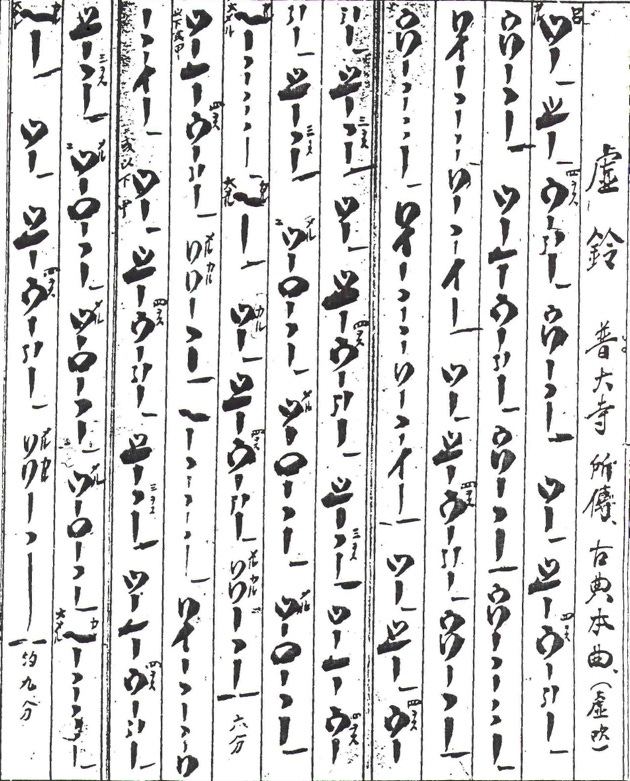
This Japanese notation is not Somewhere. . .and not Kojo No Tsuki. But it is an old honkyoku piece called kyo Rei, (Empty Bell). I include it to illustrate Japanese musical notation.
I studied shakuhachi with David, and later with Yoshio Kurahashi, his shakuhachi master from Kyoto, for about twelve years. Eventually, I learned how to play many of the honkyoku (music from the Origin) pieces that are well-known in Japan. I relished this new experience of breathing, one that conveys musicality and sometimes a story that is awakened in the imagination. One piece is called Kojo No Tsuki, sometimes translated as “Moon over the Ruined Castle.” It is often played after tragedies such as war. I learned to love this piece and to play it every year on August 6 to honor the victims of the atomic bomb attacks in Hiroshima and Nagasaki. I gradually realized that as I played this piece, I was sharing both in the horrors of war and in the struggle to recover from them. I could feel that I was both a Japanese soldier on the ground and the pilot of a Marine Corps dive-bomber. The discipline and beauty of the shakuhachi seemed to open my heart to the spirit of my dad and to the spirits of all who suffered so terribly in the Pacific and European wars.
The Blowing Zen tradition awakened me, compelling me to be present and aware at the keen edge of something ultimate—present to each breath and to each note, as if my life depended on it. Being fully present was never conveyed to me as a Christian virtue, and I soon learned to value this discipline. Instead of living my thoughts, I was gradually learning to live my life.
Over the years, it seemed that my shakuhachi performances were knitting a transparent ceremonial cloth over, around, and beneath me, something like what Christian priests call chasubles and Zen priests call haregi. When I play Kojo No Tsuki for others I enter a sacred, timeless, and placeless solitude, in which all who have lived and died, all who are dying, and all who are being born are singing their way into and out of a ruined, sacred temple, and in and out of this brief, precious life that we share.
Our country’s war with Japan and Germany concluded two years before I was born. I’m here because my ancestors foresaw me and because my dad came home. In my prayers I bow to the millions of soldiers and civilians who are killed in wars and also to those who kill. As I blow down into the bamboo, I sometimes imagine America’s battles in Germany, where I see lonely, angry, and scared people getting into railroad cars on their way to concentration camps, and my heart cries out for them. When I turn to my personal past, I grieve for my wounded and unhappy parents, I bless them, and I trust that our beloved Holy Spirit (Ruach in Hebrew; Hagios Pneuma in Greek) will heal and comfort them across the decades and centuries. Remembering the past, with its tragedies and traumas, is not like watching old movies—not something sentimental, nostalgic or merely interesting. We who are alive today participate in time both past and future, because the past and future are seeded into the present. In this wholistic present we find ourselves in all the others who have passed and all those who are coming. When we bring full, sacred attention to the present moment, we see that those who have lived and those who are not yet born are not “other” or far away. We all share a common identity as human beings.
When I sit in silence, I can imagine Hitler and Japanese military leaders. I can feel rage in my heart, but years of meditation and psychotherapy have also taught me that whatever and whomever I see outside of me, is also within me. I often think of the great Russian author, Aleksandr Solzhenitsyn who wrote that "The battleline between good and evil runs through the heart of every man." I want to live a good life, and to do this I must be honest about my complicated nature and feelings. I try to release all the opposing parts of me, and all my passions as I breathe the full range of musical notes available to the shakuhachi. Shakuhachi has become a portal to a deep truth that can be found only in the harmonization of all one’s opposites. Sometimes I push the breath down the bamboo passage with gentle care, and sometimes with the strong, protective presence of Fudo, the Buddhist guardian of sacred temples. I consider honkyoku to be a musical practice in which I gather all that I am, leaving nothing and no one out—allowing all the contradictory parts within to be harmonized through the breath and the bamboo.
Jews mark Yom HaShoak, Holocaust Remembrance Day, and I bless all the victims of Nazi violence as I stand in the shadows and the breaking light of Kojo No Tsuki. I recently learned that two Jewish men wrote Somewhere, Over the Rainbow, published in 1939 when the Jews in Europe were coming under increasing surveillance, and were being captured and murdered by the Nazis. Their freedom and hopes for a normal life with family and community were destroyed. Their only hope was often over the rainbow, where they couldn’t “fly” like the bluebirds. But that invisible hope was something very real and present to many of the captives and kept many of them alive. One can feel the deep sorrow and suffering of Auschwitz prisoners who looked up past the dark clouds of chimney tops when we sing:
Someday I’ll wish upon a star
And wake up where the clouds are far behind me.
Where troubles melt like lemon drops,
High above the chimney tops,
That’s where you’ll find me.
I think that Jesus touched this over-the-rainbow place in his heart, even as he was being crucified by the Roman authorities. We all long for freedom—freedom to love, to create, and to participate in this lovely, brief and precious life. This longing is not merely a vague desire for something different from what we have or who we are. The longing to become all that we were made to be is real, holy, and a source of courage—summoning us forward to create a better world, one that already lives within us as the Spirit of new life that’s ready to be born.
I sign off here with a particular rainbow longing—that all people of good will, no matter what spiritual tradition they follow, if any, will discover that the desire to be right and to make others wrong, is to live from our lower self where opposition reigns. For me, this separation from ourselves, others, nature, and Divine is a kind of sin that eventually leads to conflict and war. It’s best to seek to embody the apparently contradictory truths discovered and lived by Buddha and by Jesus. Those Eastern and Western truths are not exactly the same, but they are all true—looking in and out from the soul in different directions. Listening to this precious song, Somewhere, Over the Rainbow, we can glimpse a blessed harmony of compassion and love that is, even now in a dangerous world, playing in the open fields of our Selves. It’s already happening in the holy Somewhere of our hearts.
Comments
Nothing yet. Say the first thing.
Sign in to join the conversation.