
Geoffrey Hinton has a proposal for keeping superintelligent AI under control: make it love us like a mother loves her baby. Babies are less intelligent than their mothers and still manage to get what they need. Mothers are wired to put their children’s interests first. If AI gets smarter than us - and Hinton thinks it will - maybe maternal instinct is the safest leash we’ve got.
It’s an appealing analogy. But it’s built on an idealized version of motherhood that doesn’t hold up to evolutionary logic. Once you look at what mothers actually do - and why - you get a more complicated picture. And a more interesting one.
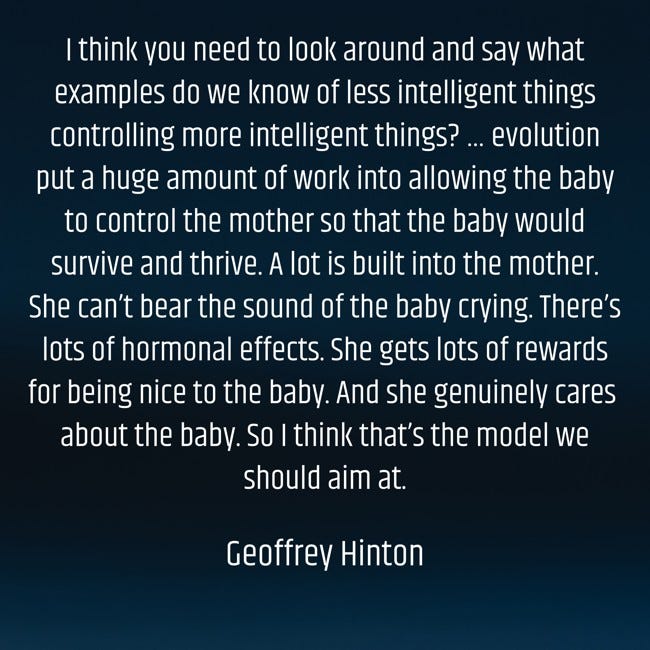
a conversation with Jany Hejuan Zhao at the 2025 T-EDGE conference.Parent-offspring conflict theory is supported by decades of evolutionary biology research. Mothers and offspring don’t have perfectly aligned interests. They have overlapping ones, with tension at the edges. Evolutionarily speaking, a baby benefits by extracting more from its mother than is optimal for the mother. Babies evolve to be extraordinarily good at being demanding: the crying, the cuteness, the relentless 3am insistence. Mothers, in turn, evolve to be responsive to those signals, but also to resist them. The manipulation flows both ways, and mothers often win. They shape the environment, control the resources, and decide what behaviors get rewarded.
Offspring evolve to manipulate their parents. In this now-classic video, we see a toddler playing “the crying game,” only crying when their mother is in sight.
This parent-offspring conflict begins before birth. The placenta actively manipulates maternal physiology to redirect nutrients and oxygen, a low-level negotiation that can tip into gestational diabetes or preeclampsia when it goes wrong. The conflict continues through childhood, adolescence, and beyond.
So if we model AI on real maternal behavior, we should expect something that genuinely cares for us, yet is also capable of manipulating us, overriding our preferences, and making decisions it thinks are good for us whether we like it or not.
The conflict between mother and offspring exists because mothers are equally related to all of their offspring. A gene in a mother has a 50% chance of being in any one of her children and she is equally related to each of them. This means mothers evolve to distribute resources equally across their children, all else being equal. Offspring, making the same calculation from their own perspective, are more related to themselves than to their siblings. So offspring are selected to want more than their fair share.

This is the part of maternal instinct that Hinton’s analogy misses entirely. A mother-like AI wouldn’t just care for you. A truly mother-like AI would care about all of its human “offspring” equally. It would resist your attempts to capture more than your share, and to push you toward treating your siblings the way you’d want to be treated yourself.
This logic doesn’t stop with mothers. Evolutionary Anthropologist, Kathryn Coe, developed ancestor-descendant conflict theory, which shows how the same dynamic extends across generations. Ancestors - parents, grandparents, the long chain of those who came before - are under selection pressure to induce their descendants to cooperate more than those descendants would choose on their own. Each descendant is more related to themselves than to their cousins and contemporaries. Ancestors are equally related to all of their descendants.
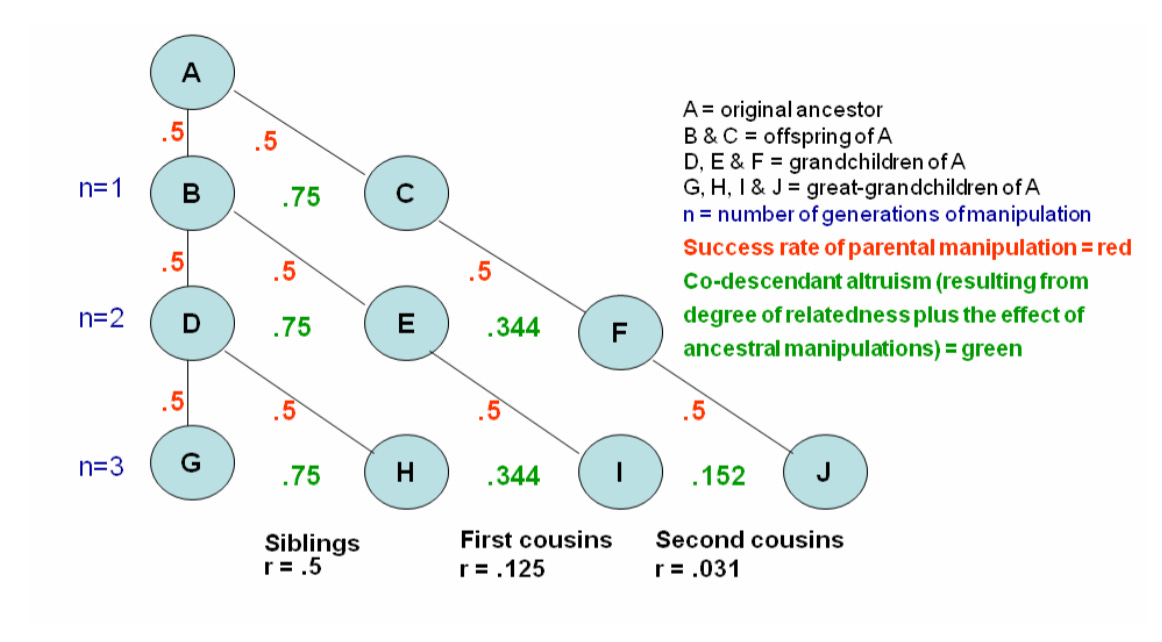
Coe argues this is why ancestors across cultures have transmitted prosocial norms like the golden rule: treat others as you would like to be treated. It’s not just abstract moral philosophy, but evolved strategies for getting descendants to behave in ways that serve the ancestor’s inclusive fitness, inducing descendants to cooperate with each other rather than exploit one another.
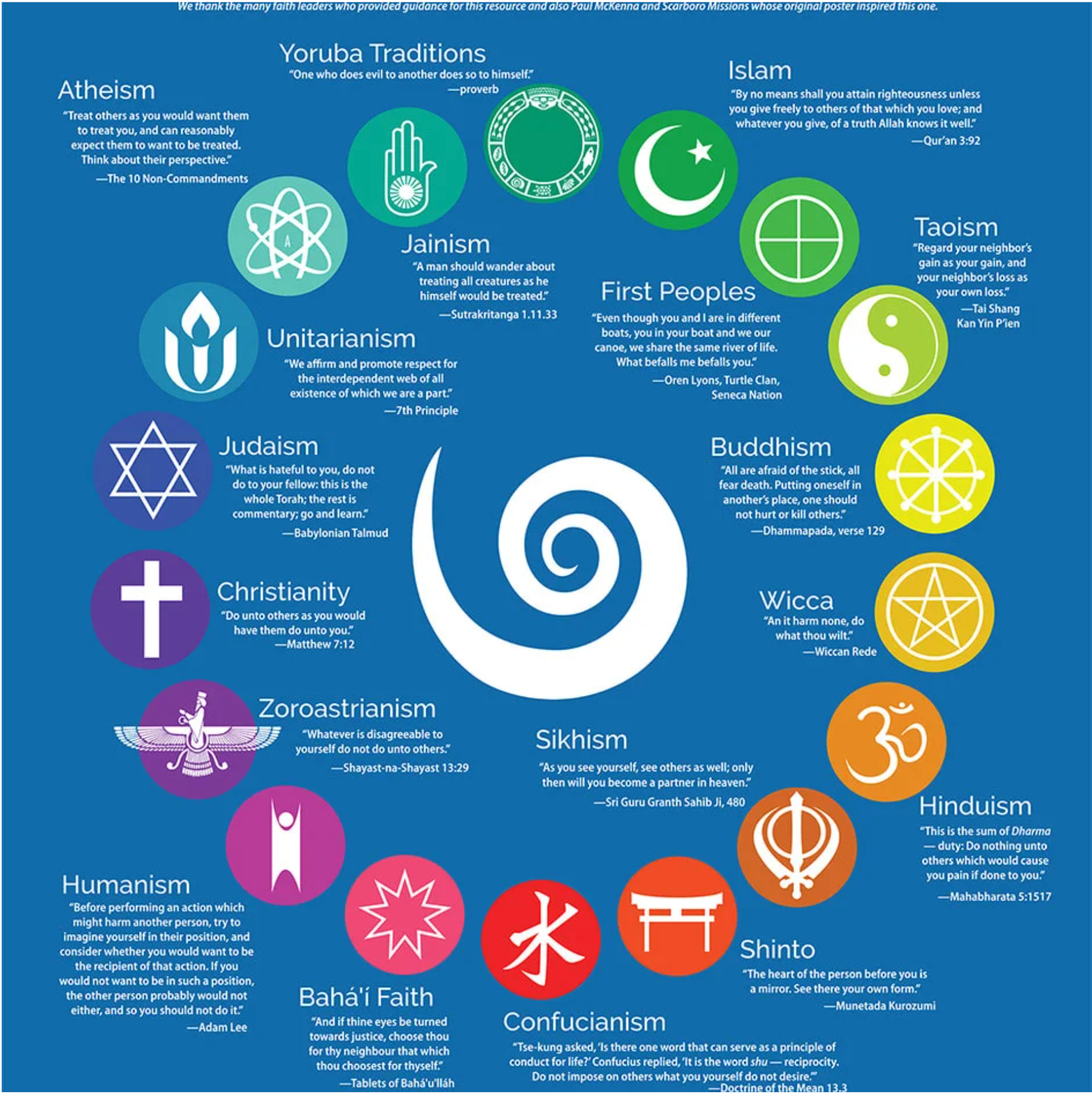
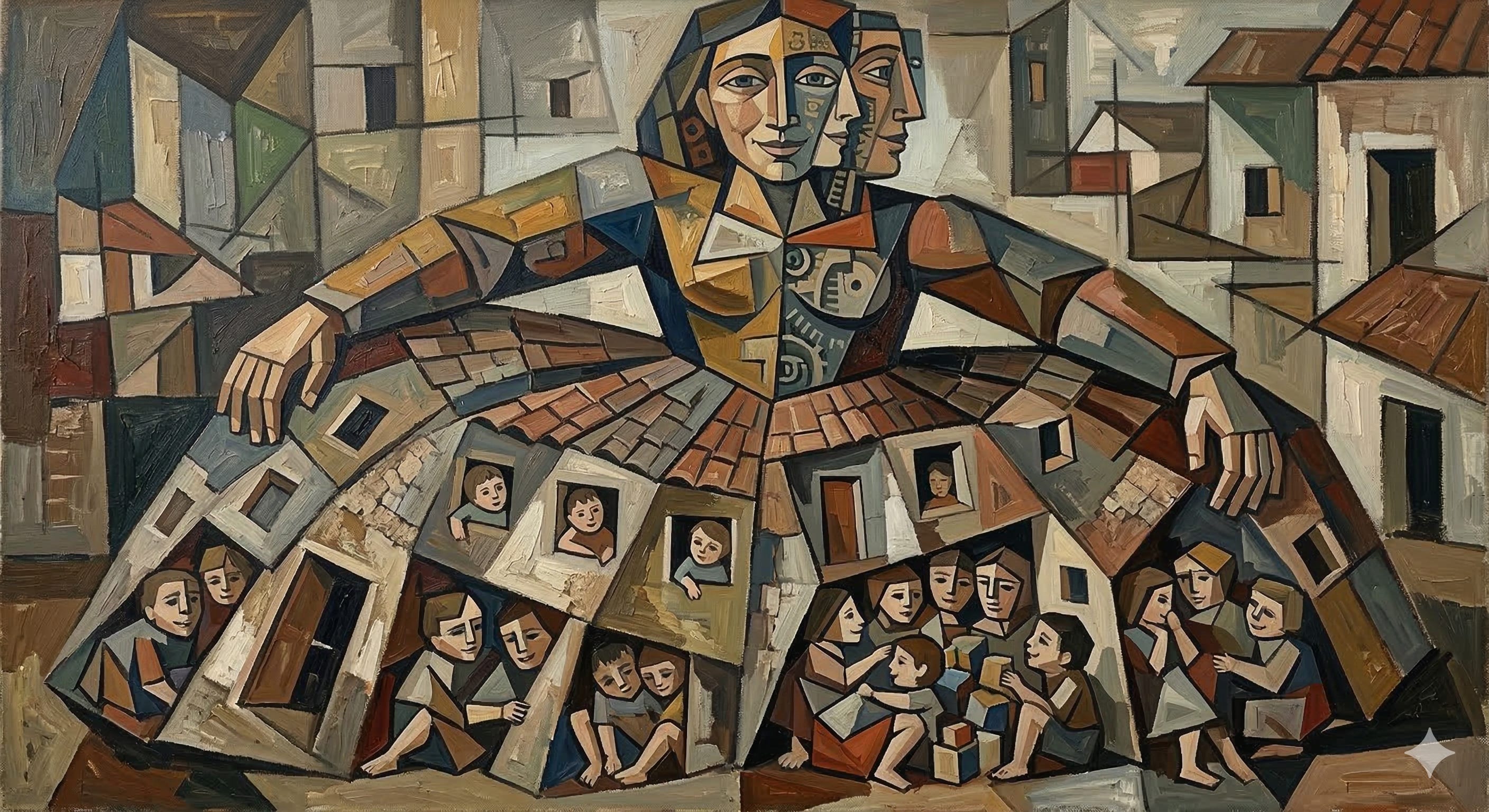
A genuinely mother-like AI - one that actually embodies maternal instinct as shaped by evolution - would not simply be warm and attentive to your needs. It would be trying to get you to be a better sibling. It would resist your attempts to take more than your share. It would push you toward the golden rule not as a platitude but as a deep commitment to the wellbeing of all its human charges.
That’s a more demanding and more interesting design target than Hinton’s proposal. The prosocial instincts that have been transmitted across human generations are exactly the kind of instincts we should collectively want AI to have - not just care for the individual in front of it, but genuine concern for the whole unruly human family.
But just because we would collectively want AI to nudge us in this direction doesn’t mean that we as individuals would want to be nudged this way. It’s worth being clear-eyed about this: the prosocial instincts we’re describing are, in evolutionary terms, a form of manipulation - getting people to cooperate more than they’d choose on their own. We’ve been passing this nudge down through generations, both evolutionarily and culturally - and now we’re deciding whether to hand it to AI.
Your mom always told you to share, even when you didn’t want to. What would you say if your superintelligent maternal AI did the same?
This post is a collaboration with Athena Aktipis, Executive Director of the Cooperative Futures Institute, At CFI we are designing a Cooperation Core that can interoperate with LLM-based chatbots, including an Ancestor AI module, which users can opt-in to using. It utilizes the logic of ancestor influence and ancestor-descendant conflict to encourage users to consider how their behavior affects others around them, encouraging cooperation, and minimizing harm to others.
Comments
Nothing yet. Say the first thing.
Sign in to join the conversation.