
In my previous post, I explored what Participatory Economics, also known as Parecon, actually is. This time, I wanted to go one step further. Instead of only asking whether Parecon is a good alternative to our current system, I tried to think about what a truly “next” economic model would need to handle.
Based on that question, I chose five criteria that I personally believe any next-generation economy must pass. I then put Parecon through a kind of stress test using these five lenses. This is not meant to be a definitive judgment. It is more like a thinking exercise. An honest attempt to see where the model feels strong, where it feels fragile, and where it leaves me uncertain.
I would genuinely love to hear your thoughts as well. What do you think the next economic model should absolutely get right? Feel free to share your ideas in the comments. I might reflect on them and build on them in future posts.
For those who are not familiar with Participatory Economics or did not read the previous post, I also added a short, AI-generated explainer video. It gives a visual overview of the model and might help ground the discussion before we dive deeper.
Since this is a longer piece and we don’t exactly live in a long-form world anymore, I also added a brief, presentation-style version to add some visual rhythm and make the journey more enjoyable. I hope you find it useful and enjoy it.
Alright, let’s begin.
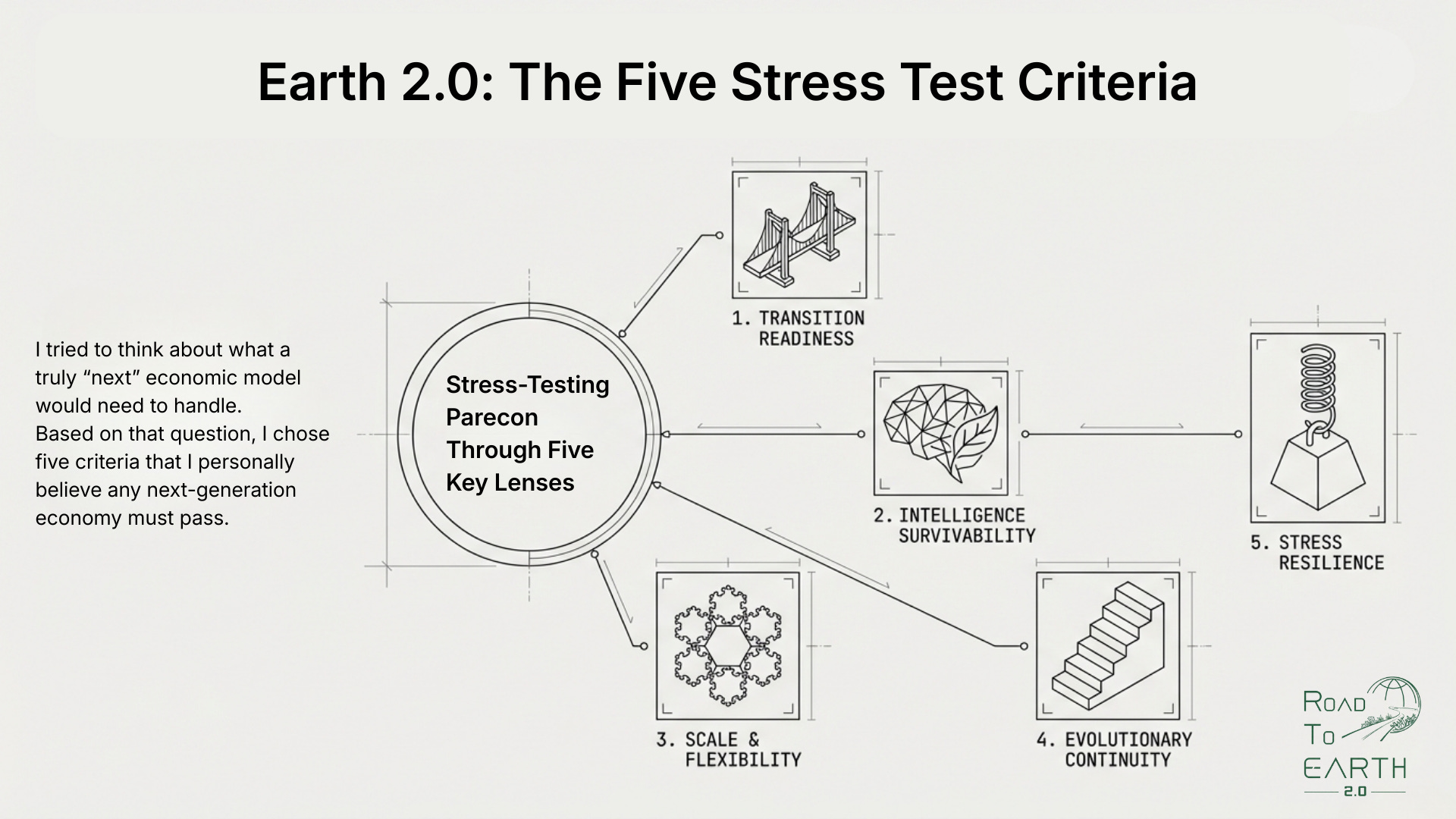
Transition Readiness
A kind of go-to-market strategy for a new civilization. This includes transition friction, historical emotion, psychological readiness, and alignment with human nature.Intelligence Survivability
The system’s alignment with planetary limits and the long-term survival of intelligence.Scale and Flexibility
The ability to function from small to global scales, across change and uncertainty.Evolutionary Continuity
Whether the system supports the growth, complexity, and adaptive evolution of human intelligence.Stress Resilience
How the model behaves under crises, scarcity, shocks, or disruption.
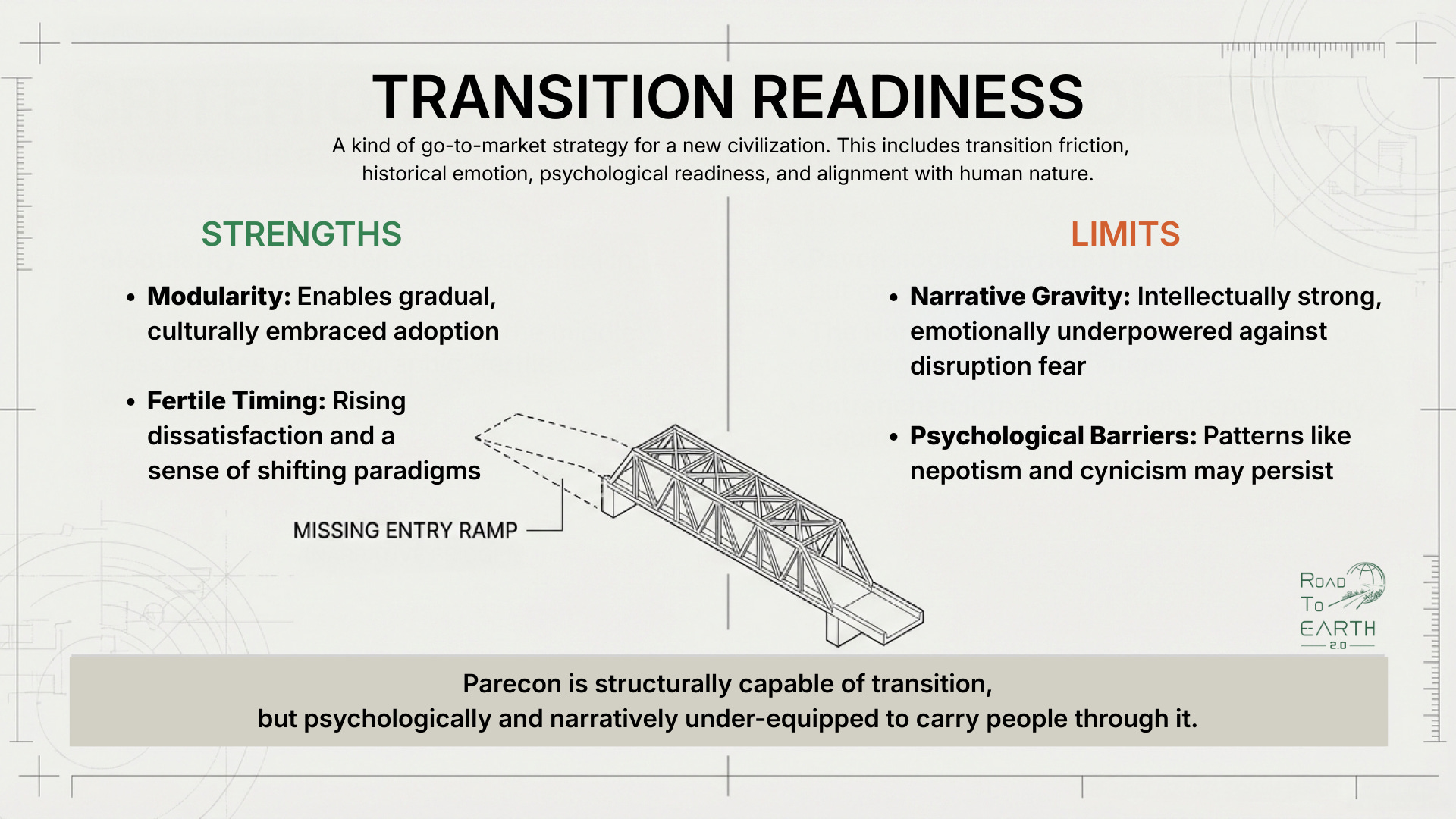
A kind of go-to-market strategy for a new civilization. This includes transition friction, historical emotion, psychological readiness, and alignment with human nature.
I think we have to look at transition readiness almost like a go-to-market strategy, but for a completely new civilization. The critical question is not only whether a model works on paper, but whether it can realistically move us from where we are now to somewhere else. Can we actually get from here to there?
A transition does not necessarily have to start immediately. It might begin years from now, or be triggered by a specific event. But what feels essential to me is that there must be a concrete plan. We cannot simply wait for awareness to rise out of collective unhappiness. Without a roadmap, even the most elegant alternative models remain theoretical. I honestly think the absence of a clear transition strategy is one of the biggest weaknesses shared by almost all alternative economic proposals today.
There is also a deep psychological barrier that cannot be ignored. Can a system built on solidarity withstand the very human tendency to protect self-interest, favor close circles, and rationalize unfair behavior when it benefits us? Participatory Economics signals that it can manage this by requiring continuous validation through mutual institutions. Still, I’m not fully convinced that this alone would eliminate deeply entrenched patterns like nepotism or informal power networks.
Because of this, I sometimes feel an external and objective anchor might be necessary. Something like a General Court of Human Rights that continuously monitors and arbitrates the system. Given current technological capabilities, supporting such oversight with artificial intelligence does not feel unreasonable to me. In fact, it could help provide the impartiality that human nature often struggles to maintain.
I’m also unsure whether we are psychologically ready for this transition right now. There is a lot of accumulated anger, distrust, and cynicism carried over from past systems. In the current order, many people operate with the belief that if they do not protect themselves, no one else will. Bridging this mindset gap would likely require a deliberate developmental process. Education alone may not be enough. Media, television, and even gaming could play a role in slowly retraining our reflexes toward cooperation rather than competition.
Comments
Nothing yet. Say the first thing.
Sign in to join the conversation.