

I interviewed Lindsey Graham at the VFW in Knoxville in 2015 when he was running for President, where he met with a group of maybe 30 people, which isn’t a bad crowd. I was working for KNIA/KRLS radio in Knoxville and Pella at the time. This was back in the day when Republicans had ideas worth discussing, before dehumanizing people was at the center of every conversation, and before nearly every utterance coming from their mouths was misdirection, a partial truth, or a lie.
Those were the good old days before Trump came into office.

Lindsey Graham@LindseyGrahamSC
If we nominate Trump, we will get destroyed.......and we will deserve it.
9:03 PM · May 3, 2016
38.1K Replies · 188K Reposts · 327K Likes
I don’t remember much of what Graham and I talked about, and the internet isn’t helping me. It gobbled up and disappeared our 15-minute or so interview, as well as the photos and video I took, sending it who knows where. I tried the Wayback Machine, with no success, which I attribute to user error.
I only remember two things about that interview. First, after he was introduced and started talking, he told us that during his time being driven to Knoxville, he spent most of that time on the phone with Bibi Netanyahu, the prime minister of Israel. Barack Obama was president at the time, and all I could think of was how Graham was likely undermining Obama’s foreign policy.
The second thing I remember is that it was a very hot summer day, the VFW had no air conditioning, and that as we sat, side by side, in metal chairs, and as I held the mic between us, sweat dripped from his upper lip onto the floor beneath us.
Drip, drip, drip.
When the interview was over, there was a small puddle of sweat on the floor beneath him.
I have read numerous articles about Graham’s death where they discussed his life and legacy; one of the best is this overview in the New York Times. In the reporting immediately after his death, most coverage was respectful. As time passed, reporting was still respectful, but laid out the complexity of his years serving his country. I have seen few reports critical of his legacy. Many reports have highlighted his early criticism of Trump, and his later conversion to being a Trump supporter/advisor (suck up). Most praised his success in getting Trump to support Ukraine.
There is a much darker side to Graham’s legacy than is being reported, which I will get to below. But first, here is Minnesota’s Democratic Senator Amy Klobuchar’s eulogy to Graham:
It was a shock this morning to find out that my friend Lindsey Graham has died. He was a man who loved his work, his country, and his family. He didn’t have an easy life growing up and to me that explained a lot about him as well as his devotion to his remaining family members including his sister. It also explained his almost kid-like exuberance about his job and the responsibilities he was given (even in his sixties he would get off a plane in a foreign land with a twinkle in his eye and look at me as if to say, can you believe we are actually here and doing this?). Lindsey was loyal to friends and causes. He was willing to work on gnarly issues and take on (at times) political risks for the right reasons. It is fitting that he died shortly after visiting Ukraine, one of those causes he would stand up for through thick and thin. Much will be said in the coming days about his relationships with others—President Trump and John McCain for instance—but what can’t be forgotten is the reason why so many people he worked with—from senators to staff—will mourn his loss: Lindsey had a zest for life and the Senate that made you want to get to work on a bill with him or at least debate him. He brought joy to his job.
Lindsey Graham was the one who was willing to work with me (when so few would) on helping the Afghan refugees. I remember standing outside of a little phone booth in the Republican cloakroom last year as he spoke with the Vice President, holding up a sign that said “Save the Afghans” and he put the phone on hold and said “OK OK I will go on your bill even if it gets me in trouble.” Or his early willingness to lead on big tech bills, including repealing the provision that protects them from consumer suits. But mostly my fond memories of spending time with Lindsey (and we travelled the world with John McCain) was not about the ups and downs of his policy positions. It was about his love for the world, his loyalty to hard causes and his friends, and the pure joy he brought to life. I will miss him.
Klobuchar’s eulogy is whitewashing, the act of deliberately concealing or minimizing someone’s moral failings to make them appear virtuous.
Klobuchar, in just four paragraphs, has helped normalize the damage the Trump administration, with the support of Graham and other Republicans, has done. Let’s begin with the cuts to USAID (costs in 2024 were a mere 0.3% of the federal budget) that led to hundreds of thousands, and eventually will lead to millions of deaths.
Most of these deaths are of children.
And Klobuchar says Graham brought “joy to his job,” and that he had a “zest for life?”
Does she not see the horror? The “zest” for whose life?
She’s not alone. This part of Graham’s legacy goes unsaid in all eulogies and media reporting of his death that I have seen.
And there’s more. Include the rise of right wing “Christian” nationalism, the DOGE cuts that dismantled important parts of government and gave access to all of our data to Elon Musk, the crushing of much of the legacy media, the crippling tariffs, the war with Iran, the SNAP cuts, the pardoning of January 6 insurrectionists, the attack on civil rights, on voting rights, on history, on immigrants, on our educational system, on scientific research, the Trump family grift, and enabling the rise of an authoritarian state ran by a madman in decline.
Lindsey Graham supported and/or enabled it all.
And in her eulogy, Klobuchar whitewashes it and, in so doing, dishonors the victims. As does much of the news media.
Michael Fanone, a D.C. Metro police officer present during the January 6, 2021, attack on the Capitol, had a different take.
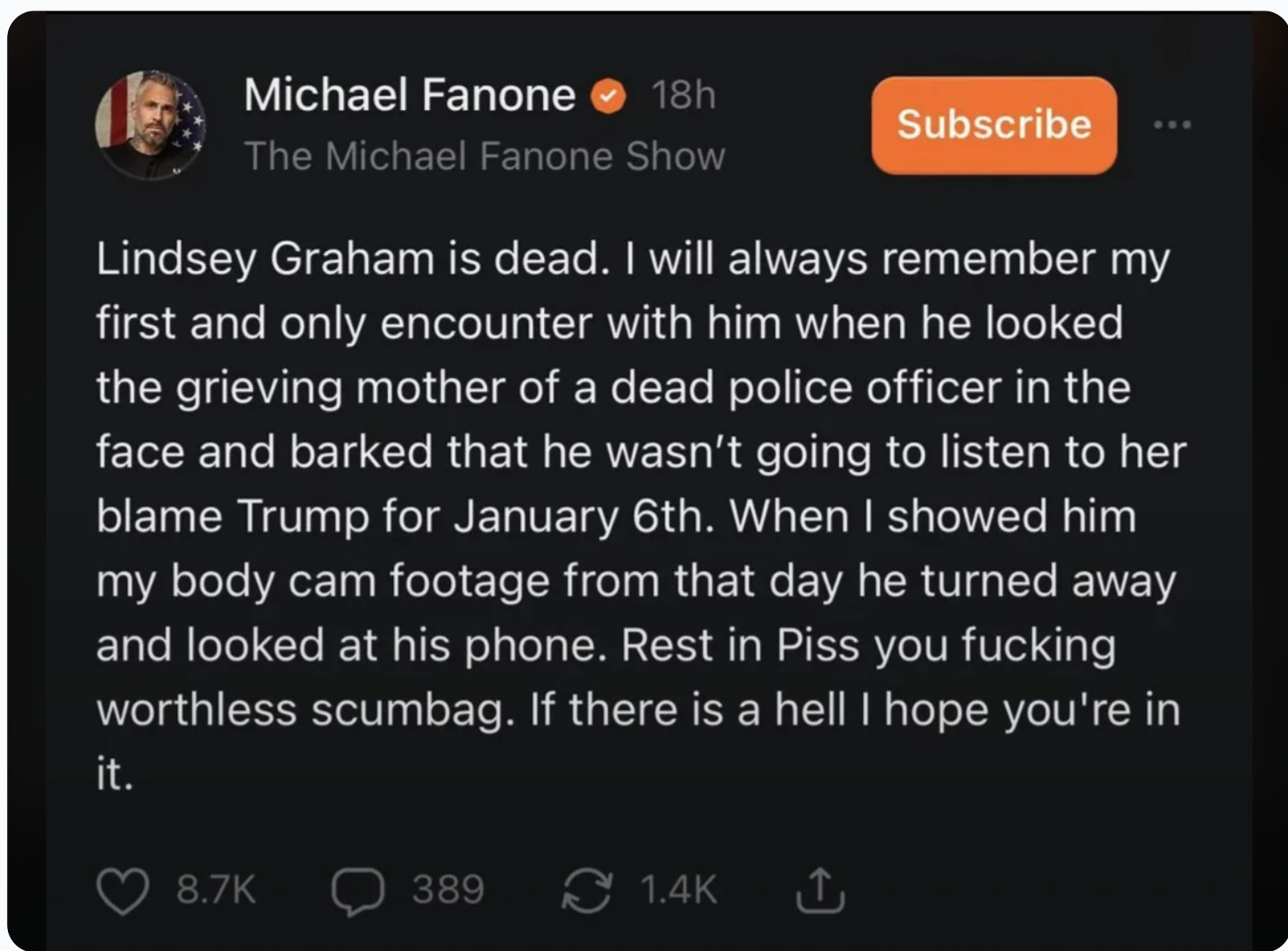
Fanone was “assaulted by rioters, dragged down the Capitol steps, beaten with pipes, stunned with a Taser, sprayed with chemical irritants, and threatened with his own gun after overt verbal abuse and physical assault from many attendees. Fanone suffered burns, a heart attack, a concussion, a traumatic brain injury, and was diagnosed with post-traumatic stress disorder as a result of the attack.”
Chuck Todd, on his podcast the other day, said that he felt that Graham flipped to support Trump and that he had worked to contain Trump’s worst tendencies. I’m sure that many Republicans in Congress justify their support for Trump internally because they feel they can do the same.
I talked with my son Asa the other day about this. Asa is as informed about national and international politics as anyone I know.
He disagrees. He says Trump originally was an isolationist who promised no more “forever wars.” It didn’t work out that way. Since Trump returned to office, we have been involved in nearly a dozen conflicts around the world, including the war with Iran and the horrors of Gaza. Graham, a well-known war hawk, has been an important advisor to Trump on foreign affairs.
Politico, in a column titled “How Lindsey Graham got Trump to yes on Iran,” reports that Graham continuously urged Trump to directly engage the regime, famously advising him, "Mr. President, you want to have your fingerprints on this".
If justice is ever served to the Trump administration, most Congressional Republicans will say they were only following orders. Graham helped draft the orders.
Asa believes that if Trump had ignored Lindsey Graham, our foreign policy would be much less hawkish, and that Trump’s policies would have been more aligned with what most Americans want.
Republicans would also have been in a much more powerful position coming into the midterms.
Maybe Klobuchar and much of the media didn’t recognize that whitewashing Graham’s legacy opens the door to whitewashing the entire legacy of MAGA.
I think it’s more simple than that. I think she likely didn’t want to speak ill of the dead and didn’t understand the consequences of not doing so.
When I was about 20, I read Theodore Dreiser’s great novel, “An American Tragedy.” It was published in 1925. I read it because someone told me that I should read as many great novels as I could before I was 25 because I would be a better person because of it. So I did. The protagonist of “An American Tragedy” is a young man who, when confronted with life’s challenges, makes decisions of which several have terrible consequences. As he moves through life, the reader understands why the protagonist made every decision he did, even if we don’t necessarily agree with it. Regardless, by the end of the book, we realize that he has become a terrible person, and by association, intellectually, so has the reader.
I don’t think Lindsey Graham was an evil man. Because of the consequences of the decisions he made, however, his legacy is monstrous.
I understand the desire not to speak ill of the dead. But we must speak the truth about the legacy of their lives. If not, we dishonor their victims.
The truth is that there is blood on the hands of Lindsey Graham. And Donald Trump. And Congressional Republicans.
Buckets of blood. Swimming pools of blood. Lakes of blood.
When I lie sleepless in bed at night with my window open, I hear the screams of their victims, mostly children, in the wind.
Does Amy Klobuchar?
p.s. If you follow Iowa politics, you will appreciate the Iowa Writers’ Collaborative podcast Iowa Down Ballot with Dave Price, Kathie Obradovich, and Laura Belin. I listen and learn every week.
p.p.s. I’d love to see you at the Okoboji Writers’ and Songwriters’ Retreat in September. It’s a life-changing event, and there’s still time to register!
My column will always be free, but please consider upgrading to a paid subscription or making a one-time donation here.
I’m a proud member of the Iowa Writers’ Collaborative. Please check out our recent work here. I also publish Cedar Creek Nature Notes, about Violet the Dog and my adventures on our morning walks at Cedar Bluffs Natural Area in Mahaska County, Iowa.
I’m also proud to announce I’m partnering with my friend Nathan Sage, former Democratic candidate for Senate in Iowa, and Spencer Dirks in a new podcast/video hosted on Substack and YouTube called Sage Against the Machine. If you enjoy my political writing, you will enjoy Sage Against the Machine.
And I’m now on TikTok as a member of the Iowa Creator Corp, believe it or not. Here you go.
No posts
Comments
Nothing yet. Say the first thing.
Sign in to join the conversation.