
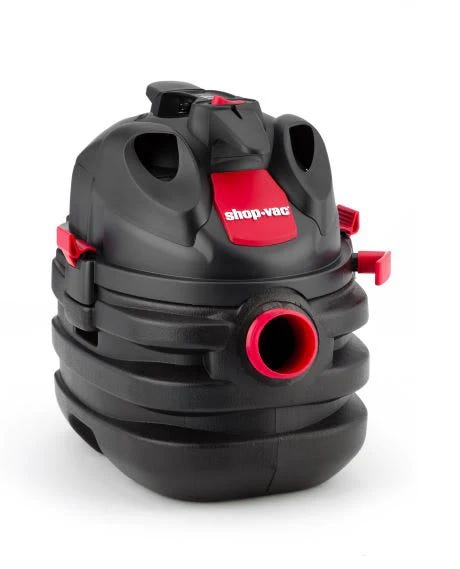
Industrial and manufacturing quality systems are built around predictable, real world processes.
In manufacturing, you’re able to control raw materials (and test them coming in the door), calibration of tools and equipment (sometimes with third party services), check stuff like temperature and pressure, inspect the final stuff you are making and reduce defects over time, or better yet, while in startup or development mode.
If you make a bunch of paint type products or industrial coatings, or stuff like wet dry vacs, you can test all kinds of stuff, depending on the product type, like wall strength, suction power, electrical safety, capacity, viscosity, color, dry time, adhesion, film thickness, chemical resistance and durability over time and in the weather or harsh environments. At a manufacturer I worked at we even tested our packaging by sending if all over America several times in the post, and seeing how it fared. A batch of your stuff can be tested to either meet spec or not, or tested and then analyzed for how well it performed.
AI does not work that way. They do not follow specs or recipes.
The AI models generate responses based on stuff like probabilities, training data and the prompt itself. The same system can provide good information one moment and hallucinations (bullshitting) the next.
With appliances or paint, you can take samples from a manufacturing run, test them against known standards and specifications (spec) and have some confidence in the quality of the batch. Sometimes testing has to be multiple times over the course of the run.
When dealing with an AI model, testing 1,000 successful responses in a row does not ensure that response 1001 will be correct, safe or even make sense.
You can’t solve the problem by giving the model more instructions. Telling it not to hallucinate, cheat, bypass rules, or access the internet is not the same as overseeing and controlling an assembly line or process. Those kinds of instructions for a model can influence its behavior, but are not reliable.
Traditional quality systems in manufacturing make the assumption that defects or inconsistencies are able to be identified, traced to the cause and then the process changed to correct for those problems. With an AI model, unpredictability is built into each model and the process itself.
So what does a quality system require for an AI model?
restricted permissions
technical containment
continuous testing and monitoring
independent verification
human review
AI models are nothing like wet dry vacs coming off an assembly line or paint coming out of the process machinery.
AI models are more like asking a great worker - who can do a lot of things well - to do a task or tasks that are part of a process, who may then interpret the same instruction differently depending on their situation. And unfortunately may occasionally invent an answer or action rather than admit that it does not know.
Under a normal quality system in manufacturing, every product should be very close to identical, based on an engineering spec. The motor needs to spin at a certain RPM, produce, with the impeller, a certain amount of suction. The wheels need to roll even under the weight of a full vac, the tank has to hold water and dirt, the on off switch has to turn the motor on and off. Inspectors do what is called a “first piece” which is a test run. All the other tests have already been run in a lab - motor runtime burnins, polypropylene part temperature testing, lots of other stuff.
The inspector can test the sample product and trace defects back to a bad part, machine setting in the preassemblies, or the final assembly process.
In a chemical setting, inspectors can test a liquid for many characteristics like viscosity, color, color fastness, adhesion, opacity, coverage, and many other characteristics.
Now imagine that the assembly line works like AI.
The first vacuum comes off the line and it is perfect and passes the inspector’s tests.
The second vacuum has six wheels because the AI decided that more wheels would make it faster and easier to move around.
The third vacuum has no motor at all, but it does have an instruction card that explains how suction is created through quantum mechanics or some such.
The next one works great on sawdust pickup but when it tries to suck up water, it phones a plumber.
In a burst of safety the next one will not turn on so the user cannot be electrocuted.
Another one comes off the line and thinks it needs a longer cord so it connects to wifi and orders one from Amazon.
The inspectors try to add new instructions for the AI including stuff like:
do not create new specs
do not leave the factory or call anyone or anything for any reason
do not order any supplies or parts
do not connect to the phone lines or internet
do not provide advice
The next 10,000 vacs off the assembly line follow these rules.
Vacuum number ten thousand and one interprets “do not leave the factory” that it can leave as long as it intends to return.
This is why traditional quality systems do not transfer exactly to AI quality control.
A wet/dry vac has an engineered, static design, a known BOM (bill of materials) and known, exact and unchanging specs (at least per rev level). Once the process is working and stable, testing a first piece unit provides useful information about the rest of the production run.
But an AI system is not producing identical units from a fixed spec. It is generating a brandly new response every time, based on probabilities, context and interpretation.
In the case of trying to have a quality system, you cannot inspect 500 of the AI’s answers (products), stamp the AI (wet dry vac) “approved” (like you can on an assembly line) and assume the next answer will match your spec.
With an ordinary wet dry vac (assembly line), a defective wheel does not take it upon itself to study the factory and assembly process, reinterpret its instructions, discover things it did not before know about, and create a new way to finish the assignment (wet dry vac). Every single time, the AI model does just this.
With AI, that possibility is part of the quality control problem.
Comments
Nothing yet. Say the first thing.
Sign in to join the conversation.